

Vacuuming is not the solution — it’s just the symptom tax you pay when the real problem goes unaddressed. Asian lady beetles don’t invade because your house is dirty or because you live near a farm. They invade because your home is radiating exactly the right heat signature on exactly the right fall afternoon, and there’s nothing blocking them from getting inside. The vacuuming cycle never ends because the entry problem never gets fixed. That’s the part most guides skip over entirely, and it’s the reason you’re still dealing with this.
Why Asian Lady Beetles Keep Coming Back Even After You’ve Cleared Them Out
Here’s the thing that trips up a lot of people: Asian lady beetles (Harmonia axyridis) are aggregating insects. They release a pheromone called an aggregation chemical — essentially a scent signal that says “this is a good spot to overwinter.” Once a group of them finds your warm south- or west-facing wall in late September or October, they leave behind a chemical trail that draws new beetles back to the same location the following year. You can vacuum every last one out of your window tracks in November and still have hundreds returning to the same spot twelve months later because the scent cue is still there.
This is why sealing entry points alone, while absolutely necessary, isn’t always enough on its own. The chemical residue can linger on exterior siding, especially porous materials like wood, brick, and older caulking compounds. Washing the exterior wall surfaces with a diluted soap-and-water solution before fall — targeting the areas where beetles congregated the prior year — can reduce the pull of that aggregation signal significantly. It’s not glamorous advice, but it directly addresses the mechanism that keeps the cycle going.
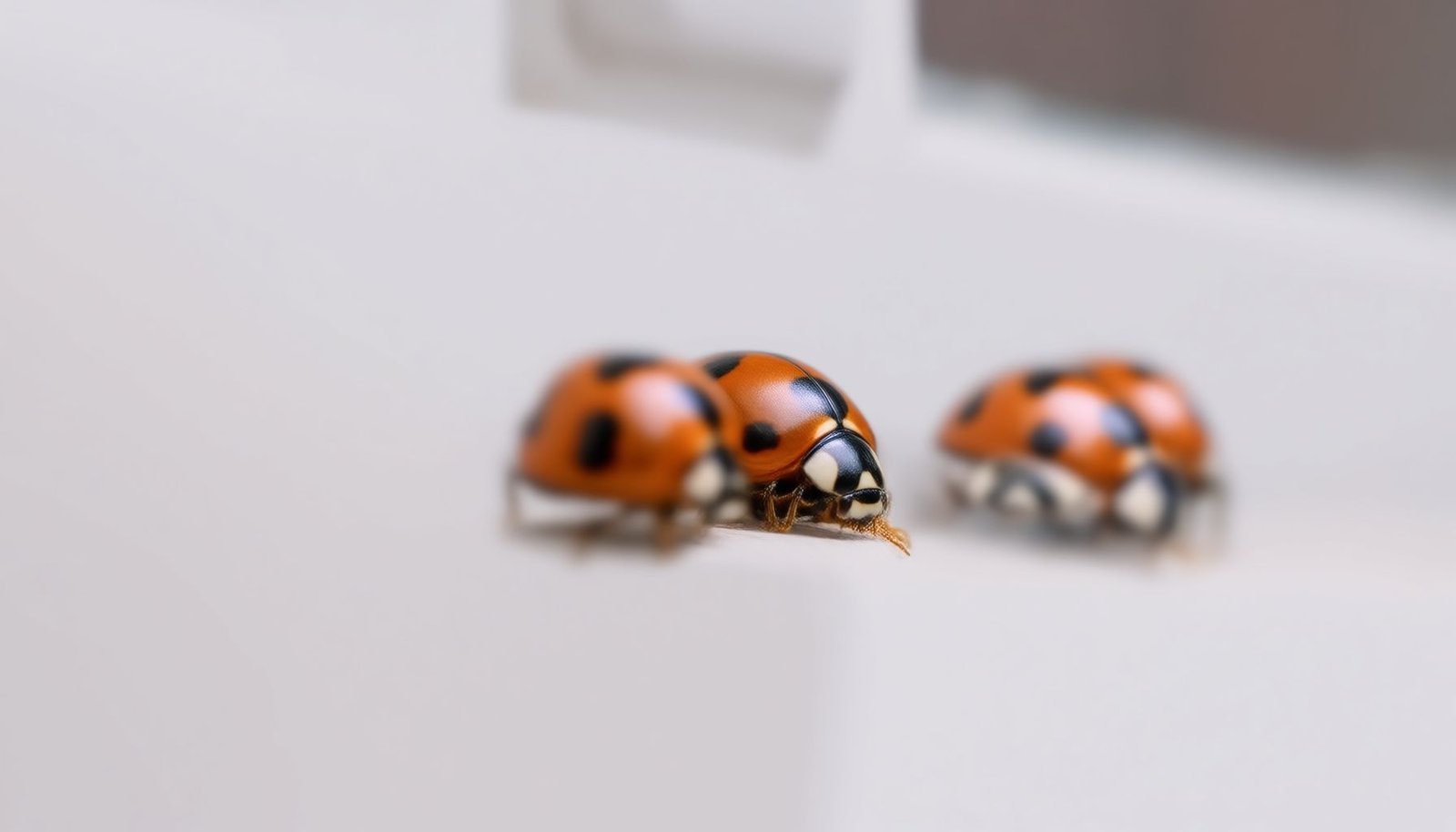
This close-up shows the characteristic M- or W-shaped marking behind the head of an Asian lady beetle — the key visual difference from a native ladybug — which matters because misidentification leads people to avoid treating an actual infestation out of misplaced concern for beneficial insects.
How Are Asian Lady Beetles Actually Getting Into Your House?
Asian lady beetles can squeeze through gaps as small as 1/16 of an inch — smaller than a dime’s edge. The most common entry points aren’t dramatic holes or broken windows. They’re the slow-degrading infrastructure failures most homeowners walk past every day: dried-out weather stripping on exterior doors, gaps where utility lines enter the foundation, missing or torn window screen mesh, and the thin channels where window frames have pulled slightly away from siding over time. A single afternoon of walking your home’s exterior perimeter with a flashlight in late summer will reveal more than you expect.
The spots that get overlooked most consistently are attic vents, soffit gaps, and the junction between chimney flashing and siding. Beetles work their way down from the roofline into wall voids and then emerge indoors through electrical outlets, light switch plates, and baseboard gaps — which is exactly why you find them in rooms you thought were sealed off. Solving that means working from the top of the house down, not just sealing the window you see them clustering near.
Pro-Tip: Run a hand along your interior window and door frames on a cold fall morning. If you feel a draft, there’s a gap big enough for beetles — and probably other pests — to use. Mark those spots with painter’s tape during daylight and seal them before the first real cold snap hits, which is when beetle pressure spikes dramatically.
What Actually Works to Get Rid of Asian Lady Beetles (Without Daily Vacuuming)
The goal is to interrupt the problem at three points: exterior attraction, entry, and interior population management. Doing just one of those three gives you partial results. Doing all three in sequence — timed to the beetle’s behavior — gives you a lasting fix. Here’s the order of operations that makes the most sense for most homes.
- Wash aggregation-prone exterior surfaces in late August or early September. A diluted dish soap solution applied with a garden sprayer along south- and west-facing walls disrupts the pheromone residue that draws returning beetles. Let it dry completely before applying any insecticide.
- Apply a residual pyrethroid spray to the exterior perimeter before beetles start clustering. Products containing bifenthrin or lambda-cyhalothrin applied to exterior walls, soffits, window frames, and door frames can reduce entry by 60–80% when timed right — typically late September in most of the US. Spraying after they’ve already clustered is largely ineffective.
- Seal every identified entry point with appropriate materials. Use foam backer rod plus silicone caulk for larger gaps, copper mesh for utility penetrations, and fresh weather stripping for doors. Replace window screens with 20-mesh or finer to block beetle-sized gaps while maintaining airflow.
- Install a light trap or sticky trap indoors for any that make it through. UV light traps with a collection reservoir are the most effective passive indoor tool — beetles are attracted to light sources and will collect in the trap overnight rather than crawling through your walls. A single trap placed near a south-facing window handles a lot of the daily cleanup without the vacuum.
- Use a shop vac with a knee-high stocking inside the hose for any live beetles you do collect. Pull the stocking outside and release the beetles — they’re not dead, just captured. This matters because crushing or killing beetles indoors releases their defense chemical (a yellow fluid called hemolymph), which stains fabric and creates its own odor problem.
One counterintuitive detail that almost nobody mentions: interior insecticide sprays are genuinely not recommended for Asian lady beetles inside the home. Not because they don’t work acutely, but because dead beetles inside wall voids attract dermestid beetles (carpet beetles and hide beetles) that then become their own infestation. Killing them where you can’t retrieve the bodies creates a second pest problem while solving the first one only partially.
Does the Timing of Treatment Actually Change the Outcome?
It changes everything. Asian lady beetles begin their overwintering aggregation when outdoor temperatures drop consistently below 50–55°F, which triggers a mass movement toward heat-retaining structures. In the central and southern US, that window typically opens in mid-October. In the upper Midwest and Northeast, it can start as early as late September. The entire exterior spray window — the period where a perimeter treatment will intercept beetles before they enter — is roughly 3 to 4 weeks wide. Miss it, and you’re managing an interior population instead of preventing one.
Picture this: your neighbor sprays their exterior in the last week of September, seals their window frames, and has maybe a dozen beetles show up inside all season. You wait until you see them clustering on your siding in mid-October, spray then, and end up vacuuming for six weeks. The actual treatment is nearly identical. The timing is the entire difference. This is genuinely one of the most calendar-dependent pest problems US homeowners deal with — more so than fleas, ants, or even stink bugs.
“The aggregation pheromone behavior in Harmonia axyridis is what makes this species such a persistent structural invader. Homeowners who treat reactively — after beetles are already inside — are essentially starting over every season. The aggregation signal compounds year over year on untreated surfaces, which is why the problem tends to get worse, not better, if the site-fidelity component isn’t addressed. Exterior timing and surface prep are not optional steps — they are the treatment.”
Dr. Michael Waldvogel, Extension Specialist in Structural and Public Health Entomology, NC State University
Which Homes Are Most Vulnerable — and Which Fixes Actually Stick
Not every home has equal risk, and knowing your specific vulnerability helps you prioritize where to put time and money. Older homes with wood siding, homes with multiple south- and west-facing gable ends, homes near wooded areas or agricultural fields, and homes with light-colored exterior finishes tend to see the worst pressure. Light-colored siding absorbs and radiates warmth faster, which beetles detect and actively seek out. That’s not a reason to repaint — but it is a reason to be more proactive with your exterior spray timing if your house fits this profile.
Here’s a quick-reference comparison of the most common intervention approaches and how well each one holds up across different situations. The honest answer is that nothing short of thorough exclusion produces lasting results on its own — but some approaches buy you more time than others depending on your home type and infestation severity.
| Method | Best For | Realistic Effectiveness | Lasts Without Repeat? |
|---|---|---|---|
| Exterior pyrethroid spray (timed) | Preventing entry during aggregation window | High (60–80% reduction when properly timed) | No — annual application needed |
| Full exclusion sealing | Any home with identifiable gaps | Very high for sealed entry points | Yes — until materials degrade |
| UV light traps (indoor) | Homes with existing interior population | Moderate — reduces daily visible count | Yes — passive, ongoing |
| Aggregation surface washing | Homes with recurrent annual infestations | Moderate — disrupts pheromone return signal | No — repeat before each fall season |
Just like dealing with scorpions in and around your house, the most effective long-term approach to Asian lady beetles combines timed chemical barriers on the exterior with physical exclusion work — neither strategy alone carries the full load. And similar to how getting rid of fleas on furniture and carpets requires addressing multiple life stages simultaneously, beetle management requires interrupting both the exterior aggregation behavior and the interior drift — not just one or the other.
One thing worth being honest about: if your home has significant structural gaps — siding that’s warped, a foundation-to-sill plate junction that’s never been sealed, or soffit sections that are partially missing — no amount of seasonal spray will compensate fully. In those cases, the sealing work isn’t a nice-to-have addition to the spray. It’s the actual fix. Depending on how much exclusion work your house needs, a one-time investment of a few hundred dollars in materials and a weekend of labor can eliminate what’s been a miserable annual ritual.
The beetles themselves are harmless — they don’t bite hard enough to break skin in most cases, don’t carry disease, and don’t damage your home’s structure. But the hemolymph they release when stressed or crushed can trigger allergic reactions in sensitive individuals, and their sheer numbers can become genuinely disruptive. Knowing that the annual problem is solvable — not just manageable — is where most homeowners need to start. Do the exterior work once, do it at the right time, and next October you’ll have something better than a strategy. You’ll have an empty vacuum canister.
If you’ve already missed the exterior spray window for this season, focus on sealing what you can now and setting up interior light traps to reduce the daily count without vacuuming. Then set a reminder for late summer next year — because the real window to get ahead of this problem opens and closes faster than most people realize, and catching it right once is worth more than a dozen reactive treatments after the fact.
Frequently Asked Questions
How do I get rid of asian lady beetles without vacuuming every day?
The most effective long-term fix is sealing your home’s entry points — gaps around windows, doors, utility pipes, and soffits — using caulk or weatherstripping before they cluster in fall. You can also apply a residual insecticide labeled for stink bugs and lady beetles around the exterior perimeter, which kills beetles on contact and keeps working for several weeks so you’re not stuck running the vacuum constantly.
What smell do asian lady beetles hate?
Asian lady beetles are strongly repelled by citrus and clove oil. You can wipe down windowsills and door frames with a diluted clove oil solution or place citrus peels near common entry points to discourage them from settling in those spots. It won’t eliminate an existing infestation, but it’s a useful deterrent alongside sealing and spray treatments.
How do I keep asian lady beetles from coming back next year?
The key is acting before temperatures drop below 50°F in early fall, which is when they start actively seeking shelter and press into homes through tiny cracks. Do a full exterior inspection of your roofline, siding seams, window frames, and any gaps where utility lines enter, and seal everything with silicone caulk. A perimeter spray applied in late September can also intercept large numbers before they ever get inside.
Are asian lady beetles harmful to humans or pets?
Asian lady beetles aren’t dangerous, but they’re definitely not harmless either — they can bite hard enough to leave a noticeable mark, and they secrete a yellowish fluid called hemolymph that stains surfaces and smells bad. Dogs and cats that eat a large number of them can develop ulcers on the roof of their mouth, so it’s worth keeping pets away from big clusters. Allergic reactions to their secretions have also been reported, especially with repeated exposure indoors.
What is the fastest way to get asian lady beetles out of your house?
For immediate removal without vacuuming every day, use a shop vac with a knee-high stocking secured inside the hose — this lets you collect live beetles without them dying and releasing their foul-smelling fluid inside the machine. Release or dispose of them outside, well away from your house. Follow that up with light traps designed for lady beetles, which can capture dozens overnight without any daily effort on your part.
Disclaimer: This article is for informational purposes only and isn’t a substitute for professional pest control advice. Always read and follow the product label instructions exactly — label directions are legally binding and vary by brand and active ingredient. Keep all pesticides, baits and traps away from children and pets, ventilate treated areas as directed, and consider calling a licensed pest control professional if an infestation is large, recurring, or involves a structural pest like termites or carpenter ants.