
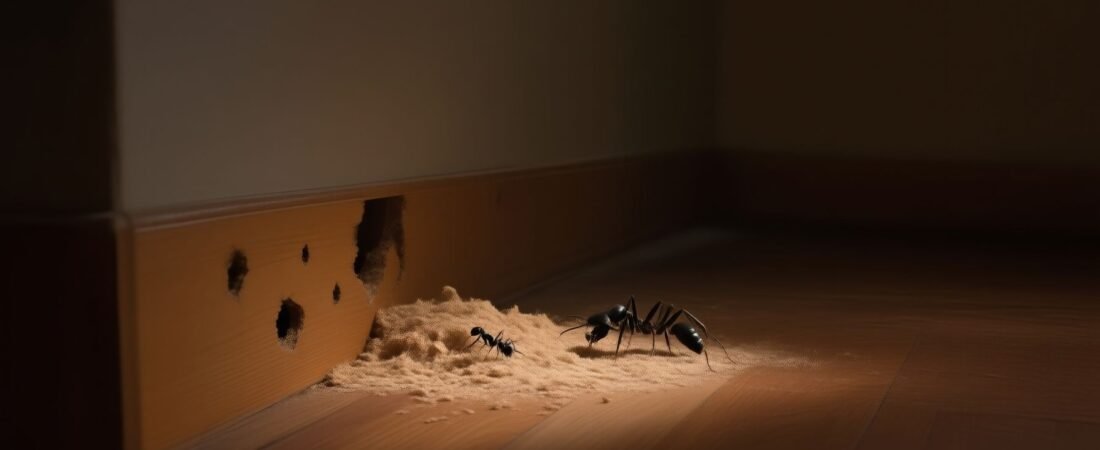
Carpenter ants can hollow out the structural wood in your walls for two to three years before most homeowners ever suspect they’re there. That’s the part nobody tells you upfront: by the time you see a single ant walking across your kitchen counter, the damage behind your drywall may already be significant. The signs are there the whole time — they’re just not the ones most people know to look for.
Why Carpenter Ants in Walls Are So Easy to Misread
Here’s what most people get wrong: they think seeing large black ants indoors means they have a carpenter ant problem inside their walls. That’s not always true. A single forager that wandered in from outside is a very different situation from an established colony that has excavated galleries through your wall studs. Conflating the two leads to wasted money on surface sprays that do absolutely nothing to address a nest 6 inches deep in your framing.
The other common misread is assuming carpenter ants only target old, rotting homes. In reality, carpenter ants prefer wood that has been softened by moisture — which can happen in a brand-new house with a slow roof leak or a poorly sealed window frame. A five-year-old build with a moisture problem is just as attractive to them as a century-old farmhouse.
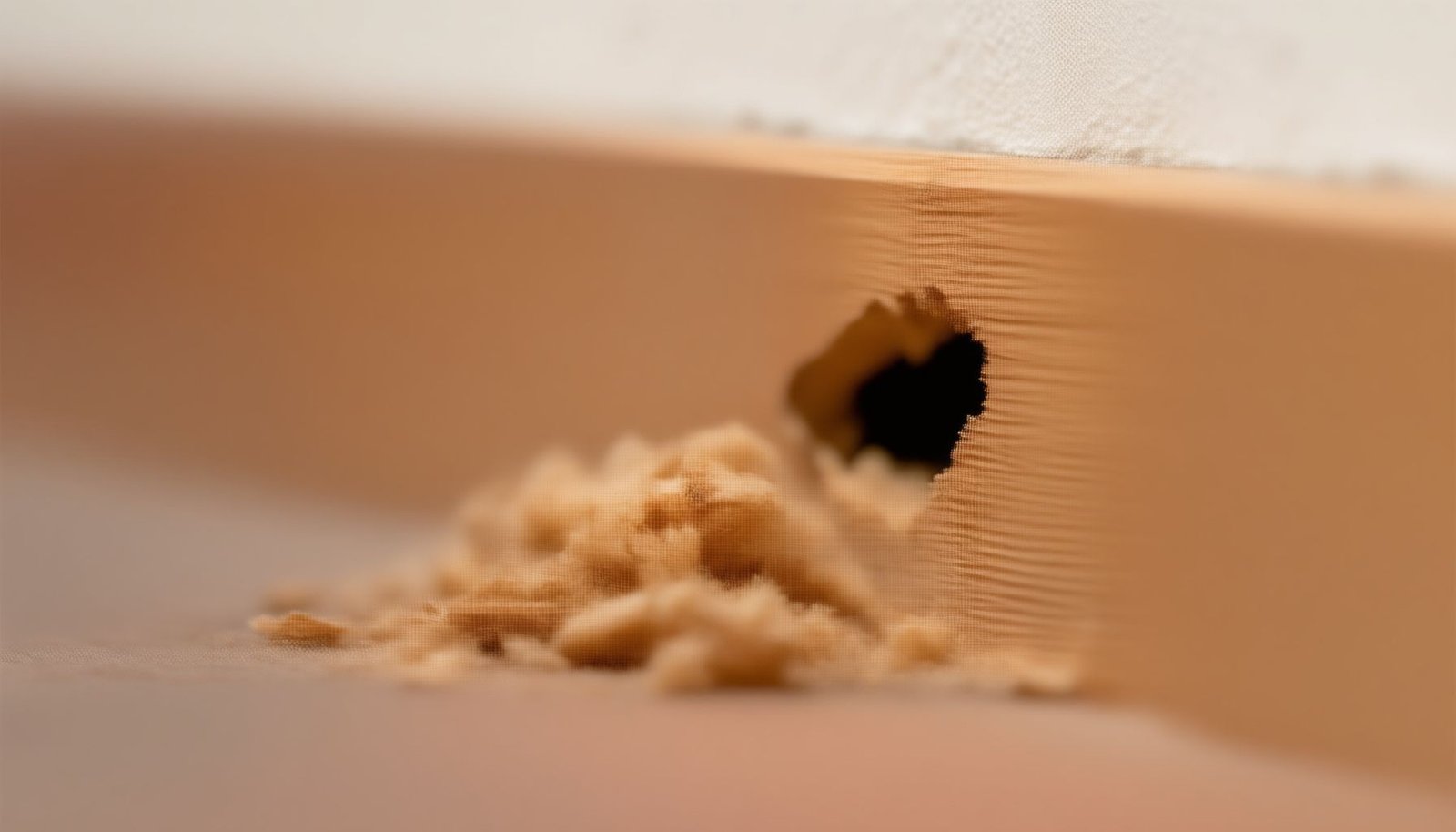
This close-up shows the characteristic smooth, almost polished gallery tunnels that carpenter ants leave inside wood — unlike the rough, mud-packed channels termites create — which is one of the fastest ways to tell the two apart once you open up a wall.
What Does a Carpenter Ant Colony Inside a Wall Actually Sound Like?
Picture this: it’s quiet, late evening, and you press your ear against the drywall near a window frame. What you might hear is a faint, dry rustling — sometimes described as the sound of crinkling cellophane or someone lightly scratching sandpaper against wood. That’s not your imagination and it’s not the house settling. It’s carpenter ants actively chewing and moving debris through their galleries. The sound tends to be most audible in the hours after dark, when the colony ramps up its activity.
The rustling sound is distinctly different from what you’d hear with mice or rats, which produce heavier scurrying and thumping noises. Carpenter ants create a lighter, more papery sound, and it’s often intermittent rather than continuous. Tapping the wall with your knuckle in the area where you hear it can sometimes trigger a brief flurry of movement — the ants respond to vibration. If the tapping produces a noticeably hollow sound in a section of wall that should be solid, that’s a secondary red flag worth taking seriously.
What Physical Evidence Do Carpenter Ants Leave Behind?
The single most diagnostic sign — and the one most articles gloss over — is frass. Carpenter ant frass is not the same as termite frass. Termite droppings are tiny, uniform pellets that look like grains of sand or sawdust. Carpenter ant frass is a coarser, irregular mix of wood shavings, insect body parts, soil, and debris that looks like it was swept out of a workshop. Finding it below a small hole in your baseboard, door frame, or wall is about as close to a confirmed identification as you’ll get without opening the wall.
Beyond frass, here’s what to look for systematically:
- Small, irregular exit holes in wood surfaces — carpenter ants push debris out through these; they’re typically 1/8 to 1/4 inch in diameter and have clean, smooth edges
- Frass accumulations on floors or shelves — often found below the exit holes, against baseboards, or inside wall cavities exposed near outlets
- Winged ants (swarmers) emerging from walls or ceilings — these appear when the colony is mature, usually after 3 to 6 years of growth, and signal an established indoor nest rather than casual foraging
- Structural wood that sounds hollow when tapped — particularly around window frames, door frames, and areas near plumbing or roof lines where moisture tends to accumulate
- Large ants (3/8 to 1/2 inch) consistently appearing indoors in winter — foragers coming in from outside disappear when it’s cold; ants active year-round, especially in winter, almost always indicate an indoor nest
That last point is genuinely underappreciated. Outdoor foragers are sluggish or absent entirely during cold months. Seeing large carpenter ants walking your walls in January or February is one of the strongest indicators that the colony has set up inside your home’s thermal envelope — not outside it.
How to Tell Carpenter Ant Damage Apart From Termite Damage
This is where homeowners lose the most time — and money. Carpenter ants and termites both destroy wood from the inside out, and both can be active inside walls for years before anything visually obvious appears. But treating for the wrong one is an expensive mistake, and the two leave very different physical evidence once you know what distinguishes them.
Here’s a direct comparison of the key differences:
| Feature | Carpenter Ants | Termites |
|---|---|---|
| Gallery appearance | Smooth, clean, polished — almost sanded | Rough, packed with mud and soil |
| Frass/droppings | Coarse mix of wood shavings, debris, insect parts | Uniform tiny pellets (drywood) or no visible frass (subterranean) |
| Mud tubes | Never present | Present with subterranean termites along foundation walls |
| Wood condition preferred | Soft, moisture-damaged wood | Both sound and damaged wood depending on species |
One practical test: if you can access the damaged wood, probe the gallery walls with a screwdriver or pick. Carpenter ant galleries feel smooth — almost like the wood was routed by a machine. Termite galleries feel gritty and packed. That texture difference alone can point you in the right direction before you spend a dollar on treatment.
“The frass is the thing I always tell homeowners to photograph and save before they sweep it up. That one sample tells us more about what’s actually in the wall than any amount of surface inspection. Carpenter ant frass under a microscope looks like a tiny construction site — you’ll see wood fibers, ant cuticle fragments, sometimes soil. Termite pellets are almost geometric by comparison. Once you’ve seen both, you won’t confuse them again.”
Dr. Marcus Reilly, Board-Certified Entomologist and Urban Pest Management Specialist, University Extension Program
How Do You Confirm the Nest Is Actually Inside the Wall?
Most pest control articles stop at “look for ants and frass,” but confirming that a nest is physically located inside your wall — as opposed to outside with foragers coming in — requires a different approach. It changes what treatment you need and how urgently you need it. An outdoor satellite nest foraging through a gap in your siding is a nuisance. An established parent colony inside your wall void is a structural problem.
Here’s a practical way to work through it:
- Track activity timing. Place a small piece of food (a few drops of honey on a paper square) near where you’ve seen ants, then watch it after 10 p.m. Foragers traveling from outside will follow a consistent trail back toward an exterior wall or window. Ants emerging from inside the wall will appear to come from multiple interior points with no consistent exterior direction.
- Check for forager trails vs. random movement. A colony inside your wall produces workers that often scatter in multiple directions because they’re already home. Outside foragers tend to move in more organized trails along baseboards and toward an exit point.
- Listen during peak activity hours. Press your ear against drywall in multiple locations between 9 p.m. and midnight. The section closest to the nest produces the loudest rustling. Map it across two or three wall sections to triangulate the general nest location.
- Remove the electrical outlet cover on any wall where you’ve heard activity. Shine a flashlight inside the wall cavity. If you see frass accumulation or ants moving along the studs, you’ve confirmed an interior nest. This takes 60 seconds and costs nothing.
- Look for moisture sources near the active area. Carpenter ants rarely establish a primary nest in dry, structurally sound wood. If the sounds are coming from below a bathroom, near a laundry room, or under a window that’s had condensation issues, the moisture source is almost certainly part of the reason they chose that location.
- Note any winged ants emerging from walls, ceilings, or floor gaps. Swarmers — reproductive males and females with two pairs of unequal wings — emerge from mature colonies only. A colony producing swarmers has typically been in place for at least 3 to 6 years and contains anywhere from 2,000 to 10,000 workers. Their emergence from inside your home removes all doubt about where the nest is.
One honest nuance here: in warmer climates, carpenter ants can maintain multiple satellite nests spread across a property, which makes pinpointing a single location genuinely harder. In the Pacific Northwest or the upper Midwest, colonies tend to be more centralized around a primary moisture source. The diagnostic steps above work in most situations, but a sprawling property with multiple moisture issues might require a professional with thermal imaging or a borescope to get a definitive answer.
Pro-Tip: Remove the cover plate from an electrical outlet on any wall where you suspect activity, then hold a flashlight at a low angle inside the wall cavity. You’re not looking for ants directly — you’re looking for the telltale pile of coarse frass that tends to collect along the bottom plate. Even a small accumulation the size of a quarter is a strong confirmation of interior nesting activity.
It’s also worth mentioning that just because you’ve found evidence of carpenter ants doesn’t mean the wall needs to come down. Infestations caught before significant structural excavation has occurred can often be addressed with targeted dust applications into wall voids through small drilled holes, without major demolition. The longer the colony has been there — measured in years, not months — the more likely you are to find wood damage that needs repair. Catching it at the “sounds and frass” stage, before the wall itself starts to feel soft or buckle, is the goal.
Just as a side note on unexpected household invaders: if you’ve been hearing rustling at night and aren’t sure whether you’re dealing with insects or something larger, it helps to know your suspects well. The sound profile of carpenter ants is very different from, say, rodents — but it’s also different from the noise made by other crawling insects that can end up inside walls. If you’ve ever been puzzled by fast-moving, many-legged creatures around your home that don’t match the carpenter ant description, checking out What Do Centipedes vs Millipedes Look Like? Key Differences can help you rule those out quickly.
One more thing that’s easy to overlook: carpenter ants don’t contaminate food the way some other household pests do, but they’re not completely benign from a health standpoint either. Unlike the much more direct contamination risk discussed in this piece about What Happens If You Eat Food Contaminated by Cockroaches?, the primary concern with carpenter ants is structural — but workers that have been tunneling through decayed wood can carry mold spores and bacteria on their bodies, which is a secondary reason not to let an infestation go unaddressed.
What the Timing and Location of Ant Activity Tells You About Severity
There’s a counterintuitive insight that most pest control coverage skips entirely: the number of ants you see indoors often has an inverse relationship to how serious your problem is. Early-stage infestations — when the colony is small and foragers are just beginning to establish trails — can actually produce more visible ant traffic than a mature, well-established colony that has settled into predictable nocturnal patterns. By the time a colony hits 3,000 to 5,000 workers, activity becomes more efficient and organized, which can paradoxically make it harder to spot during daytime hours.
What you should pay more attention to than ant count is the location of consistent activity. Carpenter ants excavating a parent nest in a wall void tend to produce workers that emerge from the same general area repeatedly — the same corner of a room, the same section of baseboard, the same wall near a window. Random ants appearing in different rooms on different days usually point to outdoor foragers coming in through gaps rather than an entrenched interior colony. Consistent, geographically predictable ant appearances are the red flag worth acting on fast.
If you’ve reached the confirmation stage and know a colony is inside your walls, the next step isn’t a can of ant spray. Surface treatments kill foragers without ever reaching the queen or the brood — and a carpenter ant queen can live for over 25 years, producing replacement workers indefinitely. Getting the actual nest is the only outcome that matters, and that requires either a direct void treatment by a pest professional or a very targeted baiting approach. The signs got you here — now the work of elimination begins.
Frequently Asked Questions
what does carpenter ant activity sound like inside walls?
Carpenter ants make a faint rustling or crinkling sound inside walls, often compared to the sound of cellophane being crumpled. You’re most likely to hear it at night when the house is quiet, since carpenter ants are most active after dark. If you press your ear against drywall and hear faint scratching or movement, that’s a strong sign of an active colony nearby.
what does carpenter ant frass look like?
Carpenter ant frass looks like fine, sawdust-like shavings mixed with dead ant parts, insect legs, and other debris — it’s not packed or compressed like termite pellets. You’ll usually find small piles of it beneath wall voids, near baseboards, or around window frames. If the material looks coarse and varied rather than uniform, it’s almost certainly carpenter ant frass rather than termite droppings.
how do I know if carpenter ants are inside my walls vs just passing through?
If you’re seeing 20 or more ants regularly, especially at night near the same spot, there’s likely a satellite nest inside your walls rather than foragers passing through. Carpenter ants that are just foraging tend to appear sporadically and in smaller numbers. Finding frass or hearing wall sounds alongside repeated sightings confirms an established nest, not just scout activity.
what part of the house are carpenter ants most likely to nest in walls?
Carpenter ants prefer wood that’s been softened by moisture damage, so they’re most commonly found in walls near plumbing leaks, roof lines, window frames, and bathroom or kitchen areas. They’re also drawn to areas where wood contacts soil or where condensation is a recurring problem. Exterior walls and areas around utility penetrations are high-risk zones to check first.
can carpenter ants in walls cause structural damage?
Yes, but it usually takes years of unchecked activity for carpenter ants to cause serious structural damage — they don’t eat wood like termites do, but they excavate it to build tunnels and galleries. A long-established colony of several thousand workers can hollow out significant sections of framing, especially in already-weakened or moisture-damaged wood. The longer an infestation goes undetected, the more costly the repairs tend to be.