
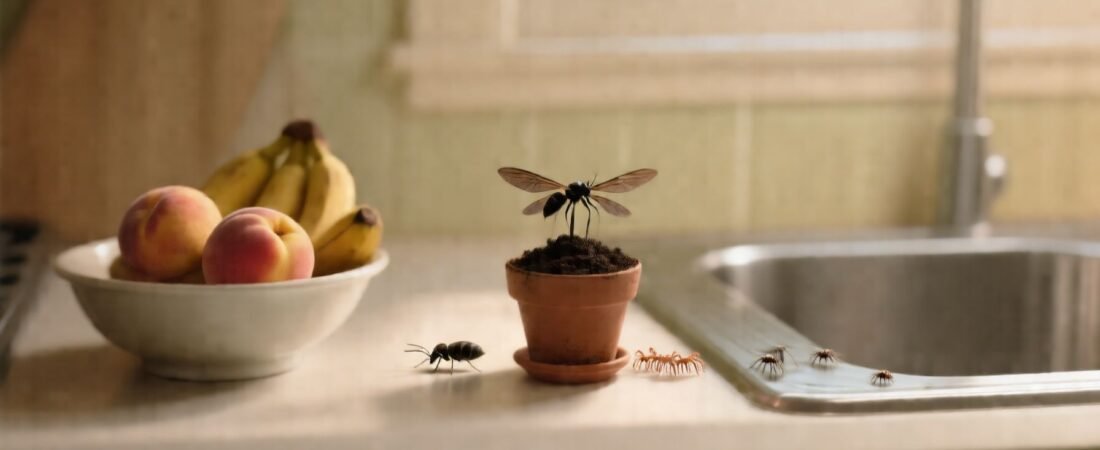
Three tiny flies are hovering near your kitchen sink, and you’ve already bought the wrong trap. That’s the most common outcome of misidentifying fruit flies, fungus gnats, and drain flies — and it’s not because homeowners aren’t paying attention. It’s because every article on the internet tells you to look at wing shape and body color, which is genuinely useless when you’re squinting at a 2mm insect on a dark countertop. The real way to tell these three apart isn’t by examining the bug itself. It’s by reading where it is, when it appears, and what it’s doing.
Why Do Most Homeowners Misidentify These Three Flies?
All three species are small, brownish, and tend to cluster near moisture — which makes eyeballing the difference genuinely hard without a magnifying glass. But the bigger problem is that people treat them as interchangeable nuisances when they’re actually telling you completely different things about your home. A fruit fly infestation means you have fermenting organic matter sitting exposed. A fungus gnat problem means your soil is staying too wet. Drain flies mean there’s a slime biofilm building up somewhere in your plumbing. These are three different diagnoses requiring three different fixes.
Picture this: someone spends two weeks pouring bleach down their bathroom drain trying to kill what they assume are drain flies, only to realize the bugs are actually fungus gnats emerging from the overwatered peace lily sitting on the back of the toilet tank. The source was six inches from the drain the whole time, and the bleach did nothing except irritate their pipes. Misidentification doesn’t just waste money — it drags out the infestation while you treat the wrong target.
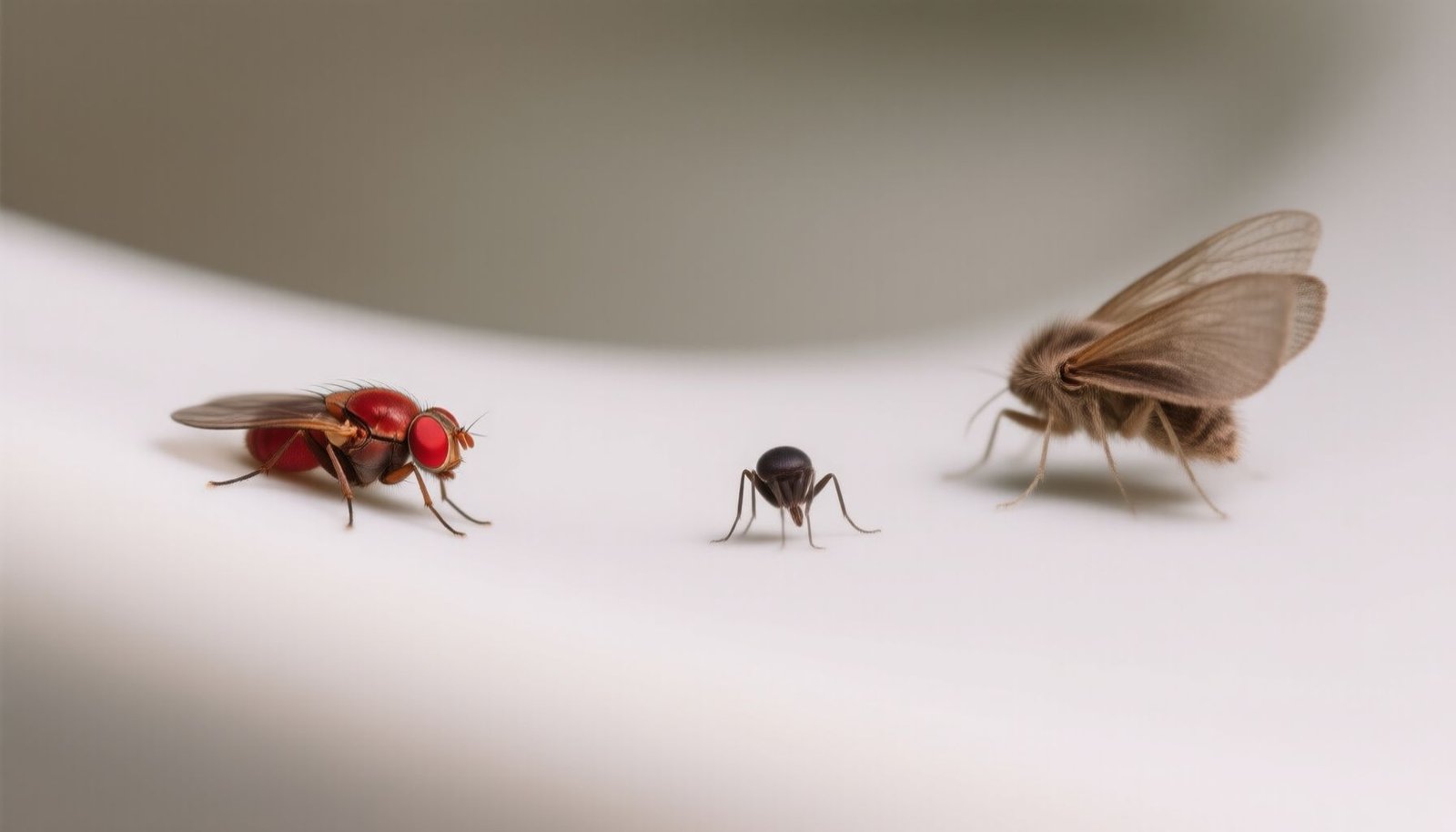
This side-by-side view of all three species at close range shows the subtle but real physical differences in wing venation, body shape, and eye size — details that confirm an ID once you’ve already narrowed it down using behavioral clues.
What Do Fruit Flies, Fungus Gnats, and Drain Flies Actually Look Like?
Fruit flies (Drosophila melanogaster and related species) are typically 3–4mm long with a tan or yellowish-brown body and, most distinctively, bright red eyes. Their eyes are large enough to see without magnification if you get the insect against a light background. Their wings are clear and held flat against the body at rest. A single female fruit fly can lay up to 500 eggs in her short lifetime — usually within 24–48 hours of finding a suitable fermenting food source — so populations can explode fast.
Fungus gnats (Bradysia spp.) are slender, dark gray to black, and look more like a tiny mosquito than a fly — they have long, delicate legs that dangle while flying and clear wings with a distinctive Y-shaped vein pattern. Drain flies (Psychoda spp.), on the other hand, are fuzzy. Their wings and bodies are covered in fine hairs that give them a moth-like appearance, and their wings are held flat and wide like a tent when resting. That fuzzy, tent-wing silhouette is the fastest visual confirmation you’ll get at a glance.
| Feature | Fruit Fly | Fungus Gnat | Drain Fly |
|---|---|---|---|
| Size | 3–4mm | 2–3mm | 1.5–5mm |
| Body Color | Tan/yellowish-brown | Dark gray to black | Gray to brown |
| Eyes | Bright red, prominent | Small, dark | Small, dark |
| Wing appearance | Clear, flat | Clear with Y-vein, mosquito-like | Fuzzy, moth-like, tent-shaped |
| Movement | Erratic hovering | Weak, erratic, wandering | Short hops, rarely flies far |
Where Each Fly Breeds — and Why That’s Your Best Diagnostic Tool
Here’s the insight that most identification guides skip entirely: you can confidently ID all three of these flies without ever looking closely at the insect if you just trace where they’re coming from. The breeding habitat is specific enough to be diagnostic on its own. Fruit flies breed exclusively in fermenting sugars — overripe fruit, the residue inside recycling bins, spilled juice under the fridge, the film inside a wine bottle that didn’t get rinsed. They need fermenting organic matter, not just moisture.
Fungus gnats breed in moist organic soil — specifically in the top inch or two where algae, fungi, and decaying plant matter accumulate. They’re almost always tied to houseplants, especially succulents and tropical plants that have been overwatered. Drain flies breed inside the gelatinous biofilm that coats the interior walls of slow or infrequently used drains — the kind of slime that builds up inside P-traps, floor drains, and the overflow drain in your bathroom sink. They don’t just hang around drains — they actually hatch from the slime layer inside them. If you’re finding mystery small bugs in a wet area and aren’t sure if they’re a fly or something else, it may also be worth checking out What Are the Small Brown Bugs in My Bathroom? since several non-fly species overlap in these spaces.
How Do You Confirm Which Fly You Have Without a Magnifying Glass?
The best field test requires nothing more than a piece of clear tape and about 30 minutes. Press a strip of clear packing tape — sticky side down — over the top of the drain you suspect is the source, leave it overnight, and check it in the morning. Drain flies crawling up from below will get stuck. If you catch small fuzzy moths with tent-shaped wings, you’ve confirmed drain flies. If the tape comes up empty and you’re still seeing flying insects, the source is elsewhere.
For fungus gnats specifically, push a wooden chopstick or toothpick about an inch into the soil of any nearby houseplants. If gnats are immediately disturbed and fly up, or if the soil smells sour or feels wet more than an inch deep, that plant is your source. A full-grown fungus gnat larvae population can damage plant roots significantly — each larva feeds on root hairs and fungi for 12–14 days before pupating — so catching this early matters for the plant too, not just your sanity. Use these four behavioral clues to narrow it down:
- Flies hovering around fruit bowls, wine glasses, or the recycling bin → fruit flies
- Flies emerging from soil or crawling up the sides of plant pots → fungus gnats
- Flies resting on walls and tiles near drains, especially in bathrooms → drain flies
- Flies appearing in a room with no food and no plants → check for a hidden slow drain or P-trap that’s dried out
Pro-Tip: A dried-out P-trap is one of the most overlooked drain fly sources in homes. Drains in guest bathrooms, basement floor drains, or utility sinks that aren’t used regularly can dry out and lose their water seal, then get colonized by drain flies coming up from the sewer line. Running water in every drain in your home once a week prevents this entirely.
Does It Matter Which One You Have, or Can You Just Treat All Three the Same Way?
Treating all three the same way is exactly why so many infestations drag on for weeks longer than they need to. Apple cider vinegar traps — which everyone recommends as a universal small-fly solution — only work for fruit flies. The trap depends on attracting flies to a fermenting lure, and drain flies and fungus gnats aren’t drawn to it in meaningful numbers. You’ll catch a stray or two and assume the problem is resolving, while the actual colony continues undisturbed.
The elimination method for each species has to target the breeding site specifically. Here’s the breakdown of what actually works for each one:
- Fruit flies: Remove or refrigerate all exposed ripe fruit, clean recycling bins with soap and water, wipe down the drain mouth and garbage disposal with a brush (not just bleach), and use a fermenting apple cider vinegar and dish soap trap to catch adults while the source is eliminated.
- Fungus gnats: Let soil dry out completely between waterings — the larvae need moisture to survive and most die off if the top two inches of soil stay dry for several days. Yellow sticky traps placed at soil level catch adults. For persistent cases, a soil drench with Bacillus thuringiensis var. israelensis (Bti) kills larvae without harming plants.
- Drain flies: The goal is destroying the biofilm, not killing adult flies. Mechanical cleaning with a drain brush and enzyme-based drain gel (not bleach, which doesn’t penetrate biofilm effectively) breaks down the organic layer where eggs are laid. Adults will stop appearing within 7–10 days once the breeding site is gone.
- Mixed infestations: It’s more common than people realize to have two species at once — especially fungus gnats and fruit flies in kitchens where houseplants sit near a fruit bowl. Address each source independently with the appropriate method rather than reaching for a single spray.
- Recurring infestations: If any of these three keeps coming back after elimination, the source hasn’t been fully removed. For fruit flies, check under and behind appliances for rotting organic matter — a single piece of forgotten produce under the fridge can sustain a population indefinitely. For drain flies, infrequently used drains are almost always the culprit.
“The most common mistake I see is homeowners treating the symptom — the adult flies — without removing the breeding habitat. You can kill every adult in the room today, and if the source is still there, you’ll have the same population back within a week. With fruit flies especially, the turnaround from egg to reproductive adult is only about 8–10 days under warm indoor conditions, so the math works against you fast if you’re not targeting the source.”
Dr. Sandra Keppler, Extension Entomologist, University of Florida Department of Entomology and Nematology
One honest nuance worth acknowledging: in older homes with clay or cast-iron drain pipes, biofilm removal for drain flies can be genuinely difficult. Rough interior pipe surfaces accumulate organic material faster and more thoroughly than smooth PVC, and a single enzyme treatment may not be enough. In those situations, repeated treatments over 3–4 weeks combined with mechanical scrubbing are often necessary, and in severe cases a plumber who can do hydro-jetting is worth the cost. Building type and plumbing age matter here in ways that flat pest control advice doesn’t account for.
It’s also worth noting that identifying small indoor insects sometimes reveals other issues entirely — not everything small and flying is one of these three species. If you’ve been dealing with what you thought were gnats but the problem traces to structural wood or a wall void, you may be looking at something different. For instance, some wood-boring insects leave fine debris that gets confused with insect activity near drains, and misreading those clues can lead you in the wrong direction — just as misreading subtle damage signs can delay catching something serious, like what’s described in Signs of Termites in Wood Floors, Walls and Furniture.
Once you’ve correctly identified which fly you’re dealing with — and eliminated the breeding source — these infestations are genuinely solvable in under two weeks without an exterminator. The species that’s hardest to fully eliminate on your own is drain flies in older plumbing, followed by fungus gnats in large plant collections where it’s impractical to let all the soil dry simultaneously. But the identification step is where the real leverage is. Get that right, and the rest of the process becomes a lot less frustrating — and a lot less expensive.
Frequently Asked Questions
How do I tell the difference between fruit flies vs fungus gnats vs drain flies?
The easiest way is to look at their size, color, and where they’re hanging out. Fruit flies are about 1/8 inch long, tan or brownish with red eyes, and they hover near ripe fruit or trash. Fungus gnats are slightly smaller, black, and you’ll find them near houseplants or wet soil. Drain flies are the biggest of the three at about 1/5 inch, fuzzy, moth-like, and they almost always stay close to sinks or floor drains.
where are fruit flies vs fungus gnats vs drain flies most commonly found in the house?
Location is one of the fastest ways to figure out which pest you’re dealing with. Fruit flies cluster around kitchens — think overripe bananas, open wine bottles, or a dirty recycling bin. Fungus gnats stick to houseplants, potting soil, and any area where soil stays wet for more than a few days. Drain flies live inside the organic slime that builds up in drains, and they rarely stray more than a few feet from the pipe.
can fruit flies and fungus gnats infest at the same time?
Yes, it’s completely possible to have both at once, which is why a lot of people misidentify them. If you’ve got overripe produce AND overwatered houseplants, you’re giving each pest exactly what it needs to breed. The key is to check both locations separately — set a piece of ripe fruit near your plants and see which fly shows up first, since fungus gnats prefer the soil while fruit flies go straight for the food.
what do drain fly eggs and larvae look like compared to fruit fly larvae?
Drain fly larvae are thin, dark, and about 3/8 inch long — they live inside the gelatinous slime coating the inside of your pipes, so you won’t normally see them unless you scrape the drain. Fruit fly larvae are tiny white maggots, usually under 1/4 inch, and they’re found in rotting organic matter like overripe fruit or the bottom of a garbage can. If you’re seeing larvae near houseplant soil, those are almost certainly fungus gnat larvae, which are clear to white with a black head.
does apple cider vinegar trap fruit flies fungus gnats and drain flies the same way?
It works best for fruit flies, since they’re strongly attracted to the fermented smell — a small bowl with apple cider vinegar and a drop of dish soap can catch dozens overnight. Fungus gnats aren’t as drawn to vinegar; yellow sticky traps placed at soil level work much better for them. Drain flies don’t respond well to either trap, so you’re better off pouring boiling water or an enzyme drain cleaner down the affected drain to destroy the breeding site directly.