
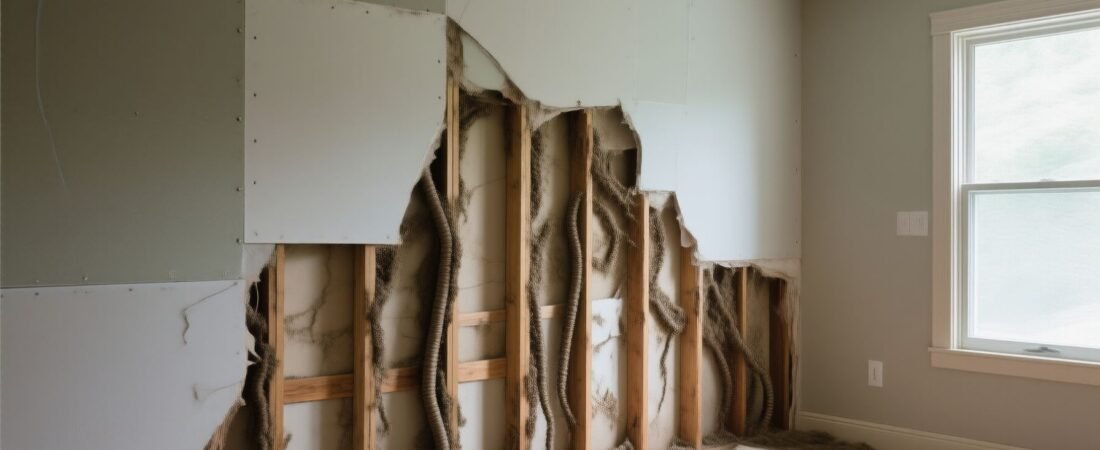
Termites are almost completely silent — and that’s exactly what makes listening for them so misleading. The sounds you’re actually hearing inside your walls are real, but most homeowners misidentify them, dismiss them, or only catch them at the wrong time of day. By the time the sounds become obvious, termites may have been eating your home for months or even years. Here’s what you should actually be listening for, what it means, and why the standard advice about “tapping on wood” gets people into trouble.
What Does Termite Activity Inside Walls Actually Sound Like?
Termites aren’t quiet because they’re hiding — they’re quiet because they’re small. A subterranean termite worker is roughly 1/8 inch long, and a colony chewing through wall framing doesn’t produce anything close to the sounds you’d expect from an animal. What you hear, if you hear anything at all, is a faint, dry rustling or soft clicking — sometimes described as the sound of paper crinkling slowly, or rice being poured into a cardboard box from a few rooms away. It’s subtle enough that most people hear it at night and assume it’s the house settling.
The clicking sound specifically comes from soldier termites, not workers. When the colony senses a threat — vibration from footsteps, a slamming door, or someone knocking on the wall — soldiers bang their heads against tunnel walls to signal an alarm. That signal travels through the wood, and if you press your ear against drywall in a heavily infested section, you may hear a faint rhythmic tapping. It’s faint because the vibration is traveling through hollow galleries, not solid wood. That hollowness is actually the real clue.
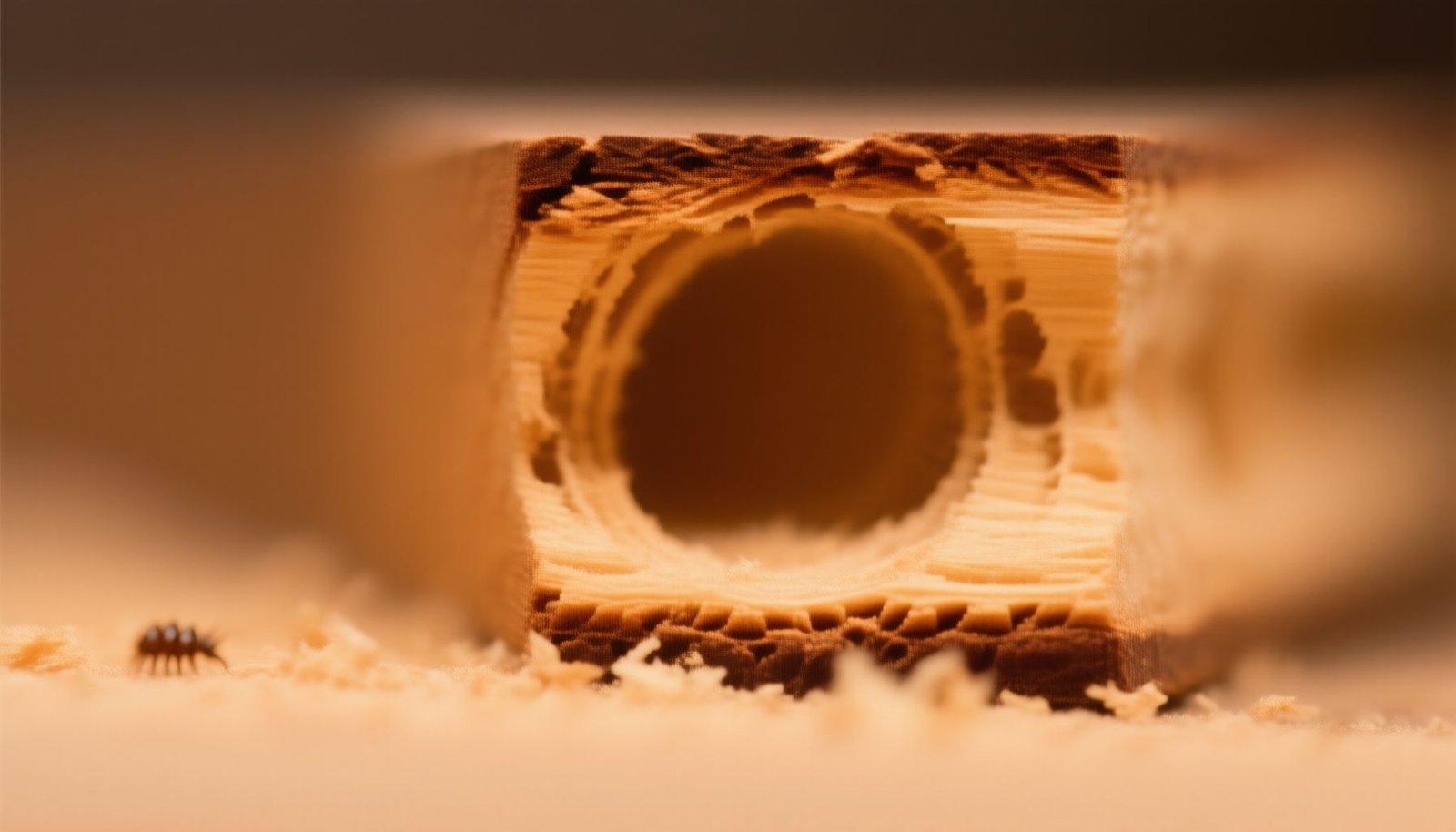
This cross-section shows how termite galleries hollow out wall framing from the inside out, leaving paper-thin outer layers that change how sound travels through the wood — which is why a termite-damaged stud sounds and feels different when you knock on it compared to a healthy one.
Why Are You More Likely to Hear Termites at Night?
Termite colonies are active around the clock — they don’t have a sleep cycle. But you’re far more likely to notice sounds at night because background noise drops, your house is quiet, and you’re often lying still in bed close to a wall. The sounds don’t get louder after dark; your ability to hear them just improves dramatically. This trips people up because they assume nighttime activity means they have a nocturnal pest, like mice or rats.
There’s an important distinction here worth understanding. Mice in walls produce irregular scratching and scurrying — movement sounds that stop and start. Termites produce a more continuous, paper-dry rustling with no clear movement pattern. If you hear something that sounds like it’s traveling from point A to point B inside your wall, that’s almost certainly not termites. If the sound is stationary and faintly rhythmic, termites move up the suspect list quickly. That said, misidentification happens constantly — some homeowners have called exterminators for rodents they were convinced were biting them in their sleep, only to discover the real culprit was a termite infestation causing structural stress that created entirely different household noises.
What’s the Difference Between Hearing Termites and Hearing Termite Damage?
This is the angle almost no one talks about — and it’s the most practically useful distinction you can make. Hearing live termite activity and hearing the effects of termite damage are two completely different things. Live termites produce biological sounds: the faint clicking from soldiers, the papery rustling of thousands of workers moving through galleries. Termite damage, on the other hand, produces structural sounds — hollow knocking when you tap a stud, a dull thud instead of a sharp knock on drywall, floors that creak and flex in spots they never used to, doors that stick because frames have shifted slightly.
These structural sounds often appear before you ever see a single termite. A colony of subterranean termites can contain over 1 million individuals and consume about a pound of wood per day at full strength. After 12 to 18 months inside a wall, the internal structure of a 2×4 stud can be compromised enough that it transmits sound differently when stressed. The house itself starts to tell you something is wrong — you just have to know what you’re listening for.
“The majority of termite infestations we confirm acoustically are found not by the sounds the insects make, but by the change in resonance of the material they’ve damaged. A hollowed stud has a distinctly different tap response than a solid one — that’s your most reliable non-invasive signal, and it’s one any homeowner can test themselves with nothing more than a screwdriver handle.”
Dr. Marcus Feeney, Board-Certified Entomologist and Wood Destroying Organism Specialist, University Extension Pest Management Program
How to Actually Test Your Walls for Termite Sound Signatures
You don’t need expensive acoustic detection equipment to do a meaningful first pass. Professional termite inspectors use acoustic emission devices and borescopes, but the basic tap test has been a reliable field technique for decades. Here’s how to do it systematically rather than randomly knocking on random sections of wall and not knowing what you’re comparing against.
- Establish a baseline first. Find a section of wall you know is undamaged — a recently renovated area, an interior partition wall that’s never been near moisture. Tap it firmly with your knuckle or the handle of a screwdriver. That clear, slightly sharp knock is your reference sound.
- Move systematically, not randomly. Termites travel up from the ground, so check walls at their base first, especially near plumbing, concrete foundations, wood-to-soil contact points, and areas with any past moisture history.
- Listen for a dull, papery thud. A hollow-sounding tap indicates either an air gap (which is normal near electrical boxes) or a gallery-riddled stud. Mark any spot that sounds noticeably different from your baseline.
- Press your ear against the drywall in suspect areas. Do this in the quietest part of your day — usually early morning or late at night. You’re listening for faint clicking or the soft rustle of movement behind the surface, not loud obvious sounds.
- Test with a probe, not just your knuckle. A sharp pick or even a sturdy skewer pressed lightly against visible wood trim or baseboard will sink in unusually easily if termites have eaten out the interior. Healthy wood resists. Termite-damaged wood gives way with almost no pressure.
- Check both sides of the wall if possible. An interior closet wall that shares a surface with an exterior-facing stud bay is often where you’ll find the most dramatic difference between a hollow tap and a solid one.
One thing to keep in mind: a single hollow-sounding spot doesn’t confirm termites. Old homes have voids, bad drywall installation, and all sorts of quirks. What you’re looking for is a pattern — multiple adjacent spots that all sound wrong, particularly in areas that connect to known risk zones like a crawl space, garage wall, or sill plate.
Which Type of Termite Makes Sounds, and Does Species Actually Matter?
Not all termite species produce detectable sounds at the same intensity, and this matters more than most online guides acknowledge. The three main categories of termites in US homes — subterranean, drywood, and dampwood — behave differently inside walls, and their acoustic signatures vary because of how they construct their galleries.
| Termite Type | Gallery Structure | Typical Sound Profile | Most Common US Regions |
|---|---|---|---|
| Subterranean (e.g., Formosan) | Extensive networks, mud tubes, follows wood grain | Faint clicking from soldiers; hollow tap on damaged wood | Southeast, Gulf Coast, nationwide |
| Drywood | Smooth-walled chambers cut across wood grain | Slightly louder rustling; frass (pellets) often the first sign | Southwest, California, Florida, Hawaii |
| Dampwood | Large, irregular galleries in moisture-damaged wood | Deeper hollow sound when tapped; less clicking from soldiers | Pacific Northwest, coastal areas |
Drywood termites are actually the species most likely to produce sounds you can hear without pressing your ear against anything, because they excavate larger chambers and their populations are localized to a single piece of wood rather than spread across a massive underground network. If you’re in California or Florida and you hear what sounds like faint scratching inside a wooden window frame or door jamb, drywood termites are worth investigating before you rule anything else out. Identifying what you’re dealing with correctly from the start — the same discipline that matters when you’re trying to distinguish between, say, a brown recluse vs. a wolf spider vs. a cellar spider — changes every decision you make next.
Pro-Tip: If you suspect drywood termites specifically, check beneath infested wood for small piles of tiny hexagonal pellets (frass) about the size of table salt grains. Drywood termites push their droppings out of exit holes, and finding frass underneath a window frame or on a shelf below wooden furniture is often a faster confirmation than relying on sounds alone.
What Else Could Be Making That Sound? How to Rule Out the Mimics
Here’s the counterintuitive thing about listening for termites: several other situations produce sounds that are almost identical, and misidentifying the source has real consequences. Homeowners who convince themselves they’ve got termites and treat accordingly while ignoring an actual rodent problem — or vice versa — waste months and sometimes thousands of dollars.
The following sounds are commonly mistaken for termite activity, and each has a distinguishing characteristic that helps separate it from the real thing:
- Mice or rats: Scratching that moves, stops, and restarts — often with a direction you can follow along the wall. Termites don’t move from room to room; mice clearly do.
- Carpenter ants: Produce a similar faint rustling, but carpenter ants remove wood rather than eat it, so you’ll often find coarse sawdust-like frass (not pellets) near baseboards. Their sounds are also slightly louder and more irregular in rhythm.
- Pipes and HVAC: Thermal expansion of pipes causes ticking and tapping that’s often mistaken for termite clicking. This sound typically follows a pattern tied to when your heat or AC kicks on or off, which you can confirm by tracking it over a few hours.
- Wood-boring beetles (powderpost beetles): These produce a very faint ticking or clicking sound from inside hardwood — sometimes described as the sound of a distant clock. Unlike termites, they leave small round exit holes and fine powder-like frass behind.
- House settling: Random, infrequent cracking and popping that varies with temperature and humidity. If the sound has a seasonal pattern — louder in winter, quieter in summer — it’s almost certainly structural movement, not termites.
An honest assessment here: even experienced pest control professionals sometimes can’t confirm an active termite infestation based on sound alone. Acoustic detection technology — specifically acoustic emission detectors that pick up vibrational frequencies in the 3 to 100 kHz range — improves accuracy dramatically, but it’s not infallible. The sound test is a starting point, not a verdict. What it does well is narrow your focus so that when you bring in a professional, you can point them toward specific areas rather than paying for a full structural inspection on a hunch.
Termite damage is one of those problems where every week of hesitation has a dollar value attached to it. A colony doesn’t pause while you decide whether that faint clicking is worth investigating. If the sounds are there, the structural tap test confirms hollow wood, and you’re in a known termite-active region of the country, treating the investigation as urgent isn’t paranoia — it’s the right call. Get a licensed WDO (Wood Destroying Organism) inspector out for a formal assessment, and in the meantime, check every accessible point where wood meets concrete or soil around your foundation. That’s where this almost always starts.
Frequently Asked Questions
What does termite damage sound like inside walls?
Termites make a faint clicking or rustling noise inside walls, often described as a soft tapping or papery crinkling sound. Soldier termites bang their heads against wood tunnels to signal danger, and you can sometimes hear this if you press your ear directly against an infested wall. The sounds are subtle — don’t expect anything loud enough to hear from across the room.
How do I know if the sounds in my walls are termites or mice?
Mice tend to make louder, more erratic scratching and scurrying sounds, especially at night, while termite sounds are quieter and more consistent — almost like a faint rustling of dry leaves. Mice also move around, so the sounds shift location; termite noise stays concentrated in one spot where the colony is active. If you also notice mud tubes, hollow-sounding wood, or frass (tiny pellet-like droppings), termites are the more likely culprit.
Can you actually hear termites in your walls without any equipment?
Yes, in some cases you can hear termites with your bare ear, especially if the infestation is large and the colony has been active for a while. Press your ear against the drywall or baseboard in a quiet room — a mild tapping or crinkling sound that repeats consistently is a red flag. That said, pest control pros use stethoscope-like acoustic detectors to pick up activity that’s too faint for the human ear.
What time of day are termite sounds in walls loudest?
Termites are most active and their sounds are easiest to detect at night when the house is quiet and there’s less background noise competing. They don’t actually get louder at night, but ambient silence makes the clicking and tapping far more noticeable. Try listening between 10 PM and 2 AM with the TV off and HVAC fans paused for the clearest results.
Should I call an exterminator if I hear clicking sounds in my walls?
Yes — if you’re hearing a consistent faint clicking or tapping from inside walls (not pipes or settling), you should have a licensed pest control inspector check it out as soon as possible. Termites cause an estimated $5 billion in property damage in the U.S. every year, and a colony can go undetected for months or years before the structural damage becomes obvious. Most reputable pest control companies offer free or low-cost inspections, so there’s little reason to wait.