
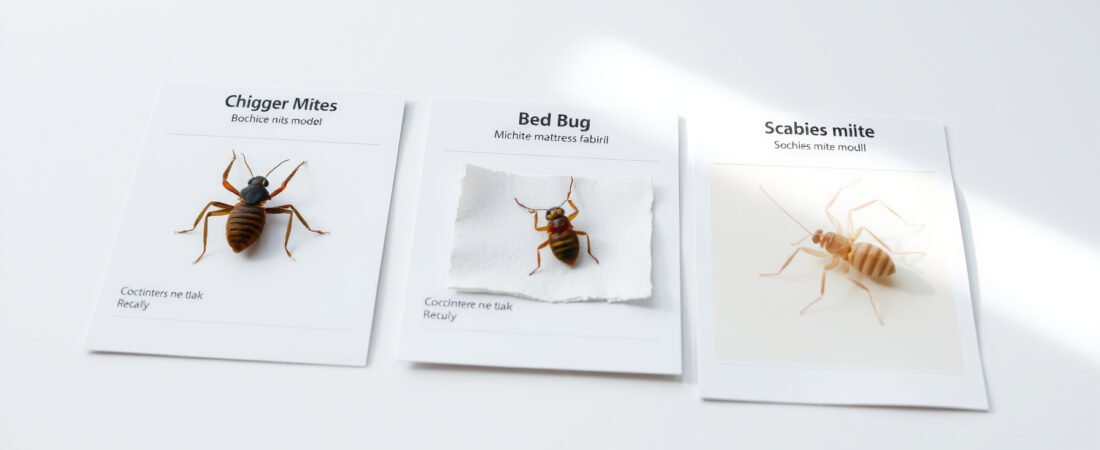
You can have all three — chigger bites, scabies, and bed bug bites — and never once see the thing that caused them. That’s the part most people miss. The internet loves telling you to “look for the bug,” but with all three of these culprits, the bite itself is your only real evidence most of the time. Here’s the bottom line: these three conditions look maddeningly similar on skin, but the pattern, timing, and where on your body the bites appear tells you almost everything you need to know — if you know what to look for.
Why Do Chigger Bites, Scabies, and Bed Bug Bites Look So Similar?
All three cause intense itching, redness, and small raised welts — which is exactly why urgent care doctors misdiagnose them constantly. The underlying mechanism is different in each case, but your skin’s response is frustratingly uniform: it sees a foreign substance, histamines flood in, and you end up with a red, swollen, itchy patch that looks almost identical regardless of what caused it. Chiggers inject digestive enzymes that liquefy skin cells; scabies mites physically burrow tunnels into the top layer of your skin; bed bugs pierce skin, inject an anticoagulant, and feed for three to ten minutes before detaching.
The itching from all three is also driven by your immune system overreacting — not by any actual venom. First-time chigger or scabies victims sometimes barely react at all, while someone with prior exposure can develop an intensely itchy welt within hours. That immune memory component is why two people sleeping in the same infested bed can have wildly different reactions, and why “I’m not that itchy, so it can’t be serious” is a genuinely dangerous assumption to make.

This close-up comparison of chigger bites, scabies lesions, and bed bug welts shows how the surface appearance overlaps — and highlights the subtle differences in bite pattern and skin texture that help with identification before you ever consult a doctor.
What Do Chigger Bites Actually Look Like — and Where Do They Show Up?
Chigger bites are almost always clustered where clothing fits tightly against skin — waistbands, sock lines, behind the knees, and around the ankles. That’s not random. Chigger larvae, which are the biting stage (the adults don’t bite at all), crawl upward from grass and soil and get trapped where fabric creates a barrier. A single chigger can produce a welt up to 2 centimeters wide, and the bites typically appear 3 to 6 hours after exposure, peaking in intensity around 24 to 48 hours later. You’ll often find a hard, bright-red bump with a slightly darker center, sometimes surrounded by a pale halo.
Here’s the counterintuitive part most outdoor guides get wrong: chiggers do not burrow into your skin and stay there. They feed briefly — often dislodging before you even notice them — and the welt you’re scratching days later is your body reacting to the enzymes they left behind, not to an active infestation. That means no amount of scrubbing will “remove” the chigger from an existing bite, because it’s already gone. The itching lasts 1 to 3 weeks purely because of that immune response, not because anything is still living under your skin.
How Do Scabies Bites Differ — and What Makes Them Harder to Diagnose?
Picture this: you’ve been intensely itchy for two weeks, especially at night, and you notice thin grayish lines about 1 centimeter long between your fingers. Those lines are actual scabies mite burrows — and they’re the one feature that separates scabies from everything else on this list. The Sarcoptes scabiei mite digs into the outermost skin layer, lays 2 to 3 eggs per day, and the tunnels it leaves are visible to the naked eye if you know what you’re looking at. Scabies rash tends to concentrate in skin folds: between fingers, inside wrists, around the waistband, in the groin, and under breasts — anywhere warm and confined.
The delay before symptoms appear is what makes scabies so dangerous in shared-living situations. A first-time infestation takes 4 to 6 weeks before itching begins, meaning someone can spread it to an entire household before they know they have it. The itching is driven by an allergic reaction to mite feces and shed skins, not to the bites themselves — which is why it intensifies dramatically at night when the body warms up under blankets. Scabies is contagious through prolonged skin-to-skin contact; unlike bed bugs, you can’t get it from briefly touching an infested surface.
Pro-Tip: If multiple people in the same household develop itching within a few weeks of each other — especially with symptoms concentrated on the hands and wrists — scabies is far more likely than a chigger or bed bug situation. A dermatologist can confirm it with a skin scraping in about 10 minutes, which is worth the copay before you spend $200 on mattress treatments that won’t fix anything.
What Makes Bed Bug Bites Distinctly Different — and What’s the Actual Proof?
Bed bug bites have a reputation for appearing in a “line of three” — sometimes called breakfast, lunch, and dinner — but that pattern is far less reliable than pest control marketing suggests. Research shows that roughly 30% of people don’t react to bed bug bites at all, and the bite pattern depends entirely on how much the bug was disturbed during feeding. What’s more consistent: bed bug bites appear on exposed skin during sleep — neck, face, arms, shoulders, and upper back — and almost never below the waist where sheets cover the body. They show up as flat or slightly raised pink welts, often with a darker center, and they tend to appear in small irregular clusters rather than isolated single bites.
The real diagnostic difference isn’t the bite — it’s the evidence you find in the room. Bed bugs leave behind dark rust-colored fecal stains on mattress seams, shed exoskeletons in box spring folds, and a faint sweetish-musty odor in heavily infested rooms. An adult bed bug is about 5 to 7 mm long and visible to the naked eye, but they’re masters at hiding in a 1 mm gap. If you’re waking up with new welts every morning and you’ve been sleeping in the same bed, that repeatability — new bites every night — is your strongest indicator it’s bed bugs and not chiggers or scabies. Do pest control services work long-term or do pests come back? — worth understanding before you commit to a treatment plan, because bed bug cases in particular have a frustrating recurrence rate without the right follow-through.
“The single biggest mistake I see patients make is treating the skin reaction without identifying the source. Scabies requires a prescription treatment for every person in the household simultaneously. Treating one person while others remain infested is essentially starting over. And if it turns out to be bed bugs, no topical treatment will do anything — the problem is environmental, not dermatological.”
Dr. Renata Kovacs, Board-Certified Dermatologist and Medical Entomology Consultant, University Extension Skin Health Program
How to Tell Them Apart: A Side-by-Side Comparison That Actually Works
The fastest way to narrow it down is to run through four diagnostic questions in order: Where are the bites? When did they start? Who else is affected? And were you recently outdoors in grassy or wooded areas? Answering those honestly will eliminate at least one candidate almost every time. The table below captures the key differences that actually help with identification — not the surface-level stuff you’ll find in every other comparison, but the behavioral and contextual markers that distinguish them in real life.
| Feature | Chigger Bites | Scabies | Bed Bug Bites |
|---|---|---|---|
| Typical body location | Waistband, ankles, behind knees, sock lines | Finger webs, wrists, groin, skin folds | Neck, arms, face, shoulders (exposed during sleep) |
| Onset after exposure | 3–6 hours (itch peaks 24–48 hrs) | 4–6 weeks (first infestation) | Hours to days depending on immune sensitivity |
| Contagious person-to-person? | No | Yes (prolonged contact) | No (environment-based) |
| Distinctive physical marker | Bright red welt with darker center | Thin grayish burrow lines in skin | Rust stains and exoskeletons near mattress seams |
One honest nuance worth flagging: if you live in a humid Southern state and spent time outdoors in late summer, chiggers become dramatically more likely — chigger larvae are most active when soil temperature sits between 77°F and 99°F, and populations spike dramatically in states like Texas, Georgia, Missouri, and the Carolinas during that window. Meanwhile, scabies spreads fastest in dense-living environments like college dorms, nursing facilities, and apartment complexes. Context isn’t a shortcut to diagnosis, but it’s a legitimate piece of the puzzle.
How to Confirm Which One You Have — Before Spending Money on the Wrong Treatment
The self-diagnosis mistake that costs people the most time and money is treating symptoms instead of causes. Someone convinced they have bed bugs might buy $150 worth of mattress sprays and encasements when they actually have scabies — which means the mites keep spreading while the mattress sits perfectly fine in its new cover. Here’s a practical sequence for ruling each one out:
- Check for outdoor exposure in the last 72 hours. If you walked through tall grass, sat on a lawn, or hiked a wooded trail recently, chiggers belong at the top of your list — especially if bites are clustered at clothing boundaries.
- Look for burrow lines on your hands and wrists. Use a magnifying glass in good light. Thin, irregular grayish lines — often 5 to 10 mm long — between fingers or across the inner wrist strongly suggest scabies and warrant a dermatology visit, not a hardware store run.
- Strip and inspect your mattress seams. Pull back the piping on all four sides of your mattress and look for dark brown specks (fecal matter), translucent shed skins, or live bugs. Adult bed bugs are roughly the size and color of an apple seed.
- Track the timing of new bites. Waking up with fresh welts after every night in the same bed points to bed bugs. Bites that appeared once after an outdoor event and aren’t multiplying point to chiggers. Bites that are spreading to other household members over weeks point to scabies.
- See a dermatologist before treating. A skin scraping for scabies takes 10 minutes. A confirmed diagnosis saves you from weeks of wrong-path treatments. If it’s bed bugs or chiggers, your doctor can tell you that too — and it changes your next steps completely.
Renters dealing with suspected bed bugs face an additional layer of complexity. Depending on your state, your landlord may be legally required to address a confirmed infestation — but the burden often falls on you to document it properly before they’re obligated to act. Can you sue a landlord for a pest infestation? What you need to prove breaks down exactly what documentation and legal thresholds apply, which matters especially when you’re dealing with bites you can’t yet explain.
The treatment paths for all three diverge sharply once you have a confirmed answer. Chigger bites are treated supportively — antihistamines, hydrocortisone cream, and time, since the mites are already gone. Scabies requires a prescription permethrin cream applied to the entire body (not just where you’re itching) and must be done simultaneously by every person in the household; retreatment after 7 to 10 days is standard. Bed bugs require environmental elimination — heat treatment, chemical treatment, or a combination — and the bites themselves will resolve on their own once the source is gone. Treating in the wrong category doesn’t just waste money; it delays the right treatment while the actual problem continues.
Here’s the part almost no pest guide mentions: scabies mites can survive off a human host for 24 to 72 hours on bedding and clothing — which means if someone in your home has confirmed scabies, laundering bedding at 122°F or higher is genuinely necessary, not optional. That overlap with bed bug protocols trips people up constantly: they heat-treat the environment for what they think are bed bugs, accidentally treat a scabies-contaminated environment appropriately, and assume it was bed bugs all along. The right pest identification isn’t just about peace of mind — it’s the only way to know your treatment actually worked for the right reason.
What to Do Right Now If You’re Not Sure Which One You Have
Stop scratching — seriously — because broken skin from scratching all three of these can introduce secondary bacterial infections that complicate diagnosis and treatment. Photograph your bites in good lighting, noting their exact locations on your body and whether they’ve changed in size or number over 24 to 48 hours. That photo record is useful whether you’re seeing a dermatologist, talking to a pest control company, or documenting something for a landlord.
The practical short list of immediate steps:
- Wash all recently worn clothing and bed linens in hot water (at least 120°F) and dry on high heat — this is a safe first step regardless of which culprit you’re dealing with
- Apply an over-the-counter 1% hydrocortisone cream to calm the immune reaction while you work out the cause — it helps with all three
- Avoid using permethrin-based products on yourself without a diagnosis — permethrin is a scabies treatment, not a chigger or bed bug topical, and self-treating incorrectly can mask symptoms a doctor needs to see
- If others in your household are developing similar symptoms, contact your healthcare provider immediately — that’s the pattern that points to scabies and requires coordinated treatment
- Don’t throw out your mattress before an inspection — most people who toss a mattress over suspected bed bugs do it before anyone confirms the bugs were actually there, and a new mattress won’t protect you if the infestation is in the box spring, baseboards, or nearby furniture
Getting the identification right the first time isn’t just about saving money on the wrong treatment — it’s about not spending another three weeks itching while the real problem goes unaddressed. The bites all look similar, but the situations that produce them are completely different, and so are the solutions. Your skin is giving you clues; it just takes knowing what language it’s speaking.
Frequently Asked Questions
how do I know if I have chigger bites or scabies?
Chigger bites show up as small red welts that itch intensely but stay near the surface of the skin, usually around ankles, waistbands, and behind the knees. Scabies causes a widespread rash with thin, irregular burrow lines just under the skin and almost always spreads to the webbing between fingers and wrists. If your itching gets dramatically worse at night and you see burrow tracks, that’s a strong sign of scabies rather than chiggers.
where on your body do chigger bites appear compared to bed bug bites?
Chigger bites cluster in spots where clothing fits tightly against skin — think ankles, groin, waistline, and behind the knees. Bed bug bites tend to show up on exposed skin you have while sleeping, like your arms, neck, shoulders, and face. If bites are under your clothes where elastic sits, chiggers are the more likely culprit.
do bed bug bites itch as bad as chigger bites?
Chigger bites are generally considered more intensely itchy — they inject a digestive enzyme that breaks down skin cells, which triggers a stronger inflammatory reaction. Bed bug bites cause itching too, but many people describe it as more of a mild, persistent itch rather than the maddening, burning itch chiggers produce. About 30% of people don’t react to bed bug bites at all, which almost never happens with chiggers.
can chigger bites spread on your body like scabies does?
No — chigger bites don’t spread after they form because chiggers don’t burrow into or live inside your skin. Scabies mites actually tunnel under the skin and lay eggs, so the infestation spreads and gets worse over days and weeks without treatment. If your rash keeps expanding to new areas of your body over time, get checked for scabies rather than assuming it’s chiggers.
what does a bed bug bite pattern look like on skin?
Bed bug bites often appear in a line or loose cluster of 3 or more bites, sometimes called a ‘breakfast, lunch, and dinner’ pattern. Each bite looks like a small, flat or raised red welt, similar to a mosquito bite, and they typically show up on the same body part night after night. Unlike chigger or scabies rashes, bed bug bites don’t have burrow lines or a skin tunnel appearance — they’re just clean, round red marks.