
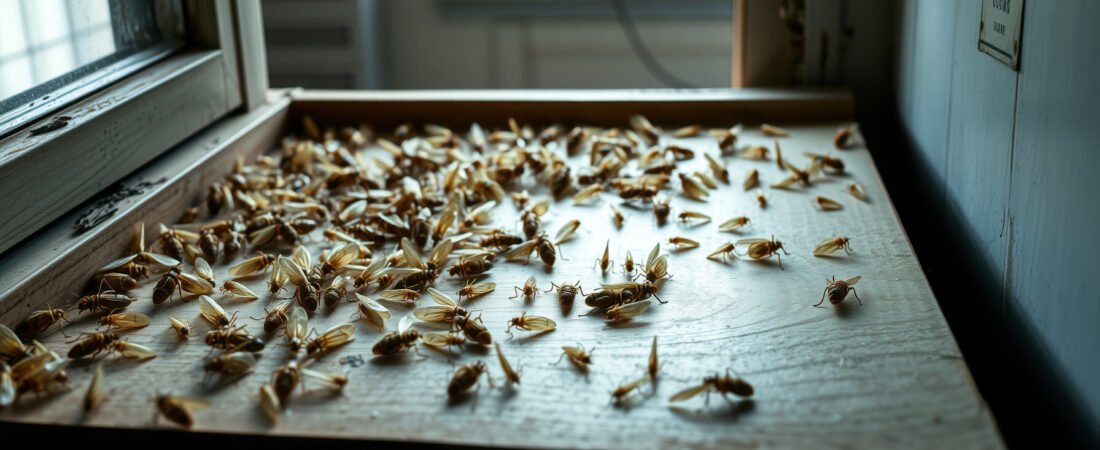
Those tiny pale wings scattered across your windowsill aren’t random debris — they’re a confession. Termites shed their wings deliberately, within minutes of landing, and what’s left behind is one of the most misread clues in pest identification. The problem isn’t that homeowners don’t notice the wings. The problem is they notice them, aren’t sure what they’re looking at, and wait too long to act because the wings look so… harmless.
Here’s the angle most articles skip entirely: the wings themselves don’t tell you there’s an active infestation. They tell you there was a swarm — which means a mature colony, likely 3 to 5 years old, already exists somewhere nearby or inside your structure. By the time you’re finding shed wings, you’re not at the beginning of a termite problem. You’re catching a problem that’s been quietly growing for years.
That reframes everything. Identifying the wings correctly isn’t just an academic exercise — it determines how urgently you need to move and what you’re actually dealing with. Let’s get into exactly what those wings look like, why they look that way, and what the details you’d probably overlook actually mean.
What Do Shed Termite Wings Actually Look Like Up Close?
Termite wings after swarming are translucent to milky white, roughly uniform in size, and surprisingly delicate — almost like a fish scale made of tissue paper. Each wing is about 3/8 to 1/2 inch long depending on species, with a fine network of veins running through it. The edges are slightly rounded, and the texture is smooth rather than fuzzy or hairy.
The single most identifying feature: all four wings are nearly identical in size and shape. That’s different from flying ants, which have a distinctly larger front pair. If you hold a shed termite wing up to light, you’ll see a consistent, even venation pattern without the heavy dark veins you’d spot on a wasp or bee wing. They’re also almost always found in piles — not scattered randomly — because termites shed both wings at once at the same spot where they land.

This close-up shows the near-identical size of all four wings and the fine, evenly distributed vein pattern — two features that definitively separate termite wings from ant wings and help you confirm a swarm event rather than a stray insect.
Why Do Termites Drop Their Wings, and What Does That Timing Tell You?
Termites shed their wings on purpose. Swarmers — also called alates — are the reproductive caste of the colony, and their wings exist for one job: dispersal. Once they’ve flown and found a mate, the wings become dead weight. Termites detach them by pressing the wing against a surface and snapping it off at a built-in breakpoint near the base called the basal suture. It takes seconds, and it’s irreversible.
What the timing reveals is actually useful intelligence for you as a homeowner. Subterranean termites — the species responsible for about 95% of termite damage in the US — swarm during daylight hours in spring, typically after a warm rain. Drywood termites tend to swarm in late summer or fall and can do so at night. If you find wings on a sunny April morning near a basement window, that’s a very different scenario than finding wings near an interior door frame in September. The species, and therefore the likely entry point and treatment approach, differs.
How Are Termite Wings Different From Flying Ant Wings?
This is the identification mistake that costs homeowners real money. Flying ants swarm too, and their discarded wings can look superficially similar to termite wings — same general size range, same translucent appearance. But get a magnifying glass and compare them side by side, and the differences are clear enough to spot without any entomology training.
| Feature | Termite Wings | Flying Ant Wings |
|---|---|---|
| Wing size (front vs. back) | All four wings nearly equal | Front wings noticeably larger than rear |
| Wing texture | Smooth, milky, fine veins | Slightly more defined, thicker veins |
| Wing attachment point | Snaps cleanly at basal suture | No clean break point, harder to shed |
| Wing shape | Rounded, uniform oval | More elongated, narrower rear wing |
The equal-sized wings are your fastest visual confirmation. Hold one up — if the wing you found is longer than it is wide, symmetrically oval, and matches a second wing you find nearby in near-identical size, you’re almost certainly looking at a termite wing, not an ant wing. Ants also tend to leave wings in more scattered patterns because they’re less deliberate about where they detach them.
Where You Find the Wings Matters as Much as What They Look Like
Picture this: you’re running a vacuum along the baseboard in your living room and you hit a small pile of what looks like pale fish scales near the sliding glass door track. That location — ground level, near a light source, next to a wood-framed door — is exactly where subterranean termite swarmers emerge and shed. The location of shed wings is diagnostic information, not just cleanup.
Here’s where different termite species tend to leave their shed wings, and what each location implies:
- Windowsills and door frames (interior): Swarmers are attracted to light and often emerge inside, then pile up trying to exit — strongly suggests a colony is already inside the structure or in the soil directly beneath
- Near foundation vents or basement windows: Classic subterranean termite emergence point — colony is almost certainly in the soil adjacent to the foundation
- Near attic vents or roof eaves: Points toward drywood termites, which infest wood directly without soil contact
- On outdoor patios or porches near wood: Could indicate a nearby outdoor colony that hasn’t entered the structure yet — potentially an early warning you can act on
- Inside kitchen or bathroom cabinets: Drywood termites infesting furniture or cabinetry — this is less common but more immediately damaging to specific items
The honest nuance here: finding wings outdoors on a patio or near a tree stump doesn’t automatically mean your house is infested. Termite colonies exist in nature, including in trees, railroad ties, and landscape timbers. An outdoor wing pile warrants investigation but not immediate panic. An indoor pile, especially near structural wood or in a finished living space, is a different matter entirely.
What Should You Do Within the First 48 Hours of Finding Termite Wings?
Speed matters here more than most pest situations, and not for the reason you might think. Termite swarmers themselves cause zero structural damage — they don’t eat wood. But a successfully mated pair that finds a suitable site can start a new colony, and if wings are found indoors, there’s a meaningful chance swarmers emerged from an existing colony already in your walls or subfloor rather than flying in from outside. Within 24 to 48 hours of finding wings, you want to do three things before calling anyone.
Here’s the sequence that gives you the most useful information:
- Photograph and collect a sample. Use a piece of tape or a small container to preserve two or three wings intact. You’ll want them for species identification by a professional — crushed wings are much harder to evaluate.
- Note the exact location and time of day. Take a photo of the spot in context (not just a close-up). Whether wings appeared at 9am on a sunny morning versus 10pm near an interior light narrows the species significantly.
- Check for mud tubes within 6 feet of where you found wings. Subterranean termites build pencil-thin mud tubes — about 1/4 inch wide — along foundations, piers, joists, and walls. A mud tube within arm’s reach of the wing pile is near-confirmation of an active subterranean colony.
- Tap structural wood nearby. Use a screwdriver handle to knock on baseboards, door frames, and window sills in the area. Hollowed, papery-sounding wood — rather than a solid thud — indicates feeding damage has already occurred.
- Get a professional inspection before treating. DIY termiticides applied to the wrong species in the wrong location can drive a colony deeper into the structure without eliminating it. Termite colonies can contain over 1 million individuals — misapplied spot treatment rarely scratches the surface.
Pro-Tip: If you find shed wings near a wooden window frame or door casing, probe the wood with a thin flathead screwdriver. Drywood termites often infest trim and casings before attacking structural framing — if the screwdriver sinks in with almost no resistance, you’ve likely found active damage right at the wing site, which significantly changes the treatment priority.
“Most homeowners who call us after finding wings have already lived with an active termite colony for two to four years. The swarm is actually the colony announcing its maturity, not its arrival. By the time you see wings, you’re already dealing with a population large enough to have caused measurable structural damage — the wings are not an early warning sign, they’re a late one.”
Dr. Marcus Ellison, Board-Certified Entomologist and Licensed Pest Management Professional, Gulf Coast Extension Program
Can You Confirm a Termite Problem From Wings Alone, or Do You Need More Evidence?
Wings alone confirm a swarm event. They don’t confirm where the colony is, how large it is, or whether it’s inside your structure or nearby in the soil or a neighboring tree. That distinction matters because the treatment — and the urgency — is completely different. A colony in the soil 10 feet from your foundation is a threat worth addressing, but it’s not the same situation as a colony that’s already honeycombed a load-bearing wall.
To confirm an active interior infestation, you need at least one additional indicator beyond the wings: mud tubes, hollow-sounding structural wood, visible frass (drywood termite droppings look like tiny pellets of sawdust, roughly 1mm long with six rounded sides), or actual termite bodies — either live workers or the shed exoskeletons they leave behind. The counterintuitive truth that most pest control content glosses over is this: a large wing pile sometimes means the swarm failed. Swarmers that emerge indoors often can’t find their way out, die, and pile up near windows. That’s still evidence of a colony, but it may actually indicate the swarm wasn’t successful in establishing new colonies — which is cold comfort, since the original colony is still very much active. Just because you’re seeing the wings of dead swarmers doesn’t mean you’re safe. It means the original colony is mature enough to have produced them, and it will swarm again.
If you’re a renter dealing with this situation, the responsibility question gets complicated quickly — similar to how landlord vs. tenant responsibility plays out with mice in an apartment building, termite disclosure and treatment obligations vary significantly by state and lease terms. Document everything before the wings get swept away.
One more thing worth flagging: the cost comparison between termite treatment and other pest problems often surprises people. Professional termite treatment for a slab foundation home can run $800 to $2,500 depending on method and linear footage — which is meaningful but typically far less than the structural repairs that delayed action makes necessary. For perspective, even a professional wasp nest removal, which most people consider expensive, is a fraction of what termite remediation costs — professional wasp nest removal runs $100 to $400 in most markets. Termites are in a different cost category entirely once they’ve been active for multiple seasons.
The wings are telling you something specific. They’re telling you that somewhere in or near your home, a colony reached reproductive maturity — and that almost always means years of invisible feeding already happened. Treat the wings as intelligence, not just mess. Collect a sample, note exactly where and when, check for corroborating evidence within arm’s reach, and get a professional inspection with a written report before any treatment begins. That report, not the wings themselves, is what tells you what you’re actually dealing with.
Frequently Asked Questions
what do termite wings look like after they fall off?
Shed termite wings are small, pale or translucent white, and all four wings are nearly identical in size — that equal length is one of the clearest signs you’re dealing with termites rather than ants. They’re usually about 1/4 to 3/8 of an inch long and have a slightly veined appearance. You’ll often find them in small piles near windowsills, door frames, or light fixtures.
how do I know if the wings I found are from termites or flying ants?
The easiest way to tell them apart is wing size — termite wings are all the same length, while flying ant wings have a larger front pair and a smaller back pair. Termite wings also break off very easily and are often found in neat piles, whereas ant wings tend to stay attached longer. If the wings are uniform and paper-thin with a milky color, you’re almost certainly looking at termite swarmers.
where do termites leave their wings after swarming?
Termites shed their wings almost immediately after landing, so you’ll typically find piles of wings close to where they entered or were attracted to light. Common spots include window ledges, door thresholds, baseboards, and around light fixtures. Finding wings in more than one location inside your home is a strong indicator the swarm originated from inside the structure.
how long does a termite swarm last?
Most termite swarms only last about 20 to 30 minutes, though some can stretch to an hour depending on colony size and conditions. Swarmers are poor fliers and don’t travel far — most land within a few hundred feet of where they launched. Because swarms are so brief, many homeowners miss them entirely and only notice the shed wings left behind.
should I be worried if I find termite wings in my house?
Yes — finding termite wings indoors is a serious warning sign that a colony may already be established inside your home, not just nearby. Swarmers that shed wings indoors were almost certainly produced by a mature colony that’s been feeding on your structure for at least 3 to 5 years. You should contact a licensed pest control professional for an inspection as soon as possible rather than waiting to see more signs of damage.