
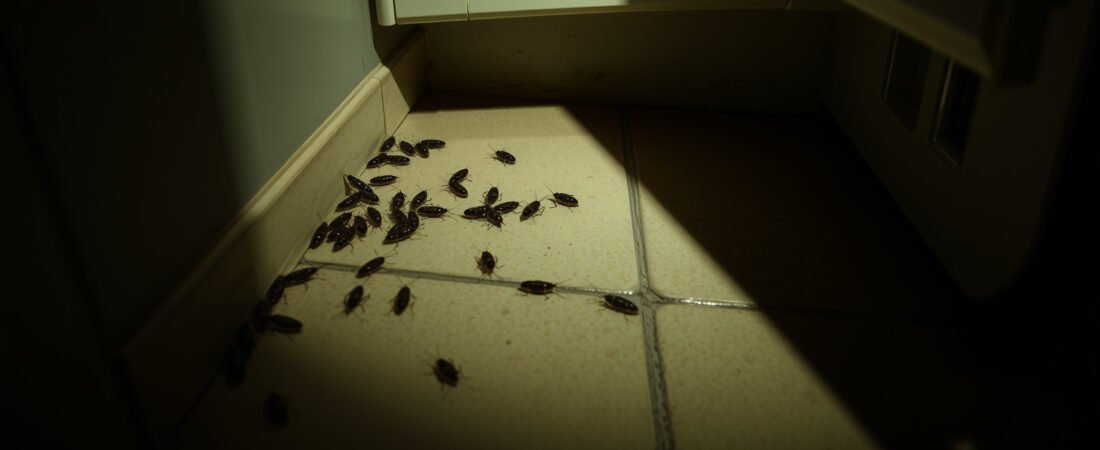
Two weeks is enough time to break a German cockroach infestation — but only if you stop doing the one thing that makes it worse. Most people grab a can of spray, hit every roach they see, and call it done. That approach doesn’t just fail; it actively scatters the colony and makes them harder to eliminate. The real fix isn’t about killing individual roaches. It’s about collapsing the population from the inside out, and the difference in approach is everything.
Why Spraying German Cockroaches Makes the Infestation Worse
Repellent sprays — the kind you find at any hardware store — push German cockroaches away from treated areas rather than killing them at the source. They scatter into walls, behind appliances, and into rooms they weren’t in before. You haven’t reduced the population; you’ve just moved it and given the colony more time to reproduce. A single female German cockroach produces an egg capsule containing 30–40 eggs, and she can generate up to 8 capsules in her lifetime. Do the math and one pregnant roach can become hundreds in a matter of weeks.
The other problem with spray-first thinking is that it ignores where the actual population lives. German cockroaches spend roughly 75% of their time hiding in harborage sites — the narrow gaps behind your stove, inside your dishwasher motor housing, under the refrigerator compressor. Spraying the floor or countertop barely grazes the edges of where they actually breed. You need a treatment strategy that reaches those harborage zones directly, not one that sends roaches deeper into them.
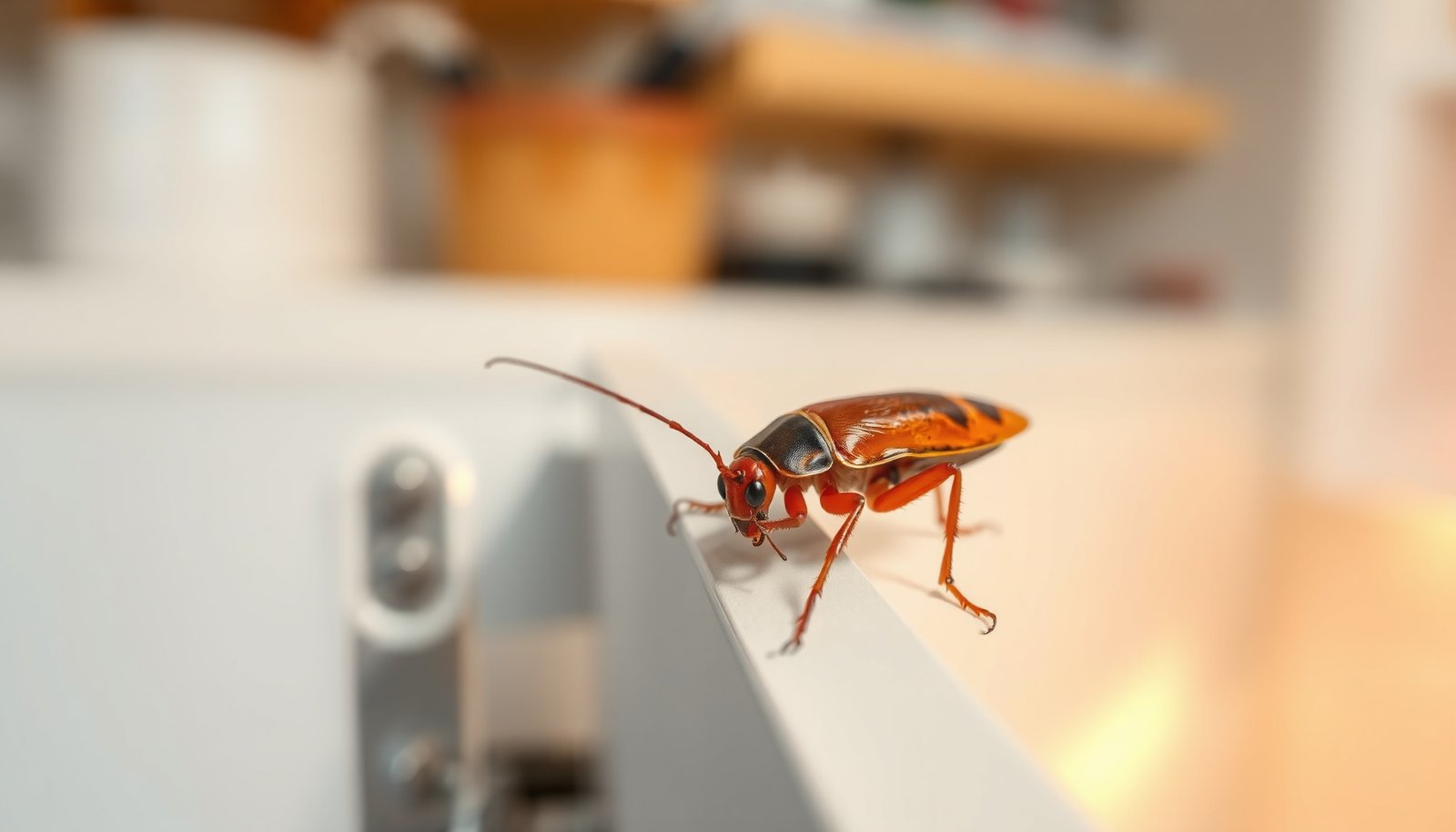
This close-up shows the distinctive two dark stripes running down a German cockroach’s pronotum — the shield just behind its head — which is the fastest way to confirm you’re dealing with this species rather than a less prolific one, because the treatment approach differs significantly.
What Makes German Cockroaches So Much Harder to Kill Than Other Species
German cockroaches are an indoor-only species. Unlike American or smokybrown cockroaches that live primarily outside and wander in, German cockroaches live their entire life cycle inside your home. That means there’s no outdoor population to deal with, but it also means every single individual is sheltered, warm, and constantly reproducing in your walls. They don’t need to go outside to survive the winter. They just need your kitchen.
They’ve also developed documented resistance to multiple classes of insecticides — pyrethroids, organophosphates, and even some neonicotinoids — depending on the region and how heavily those products have been used in your building. Picture this: you’re in a multi-unit apartment building, and the unit next to you has been sprayed monthly for two years with the same pyrethroid product. The surviving cockroaches that migrated into your unit are already resistant to it before you even buy a can. Resistance isn’t a theory — it’s a measurable population-level change, and it’s why product rotation matters as much as product choice.
“German cockroaches are the species we worry about most in urban environments because their entire biology is optimized for indoor survival. The resistance issue is real — I routinely see infestations that don’t respond to over-the-counter pyrethroids at all. A gel bait with a different active ingredient, rotated with an insect growth regulator, is almost always a more effective starting point than anything in a spray can.”
Dr. Michael Kaplan, Board-Certified Entomologist and Urban Pest Management Specialist, Rutgers Cooperative Extension
The Two-Week Protocol That Actually Works
The 14-day elimination method works because it combines three mechanisms at once: fast-acting bait that kills adults, an insect growth regulator (IGR) that sterilizes survivors and prevents eggs from hatching, and physical exclusion that cuts off the harborage. Using any one of these alone gives the infestation a way to recover. Using all three simultaneously closes the loop. Here’s the sequence:
- Day 1 — Deep clean harborage zones: Pull out the stove, refrigerator, and dishwasher. Vacuum up all visible roaches, egg capsules, and frass with a HEPA vacuum. This isn’t about sanitation — it’s about removing competing food sources so the bait becomes the most attractive thing in the kitchen.
- Day 1 — Apply gel bait in small dots: Place pea-sized dots of a fipronil or indoxacarb-based gel bait (Advion, Vendetta, or similar) every 6–12 inches inside cabinet hinges, under the lip of the stove drawer, behind the refrigerator, and inside the dishwasher door frame. Small dots go stale slower and get discovered faster than large blobs.
- Day 1 — Apply IGR: Spray a pyriproxyfen or hydroprene-based IGR (Gentrol, for example) in the same harborage zones. IGRs don’t kill on contact — they mimic juvenile hormones so roaches can’t mature into breeding adults and eggs fail to develop. This is the population-control layer that bait alone can’t provide.
- Day 3–5 — Monitor and replenish bait: Check the bait placements. If dots are gone or dried out, replace them. Heavy feeding in the first few days is a good sign — it means the colony is taking the bait back to the harborage where other roaches and nymphs will contact it.
- Day 7 — Apply boric acid to voids: Lightly dust boric acid powder inside wall voids behind outlet covers and under the toe kick of cabinets. Boric acid works through contact and ingestion, and it stays active for months. Don’t over-apply — a thin, barely-visible layer works; a visible pile of powder gets avoided.
- Day 14 — Inspect and seal: If live roach activity has dropped significantly (which it should have), use silicone caulk to seal gaps around pipes, under the sink, and along baseboards behind appliances. This is exclusion — it eliminates harborage and blocks entry from adjacent units.
One honest nuance worth flagging: if you’re in a multi-unit building with confirmed activity in adjacent units, two weeks gets your unit under control but doesn’t stop reintroduction through shared walls and plumbing chases. In that situation, you’re managing an ongoing pressure, not achieving a one-time elimination. That’s a building-level problem, and the solution requires coordination with your landlord — something worth understanding before you sign any lease (it helps to know what your lease actually says about pest control responsibility, which is something Pest Control Clauses in Leases: What to Look for Before You Sign breaks down clearly).
Which Products Actually Work and Which Are a Waste of Money
The gel bait category is where your money should go first — it’s not even close. Consumer-grade aerosol sprays kill on contact but leave no residual effect in the harborage zones where colonies actually live. Professional-tier gel baits like Advion (indoxacarb) and Vendetta Plus (abamectin with IGR) are available to the public and cost around $15–$30 for a syringe that covers an entire kitchen. That’s a better return than any spray product at any price.
Here’s a side-by-side comparison of the main product types so you can see what each actually does:
| Product Type | How It Works | Best Use | Effectiveness Against Colony |
|---|---|---|---|
| Gel Bait (indoxacarb/abamectin) | Slow-acting toxicant carried back to harborage; secondary kill through contact and feeding | Cabinet hinges, appliance gaps, under sink | High — reaches colony directly |
| IGR Spray (pyriproxyfen/hydroprene) | Disrupts juvenile hormone; prevents nymphs maturing and eggs hatching | Same harborage zones as bait | High — collapses reproduction cycle |
| Pyrethroid Aerosol (OTC sprays) | Contact kill; repellent residual | Perimeter barrier (not kitchen harborage) | Low — repels rather than eliminates |
| Boric Acid Dust | Contact and ingestion; damages exoskeleton and gut lining | Wall voids, toe kicks, behind outlets | Moderate — long-lasting but slow |
Pro-Tip: Never apply gel bait and a repellent spray in the same area on the same day. The spray residue deters roaches from approaching the bait, which defeats the entire point. If you need to use both, apply bait first and let it establish for 48–72 hours before any spray goes anywhere near the same zone.
What to Do If Roaches Are Still Visible After Two Weeks
Seeing a handful of roaches in week two isn’t necessarily failure — it depends on what you’re seeing. Nymphs (small, dark, wingless juveniles) coming out in the open during the day often means the IGR is working: the harborage is overcrowded because adults are dying faster than the population can reproduce, so juveniles are getting pushed out. That’s actually a sign the treatment is collapsing the colony from within. What you don’t want to see is large adults actively foraging at night in week two, which suggests the bait wasn’t consumed or the harborage wasn’t fully treated.
If activity hasn’t dropped noticeably by day 14, run through this checklist before calling a professional:
- Bait avoidance: Some colonies develop bait aversion — a learned or genetic preference to avoid glucose-based attractants. Switch to a bait with a different attractant matrix (protein-based vs. carbohydrate-based) and a different active ingredient.
- Competing food sources: Even small amounts of grease behind the stove or crumbs under the refrigerator make bait less attractive. Re-clean and re-bait.
- Missed harborage zones: The motor housing inside the dishwasher, the inside of the clock radio on the counter, inside electrical wall plates — these are real harborage sites that get missed on the first pass.
- Reintroduction from adjacent units: If you’re in an apartment or condo, roaches can re-enter through plumbing penetrations faster than bait can kill them. Caulk every pipe penetration under the sink and behind the toilet.
- Product resistance: If the bait you’re using contains the same active ingredient that’s been used in the building for years, the population may have partial resistance. Switch active ingredients — indoxacarb to abamectin, or vice versa.
One thing that genuinely surprises people: German cockroaches will colonize electronics. Routers, game consoles, microwaves, and clocks all generate warmth and are rarely cleaned inside. A population can survive and re-seed a kitchen from a device sitting on the counter even after the kitchen itself has been fully treated. If your infestation keeps coming back despite doing everything right, unplug and inspect your electronics — this is one of those overlooked facts that most pest control write-ups skip entirely, even though it explains a lot of “re-infestation” situations that are actually continuations of the original infestation. You might also find it useful to review what type of insect you’re actually dealing with, since some people mistake German cockroaches for other small insects — just as homeowners sometimes confuse very different pest species when they spot something unfamiliar, the way people confuse termite alates vs. flying ants indoors.
Two weeks gets you to a controlled infestation in a single-family home or a well-sealed unit. After that, the goal shifts to long-term prevention: no standing water, sealed food containers, monthly bait checks, and caulked harborage points. German cockroaches don’t disappear because you killed every one — they disappear because you made your home a place where a colony can’t sustain itself. Keep that condition in place and you won’t have to do this again.
Frequently Asked Questions
How long does it take to get rid of German cockroaches?
With a consistent treatment plan using gel bait, IGR (insect growth regulator), and boric acid, most infestations can be knocked down within 2 weeks. Heavier infestations may take 4 to 6 weeks to fully eliminate. The key is reapplying treatments every 3 to 5 days and not letting up until you’ve gone at least 7 days without seeing a single roach.
What kills German cockroaches instantly?
Contact sprays containing deltamethrin or cypermethrin will kill German cockroaches on the spot, but they don’t solve the infestation because they don’t reach roaches hiding inside walls and cabinets. Gel baits like Advion or Maxforce work slower but are far more effective at wiping out the whole colony. For fastest results, use a contact spray for visible roaches while gel bait handles the ones you can’t see.
Where do German cockroaches hide in your house?
German cockroaches almost always stay within a few feet of food and moisture, so focus your search in the kitchen and bathrooms first. Check inside cabinet hinges, under the refrigerator, behind the stove, inside the motor compartment of appliances, and along the underside of the sink. They’re flat enough to squeeze into gaps as thin as 1/16 of an inch, so any crack near a heat source is a likely hiding spot.
Can I get rid of German cockroaches without an exterminator?
Yes, you can get rid of German cockroaches yourself using the same professional-grade products exterminators use — gel baits, IGRs, and boric acid powder are all available to homeowners. The honest truth is that DIY works well for mild to moderate infestations if you apply treatments consistently and hit every harborage point. If you’re seeing roaches during the day or finding them in multiple rooms, that usually signals a heavy infestation where a pest control professional will get faster results.
Why do I keep getting German cockroaches no matter what I do?
German cockroaches breed extremely fast — a single female can produce up to 400 offspring in her lifetime — so if you’re missing even one harborage area, the population rebounds quickly. The most common mistakes are using repellent sprays that scatter roaches instead of eliminating them, not placing enough gel bait, and failing to address moisture sources like leaky pipes. You’ll also want to check any cardboard boxes, grocery bags, or used appliances you brought in, since that’s one of the most common ways re-infestations start.
Disclaimer: This article is for informational purposes only and isn’t a substitute for professional pest control advice. Always read and follow the product label instructions exactly — label directions are legally binding and vary by brand and active ingredient. Keep all pesticides, baits and traps away from children and pets, ventilate treated areas as directed, and consider calling a licensed pest control professional if an infestation is large, recurring, or involves a structural pest like termites or carpenter ants.