
Cockroach bait stations work — but not the way most people think they do. The common assumption is that a roach eats the bait and dies on the spot, problem solved. What actually happens is far more interesting, and understanding it is the difference between wiping out a colony in two weeks and wondering why your infestation is getting worse despite spending $40 at the hardware store.
The real power of gel bait isn’t the kill — it’s the transfer. Roaches that consume bait carry the active ingredient back to harborage sites, contaminate surfaces through their feces, and when they die, other roaches cannibalize them and ingest a lethal secondary dose. A single bait station, placed correctly, can kill roaches that never touched it directly. That’s the mechanism most DIY guides skip entirely, and it’s why placement and product selection matter so much more than how many stations you put out.
Bottom line up front: the best cockroach bait stations for most US households are gel-based products containing either indoxacarb or fipronil as the active ingredient, applied in small dots near harborage areas — not smeared along baseboards. The rest of this article explains exactly how to choose the right product, avoid the mistakes that make bait fail, and get this done without calling an exterminator.
Why Cockroach Bait Stations Fail Even When You’re Using Them
Bait aversion is real, and it’s one of the most underreported reasons DIY cockroach control fails. German cockroaches — the small, tan ones most commonly found in kitchens and bathrooms — have demonstrated a documented genetic aversion to glucose, a sugar that used to be a standard attractant in older bait formulas. Roaches that evolved in heavily baited environments stopped finding glucose-based baits palatable, and those traits got passed down. If you’re using an older or bargain-brand bait, you may literally be placing food the roaches have learned to avoid.
The second reason bait fails is competition. If there are grease residues, crumbs, or standing moisture nearby, roaches have no incentive to eat the bait. It’s not that they can’t find it — it’s that they’re not hungry enough to risk a new food source when familiar ones are inches away. Clean the immediate application area without using strong-smelling cleaners (bleach and citrus repel roaches and contaminate bait), and apply gel in small pea-sized dots every 6 to 12 inches in active zones, not in long streaks along a wall.
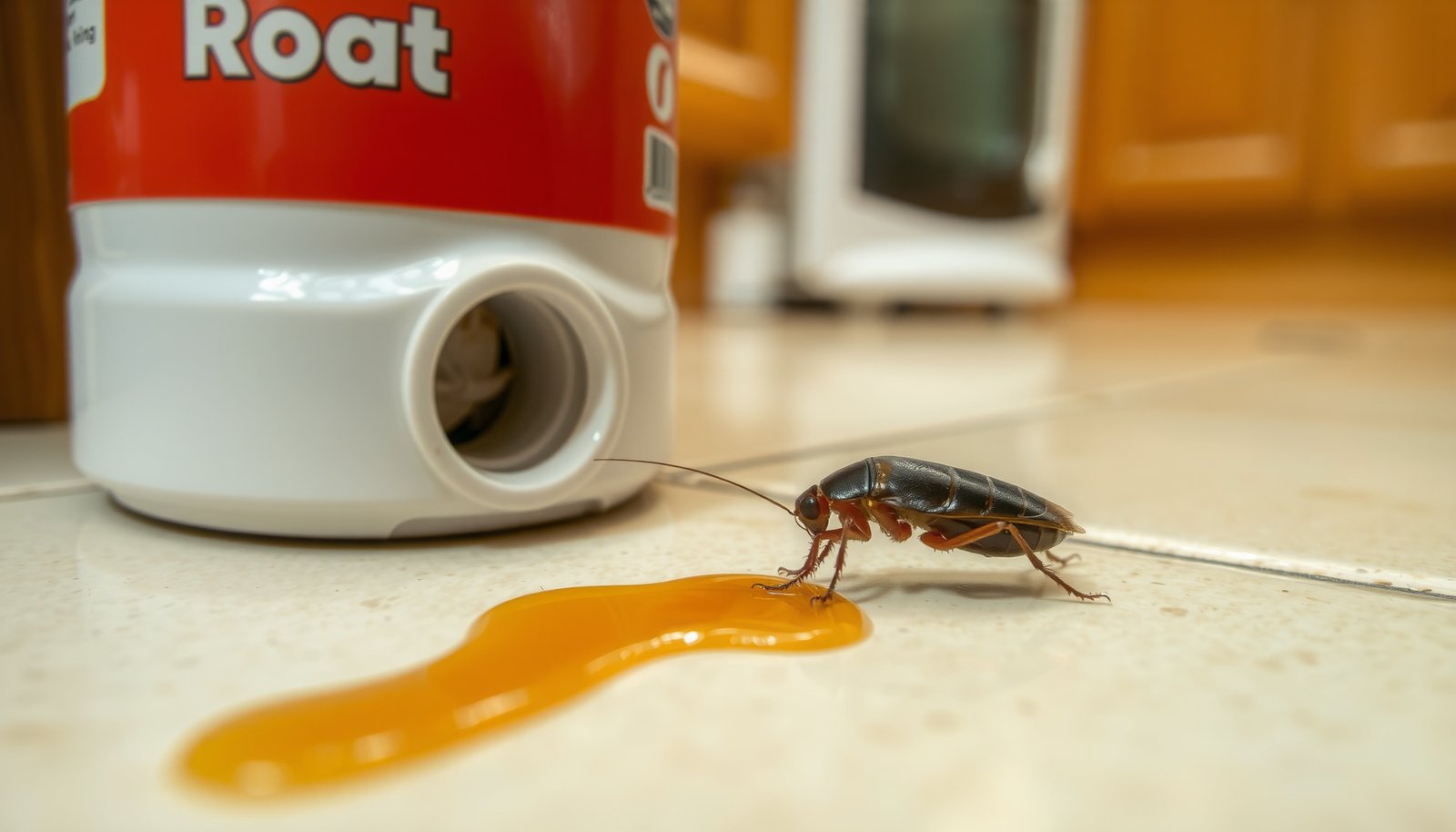
This close-up shows the correct bait dot size and placement positioning inside a cabinet hinge — exactly the kind of tight, dark harborage zone where roaches spend most of their time and where bait has the highest contact rate.
Which Active Ingredients Actually Eliminate Cockroach Colonies?
Not all bait formulas work through the same mechanism, and that matters depending on how severe your infestation is. Indoxacarb is a slow-acting insecticide that takes 24 to 72 hours to kill after ingestion — deliberately slow, because roaches need time to return to harborage sites and contaminate others through contact and cannibalism. Fipronil works similarly, disrupting the central nervous system gradually. Both are significantly more effective for colony elimination than faster-acting pyrethroids, which kill on contact but cause scatter behavior that spreads the infestation to new areas of a home.
Hydramethylnon is a third option found in products like Maxforce FC and some Combat formulas — it works by disrupting energy metabolism in roaches and has solid secondary kill rates. The honest nuance here: in warm, humid climates like Florida or Texas where German cockroach populations are denser and breed faster (a female German cockroach produces 30 to 40 eggs per capsule and can generate up to 8 capsules in a lifetime), you may need to rotate active ingredients every 90 days to prevent resistance buildup. In a northern climate dealing with a smaller infestation, one consistent product used correctly will usually do the job.
| Active Ingredient | Speed of Kill | Best Use Case |
|---|---|---|
| Indoxacarb | 24–72 hours | Heavy infestations, colony elimination |
| Fipronil | 24–48 hours | General household use, German roaches |
| Hydramethylnon | 48–72 hours | Resistance rotation, moderate infestations |
What Are the Best Cockroach Gel Bait Products Available Right Now?
Advion Cockroach Gel Bait (indoxacarb) consistently outperforms most consumer products in independent testing and is the formulation many pest management professionals use — it’s available to consumers in syringe applicators and works on German, American, Australian, and brown-banded cockroaches. Syngenta’s Advion has a food-grade attractant base that stays palatable even to glucose-averse roach populations. Maxforce FC Magnum (fipronil) is a close second and tends to perform especially well in multi-unit housing where roach populations are large and pressure is constant.
For pre-loaded bait stations — the kind you buy in a retail blister pack — Combat Max 12-Month Roach Killing Bait Stations use fipronil and are a reasonable option for light to moderate activity in areas where gel syringes aren’t practical, like inside electrical panels or appliance motor housings. Hot Shot Ultra Liquid Roach Bait takes a different approach entirely: the liquid formula exploits roaches’ biological need for water and works well in dry environments where gel’s moisture content isn’t as attractive. Picture this — an apartment with forced-air heat running all winter making everything bone-dry. In that scenario, liquid bait often outperforms gel because thirsty roaches seek it out faster than a paste-based product.
Pro-Tip: Never apply cockroach gel bait in the same area where you’ve recently used a spray insecticide. Pyrethroid residues from sprays repel roaches for weeks and will cause them to avoid bait stations entirely — you’ll end up with a perfectly good bait that goes completely uneaten. If you’ve sprayed, wait at least 2 to 3 weeks, ventilate thoroughly, and clean surfaces before applying gel.
Where Exactly Should You Place Cockroach Bait Stations for Maximum Contact?
Roaches are thigmotactic — they instinctively prefer tight spaces where their bodies touch surfaces on multiple sides. This is why you never find them in the middle of a room, and why bait placed on an open countertop almost never gets consumed. The highest-contact zones are: the inside edges of cabinet hinges, the gap between the stove and counter, underneath and behind the refrigerator motor housing, inside the void between the sink and the cabinet wall, and along the underside of shelving where it meets the back wall.
For bait stations in syringe form, place dots in a pattern that intercepts roach travel routes — not just at one point. A common mistake is placing all bait near where you see roaches at night, which is typically the feeding zone, not the harborage zone. To learn more about the specific species you’re dealing with (since German and American cockroaches have different harborage preferences), identifying your cockroach species before you place bait will help you target the right zones and get faster results.
- Inside cabinet hinges and corner joints — dark, tight, high-traffic roach corridors where multiple roaches pass every night.
- Under the refrigerator near the compressor motor — warm, dark, and close to food/moisture; one of the most productive bait zones in a kitchen.
- Behind and beneath the stove — grease accumulates here naturally; roaches treat this as both a food source and harborage.
- Under the sink, along pipe penetrations through the wall — the gap where plumbing enters the cabinet wall is a roach highway between units in apartment buildings.
- Inside electrical outlet voids and switch plates — use a small amount here; roaches use wire chases to travel across walls without being seen.
- Bathroom vanity interior, near the drain pipe — especially relevant for German cockroaches in apartments, which breed heavily in bathroom plumbing voids.
How Do You Know Cockroach Bait Is Actually Working — and When Should You Call for Help?
Here’s a counterintuitive sign that bait is working: seeing more roaches in the first few days, not fewer. When a colony is disturbed by the slow die-off of members, surviving roaches increase foraging activity. Dead roaches appearing in open areas (rather than tucked in harborage) is also a positive indicator — it means roaches consumed bait, made it partway back to hiding, and died en route. Bait that disappears from application points within 24 to 48 hours means strong activity and good consumption, which is exactly what you want in weeks one and two.
If you’ve applied bait correctly for three full weeks and seen zero reduction in activity, two things are likely: either there’s an untreated entry point bringing in new roaches (common in multi-unit buildings where neighboring units are infested), or the product has active ingredient resistance in your local population. For a deeper look at how to eliminate a full infestation without professional help, especially if you’re renting, getting rid of cockroaches in an apartment without an exterminator covers the full strategy including exclusion and IGR use alongside bait.
“The single biggest mistake I see homeowners make with gel bait is treating it like a spray — more product, more places, faster results. Cockroach bait works through a cascade effect, and that takes time. Twelve small, targeted placements in true harborage zones will outperform fifty blobs spread across a kitchen every single time. Patience and precision beat volume.”
Dr. Karen Vail, Extension Urban Entomologist, University of Tennessee Institute of Agriculture
Knowing when to escalate is equally important. A moderate German cockroach infestation in a single apartment unit — say, roaches visible nightly in the kitchen but not yet appearing in bedrooms or living areas — is genuinely within DIY range using gel bait plus an insect growth regulator (IGR) like hydroprene or pyriproxyfen to sterilize the population. When roaches are appearing in multiple rooms, in daytime (a sign of severe overcrowding), or throughout a multi-story building, that’s no longer a bait-station problem — that’s a building-wide infestation that requires professional treatment and, in a rental situation, landlord coordination.
Here’s what to watch for that separates a manageable infestation from one that needs escalation:
- Roaches visible during daylight hours — indicates overcrowding so severe that nighttime foraging can’t accommodate all individuals in the colony.
- Roach activity in bedrooms or living rooms — means the infestation has outgrown kitchen/bathroom harborage and expanded through wall voids.
- Egg cases (oothecae) visible in multiple locations — means active breeding across zones, not just a transient population.
- Musty, oily odor in the kitchen — a smell often described as stale or greasy is produced by German cockroach aggregation pheromones and indicates a large, established colony.
- No bait consumption after 72 hours despite confirmed activity — a signal of product aversion or heavy competing food sources that haven’t been eliminated.
One more thing worth saying plainly: gel bait is not a one-time application. Replace bait every 3 months even if it hasn’t been fully consumed — old gel dries out, loses palatability, and can actually repel roaches rather than attract them. Consistent maintenance is what separates a home that stays roach-free from one that has the same infestation six months later. Get the placement right, pick a product with a proven active ingredient, and give it time to work the way it was designed to — through the colony, not just at its edges.
Frequently Asked Questions
how long does it take for cockroach bait stations to work?
Most cockroach bait stations start killing roaches within 24 to 72 hours, but you won’t see the full effect for 1 to 2 weeks. The bait works through a cascade effect — roaches that eat it carry it back to the nest, poisoning others through contact and droppings. Don’t spray insecticides near the bait stations while they’re working or you’ll repel roaches away from them.
where do you place cockroach bait stations in your house?
Place bait stations in the spots roaches travel most — under the sink, along the back edges of cabinet shelves, behind the refrigerator, and in the corners of bathroom vanities. Roaches hug walls and tight spaces, so placement within 6 inches of a corner or crack is way more effective than open floor placement. For a heavy infestation, use 1 station per linear foot in the kitchen and increase placements in any room where you’ve spotted droppings.
are cockroach bait stations safe for pets and kids?
Most gel bait stations contain active ingredients like fipronil, indoxacarb, or hydramethylnon at very low concentrations — typically less than 0.05% — which makes them low-risk when placed correctly. The enclosed station design keeps kids and pets from directly contacting the gel. That said, you should still place them in spots that aren’t easily accessible to toddlers or small dogs, like inside cabinet hinges or under appliances.
do cockroach bait stations work for German roaches?
Yes, and gel bait stations are actually one of the most effective treatments specifically for German cockroaches, which are the small brown roaches most commonly found in kitchens and bathrooms. Products containing indoxacarb or abamectin are especially well-documented against German roach populations. The key is replacing bait every 3 months or sooner if it dries out, since German roaches won’t eat stale or contaminated bait.
why are cockroaches not eating the bait stations?
Roaches avoid bait stations when there are competing food sources nearby, so clean up grease, crumbs, and standing water before placing them. Some bait formulas also lose effectiveness if they dry out or if a local roach population has developed a glucose aversion, which causes them to reject sweet-based baits — switching to a protein-based formula like Advion or Vendetta Plus often solves this. Never place bait near insecticide sprays or strong-smelling cleaners, since both can repel roaches from the area entirely.