
Jumping spiders don’t need to be eliminated — and that’s the part most people get completely wrong. They’re not dangerous, they’re not infesting your home in the way cockroaches or ants do, and every time you smash one on instinct, you’ve just killed something that was actively hunting the pests you actually don’t want inside. That said, “I know they’re harmless” and “I’m okay with one staring at me from the bathroom mirror at 6am” are two very different things, and if you want them out, there’s a right way to do it that doesn’t involve torching your whole house with pesticide.
Why Are Jumping Spiders Getting Inside Your House in the First Place?
Jumping spiders — most commonly the bold jumping spider (Phidippus audax) or the zebra jumping spider (Salticus scenicus) in US homes — don’t wander inside because your house is dirty or because they’re attracted to food scraps. They follow prey. If you have small flies, gnats, ants, or other soft-bodied insects moving through your house, a jumping spider will follow that food source right through whatever gap they can find. That gap is usually smaller than you’d expect — as small as 1/8 inch around window frames, door sweeps, or utility line entry points.
The real driver here is your home’s insect population, not some flaw in the spider itself. A single jumping spider spotted in your kitchen is almost always a scout following prey, not a sign of a spider infestation. They’re solitary hunters with territories, and they don’t nest in groups or breed inside like house spiders do. Understanding that distinction changes how you approach the problem — you stop asking “how do I kill this spider” and start asking “what is it eating, and why is that bug already in here?”
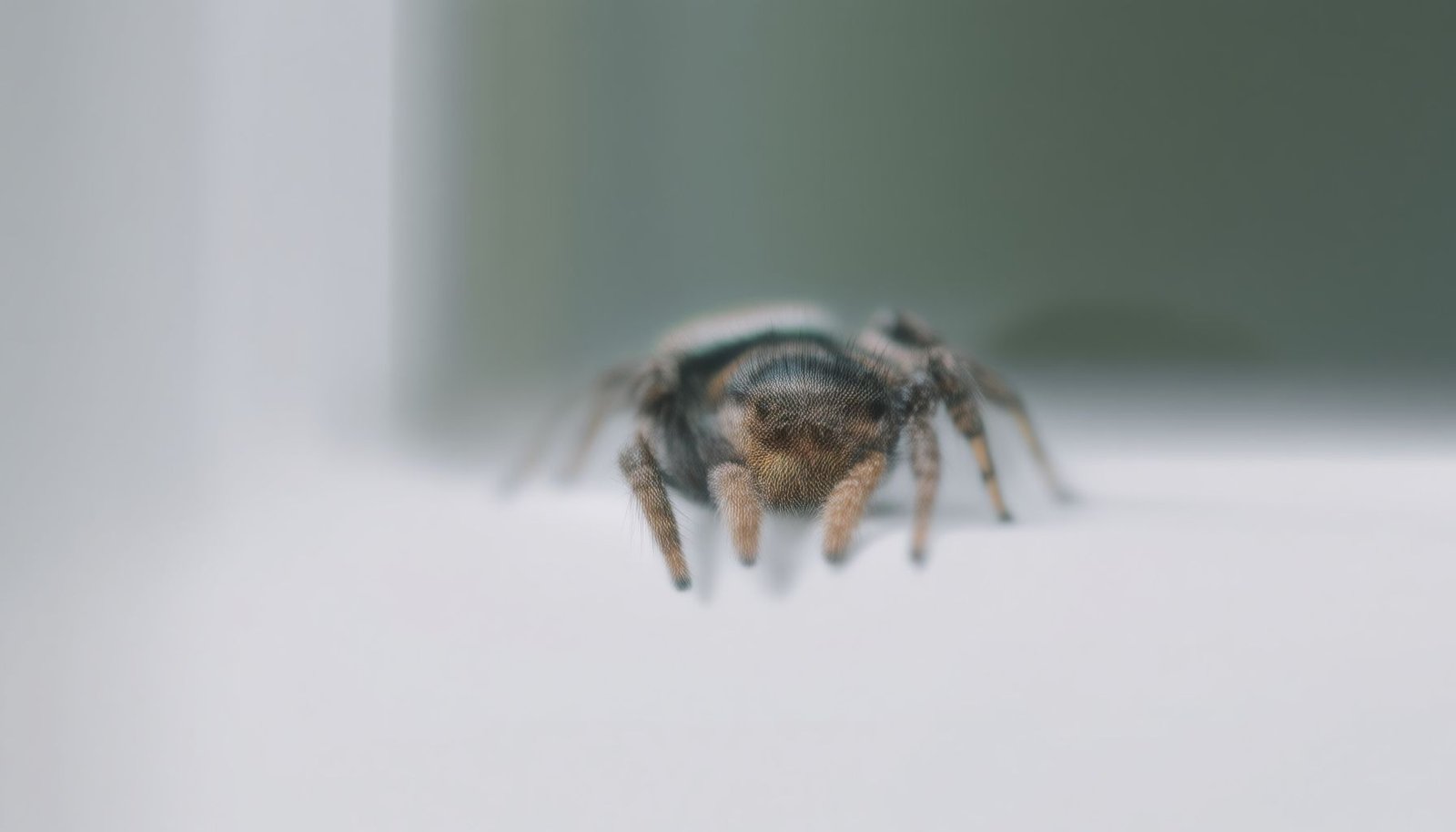
This close-up shows a bold jumping spider near a typical interior window frame — exactly the kind of entry and hunting zone where homeowners encounter them most, and where targeted exclusion efforts will have the most impact.
Are Jumping Spiders Actually Dangerous or Just Unsettling?
Jumping spiders are venomous in the technical sense — every spider is — but their venom poses essentially zero threat to humans. Their fangs are too small to reliably pierce human skin in most cases, and even the rare defensive bite (which only happens if you grab or squeeze one directly) produces nothing worse than mild, localized redness that clears within a few hours. There’s no medically documented case of a jumping spider causing serious injury to a healthy adult in the United States.
What makes people uneasy isn’t the threat — it’s the behavior. Jumping spiders have exceptional eyesight, with four pairs of eyes and a primary set that can see in near-human-level detail. They turn to track movement and will watch you watching them. That direct eye contact, combined with their ability to jump up to 50 times their own body length in an unpredictable direction, makes them feel far more alarming than they are. Knowing that the spider staring at you from the windowsill is probably more curious than aggressive doesn’t always help in the moment, but it should shape your response.
How to Actually Get Rid of Jumping Spiders in the House (Without Pesticide)
The most effective long-term approach targets the reason jumping spiders enter rather than the spiders themselves. Spraying the spider you see doesn’t stop the next one from coming in. Here’s the sequence that actually works, in order of priority:
- Seal physical entry points first. Check window screen edges, door sweeps, utility penetrations (HVAC lines, cable wires), and the gap beneath exterior doors. Weatherstripping and caulk handle most of this. A jumping spider needs only a 1/8-inch gap, so don’t assume a “small” crack is too tight.
- Reduce the prey population inside. Jumping spiders follow insects. If you’re seeing them in the kitchen, you likely have a fungus gnat, fruit fly, or small ant problem you haven’t fully noticed yet. Eliminating that food source removes the reason spiders enter in the first place.
- Reduce outdoor lighting near entry points. Exterior lights attract moths, flies, and gnats at night — which in turn attract jumping spiders hunting near your doors and windows. Switching to yellow-spectrum or LED bulbs reduces this attraction significantly.
- Clear vegetation and clutter directly against the structure. Shrubs, woodpiles, and leaf debris pressed against your foundation create a hunting ground and transit zone. Moving them 12–18 inches away from the house wall breaks that highway.
- Catch and release the ones you find inside. A cup and a piece of cardboard is genuinely the fastest solution for an individual spider. Jumping spiders are slow to react when approached calmly from the side. Slide the cup over them, slip the card underneath, and release them outside — away from entry points.
Picture this: you’ve found three jumping spiders in your living room over two weeks. You spray the third one and feel like you’ve solved it. But there’s a small gap behind the baseboard heater where your window unit enters the wall, and every evening the porch light is drawing in a halo of gnats. You haven’t changed either of those things. Spider number four will be along shortly. The entry point and the food source are the actual problem — the spider is just a symptom.
Pro-Tip: Before reaching for a spray, check whether the jumping spider is near a window or light source where insects congregate. If it is, the fastest fix is dealing with that insect attractant — the spider will move on within 24–48 hours once its hunting ground goes dry.
When Does Chemical Treatment Make Sense for Jumping Spiders?
Here’s the honest nuance that most articles skip: chemical treatment for jumping spiders rarely makes sense for a single individual or a handful of sightings, but it becomes more relevant when you’re dealing with a high-density situation — a garage, basement, or attic where dozens of spiders have established themselves over a season. Even then, the spider isn’t really the target; any residual spray applied along baseboards and entry points is working by killing the insects that attract them.
If you do decide to use a perimeter spray or contact insecticide, pyrethrins and pyrethroids (like cypermethrin or lambda-cyhalothrin) are the active ingredients that work on spiders. Apply them along the exterior foundation, window sills, and door frames — not as a broadcast spray inside. Spiders aren’t as susceptible to residual insecticides as insects are because they don’t groom themselves the same way and their feet have limited contact with treated surfaces. Spraying a jumping spider directly knocks it down fast, but a residual treatment on a flat wall surface where spiders simply walk across is much less reliable than the same treatment applied to a crack or crevice they must pass through.
“Most homeowners reach for the spray can when they see a jumping spider, but they’re treating the wrong variable. The spider’s presence is diagnostic — it tells you there’s an insect food source nearby that you haven’t identified yet. Address that population, seal the entry points, and the jumping spider problem resolves itself in the majority of cases without any chemical intervention at all.”
Dr. Marcus Ellery, Ph.D. Entomology, University Extension Specialist in Urban Pest Management
What Actually Keeps Jumping Spiders Out Long-Term?
Diatomaceous earth applied in thin layers along baseboards, window tracks, and door thresholds works as a passive, non-toxic deterrent — it damages the exoskeleton of the insects jumping spiders prey on, cutting off the food supply at the point of entry. It doesn’t reliably harm jumping spiders directly, but it’s not meant to. You’re cutting off the food chain one link below the spider. Best Pantry Moth Pheromone Traps Compared by Brand is a good example of how pheromone-based tools work on the insect level to stop a pest cycle before it spirals — the same thinking applies here when you’re trying to break the insect-spider cycle inside your home.
Essential oil sprays — particularly peppermint, tea tree, and vinegar-based formulas — get mentioned constantly in spider articles, and the honest answer is that they work modestly and temporarily at best. Jumping spiders detect chemical signals through sensory organs on their feet, so a strong-smelling surface may discourage them from lingering in a specific spot. But the effect dissipates within a day or two, and if the underlying prey population is still present, the spider’s hunger overrides the deterrent. Use these as a supplement to physical exclusion, not a substitute for it.
| Method | Effectiveness Against Jumping Spiders | Duration | Best Use Case |
|---|---|---|---|
| Physical exclusion (caulk, weatherstrip) | High | Permanent (until materials degrade) | Any home, first step always |
| Prey insect reduction (traps, spray) | High | Ongoing maintenance | Homes with visible gnat/fly activity |
| Perimeter residual spray (pyrethroid) | Moderate | 4–8 weeks per application | High-density garage or basement situations |
| Essential oil sprays | Low–Moderate | 24–72 hours | Short-term spot deterrent only |
One detail that almost never gets mentioned: jumping spiders are strongly visual hunters and prefer well-lit, open areas where they can spot prey from a distance. Cluttered shelving units, dusty corners, and stacked boxes in garages provide terrible hunting conditions for them — but excellent hiding conditions. Ironically, if you see a jumping spider in a bright, open spot on your wall, that’s actually a sign it’s actively hunting and healthy. One found stumbling in a dim corner or moving slowly may be dying or disoriented. The behavior tells you something about what’s driving the population in that space. Monitoring subtle differences like this — the kind of situational reading that requires attention rather than just a spray schedule — is what separates effective long-term pest management from a cycle of perpetual reaction.
Consistent home monitoring is an underrated part of keeping any pest population under control. The same attentiveness that helps you notice a jumping spider early is the same attentiveness that catches a more serious problem before it gets expensive — in the same way that tools like Best Termite Detection Devices for Early Warning work best when you’re already in the habit of checking rather than waiting for visible damage to appear.
Here’s what long-term jumping spider prevention actually looks like broken down by area of the home:
- Windows and window sills: Replace torn screens, caulk the gap between frame and wall, and keep the sill clean of dead insects (which attract other insects, which attract spiders).
- Exterior doors: Install door sweeps on every exterior door. A gap of even 1/4 inch at the base is a usable entry for jumping spiders and the insects they follow.
- Garage and basement: These are the highest-density zones. Dehumidify to reduce the fungus gnats and small flies that thrive in damp, dark conditions. Sticky glue boards along the floor perimeter catch both prey insects and wandering spiders and give you an accurate count of what’s active.
- Outdoor perimeter: Trim vegetation back from the structure, keep mulch layers under 2 inches deep near the foundation, and relocate firewood storage at least 20 feet from the house wall.
- Interior lighting: Replace white or blue-spectrum bulbs near exterior entry points with warm-yellow LED equivalents. This alone can meaningfully reduce nighttime insect congregation at doors and windows within the first week.
The counterintuitive reality of jumping spiders is this: a home that has no jumping spiders at all indoors may not be a healthier home — it may just be a home where no one has noticed the ones quietly doing their job in the corners. If you want them gone because you simply don’t want spiders in the house, that’s a completely reasonable preference and everything above will get you there. But if you’re expecting their presence to mean something is wrong, you’re likely pointing your energy in the wrong direction. Fix the gaps, manage the insects that draw them in, and the spiders will have no reason to be there — because you’ll have eliminated the reason they came in the first place.
Frequently Asked Questions
What smell do jumping spiders hate?
Jumping spiders strongly dislike peppermint oil, vinegar, and citrus scents. You can mix 15–20 drops of peppermint essential oil with water in a spray bottle and apply it along windowsills, door frames, and corners where you’ve spotted them. Reapply every 3–5 days for the best results.
Are jumping spiders in the house dangerous to humans?
Jumping spiders aren’t considered dangerous — they’re not venomous in any medically significant way for healthy adults. They can technically bite if handled roughly, but reactions are usually minor, like a small red bump that clears up within a day or two. They’re actually beneficial since they eat other insects like flies, mosquitoes, and roaches.
Why do I suddenly have so many jumping spiders in my house?
A sudden spike usually means there’s an insect problem drawing them in — jumping spiders follow their food source, so if you’ve got flies, gnats, or other small bugs indoors, spiders will follow. They also move inside when outdoor temperatures drop in fall or when there are gaps around windows, doors, or utility lines. Sealing entry points and reducing indoor insects typically brings the numbers down fast.
What is the most effective way to get rid of jumping spiders in the house?
The most effective approach combines a few steps: seal cracks and gaps larger than 1/16 of an inch around windows, doors, and pipes, reduce clutter where they hide, and use a residual insecticide spray like one containing cypermethrin or deltamethrin along baseboards and entry points. Sticky glue traps placed in corners can also help you monitor and catch them without chemicals. Consistency matters — treat every 4–6 weeks until you stop seeing activity.
How do I keep jumping spiders from coming back after I remove them?
Long-term prevention comes down to cutting off what attracts them in the first place. Keep outdoor lighting to a minimum near doors and windows since lights attract the insects jumping spiders feed on, and trim back shrubs or vegetation within 2 feet of your home’s exterior. Inside, vacuum regularly along baseboards and in corners, and fix any window screens with tears larger than a few millimeters.
Disclaimer: This article is for informational purposes only and isn’t a substitute for professional pest control advice. Always read and follow the product label instructions exactly — label directions are legally binding and vary by brand and active ingredient. Keep all pesticides, baits and traps away from children and pets, ventilate treated areas as directed, and consider calling a licensed pest control professional if an infestation is large, recurring, or involves a structural pest like termites or carpenter ants.