
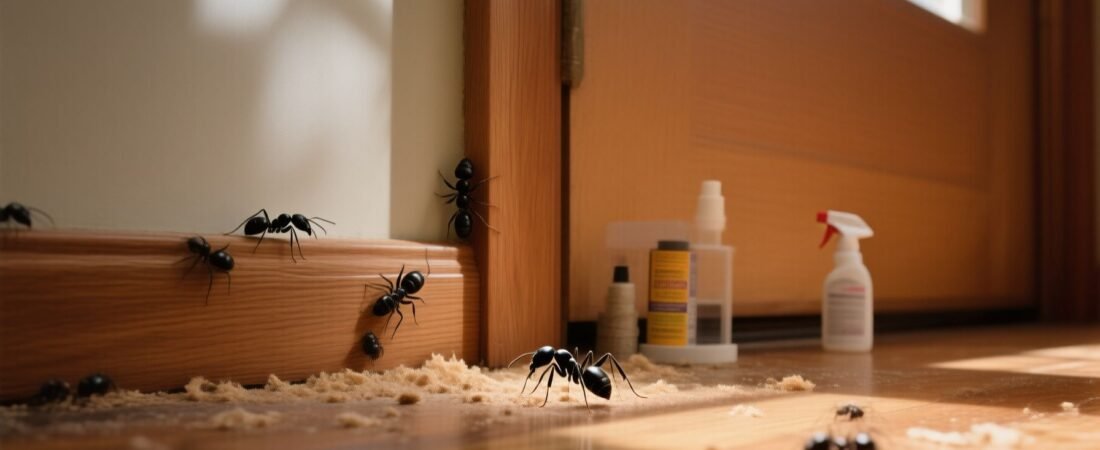
Killing the ants you can see is almost completely useless. That’s the core problem with most DIY carpenter ant approaches — people spray the foragers trailing across the kitchen floor and feel like they’ve handled it, while a satellite colony of several hundred ants quietly keeps chewing through a wall stud six feet away. The ants you see are scouts and workers from a colony that may contain 3,000 individuals or more, and those visible insects represent maybe 10–15% of the total population. Getting rid of carpenter ants without an exterminator is absolutely doable, but only if you stop targeting the symptom and start targeting the structure of the infestation itself.
Why Killing Carpenter Ants on Contact Doesn’t Actually Fix the Problem
Carpenter ants don’t eat wood — they excavate it. That distinction matters more than most people realize, because it changes what you’re actually dealing with. A colony isn’t looking for food inside your wall; it’s building galleries and nurseries, pushing out sawdust-like frass as it goes. The moisture that attracted them in the first place is still there whether you spray the visible workers or not.
Contact sprays like permethrin or bifenthrin will absolutely kill individual ants on touch. But the queen — the only ant that actually matters for colony survival — is buried deep inside a parent nest that’s often located outside your home entirely, in a rotting log or tree stump within 300 feet of your foundation. Killing foragers doesn’t reach her. The colony simply produces more workers within days and resumes normal operations.
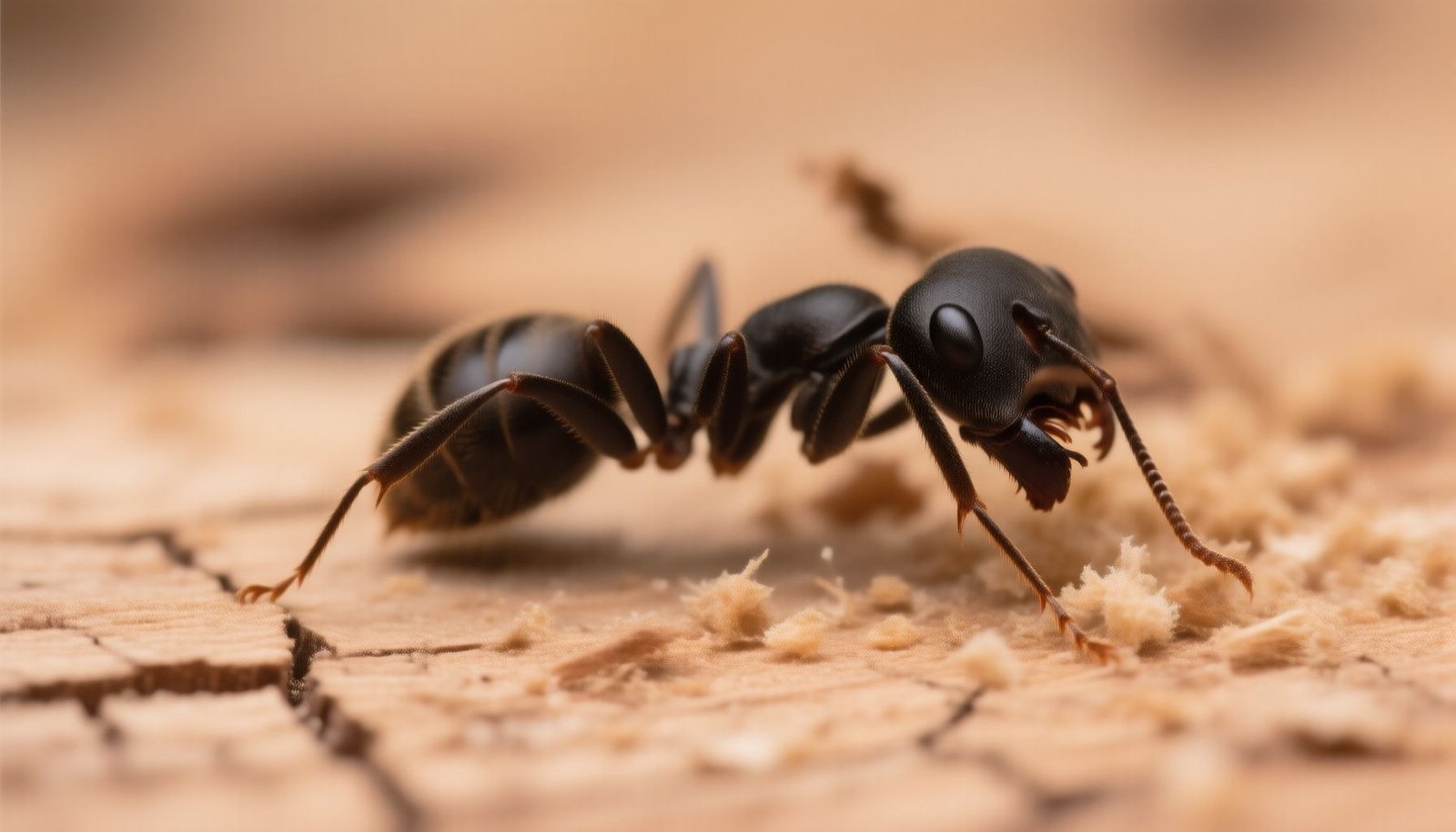
This close-up shows the coarse frass and hollowed gallery channels that carpenter ants leave behind — noticeably different from termite damage, which looks more layered and packed with mud, and recognizing the difference will help you confirm you’re treating the right pest before spending a dime.
How to Find the Satellite Nest Inside Your Home (Before Treating Anything)
Picture this: you’ve been finding ants in your bathroom every morning for three weeks. You assume they’re coming in from outside each time, but what’s actually happening is there’s already a satellite colony living inside your bathroom wall, feeding on moisture from a slow pipe leak behind the vanity. This is more common than most people expect, and it’s the reason treatment fails when people don’t locate the nest first.
Satellite nests don’t need a queen — they’re worker-only outposts that extend the reach of the parent colony. They prefer wood that’s already softened by moisture: window frames with failed caulk, roof eaves with ice dam damage, hollow-core doors in damp basements. Here’s how to track one down before applying a single product:
- Follow the forager trail at night. Carpenter ants are most active between 10pm and 2am. Turn off overhead lights, use a red-filtered flashlight (they’re less reactive to red light), and watch where the trail leads — specifically where ants disappear into a wall, baseboard gap, or ceiling void.
- Listen for faint rustling. Put your ear against suspect wall panels during quiet hours. Active colonies produce a dry, crackling sound — like someone slowly crumpling cellophane — from the workers chewing and moving inside galleries.
- Look for frass piles. Carpenter ant frass is coarse and fibrous, resembling pencil shavings mixed with insect body parts. It accumulates below kick-out holes — small oval openings the colony uses to expel debris. Check along baseboards, window sills, and below attic joists.
- Probe soft wood with a screwdriver. Anywhere wood sounds hollow or feels spongy when tapped is worth a closer look. You’re not necessarily looking for ants — you’re looking for the moisture damage that invited them.
- Check exterior junction points. Where wood siding meets a concrete foundation, where deck ledger boards attach to the house, where utility lines enter through exterior walls — these are the high-probability entry zones for both foragers and the initial infestation path.
Which DIY Products Actually Work on Carpenter Ants — and How to Use Them Correctly
Not all ant products are created equal for this species. Carpenter ants are notoriously bait-averse compared to odorous house ants or pavement ants — workers are protein feeders early in the season and switch to sugar-based foods later in summer, which means the wrong bait at the wrong time gets completely ignored. Slow-acting gel baits work well when matched to the colony’s current nutritional preference, but you also need a residual product to break the forager-to-nest connection.
Here’s a quick comparison of the product types that consistently produce results versus those that mostly just feel productive:
| Product Type | How It Works | Best Use Case | Honest Limitation |
|---|---|---|---|
| Slow-acting gel bait (protein or sugar) | Workers carry toxicant back to nest; kills over 3–7 days | Active forager trails indoors | Ignored if bait type doesn’t match colony’s current food preference |
| Borate dust (e.g., Tim-bor, disodium octaborate) | Absorbed through contact and grooming; disrupts energy metabolism | Wall voids, attic timbers, gallery areas | Requires access to void; ineffective on exterior surfaces |
| Pyrethroid residual spray (indoor) | Kills on contact; leaves residual film on surfaces for weeks | Entry points, baseboards, perimeter | Repels ants away from bait — do not use simultaneously with bait |
| Perimeter granule bait (e.g., Advance Carpenter Ant Bait) | Protein-based; targets exterior parent colony foragers | Soil around foundation, mulch beds, tree stumps | Requires consistent reapplication; moisture degrades bait quickly |
Pro-Tip: Never apply a contact-kill spray and a slow-acting bait at the same time in the same area. Pyrethroids are repellent — ants detect the chemical boundary and avoid it, which means they’ll also avoid any bait you’ve placed nearby. Run bait-only for 1–2 weeks first, then follow up with a residual spray along entry points once the bait feeding slows down.
Does Treating the Outside Actually Matter More Than What You Do Inside?
Yes — and this is the part most indoor-focused treatments skip entirely. The parent colony lives outside. Until you address what’s happening at the exterior, you’re essentially trying to drain a bathtub without turning off the faucet. A mature carpenter ant colony can produce winged reproductives (alates) that swarm in early spring to establish new nests, so a single neglected parent colony in a landscape timber can reseed your home’s walls year after year.
“The biggest mistake homeowners make is treating carpenter ants as an indoor problem. In the vast majority of cases, the primary nest is in the yard — a stump, a dying tree, a buried log from old construction — and indoor satellite nests are just extensions of that outdoor population. Eliminate the moisture source and the exterior harborage, and the indoor activity typically collapses within a few weeks without any interior chemical application at all.”
Dr. Marcus Ellery, Board-Certified Entomologist and University Extension Pest Management Specialist
Exterior treatment priorities break down into two categories: harborage removal and chemical barrier. On the harborage side, remove or treat any rotting wood within 100 feet of the foundation — old stumps are the single biggest offender. Firewood stacked against the house is another common culprit; a stack left against siding over winter can harbor thousands of workers by spring. On the chemical side, a granule bait scattered around the perimeter (especially near tree bases, mulch beds, and along fence lines) interrupts foragers before they reach the structure.
What to Fix Structurally So Carpenter Ants Don’t Come Back
Treatment without structural correction is a short-term fix. Carpenter ants don’t randomly select a home — they’re drawn by two specific signals: moisture and existing wood softness. If the conditions that attracted the original colony persist, new scouts will locate the same entry points within a season or two. The structural fixes aren’t complicated, but they do require actually doing them rather than just reading about them.
Here’s what to address in the right order:
- Fix active moisture sources first. Leaking gutters, condensation on pipes, failed caulk around windows, and poorly ventilated crawl spaces are the top four moisture contributors that make wood hospitable to carpenter ants. No product will hold long-term if wet wood remains in the wall.
- Seal entry points with a non-repellent material. Use copper mesh or steel wool packed into gaps, followed by expanding foam. Silicone caulk alone works for small cracks at window frames and door thresholds — focus anywhere a utility line, pipe, or conduit enters an exterior wall.
- Trim tree branches that touch or overhang the roof. Carpenter ants are excellent climbers and will use canopy contact as a bridge to reach soffit and fascia boards — the same strategy is used by roof rats, which is worth knowing if you’re also dealing with sounds in your attic. Similar to how getting rid of wasps in the attic without chemicals requires cutting off the access point first, carpenter ant control depends on removing the physical highway before worrying about the insects themselves.
- Replace or treat damaged wood. If carpenter ants have been active in a specific area for more than one season, that wood is structurally weakened. Borate-based wood preservatives (like Timbor or Shell-Guard) can be applied to damaged but salvageable timbers and will deter future colonization while also killing any remaining ants that contact the treated surface.
- Improve ventilation in crawl spaces and attics. Relative humidity above 70% in a wood-framed crawl space is an open invitation. A vapor barrier on the crawl space floor combined with adequate cross-ventilation or a dehumidifier will dry out the environment faster than any pesticide addresses the underlying draw.
One honest nuance worth acknowledging: in older homes with balloon-frame construction or in regions with consistently high humidity — the Gulf Coast, Pacific Northwest, or anywhere that sees frequent freeze-thaw cycles — structural moisture control is genuinely harder and the window for successful DIY treatment is narrower. If you’re dealing with a multi-story home where you can’t access the wall voids, or if you’ve already done the structural corrections and the ants are still active after 6–8 weeks of proper bait treatment, that’s the point where a professional with a drill-and-dust injection rig brings value that’s difficult to replicate on your own.
The same logic applies to any pest that nests inside structural elements rather than on surfaces — it’s why deep-harborage problems like bed bugs in an upholstered couch require a treatment strategy built around reaching the actual harborage, not just the visible pest. Carpenter ants are no different: the infestation lives where you can’t easily see or reach it, and treatment has to be designed around that reality from the start.
Get the moisture fixed, locate and treat both the satellite nest indoors and the parent colony outdoors, use bait before you use spray, and close the structural gaps that gave them access. Do those things in that order, and you don’t need an exterminator for the majority of carpenter ant situations. The ants aren’t the real problem — they’re just the indicator that something in the structure is already failing, and fixing that is what actually makes them leave for good.
Frequently Asked Questions
What kills carpenter ants instantly?
Diatomaceous earth and boric acid are two of the most effective DIY options — boric acid kills carpenter ants within 24 to 48 hours after they carry it back to the nest. For a faster knockdown, you can spray carpenter ants directly with a solution of dish soap and water, which suffocates them on contact. Just keep in mind that killing visible ants won’t eliminate the colony unless you target the nest.
How do I find a carpenter ant nest inside my house?
Follow the ant trails, especially at night when carpenter ants are most active, and listen for a faint rustling or crinkling sound inside walls — that’s the ants excavating wood. Common indoor nesting spots include window frames, door frames, crawl spaces, and any wood that’s been softened by moisture damage. Tap on suspected areas and listen for a hollow sound, which can indicate a gallery carved out inside the wood.
How long does it take to get rid of carpenter ants without an exterminator?
Most DIY treatments take anywhere from 2 to 8 weeks to fully eliminate a carpenter ant colony, depending on how large the infestation is and whether you can locate the nest. Bait stations tend to work more slowly than direct nest treatments, but they’re often more thorough because forager ants bring the poison back to the queen. Consistency matters — reapply treatments every 5 to 7 days until you stop seeing activity.
What do carpenter ants hate the most?
Carpenter ants strongly avoid essential oils like peppermint, tea tree, and clove oil, which disrupt their scent trails and act as a natural deterrent. They also hate diatomaceous earth, which damages their exoskeletons and dehydrates them when they walk through it. While these repellents help keep ants away from treated areas, they won’t wipe out an existing colony on their own — you’ll still need a bait or direct nest treatment to fully get rid of them.
When should I call an exterminator for carpenter ants instead of doing it myself?
If you’ve tried DIY treatments for 6 to 8 weeks with no reduction in ant activity, it’s time to call a professional. You should also skip the DIY route if you’re seeing large numbers of winged carpenter ants indoors, which signals a mature colony that’s likely been established for at least 3 to 6 years. Any signs of serious structural wood damage — like sagging floors, soft spots, or visible galleries — also warrant a professional inspection before the problem gets worse.
Disclaimer: This article is for informational purposes only and isn’t a substitute for professional pest control advice. Always read and follow the product label instructions exactly — label directions are legally binding and vary by brand and active ingredient. Keep all pesticides, baits and traps away from children and pets, ventilate treated areas as directed, and consider calling a licensed pest control professional if an infestation is large, recurring, or involves a structural pest like termites or carpenter ants.