
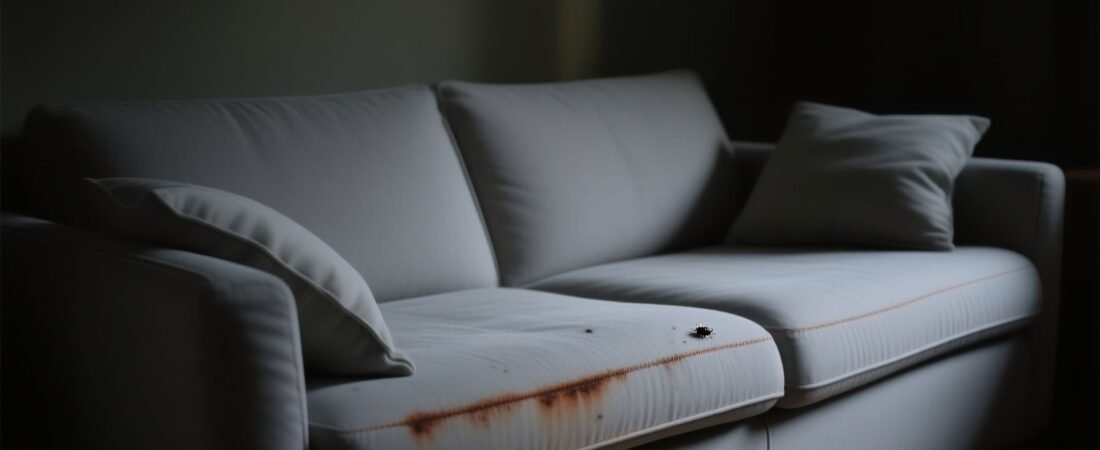
Throwing out your couch won’t solve a bed bug problem. That’s the first thing most people get wrong — and it’s also how a localized infestation in one piece of furniture turns into a whole-room problem when bugs hitchhike to the new couch on their way out the door.
Here’s what actually matters: bed bugs in upholstered furniture are treatable in place, without a dumpster and without a fumigation tent, if you understand how they use the furniture as a habitat. The couch isn’t just where they hide. It’s where they feed, molt, breed, and lay eggs — sometimes for months before you notice a single bite. Female bed bugs lay 1 to 5 eggs per day and up to 500 over a lifetime, and those eggs are the size of a pinhead. By the time you spot one adult bug on a cushion, there’s almost certainly a population living in the frame you can’t see.
This article is specifically about couches, sectionals, recliners, and other upholstered pieces — not mattresses, not the whole room. The approach is different, the access points are different, and the mistakes people make are different. Start here.
Why Does Your Couch Have Bed Bugs When Your Bed Doesn’t?
Picture this: you start waking up with itchy red welts but you’ve checked your mattress seams three times and found nothing. You strip the bed, you flip the box spring, you run a credit card along every seam — clean. The bites keep coming. Then one afternoon you notice a small rust-colored smear on the back cushion of your couch, the one you fall asleep on every night watching TV. That’s where they’ve been the whole time.
Bed bugs follow heat and carbon dioxide, not the word “bed.” Any spot where a human sits or sleeps for more than a few hours is prime real estate. Couches — especially sectionals and recliners with deep frames, wooden joints, and layered fabric — are actually harder to inspect than a mattress and offer more undisturbed harborage. A couch cushion cover has a zipper seam. The dust cover underneath the frame has staples. The wooden frame has gaps at every corner joint. All of it is usable hiding space that most homeowners never think to check.
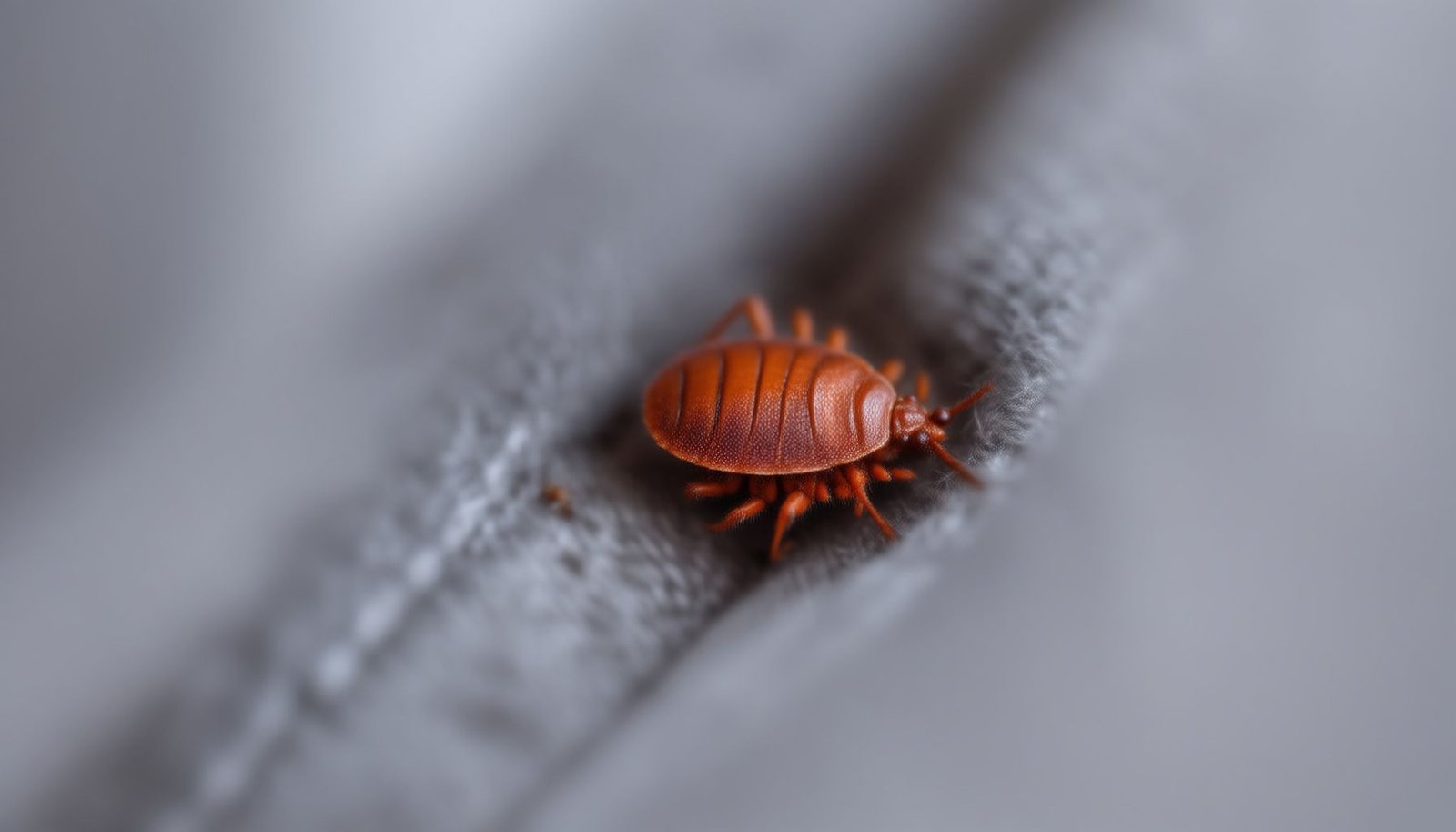
This close-up shows bed bugs and their shed skins clustered in a couch frame joint — the kind of spot that looks empty to the naked eye during a quick visual check but harbors dozens of bugs at various life stages.
How to Inspect a Couch for Bed Bugs the Right Way
A flashlight and a credit card are your two most important tools. Use the card to drag slowly along seams, piping, and zipper edges — it dislodges eggs and bugs hiding in tight folds where your eyes can’t see straight on. You’re looking for four things: live bugs (apple-seed shaped, flat, reddish-brown), molted skins (translucent husks), eggs (white, about 1mm, often in clusters), and fecal spots (dark brown or black ink-dot smears that don’t wipe off cleanly).
Don’t stop at the cushions. Remove every removable cushion. Flip the couch completely upside down and inspect the dust cover — that thin black or gray fabric stapled to the bottom. Cut it away or peel back the staples; the wooden frame underneath is often the heaviest infestation site. Check every corner block, every wooden joint, and the area around any recliner mechanism if you have one. Bed bugs can survive over 300 days without feeding, so even a couch that’s been unused for months can still be actively infested.
What Actually Works to Kill Bed Bugs in Upholstered Furniture
Most people reach for a spray first. Sprays are not useless, but they’re the last step, not the first — and using the wrong one actually makes things worse by triggering bed bugs to scatter deeper into the frame or into adjacent walls. The hierarchy of effective treatments for a couch goes like this:
- Steam first, everywhere you can reach. A clothes steamer or a dedicated bed bug steamer applied slowly (no faster than 1 inch per second) hits bugs and eggs at the contact point with 212°F heat. Bed bugs die at 122°F — steam far exceeds that. Work it into every seam, under every cushion, and directly into frame gaps using a narrow attachment.
- Vacuum immediately after steaming. Use a crevice tool along every seam and joint. Seal the vacuum bag in a plastic bag and take it directly outside. This removes dead bugs, shed skins, and eggs that steaming may have killed but not eliminated from the surface.
- Apply a residual contact spray to the wooden frame only. Products containing pyrethroids (like deltamethrin) or a non-repellent like chlorfenapyr can be applied to the bare wood interior with a crack-and-crevice tip. Do not spray fabric — it won’t absorb effectively and can create fumes.
- Dust exposed wood surfaces with CimeXa or diatomaceous earth. CimeXa (amorphous silica gel) is faster-acting than food-grade DE and lasts longer once applied. A light puff into frame joints and under the dust cover creates a kill zone that stays active for months.
- Encase what you can. Cushion covers that zip fully closed can be laundered on high heat (at least 30 minutes in a dryer at high setting kills all life stages) and then placed in sealed plastic bags or encasements while treatment is ongoing. This eliminates part of the habitat immediately.
- Repeat the entire process in 7–10 days. Eggs are the hardest to kill — steam and most sprays don’t penetrate them reliably. The second treatment catches newly hatched nymphs before they reach reproductive age.
One thing worth noting: the effectiveness of DIY treatment depends heavily on how far the infestation has spread. If you’ve confirmed bed bugs in the couch only and the adjacent walls, baseboards, and bedroom show no signs, localized treatment works well. If there’s evidence in multiple rooms, you’re looking at a whole-structure problem and the couch treatment is only one piece of it.
The Products Most People Use Wrong on Furniture
Foggers — “bug bombs” — are one of the most common mistakes people make with couch infestations. The aerosol mist from a fogger doesn’t penetrate into upholstery seams, cushion cores, or frame joints. It lands on exposed surfaces, where bed bugs almost never rest, and the repellent effect of the chemicals causes bugs to retreat even deeper into harborage. This is the same reason Best Roach Fogger Alternatives for Apartments recommends skipping foggers entirely for enclosed-space pests — the chemistry works against you when bugs hide in voids.
Essential oil sprays are the other category worth addressing honestly. Clove oil, peppermint, and tea tree oil have some repellent effect in direct contact lab studies, but they don’t kill at realistic application rates and they evaporate quickly. They’re not a treatment. Using them feels productive but buys time for the infestation to grow. If you want a non-chemical option that actually kills, steam is the answer — it works by physics, not chemistry, so there’s no resistance risk.
“Upholstered furniture is one of the most underestimated bed bug harborage sites in residential settings. The wooden frame alone can harbor hundreds of individuals at various life stages, and because the fabric exterior looks intact, homeowners often treat only the surface and miss the infestation entirely. Any effective treatment has to account for what’s inside the frame, not just what’s visible.”
Dr. Renata Hollis, Board-Certified Entomologist and Bed Bug Research Specialist, University Extension Pest Management Program
Should You Throw the Couch Out — or Can You Save It?
This is the question most people are actually asking when they land on an article like this, and the honest answer is: it depends on the construction of the couch and the severity of what you find inside the frame. Here’s a realistic breakdown of what to consider:
| Couch Type | DIY Treatment Feasibility | Notes |
|---|---|---|
| Fabric sofa with removable cushions and accessible frame | High — treat and keep | Steam + CimeXa + residual spray is effective if infestation is localized |
| Deep-tufted or heavily padded sectional | Moderate — treat with caution | Tufting creates hidden void spaces that are hard to reach with steam; may need professional heat treatment |
| Recliner with mechanical components | Low to moderate | Mechanism housing is nearly impossible to treat manually; professional heat treatment strongly recommended |
| Particle board frame (older budget furniture) | Low — consider disposal | Particle board absorbs and holds bugs in ways solid wood doesn’t; frame often can’t be effectively treated |
If you do decide to discard the couch, don’t carry it through the house without wrapping it first. Use contractor-grade plastic sheeting or mattress bags to wrap the entire piece before moving it. Spray-paint or mark it clearly so no one else picks it up from the curb — discarded infested furniture is one of the top ways bed bugs spread to new apartments. Cut the fabric with a utility knife before putting it out if you can, so it’s clearly not reusable. The same principle applies to any pest-related disposal: containment during removal matters as much as the removal itself, similar to how proper sealing technique matters when you’re dealing with entry points — something covered in detail in Best Products to Seal Gaps Against Mice: Steel Wool vs Foam for a different pest but with the same containment logic.
Pro-Tip: Before any spray or dust treatment, place bed bug interceptor cups under all four legs of the couch. These trap bugs trying to flee the furniture during treatment and give you a real-time read on whether the population is moving — if you’re catching bugs in the interceptors three days after treatment, the infestation is larger than just the couch frame.
The counterintuitive part of couch treatment that most articles skip entirely: the couch doesn’t have to look infested to be heavily infested. Bed bugs are cryptic — they spend roughly 90% of their lives motionless in harborage, only emerging for 5 to 10 minutes to feed. A couch that shows only a few fecal spots and no live bugs on casual inspection can easily contain dozens of adults and hundreds of eggs inside the frame. This is why visual inspection alone is not a treatment decision — only a thorough physical inspection of the frame interior gives you an accurate picture of what you’re dealing with.
The bugs living in the back of your couch frame right now are not waiting for you to decide. Start with steam today, follow up in 10 days, and use interceptors to track whether your treatment is working. If after two full treatment cycles you’re still finding live bugs or fresh fecal spotting, that’s the point where professional heat treatment — not another round of spraying — is the right call.
Bed bug populations in furniture can be eliminated with patience and the right sequence of tools. The ones that survive are almost always the result of skipping a step — usually the frame, usually the second treatment, usually the interceptors that would have told you something was still there.
Frequently Asked Questions
can bed bugs live in a couch?
Yes, couches are one of the most common places bed bugs hide besides mattresses. They’ll nest in seams, cushion folds, the dust cover underneath, and inside any cracks in the frame. If you’re spending several hours a night on your couch, it’s warm, dark, and close to a food source — exactly what bed bugs want.
how do I know if my couch has bed bugs?
Pull off the cushions and inspect the seams with a flashlight — you’re looking for live bugs (about 1/4 inch long, reddish-brown), tiny white eggs, dark rust-colored fecal spots, or shed skins. Check the underside of the couch and along the wooden frame joints too. If you’re waking up with itchy bites in clusters of 3 or more after sitting on the couch, that’s another strong sign.
can I treat bed bugs in a couch myself or do I need an exterminator?
DIY treatment can work for a mild infestation if you catch it early. A combination of vacuuming every seam and surface, steaming at 160°F or higher, and applying a residual bed bug spray rated for upholstery can knock down the population. If the infestation has spread to multiple rooms or the couch has deep foam cushions that heat can’t penetrate, a professional using heat treatment or chemical treatment is your better bet.
should I throw out my couch if it has bed bugs?
Not necessarily — throwing it out is often a waste of money and can actually spread bed bugs to other parts of your home or a neighbor’s unit if you’re not careful. Most couches can be treated successfully with steam, vacuuming, and targeted insecticides. The exception is a heavily infested couch with thick foam that’s nearly impossible to treat thoroughly, or one that’s already falling apart.
how long does it take to get rid of bed bugs in a couch?
Realistically, plan for 2 to 4 treatment cycles spaced about 7 to 10 days apart to break the egg-to-adult cycle. Bed bug eggs are resistant to most sprays, so you need follow-up treatments to kill nymphs before they reach maturity. You shouldn’t consider the problem solved until you’ve gone at least 3 weeks with no new signs of activity after your last treatment.
Disclaimer: This article is for informational purposes only and isn’t a substitute for professional pest control advice. Always read and follow the product label instructions exactly — label directions are legally binding and vary by brand and active ingredient. Keep all pesticides, baits and traps away from children and pets, ventilate treated areas as directed, and consider calling a licensed pest control professional if an infestation is large, recurring, or involves a structural pest like termites or carpenter ants.