
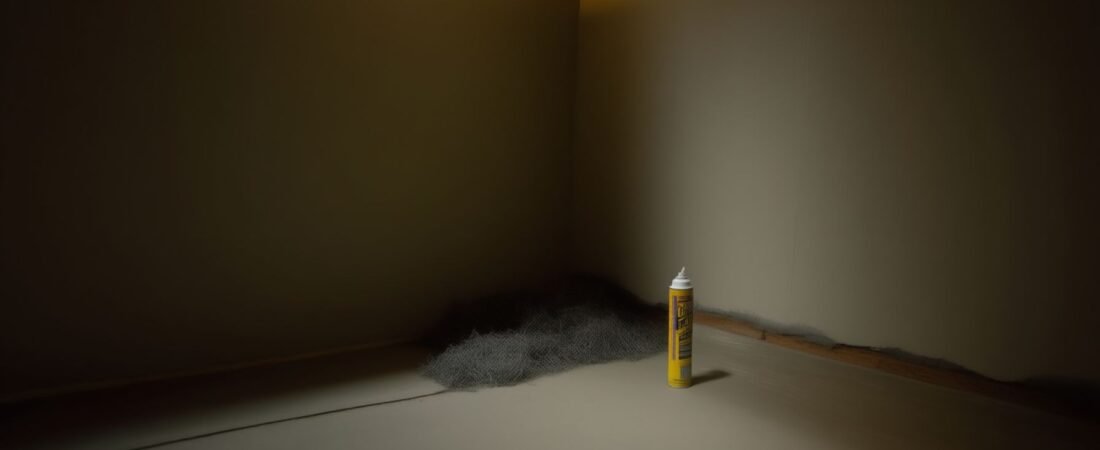
Steel wool alone won’t stop mice — and neither will expanding foam alone. The real problem isn’t which material you choose, it’s that most homeowners treat gap-sealing as a one-material job when mice exploit the exact weaknesses each product has on its own. Steel wool rusts and loosens. Foam gets chewed through in hours. Used separately, both give you a false sense of security while mice find the soft spot and push right through.
Why Sealing With Just One Material Almost Always Fails
A mouse can compress its body and squeeze through any gap as small as 1/4 inch — roughly the width of a pencil eraser. That’s not a size most people are looking for when they walk a perimeter. They’re looking for obvious holes, and missing the small stuff entirely, which is where mice actually enter.
The other half of the failure is material-specific. Steel wool left unanchored gradually oxidizes and crumbles, leaving a granular mess in the gap and almost no physical resistance. Expanding foam cures hard but stays chewable — mice teeth never stop growing, so gnawing through polyurethane foam takes them about the same effort as gnawing cardboard. Neither product alone addresses both the mechanical hold and the chew-resistance a proper seal needs.
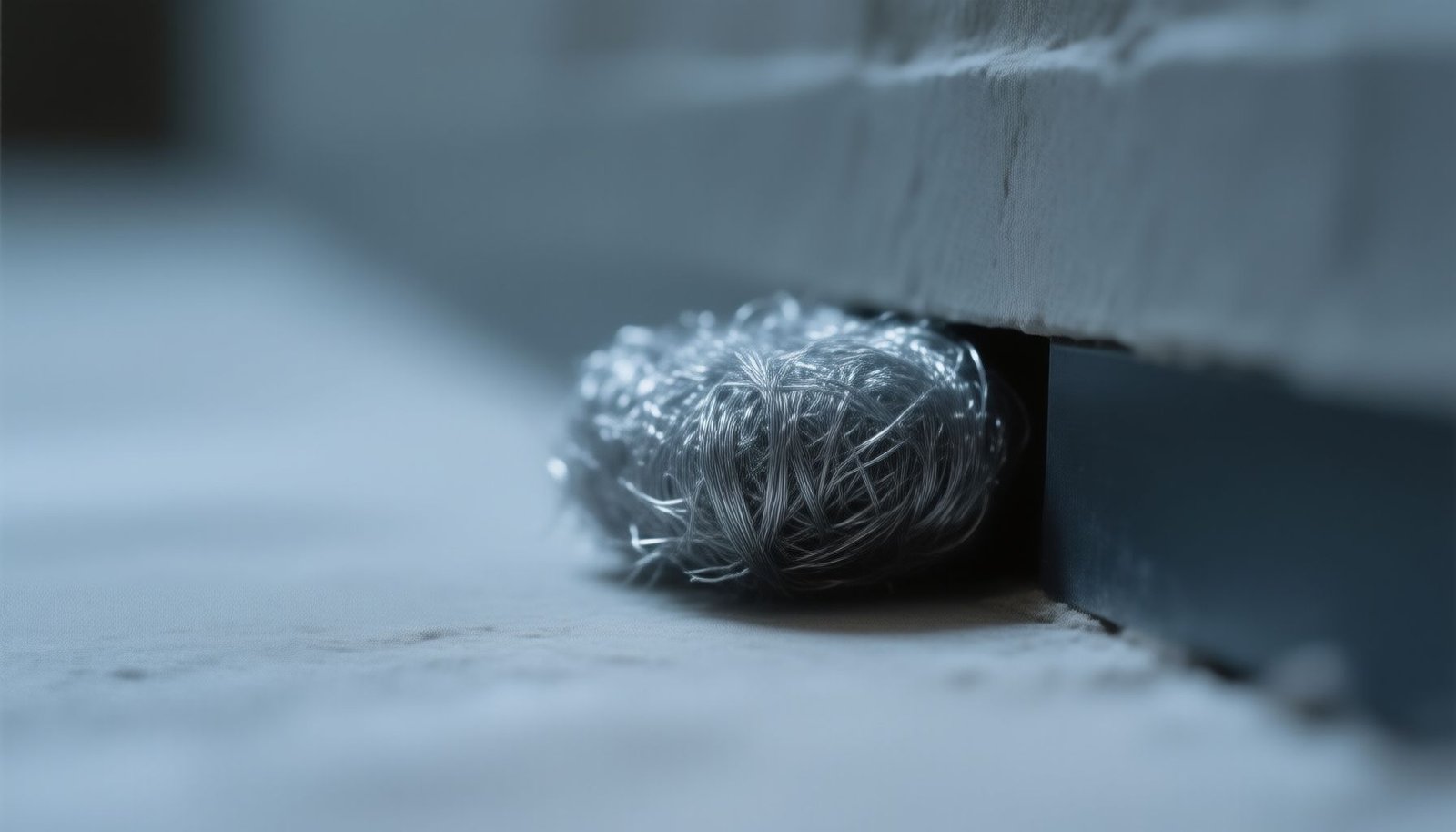
This close-up shows how steel wool and caulk-based sealant work together at a pipe penetration — the kind of entry point mice use far more often than any visible crack in the foundation.
Steel Wool vs. Foam: What Each Product Actually Does (and Doesn’t)
Steel wool works as a physical deterrent because the fine metal fibers irritate a mouse’s sensitive nose and paws on contact. The problem is that standard steel wool — the kind from any hardware store — is not stainless, and moisture causes it to rust and break apart within weeks. Once it compresses or crumbles, the gap is open again, and you won’t notice until a mouse does.
Expanding foam, specifically products like Great Stuff Pestblock or DAP Foam & Fill, is far more durable against weather and moisture than steel wool. But it’s a thermal insulator, not a rodent deterrent, and mice will chew through a foam-sealed gap without much hesitation if there’s a scent trail on the other side. The foam’s biggest value is as a backer and anchor — not as the final line of defense.
| Material | Chew Resistance | Weather Resistance | Best Use |
|---|---|---|---|
| Standard Steel Wool | High initially, degrades fast | Poor (rusts) | Temporary fill only |
| Stainless Steel Wool (e.g., Xcluder) | High and durable | Good | Primary fill material |
| Expanding Foam (standard) | Low — mice chew through | Excellent | Backer and anchor only |
| Foam + Stainless Fill (layered) | Very high | Excellent | Complete seal at penetrations |
Which Products Are Actually Worth Buying for Mouse-Proofing?
Not all steel wool is equal, and this is the distinction most buying guides skip. Hardware store steel wool (grades 0 through 4) is iron-based and starts oxidizing the moment it’s exposed to moisture — which, inside a wall cavity or near a pipe, is almost immediately. Stainless steel fill products like Xcluder Rodent Control Fill Fabric or Stuff-Fit Pro are made from stainless steel and poly fiber blends that resist both corrosion and compression, which is exactly what you need for a long-term seal.
Here’s a ranked list of products that hold up in real-world conditions, not just in a lab demonstration:
- Xcluder Rodent Control Fill Fabric — stainless steel and poly fiber blend, doesn’t rust, rated for gaps up to 4 inches, used by professional exclusion contractors
- Stuff-Fit Pro Copper Mesh — copper instead of steel, zero rust risk, ideal for wet areas like under sinks and crawl spaces, slightly easier to shape than stainless fills
- Great Stuff Pestblock Insulating Foam Sealant — contains a bitter biocide to slow chewing, best used as the locking layer over a metal fill, not as a standalone
- DAP Dynaflex 230 Exterior Sealant — paintable, flexible caulk rated for exterior use, excellent at sealing the perimeter of hardware cloth or metal plates after larger gaps are packed
- Tomcat Rodent Block — expanding foam with added rodent deterrent, performs noticeably better than standard foam alone, good for interior use around utility penetrations
- Hardware Cloth (1/4-inch galvanized mesh) — not foam or wool, but worth including here because it’s the right answer for larger gaps (over 1/2 inch) where fill materials alone won’t stay put
Pro-Tip: Always pack the metal fill material first, pushing it firmly into the gap so it makes contact with the surrounding edges on all sides — then apply foam or caulk over the top as the locking layer. This two-step method is what licensed exclusion professionals use because it addresses both chew resistance and long-term seal integrity at once.
Where Are Mice Actually Getting In? The Gaps You’re Missing
Picture this: a pest control technician comes to do an exclusion assessment on a 1970s ranch house. The homeowner has already caulked around the front door, sealed the visible foundation crack near the garage, and stuffed steel wool behind the dryer. The tech finds active entry points at the gap behind the dishwasher water line, the weep holes in the brick veneer, and the spot where the cable television line enters the wall — none of which the homeowner had ever noticed. That scenario plays out constantly.
Mice don’t look for obvious holes. They follow scent trails left by other mice along established pathways, which means they’ll find the same 3/8-inch gap around a conduit that’s been there for 20 years, because another mouse found it first. If you’ve already dealt with mice getting into kitchen drawers and cabinets, the entry point is almost never the cabinet itself — it’s the utility penetration behind or below it that leads directly inside the wall.
The gaps most homeowners miss entirely fall into consistent categories:
- Weep holes in brick veneer (standard size is exactly 3/8 inch — just over a mouse’s minimum squeeze point)
- The gap where plumbing pipes exit the floor under kitchen and bathroom cabinets
- Dryer vent connections at the exterior wall, especially where the collar has separated
- The top plate of exterior walls in unfinished basements and crawl spaces
- Gaps around electrical conduit and cable lines where they enter the structure
- Door sweeps that don’t contact the threshold continuously — even a 1/4-inch light gap is enough
“The single biggest mistake homeowners make during exclusion work is treating it like a one-time caulking project rather than a systematic inspection of every utility penetration in the structure. Mice don’t use the front door. They use the same paths that pipes and wires use to get through your walls — and those penetrations almost always have gaps around them that were never properly sealed during construction.”
Marcus Delgado, NPMA-Certified Pest Management Professional, 14 years in residential rodent exclusion
Does the Type of Building or Climate Change Which Product You Should Use?
Yes — and this is an honest nuance most buying guides ignore completely. In climates with significant freeze-thaw cycles (think the upper Midwest, New England, or mountain West), exterior sealants and foam products expand and contract repeatedly throughout the season. A standard foam seal applied in October can develop micro-gaps by March as the surrounding substrate moves, which is why exterior penetrations in cold climates should always use a flexible, paintable caulk over the fill rather than rigid expanding foam alone.
Older homes — pre-1980 construction especially — present a different challenge because of settling and irregular framing. Gaps in these structures are rarely uniform, which means rigid metal plates or hardware cloth need to be custom-fit and fastened rather than just pressed in. Xcluder fill fabric handles irregular shapes better than hardware cloth in these situations because you can pack it into non-square openings. The same flexibility that makes it easy to work with also makes it the right call for crawl space sill plates, which are almost never a clean rectangular gap. It’s also worth noting that the ground-level access points around your home aren’t the only concern — similar settlement gaps can appear in unexpected places, just like the soil disruption issues covered in guides about dealing with moles in the yard, where what you see on the surface is rarely the full picture of what’s happening underneath.
High-humidity environments — coastal homes, basement-heavy properties, anywhere with regular condensation on pipes — should avoid standard iron steel wool categorically. Rust staining on walls and surfaces is a real problem when steel wool is packed into a gap near a condensing pipe, and the structural degradation happens faster than most people expect. Copper mesh or stainless fill are the only sensible choices in those conditions, even if they cost a bit more upfront.
The counterintuitive reality of gap-sealing that most articles never say out loud: a perfectly sealed home on the outside doesn’t help much if the interior utility chases — the spaces inside walls where pipes and wires run — aren’t also addressed. Mice that find their way into a wall cavity from a neighboring unit or an attached garage can bypass your exterior exclusion work entirely. Interior pipe penetrations under sinks, around HVAC lines, and at floor-wall junctions deserve the same treatment as any exterior gap.
Start your exclusion work at the exterior perimeter with stainless fill fabric backed by flexible caulk or Pestblock foam, work through every interior utility penetration with the same two-layer method, and then reassess in 90 days. Mice establish new entry attempts within 2 to 4 weeks of being blocked from a familiar route, so a single walkthrough isn’t the end of the job — it’s the beginning of a sealed structure that actually holds.
Frequently Asked Questions
What is the best product to seal gaps against mice?
Steel wool combined with caulk or sealant is widely considered the most effective solution — mice can’t chew through the steel fibers, and the caulk holds it in place. For gaps larger than 1/4 inch, you’ll want to stuff them with copper mesh or steel wool first, then seal over it with a rodent-proof caulk like DAP Elastomeric or a silicone-based product.
Will expanding foam stop mice from getting in?
Standard expanding foam like Great Stuff won’t stop mice — they can chew right through it, usually within minutes. If you want to use foam, look for rodent-deterrent formulas that contain capsaicin, but even those work best as a secondary layer over steel wool or copper mesh rather than on their own.
What size gap can a mouse fit through?
A mouse can squeeze through a gap as small as 1/4 inch — roughly the size of a dime. That means even tiny cracks around pipes, utility lines, and door frames need to be sealed, not just the obvious holes you can easily spot.
Does steel wool rust inside walls and cause damage?
Yes, regular steel wool can rust over time, especially in damp areas like under sinks or around exterior pipes, which can stain surfaces and eventually cause it to break down. Copper mesh is a rust-proof alternative that’s just as chew-resistant and holds up much better in moist or outdoor conditions.
How do I seal gaps around pipes to keep mice out?
Pack the gap tightly with copper mesh or steel wool, making sure there’s no space around the pipe that a mouse could push through. Then apply a bead of silicone or polyurethane caulk over the mesh to lock it in place — any gap larger than 1/4 inch around the pipe needs this two-step approach to actually hold up long-term.