
Caulking every crack and spraying pesticide around your foundation won’t solve a scorpion problem — and that’s exactly what most online guides tell you to do first. The real issue is that scorpions don’t move into your home because they found a gap. They move in because your yard is giving them everything they need to survive and breed, and your house just happens to be the next stop. Fix the yard problem first, or you’ll be spraying the same baseboards every summer for the rest of your life.
Why Do Scorpions Keep Coming Back Even After Treatment?
Scorpions are not random wanderers. They hunt at night, hide during the day, and return to the same harborage spots for weeks or months at a time. A female bark scorpion can live for 3 to 5 years and give birth to 25 to 35 live young per litter — meaning if you spray a scorpion you can see, there are likely dozens you can’t. The treatment failure most homeowners experience isn’t a product failure. It’s a strategy failure.
What keeps scorpions coming back is harborage and food. Harborage means any dark, cool place to hide — woodpiles, rock borders, cardboard boxes in the garage, piles of mulch, stacked bricks, even corrugated cardboard on a concrete floor. Food means crickets, roaches, and other insects your property is producing or attracting. Scorpions follow their prey, so if you haven’t addressed your general insect population, you’re essentially running a buffet with a “scorpions welcome” sign out front.
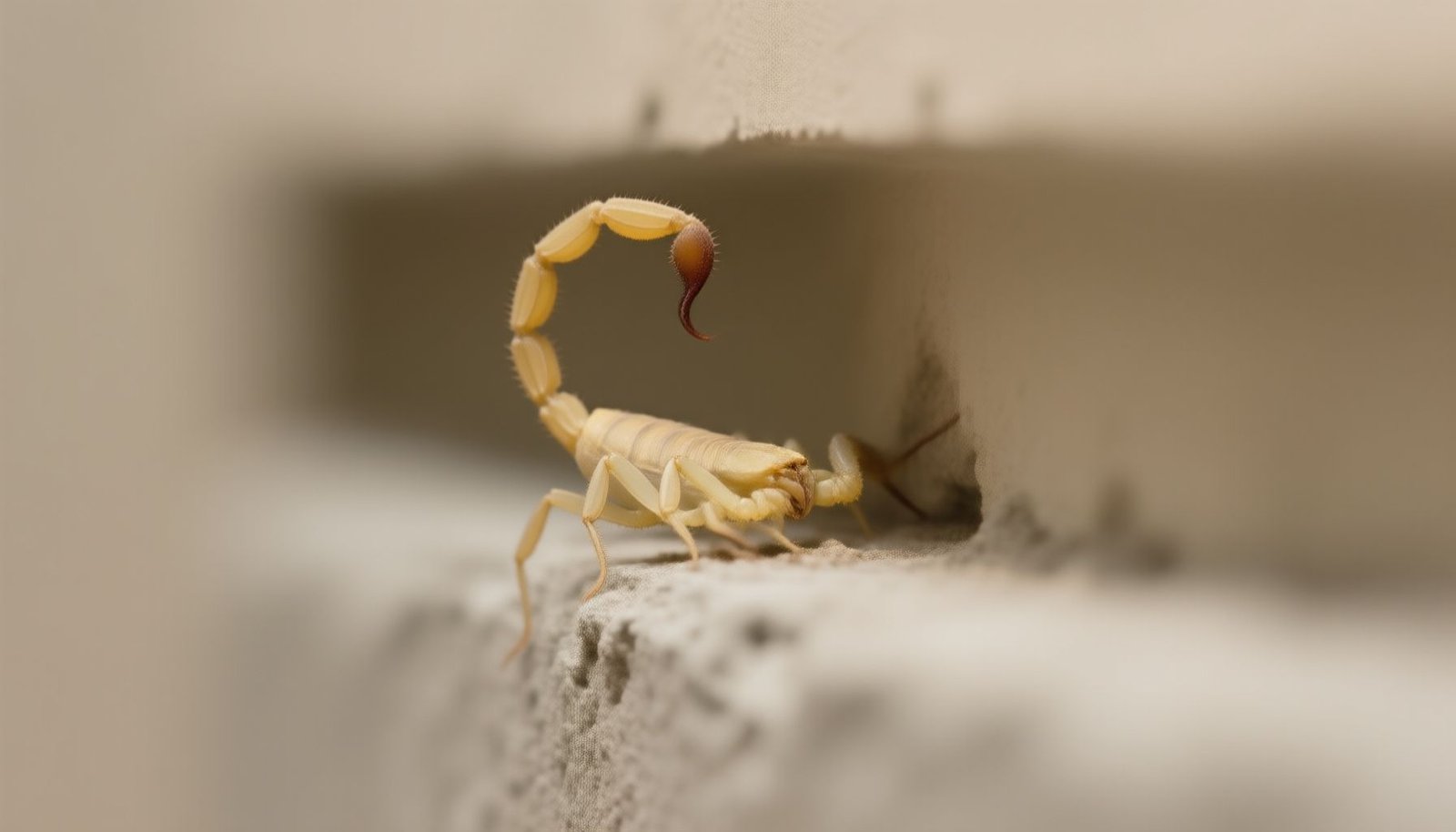
This close-up view of a scorpion shows the flat, elongated body shape that lets it slip through gaps as narrow as 1/16 of an inch — thinner than a credit card — which explains why sealing only large cracks rarely stops an infestation on its own.
How to Eliminate the Outdoor Conditions That Draw Scorpions In
Before you buy a single product, spend an afternoon doing a yard audit. Picture this: you put on a UV blacklight flashlight after dark and walk your property — scorpions glow a brilliant blue-green under UV light, which is one of the more unsettling things you’ll ever see in your own backyard. Even five or six scorpions visible in one pass means you have a population that is actively cycling into your home. That UV test costs you nothing and tells you more than any inspection report.
Harborage removal is the single highest-impact action you can take. Move firewood at least 20 feet from the house and store it elevated off the ground. Pull rock borders and decorative gravel away from your foundation or replace them with bare dirt or a cement strip. Trim tree branches that touch your roofline, since bark scorpions are excellent climbers and regularly enter homes from above. Deal with your general insect population the same way you’d handle any outdoor pest pressure — the logic isn’t that different from how you’d approach getting rid of ticks in the yard without killing the grass, where reducing habitat and prey matters more than the spray you choose.
What Actually Kills Scorpions — and What Doesn’t
Scorpions have a thick, waxy exoskeleton that makes contact insecticides significantly less effective on them than on soft-bodied insects like roaches or ants. Spraying a scorpion directly with a pyrethroid product can knock it down, but a glancing spray often won’t kill it — the scorpion may recover and move on. This is why residual barrier sprays that scorpions crawl through are more reliable than spray-and-hope contact kills.
Here’s what the research and pest control professionals consistently find works, in order of effectiveness:
- Residual insecticide perimeter spray — Cypermethrin or bifenthrin applied as a 3-foot band around the base of your home, inside and out, every 30 to 45 days during active season. Scorpions that cross it pick up a lethal dose through their legs and underside, even if they’re not directly sprayed.
- Diatomaceous earth in wall voids and attic spaces — Food-grade DE damages the waxy exoskeleton over time and works well in areas where liquid sprays aren’t appropriate. Apply in a thin, even layer; clumped or thick piles are ineffective.
- Glue board traps along interior walls — Place them in corners, behind the refrigerator, and in the garage along walls. They won’t reduce a population on their own, but they confirm activity and catch scorpions moving indoors.
- UV blacklight hunting at night — Physically removing scorpions with tongs or a jar and killing them is brutal but effective. Combining two or three nights of UV hunting with chemical treatment gives significantly faster results than chemical treatment alone.
- Reducing prey insects with a targeted IGR program — Insect growth regulators like hydroprene or methoprene interrupt the breeding cycle of crickets and roaches that scorpions feed on. Starving out their food source forces scorpions to move or die. This works on a 4-to-6-week timeline, not overnight.
Pro-Tip: Spray your garage door threshold, weep holes in brick, and any expansion joints in your concrete slab every 30 days — these are the three entry points pest control professionals treat first, and homeowners almost always skip them.
How to Scorpion-Proof the Inside of Your Home
The counterintuitive thing about indoor scorpion control is that most of the work happens before a scorpion ever gets inside. Sealing is more important than spraying once you’re dealing with an active infestation indoors — but most homeowners reverse that priority and wonder why the sprays aren’t lasting. Scorpions can compress their bodies to fit through a gap the width of a credit card, which means standard door sweeps and foam weatherstripping aren’t always enough.
Focus your exclusion work on these specific vulnerabilities:
- Door sweeps and thresholds — Standard bristle sweeps leave too much gap. Replace them with solid rubber door sweeps and check that the threshold makes full contact with the sweep when the door is closed.
- Weep holes in brick exteriors — These ventilate your wall cavity but are open invitations for scorpions. Install weep hole covers (mesh or plastic inserts) that maintain airflow while blocking entry.
- Pipe penetrations under sinks and behind appliances — Use expanding foam or copper mesh to seal the gap around supply lines, drain pipes, and conduit where they enter the wall.
- Attic access hatches and recessed lighting — Bark scorpions particularly are found in attics and can drop into living spaces through recessed light fixtures. Seal the attic side of fixtures with foam or gaskets.
- Window AC units and wall penetrations — The gaps around window units are routinely 1/4 inch or wider. Foam backer rod plus caulk beats tape, which degrades in heat.
This kind of systematic exclusion work is the same principle behind solving other structural pest problems — like the approach used when dealing with getting rid of carpenter ants without an exterminator, where blocking entry points matters as much as any bait or spray. The biology is different, but the logic holds.
When Is a Scorpion Problem Serious Enough to Call a Professional?
Honest answer: it depends on species, density, and where you’re finding them. Not all scorpions sting equally. In the US, only the Arizona bark scorpion (Centruroides sculpturatus) produces venom considered medically significant — capable of causing severe pain, numbness, and in rare cases, life-threatening symptoms in young children, elderly adults, or immunocompromised individuals. Every other common US scorpion species produces a sting roughly comparable to a bee sting — painful, but not dangerous for most healthy adults. Knowing your species changes your urgency level entirely.
Use this table as a quick reference before deciding whether to call in a pro:
| Situation | DIY Viable? | Call a Pro? |
|---|---|---|
| 1–3 scorpions found over several months, non-bark species | Yes — exclusion + residual spray | Optional |
| Repeated indoor sightings, bark scorpion confirmed | Partial — start immediately, monitor closely | Strongly recommended |
| Children or medically vulnerable people in the home | Supplement only — don’t rely on DIY alone | Yes |
| More than 10 scorpions spotted in a single UV sweep of the yard | No — population is too established | Yes, urgently |
“The mistake I see constantly is homeowners treating the interior while doing nothing about the harborage within 10 feet of the foundation. You can apply the best chemistry available and still lose the battle if there are three woodpiles, a bunch of landscape rock, and dense shrubs right against the house. Scorpions don’t need to travel far — you’re bringing the problem right to your door with the landscaping choices.”
Dr. Patricia Howell, Board-Certified Entomologist and Urban Pest Management Specialist, Texas A&M AgriLife Extension
A licensed pest control operator treating for bark scorpions will typically apply a combination of liquid residual concentrate, microencapsulated pyrethroid to the attic space, and a granular insecticide in the landscape — often on a monthly schedule during peak season (spring through early fall) and bi-monthly in cooler months. That’s a more aggressive protocol than most homeowners are comfortable executing alone, and if you’re in a high-density bark scorpion zone like central Arizona, the professional rotation approach genuinely outperforms DIY over a full season.
One more thing worth knowing: if you’re treating aggressively and still finding scorpions indoors after 60 days, the entry point is almost certainly overhead — the attic. Bark scorpions routinely travel across shared attic spaces in attached homes and townhouses, dropping down through ceiling fixtures and wall voids. No amount of perimeter spray will stop that pathway. At that point, attic treatment and ceiling fixture sealing become the priority, and that’s a job that’s genuinely easier with a professional doing the application safely.
Start outside, seal relentlessly, treat monthly during warm months, and run a UV sweep at least twice during your first season so you know whether your population is declining. A scorpion problem that feels overwhelming in spring can be genuinely manageable by late summer — if you work the problem in the right order rather than reaching for a spray can first.
Frequently Asked Questions
what kills scorpions instantly?
Direct contact with insecticides containing cyfluthrin or deltamethrin will kill scorpions on the spot. You can also use a mixture of water and cedarwood oil as a more natural option, though it works a bit slower. For immediate results indoors, most pest control pros recommend a residual spray along baseboards and entry points.
what do scorpions hate the most?
Scorpions strongly avoid lavender, cedarwood, and cinnamon — these scents interfere with their sensory receptors. They also hate diatomaceous earth, which damages their exoskeleton when they walk across it. Spreading DE around doorways, window sills, and foundation cracks is one of the easiest ways to keep them from coming inside.
how do I find scorpions hiding in my house?
Use a UV blacklight flashlight in a dark room — scorpions glow bright green or yellow under ultraviolet light, making them easy to spot. Check under beds, inside shoes, behind furniture, and along baseboards where they like to hide during the day. Do your sweep at night since scorpions are nocturnal and much more active after dark.
how do I keep scorpions out of my bed?
Move your bed frame a few inches from the wall and tuck in any bedding that touches the floor, since scorpions can climb fabric. Some people place the legs of their bed frame in glass jars or smooth plastic cups — scorpions can’t grip smooth surfaces and won’t be able to climb up. Shake out your sheets and check inside pillowcases before getting in bed if you’re in a high-scorpion area.
does pest control actually work for scorpions?
Yes, professional pest control can make a real difference, especially if you’re dealing with bark scorpions or a heavy infestation. Technicians typically apply residual insecticides around the exterior foundation, entry points, and harborage areas, and results usually last 30 to 90 days depending on the product. That said, sealing cracks and eliminating moisture issues inside the home is just as important — treatment alone won’t keep them out long-term.
Disclaimer: This article is for informational purposes only and isn’t a substitute for professional pest control advice. Always read and follow the product label instructions exactly — label directions are legally binding and vary by brand and active ingredient. Keep all pesticides, baits and traps away from children and pets, ventilate treated areas as directed, and consider calling a licensed pest control professional if an infestation is large, recurring, or involves a structural pest like termites or carpenter ants.