

Ticks don’t live in your lawn — they live at the edge of it. That one fact changes everything about how you treat your yard, and it’s why so many homeowners end up killing their grass for nothing while the ticks keep coming back from the treeline, the fence row, and the pile of dead leaves they never got around to raking.
You can absolutely get rid of ticks in the yard without harming your grass. The key is targeting the right microhabitats with the right products at the right time, instead of blanket-spraying the entire lawn and wondering why the zoysia looks burned by mid-July. Most tick control failures aren’t a product problem — they’re a geography problem. Once you understand where ticks actually hang out and why, the treatment gets a lot more precise and a lot less destructive.
Why Are Ticks in Your Yard in the First Place?
Here’s the thing most people get wrong: ticks aren’t randomly scattered across your open lawn waiting for you to walk by. They’re 95% concentrated in the transitional zone between your mowed grass and whatever is behind it — wooded areas, shrub beds, leaf litter, overgrown fences, and dense groundcover. This zone, sometimes called the “ecotone,” is where humidity stays high, sunlight stays low, and the wildlife that carries ticks (deer, mice, squirrels, rabbits) like to travel. A blacklegged tick nymph, which is only about the size of a poppy seed and responsible for the majority of Lyme disease transmission in the US, needs high humidity to survive — it desiccates and dies quickly in the open sun of a well-mowed lawn.
Wildlife is the delivery mechanism. White-footed mice alone are responsible for infecting up to 75% of blacklegged tick nymphs with Borrelia burgdorferi in the northeastern US. Every deer that passes through your yard drops ticks. Every rabbit that shelters under your deck leaves behind larvae. The ticks you encounter on the patio furniture or on your kids near the swing set almost always walked in from that shaded, humid edge zone, not from the middle of your Kentucky bluegrass.
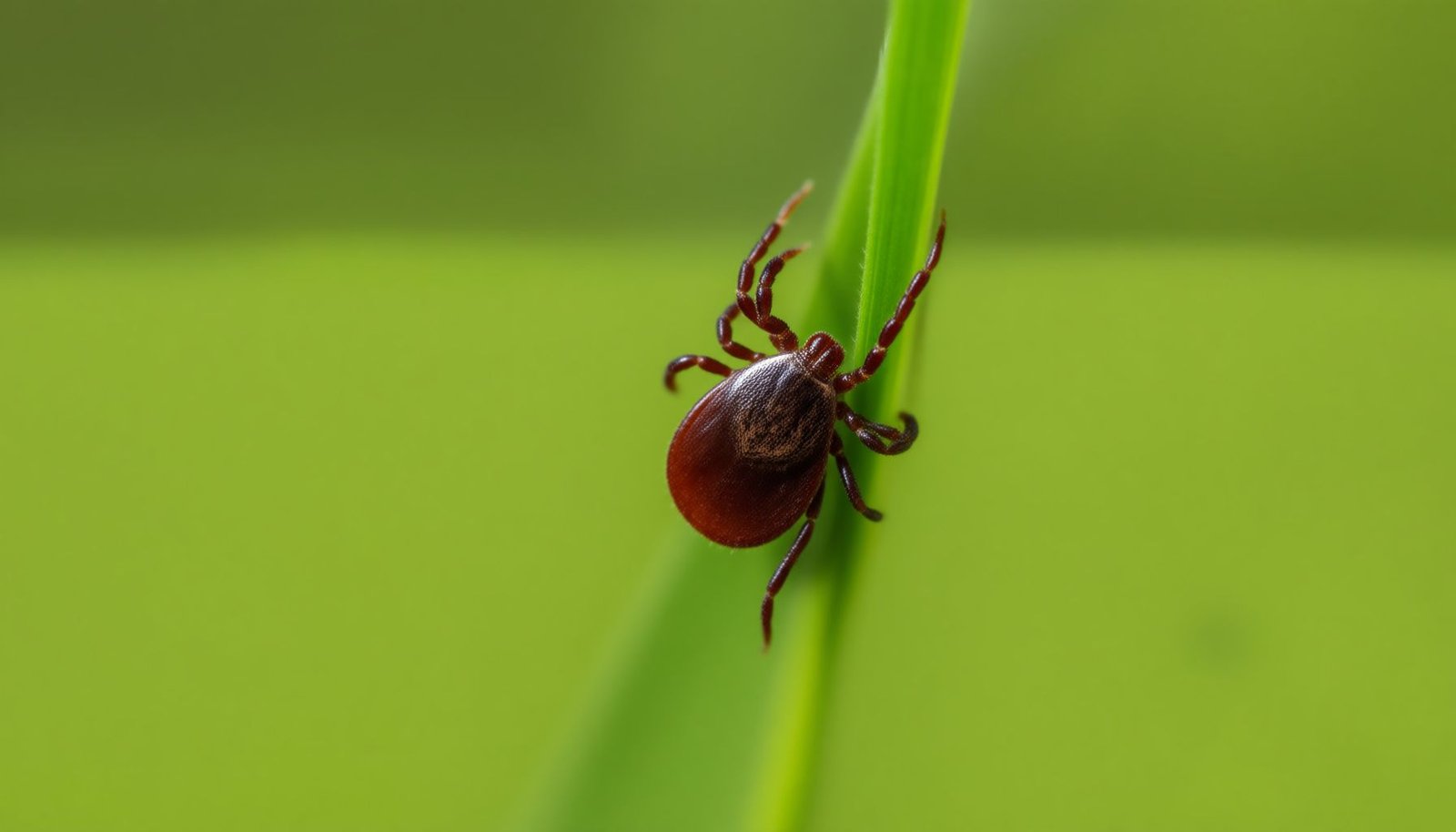
This close-up shows the tick’s preferred microhabitat — the shaded leaf-litter border where most infestations originate, not in the open lawn area most homeowners treat first.
Which Yard Treatments Actually Kill Ticks Without Damaging Grass?
The products that damage grass aren’t really tick treatments gone wrong — they’re the right products applied in the wrong concentration, at the wrong time, or over too wide an area. Bifenthrin, permethrin, and lambda-cyhalothrin are all highly effective against ticks and, used correctly, are safe on most established turfgrasses. The problem is when homeowners over-apply concentrate, skip the dilution step, or spray during the hottest part of a summer day, which causes the chemical to phytotoxify the grass blades before it has time to bind to the soil. Apply in the early morning or late evening when temperatures are below 85°F and the grass isn’t heat-stressed, and you’ll almost never see turf damage.
For people who want to avoid synthetics entirely, cedar oil-based sprays (like those with Texas cedarwood oil as the active ingredient) and rosemary oil concentrates can reduce tick populations in treated areas and are genuinely safe on grass. They’re not as long-lasting — expect 2 to 3 weeks versus the 4 to 8 weeks you’d get from a quality bifenthrin concentrate — but in lower-pressure situations or when treating near vegetable gardens, they’re a reasonable trade-off. Diatomaceous earth, despite its popularity, doesn’t work well outdoors for ticks because it loses effectiveness the moment it gets wet, which happens constantly in a lawn environment.
“Homeowners consistently over-treat the center of their lawn and under-treat the perimeter. From an entomological standpoint, you’re wasting product and potentially stressing your turf. A 9-foot treatment band along wooded edges, fence lines, and ornamental beds is where your tick pressure actually is — treat that zone correctly and you’ll reduce tick encounters by 70 to 90 percent without touching the middle of your lawn at all.”
Dr. Thomas Mather, Director of the University of Rhode Island’s TickEncounter Resource Center and extension tick specialist
How to Apply Tick Treatments Without Burning or Stressing Your Lawn
Grass damage from tick spray is almost always an application error, not a product failure. Follow these steps in order and your lawn stays intact while your tick population drops significantly:
- Mow first, treat second. Ticks rest on vegetation at a height that puts them in contact with passing hosts — usually 12 to 18 inches off the ground. Mow your lawn to a standard height (3 to 3.5 inches for most cool-season grasses) before applying any treatment so the product reaches the soil-grass interface where ticks are questing.
- Mix concentrate to the lower end of the label range. For bifenthrin-based products, this is typically 0.06% to 0.1% finished spray concentration. Going higher doesn’t kill more ticks — it just increases the odds of phytotoxicity on warm-season grasses like bermuda or zoysia.
- Focus on the 9-foot perimeter band. Walk the edge of your yard where grass meets trees, shrubs, leaf piles, or fence lines and treat only that transition zone. This is where 80 to 90% of your tick population lives. Treating the full lawn is optional unless you have documented heavy infestation across the entire yard.
- Spray during low-temperature windows. Treat early morning (before 9am) or after 7pm when temperatures have dropped. High heat causes rapid evaporation of carriers in the spray mix, which concentrates active ingredients on grass blades before they can wash to the soil — that’s your burn mechanism.
- Water lightly after treatment. A light watering (about 0.1 inches) within an hour of application helps move the active ingredient off grass blades and into the thatch layer where ticks travel. It also reduces leaf contact time, protecting your grass.
- Repeat on the right schedule. One application rarely carries you through tick season. Bifenthrin-based concentrates typically hold for 30 to 60 days depending on rainfall. Plan for 2 to 3 applications from early spring through early fall, timed to peak tick activity periods in your region.
Picture this: your neighbor treats their whole lawn twice a month all summer with a hose-end sprayer full of undiluted concentrate and their grass looks thin and yellowish by August. Meanwhile, you’ve done two targeted perimeter applications and your lawn is healthier than ever — and you haven’t pulled a single tick off your dog since May. That’s the difference precision makes.
Does Landscaping Actually Reduce Tick Populations Long-Term?
Landscaping changes are the most underrated tool in tick control, and the one most articles skip in favor of product lists. A 3-foot wide wood chip or gravel barrier between your lawn and any wooded or shrubby area creates a physical boundary that ticks are reluctant to cross — they lose moisture rapidly on dry, open, wood chip surfaces and nymphs especially struggle to survive the transit. Research from the Connecticut Agricultural Experiment Station found that a simple wood chip barrier reduced tick crossings by approximately 50%. That’s not a chemical. That’s landscaping.
Beyond barriers, the habitat modifications that matter most are the ones that reduce wildlife access and eliminate tick-friendly microclimates. Leaf litter is probably the biggest overlooked factor — a single bag of unraked leaves left against a fence all winter can harbor hundreds of overwintering tick larvae and nymphs. Stack firewood away from the house on a raised platform. Trim low-hanging branches that create shaded, humid corridors. Remove old stone walls or lumber piles near the yard perimeter where mice nest in dense concentrations — and since mice are just as capable of bringing fleas into your home as ticks into your yard, eliminating their habitat addresses more than one problem at once.
Pro-Tip: Plant deer-resistant perimeter plantings like lavender, Russian sage, or catmint along fence lines and yard edges. Less deer traffic means dramatically fewer tick drop-offs — a single deer can carry 500 or more adult ticks, so even reducing deer visits by half cuts your annual tick burden significantly.
What’s the Difference Between Treating for Ticks vs. Fleas in the Yard?
This matters because a lot of homeowners treat for ticks and fleas simultaneously and end up using the wrong product concentration or the wrong application method for one or the other. Ticks and fleas have meaningfully different biology, and a treatment optimized for one can miss the other entirely.
| Feature | Ticks | Fleas |
|---|---|---|
| Primary habitat in yard | Vegetation edges, leaf litter, tall grass borders | Shaded sandy soil, under decks, pet resting areas |
| Treatment target zone | 9-foot perimeter band, shrub beds | Soil surface under structures, shaded lawn areas |
| Effective active ingredients | Bifenthrin, permethrin, lambda-cyhalothrin | Bifenthrin + IGR (s-methoprene or pyriproxyfen) |
| Reapplication interval | 30–60 days | 21–30 days (faster flea life cycle) |
The counterintuitive fact here is that fleas actually prefer shaded, moist soil — the opposite of what many people assume when they spray for them on sunny open lawn areas. Ticks prefer vertical vegetation to quest from. That’s why a single all-purpose spray applied uniformly across your lawn often underperforms on both pests — you’d need to treat different zones at different rates to get real control. If you’re also dealing with a flea problem that’s made it indoors, the outdoor treatment is only half the battle, which is part of why treating pests in secondary habitats around the home matters as much as the yard itself. The biology of each pest determines where the treatment needs to land — not the marketing on the bottle.
One honest nuance worth acknowledging: in very high-pressure tick zones — the upper Midwest, the Northeast, and parts of the Pacific Coast where blacklegged tick populations are dense — habitat modification and targeted chemical treatment alone may not be enough. In those areas, especially on properties that border large wooded tracts with high deer populations, a combination of acaricide treatment, tick tubes (cardboard tubes filled with permethrin-treated cotton that mice take to line their nests, killing larvae), and physical barriers works meaningfully better than any single approach. Tick tubes are one of the few non-spray tools that genuinely interrupt the white-footed mouse-to-tick transmission cycle at the source.
What Tick Control Methods Are Safe Around Kids, Pets, and Pollinators?
Safety concerns are legitimate and worth addressing directly rather than with vague reassurances. Bifenthrin and permethrin are highly toxic to fish and aquatic invertebrates, so if your yard drains to a pond, creek, or storm drain, you need to be very careful about application rates and runoff. They’re also toxic to bees while wet, but once dry — typically within 30 to 60 minutes on a warm day — the risk to pollinators drops substantially. Never spray flowering plants or anything blooming, and apply in the evening when bees aren’t foraging.
For households with dogs who spend a lot of time in the yard, the re-entry interval matters. Most bifenthrin-based yard sprays require keeping pets off the treated area until completely dry, which is usually 1 to 2 hours under normal conditions. Here’s what most articles don’t mention: cats are significantly more sensitive to pyrethroids than dogs because they metabolize them differently — a yard treated with concentrated bifenthrin can be a hazard to outdoor cats even after it’s dry if they groom their paws immediately after walking through treated areas. If you have outdoor cats, cedar oil or rosemary-based alternatives are genuinely worth the shorter residual window.
- Tick tubes (Damminix or DIY): Safe around children and pets, no direct chemical exposure, specifically targets the tick-mouse transmission cycle
- Cedar oil concentrates: Grass-safe, pet-safe after drying, genuinely repellent and contact-lethal to ticks; shorter residual (2–3 weeks)
- Bifenthrin-based sprays (applied correctly): Highly effective, 30–60 day residual, grass-safe at proper dilution; keep pets and children off until dry
- Nootkatone-based products: An EPA-registered biopesticide derived from grapefruit, effective against ticks, very low mammalian toxicity — an emerging option that’s genuinely underused by homeowners
- Granular acaricides (e.g., bifenthrin granules): Applied dry and watered in, they reduce spray drift and lower the chance of grass contact; a solid option around flower beds and shrub borders
The bottom line is that tick control in the yard doesn’t require a trade-off between effectiveness and lawn health — it requires understanding that the real tick pressure is concentrated in a narrow band at the edges of your property, not spread evenly across every square foot you mow. Treat that zone with the right product at the right concentration and at the right time of day, build in a landscape barrier, and you’ll reduce your family’s tick encounters dramatically without a single brown patch in the lawn. Start with your perimeter this spring and see how much of the problem you solve before you ever open a second bottle.
Frequently Asked Questions
what can I spray in my yard to kill ticks but not the grass?
Bifenthrin and permethrin-based sprays are your safest bets — they kill ticks on contact without harming turf grass when applied at label rates. Products like Bifen IT or Permethrin SFR can be mixed and applied with a hose-end sprayer, and they won’t burn or yellow your lawn. Always apply in the early morning or evening when the grass isn’t heat-stressed for the best results.
does cedar oil kill ticks in the yard?
Yes, cedar oil is a natural tick killer that’s completely safe for grass, pets, and kids once it dries — usually within 30 to 60 minutes. It works by disrupting the tick’s ability to breathe, and it’s most effective when sprayed directly on leaf litter, mulch, and shaded lawn edges where ticks hide. The downside is it breaks down faster than synthetic options, so you’ll need to reapply every 1 to 2 weeks during peak tick season.
how short should I cut my grass to keep ticks away?
Keep your lawn mowed to 3 inches or shorter — ticks prefer tall grass and dense ground cover because it holds moisture and shade. Cutting weekly during spring and summer removes the microhabitat ticks depend on to survive and wait for a host. It won’t eliminate ticks on its own, but combined with a border spray treatment it significantly reduces your yard’s tick population.
will diatomaceous earth kill ticks in the yard without hurting the lawn?
Food-grade diatomaceous earth can kill ticks by puncturing their exoskeletons and causing dehydration, and it won’t damage your grass. Spread it along yard borders, wood lines, and areas where your lawn meets mulch or brush — these are the high-traffic zones for ticks. It loses effectiveness when wet, so you’ll need to reapply after rain, and it works best as a preventive barrier rather than a full yard treatment.
are there plants I can put in my yard that repel ticks?
Yes — rosemary, lavender, garlic, and chrysanthemums naturally repel ticks and can be planted along yard borders or garden beds. Chrysanthemums are especially useful because they contain pyrethrin, the same compound used in many commercial tick sprays. These plants won’t eliminate a heavy infestation on their own, but they’re a solid low-maintenance addition to a broader tick control strategy.
Disclaimer: This article is for informational purposes only and isn’t a substitute for professional pest control advice. Always read and follow the product label instructions exactly — label directions are legally binding and vary by brand and active ingredient. Keep all pesticides, baits and traps away from children and pets, ventilate treated areas as directed, and consider calling a licensed pest control professional if an infestation is large, recurring, or involves a structural pest like termites or carpenter ants.