
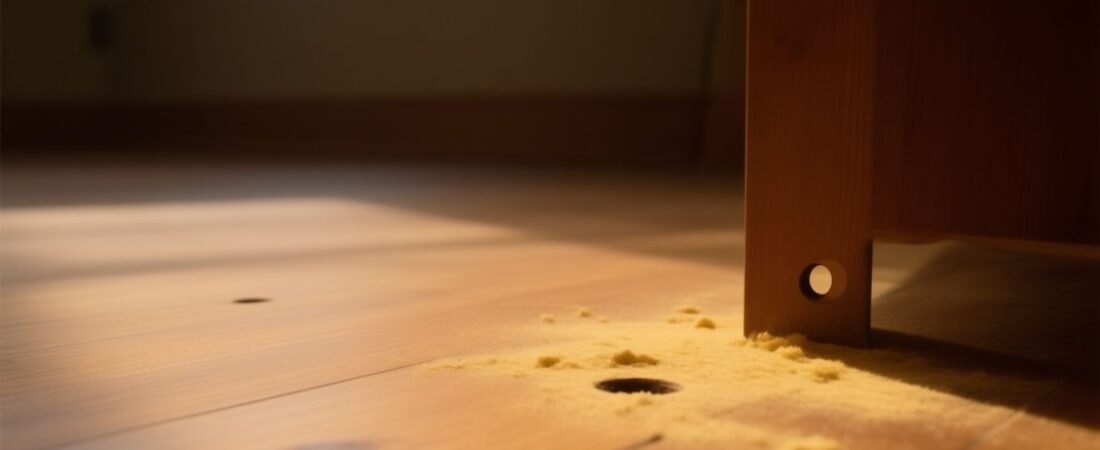
Sanding and refinishing your floors won’t kill a powderpost beetle infestation — it’ll just hide it until the beetles chew their way back to the surface. That’s the mistake that costs homeowners thousands of dollars and months of unnecessary frustration. The real problem with these beetles isn’t the exit holes you can see; it’s the larvae tunneling invisibly through your wood for anywhere from one to five years before they ever emerge as adults.
Powderpost beetles are genuinely one of the more confusing pest problems because most of the damage happens in total silence, completely out of sight. By the time you spot the telltale pinholes and fine powdery frass on your hardwood floors or antique furniture, the infestation may have been active for years. The good news: there are treatments that actually work — but only if you match the right method to the wood type, infestation depth, and whether the wood is finished or raw.
Why Powderpost Beetles Keep Coming Back Even After Treatment
Here’s something most articles skip entirely: powderpost beetles often reinfest the same wood, repeatedly, because adults emerge and lay eggs right back into the surface they just exited. A single female lyctid beetle can lay 15 to 50 eggs directly into the pores of unfinished hardwood. If you treated the surface but didn’t address the interior larvae still tunneling through the wood, you haven’t solved anything — you’ve just reset the clock on a new generation.
The other reinfestation driver that almost nobody talks about is moisture content. Powderpost beetles — particularly the lyctid species that attack hardwoods — require wood with a moisture content above 8% to successfully develop. Furniture stored in a humid basement or flooring installed over a poorly ventilated crawl space creates exactly the conditions that invite repeated attack. Fixing the beetle without fixing the humidity is like bailing a sinking boat without plugging the hole.
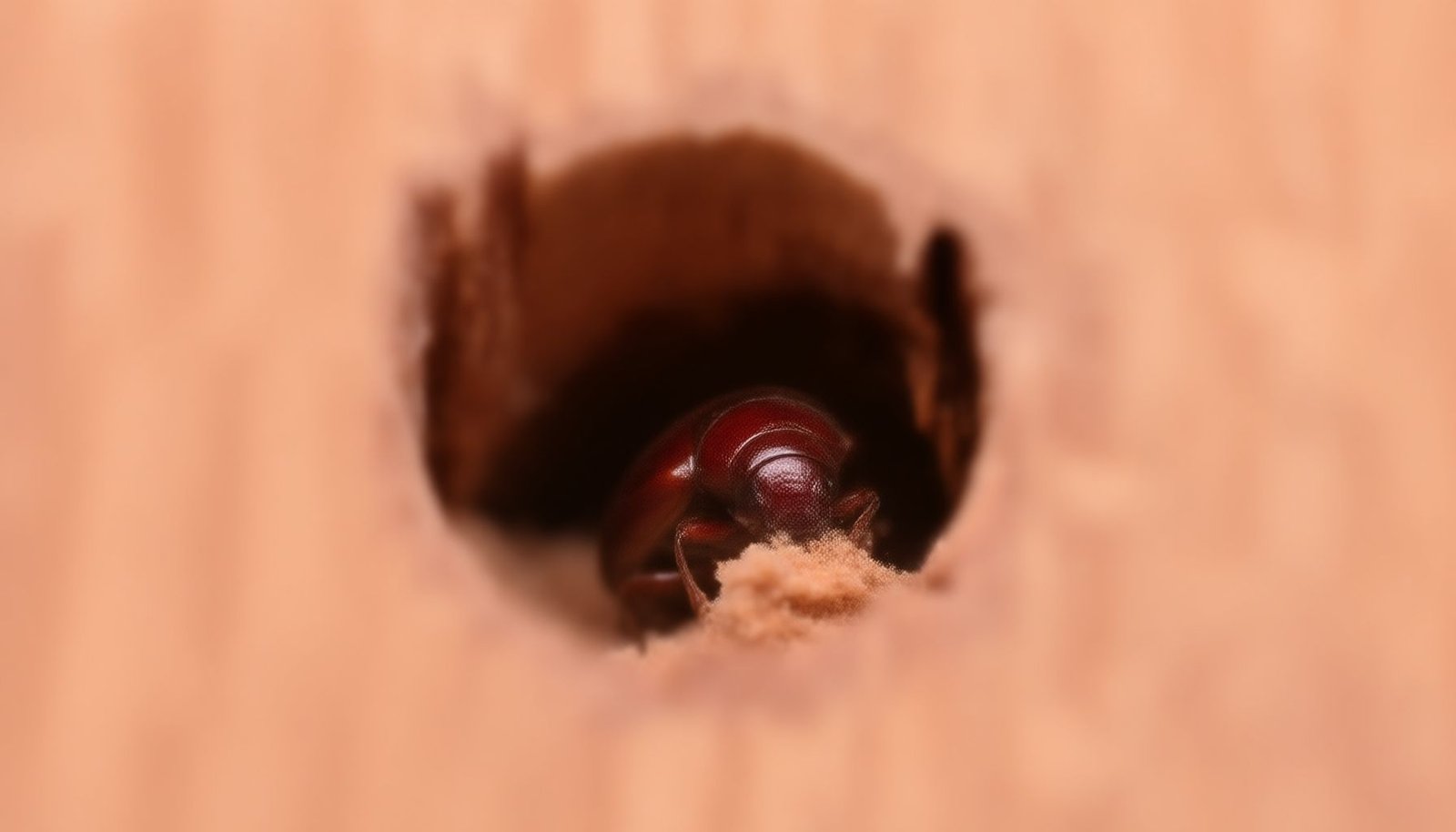
This close-up shows the characteristic exit holes and fine powdery frass left by powderpost beetle larvae — knowing what active versus old damage looks like is the first step to understanding whether you actually have a live infestation right now.
How Do You Know If Your Powderpost Beetle Infestation Is Still Active?
This is the question that matters most before you spend a dime on treatment. Old exit holes with grayish, compacted frass almost certainly mean the infestation has run its course — possibly years ago. Fresh, active damage produces frass that looks like fine talcum powder, is loose and flour-like to the touch, and tends to be cream or tan colored rather than gray. If you wipe a surface clean and new frass appears within a few days, you have live larvae actively feeding.
Picture this: you’re refinishing a set of oak dining chairs you inherited, and you notice tiny holes along the legs. Before you panic or call an exterminator, press a piece of white paper under one of the holes and tap the wood. If fine powder sifts out, that’s potentially active frass. If nothing comes out or the debris is granular and dark, you’re likely looking at a long-dead infestation in wood that’s still structurally fine. The distinction completely changes what you need to do next — and whether you need to do anything at all.
Pro-Tip: Tape a small square of dark paper over suspected exit holes and check it after 48–72 hours. If fresh cream-colored frass has sifted onto the paper, larvae are actively feeding inside and treatment is warranted. No frass means the infestation is likely dormant or already finished.
Which Treatment Method Actually Works for Furniture vs. Flooring?
The treatment that works on a piece of antique furniture is not necessarily the one that works on your installed hardwood floors — and conflating the two is where most DIY attempts fail. For movable items like furniture, heat treatment is one of the most effective options available: raising the internal wood temperature to 130°F for at least 30 minutes kills all life stages, including eggs and deep larvae that surface sprays can’t reach. Small items can be treated in a rented heat chamber; larger pieces may require a professional.
For installed flooring, the calculus is different. Raising an entire room to lethal temperatures is expensive and logistically complex. Surface-applied borate treatments — products like Tim-bor or Bora-Care — work well on bare, unfinished wood because borates penetrate into the wood and poison larvae as they feed. But finished floors with polyurethane or wax coatings don’t absorb borates effectively, which means the coating has to be stripped first or a different approach used entirely. Fumigation is the nuclear option for severe whole-house infestations and is always a professional job.
| Treatment Method | Best For | Works on Finished Wood? |
|---|---|---|
| Borate treatment (Tim-bor, Bora-Care) | Unfinished floors, structural wood, raw furniture | No — coating must be stripped first |
| Heat treatment (130°F+) | Movable furniture, small isolated pieces | Yes — penetrates regardless of finish |
| Freezing (0°F for 72+ hours) | Small antiques, decorative items | Yes — but check for finish cracking risk |
| Structural fumigation | Severe whole-structure infestations | Yes — whole-structure penetration |
How to Use Borate Treatments Correctly on Wood Floors and Furniture
Borates are genuinely one of the best tools available for powderpost beetles — but only when applied correctly. The mechanism is elegant: borates are absorbed into the wood fibers, and when larvae chew through the treated wood, they ingest the borate and it disrupts their digestive system. The larvae don’t need to contact a surface spray; they poison themselves by eating. That’s why borate penetration depth matters far more than surface concentration.
Here’s how to apply a borate treatment properly, step by step:
- Strip any finish from the wood surface. Polyurethane, varnish, paint, or wax will block borate absorption almost completely. Use a chemical stripper or sand the surface down to bare wood before applying anything.
- Mix the borate product according to label instructions. Products like Bora-Care are typically mixed with water in specific ratios — usually 1:1 for heavy infestations. Don’t dilute further hoping to stretch the product; it reduces penetration depth significantly.
- Apply generously to all exposed surfaces. Use a brush or roller to saturate the wood — don’t spray lightly. You want the liquid to visibly soak in, not bead up or run off.
- Allow full drying time before refinishing. Borates need to dry completely and bind to wood fibers before you apply any new finish coating. This typically takes 24–72 hours depending on humidity and temperature.
- Apply a second coat on heavily infested wood. For boards with extensive tunneling or wood over 1 inch thick, a second application 24 hours after the first improves penetration to depths larvae are actually living at.
- Reapply if wood gets wet repeatedly. Borates can leach out over time with moisture exposure, particularly in crawl spaces or areas with humidity fluctuations. Annual reapplication in high-moisture environments is reasonable maintenance.
“The biggest mistake I see with DIY borate treatments is applying over finished wood and expecting results. Borates are not a surface contact pesticide — they need to be inside the wood matrix to work. If you can’t strip the finish, you need to consider heat treatment or accept that you’re not actually treating the infestation.”
Dr. Marcus Henley, Board-Certified Entomologist and Wood Destroying Insect Specialist, University Extension Advisory Program
What to Do About Powderpost Beetles in Antique or Irreplaceable Furniture
Antique furniture presents a problem that most pest control articles gloss over: the treatments that work best — heat, freezing, chemical stripping — can also damage the very piece you’re trying to save. Rapid temperature changes can crack old finishes or split joinery glue. Chemical strippers remove the original finish that gives antiques their value. This is genuinely a situation where the right answer depends on how severe the infestation is and how much the piece is worth, both financially and sentimentally.
For high-value antiques with confirmed active infestations, freezing is often the gentlest effective option — but it has to be done slowly to avoid thermal shock. Place the piece in a sealed plastic bag to prevent condensation damage, then lower the temperature gradually to 0°F over 24 hours and hold it there for at least 72 hours. Unlike the misconception that you can “freeze out” beetles by leaving furniture in an unheated garage in winter, this requires a sustained and consistent 0°F — a cold snap that dips to 20°F overnight isn’t going to cut it. There’s also an interesting counterintuitive fact here that most sources ignore: some wood-boring beetle eggs in deeply embedded tunnels can survive brief cold exposure better than surface-dwelling adults, which is why the 72-hour minimum at 0°F is non-negotiable, not a rough guideline.
Dealing with other wood-destroying or structurally-damaging pests around the same time? It’s worth knowing that some insects most people assume are destructive are actually just a nuisance. For example, reading about How to Get Rid of Kissing Bugs Around Your Home makes it clear that not every alarming-looking bug is doing structural damage — but powderpost beetles genuinely are, and that distinction matters for how aggressively you respond.
Here are the options worth considering for antique and irreplaceable pieces:
- Slow freezing to 0°F for 72+ hours — gentlest option, effective for all life stages if temperature is maintained consistently throughout the piece’s interior, not just at the surface
- Professional heat chamber treatment — antique restorers and some pest companies use controlled heat chambers that raise temperature slowly enough to avoid finish cracking; ask specifically about ramp-up rate before agreeing to any service
- Localized injection with residual insecticide — using a fine-tip applicator to inject a product like Jecta Gel directly into exit holes; this reaches larvae in tunnels without requiring surface treatment, though it won’t treat the entire wood mass
- Consultation with a conservator before treatment — for museum-quality or high-dollar antiques, an American Institute for Conservation (AIC) member can advise on treatment options that won’t damage the piece’s integrity or value
- Quarantine and monitoring — for low-severity or potentially inactive infestations, isolating the piece on white paper for 90 days to monitor for fresh frass is a reasonable first step before committing to any treatment
Just as some household pest problems look more dramatic than they are — the way How to Get Rid of Asian Lady Beetles Without Vacuuming Every Day explains why overreaction often makes things worse — the same principle applies here. A single antique chair with a handful of exit holes and no fresh frass is not an emergency requiring fumigation. Accurate assessment first, treatment second.
How to Prevent Powderpost Beetles From Infesting New Wood and Flooring
Prevention with powderpost beetles is actually more achievable than most people realize, because these insects are largely preventable at the point of wood selection and installation. Lyctid beetles — the most common type attacking hardwood furniture and flooring — can only lay eggs in wood with large enough surface pores to accept the eggs. That’s why they attack ring-porous hardwoods like oak, ash, and hickory far more readily than tight-grained species. Choosing maple, cherry, or pine for flooring in high-risk environments isn’t just an aesthetic choice — it’s a genuine risk-reduction strategy.
Kiln drying is the other major prevention lever. Properly kiln-dried lumber brought to a moisture content below 8% is far less hospitable to powderpost beetle development, because eggs can be present but larvae won’t develop successfully in dry wood. The problem is that “kiln dried” on a lumber yard tag doesn’t guarantee the wood was stored correctly afterward — wood left in a humid warehouse or delivered in wet conditions can reabsorb enough moisture to become vulnerable again. If you’re installing new hardwood flooring, letting the flooring acclimate in your home for the manufacturer-recommended period (usually 3–7 days) while running your HVAC also reduces moisture content to equilibrium with your indoor environment. Finishing all six sides of a board — top, bottom, and all four edges — seals the pores that female beetles need to lay eggs, adding another layer of protection for any wood that enters your home raw.
Long-term humidity control matters just as much as any chemical treatment. Keeping indoor relative humidity below 50% — consistently, not just seasonally — reduces both the risk of new infestation and the likelihood of re-infestation after treatment. A crawl space encapsulation or dehumidifier for a basement where infested flooring sits above is often the single most cost-effective step a homeowner can take. No beetle can finish its life cycle in wood that stays dry enough, and that’s a fact the pest control industry has less financial incentive to lead with than selling another spray treatment.
Powderpost beetles are a slow problem that rewards patient, accurate diagnosis over panicked action. If you’ve confirmed a live infestation, match the treatment to the wood type and its finish. If you’re not sure whether it’s active, do the paper test and wait. The beetles have been in that wood for potentially years already — taking an extra week to be certain before you act isn’t going to meaningfully change the outcome. What does change outcomes is treating correctly the first time rather than repeatedly treating wrong.
Frequently Asked Questions
how do I know if I have powderpost beetles in my furniture?
The clearest sign is tiny round exit holes — usually 1/32 to 1/8 inch wide — along with fine, flour-like sawdust (called frass) sitting beneath or around the wood. You might also notice the holes appearing in new spots over time, which means the infestation is still active. Fresh frass that’s powdery and loose is a strong indicator beetles are still feeding inside the wood.
can I treat powderpost beetles in furniture myself or do I need an exterminator?
For small, localized infestations, DIY treatments like borate-based products (such as Tim-bor or Boracare) can work well if the wood is unfinished and can absorb the solution. If the infestation has spread through a large piece, multiple pieces, or into structural flooring, it’s worth calling a pest control pro — they have access to fumigation and other methods homeowners can’t do themselves. Don’t wait too long; powderpost beetles can destroy wood from the inside out before the damage becomes obvious.
does freezing furniture kill powderpost beetles?
Yes, freezing is a legitimate treatment option for smaller infested pieces — you’ll want to hold the item at 0°F (-18°C) for at least 72 hours to kill all life stages, including eggs and larvae. Wrap the furniture in plastic first to prevent moisture damage when it warms back up. This method works best for antiques or items where you can’t use chemical treatments without risking damage to finishes.
will powderpost beetles spread from furniture to my hardwood floors?
They can, especially if the infestation is heavy and your floors are made of susceptible wood species like oak, ash, or hickory. Powderpost beetles prefer hardwoods with high starch content, so not every wood type is at equal risk. If you find an infested piece sitting directly on hardwood floors, move it immediately and inspect the floor closely for exit holes or frass.
how long does it take to get rid of powderpost beetles?
It depends on the treatment method — borate treatments can stop an active infestation within a few weeks, but you may still see adult beetles emerge for up to a year since larvae already deep in the wood take time to die off. Fumigation works faster, typically knocking out an infestation in a matter of days. The key is to confirm the infestation is actually gone by checking whether new frass or exit holes appear after treatment.
Disclaimer: This article is for informational purposes only and isn’t a substitute for professional pest control advice. Always read and follow the product label instructions exactly — label directions are legally binding and vary by brand and active ingredient. Keep all pesticides, baits and traps away from children and pets, ventilate treated areas as directed, and consider calling a licensed pest control professional if an infestation is large, recurring, or involves a structural pest like termites or carpenter ants.