

About 300,000 people in the United States are living with Chagas disease right now — most of them don’t know it, and most of them got it inside their own home. That’s the part nobody tells you when they hand you a can of bug spray and say “seal your doors.” Getting rid of kissing bugs isn’t really about the bugs themselves. It’s about understanding that the standard perimeter-spray approach most pest control guides push actually misses where kissing bugs spend most of their time — which is not inside your house at all, until the moment it suddenly is.
Why Killing Kissing Bugs Inside Your Home Is Already Too Late
Kissing bugs — formally known as triatomine bugs — don’t establish colonies indoors the way cockroaches or ants do. They’re outdoor insects that feed on blood at night and retreat back outside by dawn. Finding one inside your bedroom doesn’t mean you have an infestation in your walls. It means one bug made it through a gap, fed on you or your pet while you slept, and either left or got lost. That single event is what carries the real risk: Trypanosoma cruzi, the parasite behind Chagas disease, is transmitted through the bug’s feces, which it deposits near the bite site during or after feeding.
The practical consequence of this is that your control strategy has to be built around the outdoor harborage zones — the woodpile stacked against the house, the dog kennel, the rock wall, the chicken coop — not around spraying baseboards inside. Indoor treatments done alone are essentially reactive and incomplete. The bug already did the damage before you ever found it.
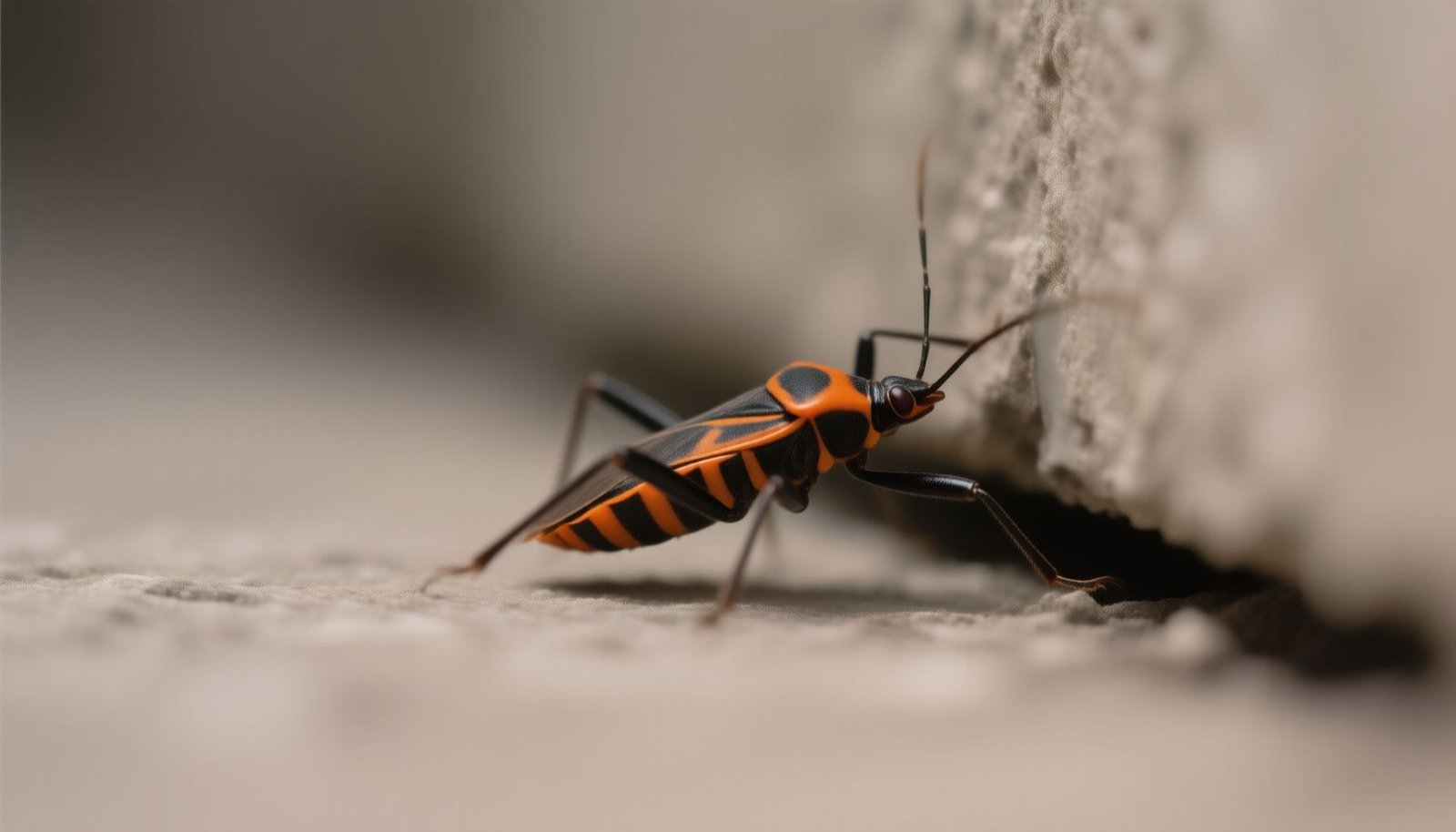
This close-up shows the distinctive cone-shaped head and banded abdomen of a triatomine bug — features that help you tell it apart from look-alikes like the western conifer seed bug or wheel bug before you handle it or assume it’s harmless.
Where Kissing Bugs Actually Live Around Your Property
Picture this: it’s a warm evening in Texas, and a homeowner’s dog has been sleeping in an outdoor kennel with a cracked concrete pad and old wood chips piled in one corner. The dog starts losing weight, develops an irregular heartbeat, and the vet eventually diagnoses Chagas cardiomyopathy. The kennel, it turns out, had been harboring triatomines for years — feeding on the dog nightly. This is not rare. Studies in Texas and Arizona have found triatomine infestation rates in dog kennels as high as 40% in endemic areas.
Kissing bugs are strongly associated with the burrows and nests of their preferred wildlife hosts: opossums, raccoons, wood rats, and armadillos. If those animals have denned under your porch, in a brush pile, or in a crawl space, triatomines followed them there. The bugs can survive outdoors through multiple seasons in the same harborage and will only enter your home when a light source draws them in or when their host animal moves on. This is why so many “random” indoor finds happen in late summer — bugs are dispersing from drying or disturbed nests.
How to Get Rid of Kissing Bugs Step by Step
Effective removal works in layers. You’re eliminating harborage, cutting off entry points, and applying targeted insecticide in the right sequence — not all at once, and not starting indoors. Each step below addresses a different part of their life cycle and movement pattern.
- Audit and remove outdoor harborage first. Move woodpiles at least 20 feet from the house and elevate them off the ground on metal racks. Clear leaf litter, brush piles, and rock stacks within 10 feet of the foundation. If wildlife has been nesting under a deck or porch, that shelter needs to be excluded with hardware cloth before any chemical treatment is applied.
- Treat the outdoor perimeter with a residual pyrethroid. Bifenthrin or cypermethrin applied as a 3-foot band around the foundation, along fence lines adjacent to brushy areas, and directly around outbuildings like dog kennels will kill triatomines on contact and leave a residual for 30–90 days depending on rainfall and product concentration. Apply at dusk, since these bugs are nocturnal.
- Seal every gap larger than 1/16 inch on the home’s exterior. Kissing bugs can squeeze through surprisingly tight spaces — torn window screens, gaps around pipe penetrations, loose mortar in stone foundations, and spaces under exterior doors without door sweeps. Use silicone caulk for small gaps and copper mesh or expanding foam for larger voids before sealing the surface.
- Relocate outdoor pets and secure their sleeping areas. Dogs in particular are at serious risk and should not sleep in outdoor kennels in endemic areas without a thorough inspection and treatment of the kennel structure. Replace dirt or wood chip flooring with concrete where possible, and wash and inspect kennel bedding weekly.
- Manage outdoor lighting strategically. Triatomines are highly phototactic — they fly toward light sources. Swap white outdoor bulbs for amber or yellow LED bulbs that attract significantly fewer insects. Keep lights positioned away from doors and windows, and turn off unnecessary exterior lights in peak activity months (May through September in most southern states).
- Apply a residual dust in crawl spaces and wall voids if indoor finds continue. Delta dust (deltamethrin) or CimeXa (silica gel) applied with a hand duster into crawl spaces, attic edges, and any voids where the structure meets the exterior provides a secondary barrier. These products remain effective for months and address bugs that get past the exterior perimeter.
One thing worth knowing: if you’ve found a kissing bug inside your home, don’t crush it with your hand. The feces are where T. cruzi transmission risk lives, and crushing the bug can smear that material. Use a gloved hand or tissue, seal it in a small zip bag, and either submit it to your state health department for species verification or dispose of it in an outdoor trash can away from the home.
Which Products Actually Work Against Kissing Bugs (and Which Don’t)
Not every product labeled for “crawling insects” performs the same against triatomines, and a few categories are genuinely worth separating from the noise. The research on triatomine control is fairly consistent: synthetic pyrethroids are effective, natural repellents are not, and ultrasonic devices have zero evidence behind them for any purpose involving this species.
| Product Type | Effectiveness Against Kissing Bugs | Best Use Case |
|---|---|---|
| Bifenthrin or cypermethrin spray (outdoor perimeter) | High — direct kill and residual | Foundation band, around outbuildings, fence lines |
| Deltamethrin dust (Delta Dust) | High in voids and dry areas | Crawl spaces, wall voids, kennel gaps |
| Silica gel dust (CimeXa) | High — physical desiccant, no resistance risk | Indoor voids, under appliances if needed |
| Natural essential oil sprays (cedar, peppermint) | Low to none — no field efficacy data for triatomines | Not recommended as standalone control |
One honest nuance here: if you’re in a border state like California, Arizona, New Mexico, or Texas with a known Triatoma gerstaeckeri or T. protracta population nearby, the perimeter spray approach genuinely makes a significant difference. If you’re in the mid-Atlantic or Pacific Northwest and found a single bug that may have hitchhiked in on someone’s clothing or camping gear, the treatment priority is very different — mostly verification, not remediation.
Pro-Tip: Apply your outdoor perimeter spray within 24 hours after a warm rain event when possible — triatomines become more active and mobile after humidity increases, making them more likely to contact treated surfaces while foraging. Evening applications in late spring and summer will also target peak dispersal flight activity.
When to Stop DIY and Call a Pest Control Professional
There’s a clear line between a manageable DIY situation and one where you’re genuinely out of your depth. A single kissing bug found indoors once, with no obvious harborage on the property and no pets showing symptoms — that’s a seal-and-monitor situation that most homeowners can handle. What crosses into professional territory is repeated finds over multiple weeks, evidence of wildlife nesting under the structure, or a dog or outdoor animal that’s been consistently exposed.
“Triatomine bugs are not like most structural pests — they don’t breed inside your home, which is actually good news. But it means the infestation pressure is always coming from outside, and if you have the right wildlife hosts and harborage conditions nearby, the pressure can be continuous. DIY perimeter treatments can be highly effective, but if there’s a wildlife reservoir actively using your crawl space or substructure, you need someone who can address both the pest and the habitat simultaneously.”
Dr. Rachel Mims, Board-Certified Entomologist and Texas A&M AgriLife Extension Specialist in Urban Pest Management
Pest control companies familiar with triatomine biology — particularly those operating in endemic states — will typically combine a perimeter residual spray with a wildlife exclusion assessment and sometimes a crawl space inspection. That combination costs more than a DIY spray run, but it addresses the source rather than just the symptom. Just as you’d consult a professional if you were dealing with a scorpion problem in and around your house — where venom risk changes the math on guessing — the disease transmission risk from triatomines makes professional verification worth the cost when finds are repeated.
How to Keep Kissing Bugs From Coming Back Long-Term
The one thing that separates a one-time find from a chronic problem is whether the conditions that attracted the bug in the first place have been corrected. Kissing bugs don’t choose your home randomly. They followed a food source — a rodent nest under your porch, a stray cat that sleeps in a wood pile, the opossums that raid your compost bin nightly. Removing the bug without removing what drew it there means you’re resetting the clock, not solving the problem.
Long-term prevention looks like this — and these aren’t one-and-done tasks, they’re a maintenance rhythm:
- Reapply outdoor perimeter insecticide every 60–90 days during active season (spring through early fall), or after heavy rainfall that degrades the residual.
- Inspect and reseal all exterior penetrations annually — rodent pressure and weathering can open gaps in caulk and foam that were sealed the previous year.
- Control the wildlife that hosts triatomines — this means sealing crawl spaces with hardware cloth, not leaving pet food outside overnight, and not allowing brush or debris to accumulate near the structure.
- Check window and door screens every season and repair any tears immediately — a 1/4-inch tear in a screen is more than enough for a triatomine to enter.
- Talk to your vet about Chagas disease testing if your dog spends time outdoors in endemic areas, particularly if the dog has ever lived in or near an area where kissing bugs are known to be present.
An interesting parallel: if you’ve dealt with overwintering pests like cluster flies in your windows and attic, you already understand the principle of outside-in pressure — insects that aren’t trying to colonize your home, they’re just using it as a waypoint. The control logic is similar: reduce outdoor conditions that make the structure appealing, then seal the entry points so the ones that remain outside stay there.
Kissing bugs are ultimately a manageable problem in most US homes — but only if you treat them as the outdoor pest they actually are, not as something to spray inside and forget. The disease risk is real, the exposure window is short, and the prevention steps are specific. Get those right, and a kissing bug inside your home can go from a recurring health concern to a single unusual event that never happens again.
Frequently Asked Questions
how to get rid of kissing bugs naturally
You can reduce kissing bugs naturally by sealing cracks and gaps around doors, windows, and your home’s foundation with caulk or weatherstripping. Remove outdoor debris like woodpiles, leaf litter, and rock piles within 20 feet of your house, since these are prime hiding spots. Cedar oil sprays and diatomaceous earth applied along entry points can also help deter them without harsh chemicals.
what kills kissing bugs on contact
Pyrethroid-based insecticides — like those containing bifenthrin or cyfluthrin — kill kissing bugs on contact and are available at most hardware stores. Apply them around the perimeter of your home, focusing on cracks, crevices, and areas where walls meet the floor. For indoor infestations, a licensed pest control professional can apply more targeted treatments safely.
are kissing bugs dangerous to humans
Yes, kissing bugs can be dangerous because they’re capable of transmitting Chagas disease through their feces, not their bite. Not every kissing bug carries the parasite, but the risk is real — Chagas disease affects an estimated 300,000 people in the US. If you’ve been bitten or find kissing bugs in your home, it’s worth contacting your doctor and a pest control professional.
what attracts kissing bugs to your house
Kissing bugs are drawn to outdoor lighting, warm-blooded hosts (including pets), and cluttered areas close to your home where they can hide during the day. They often enter houses through gaps in doors, windows, and walls, especially in single-story homes in the southern and southwestern US. Keeping outdoor lights turned off or switching to yellow bug lights can make your home less attractive to them at night.
how do I know if I have kissing bugs or just regular stink bugs
Kissing bugs are oval-shaped, about 3/4 to 1 inch long, and have a distinctive cone-shaped head with orange or red stripe markings along the edges of their abdomen. Stink bugs are wider, shield-shaped, and don’t have those colored stripe markings. If you’re unsure, don’t handle the bug with bare hands — capture it in a sealed bag and compare it to images from your local county extension office for a positive ID.
Disclaimer: This article is for informational purposes only and isn’t a substitute for professional pest control advice. Always read and follow the product label instructions exactly — label directions are legally binding and vary by brand and active ingredient. Keep all pesticides, baits and traps away from children and pets, ventilate treated areas as directed, and consider calling a licensed pest control professional if an infestation is large, recurring, or involves a structural pest like termites or carpenter ants.