
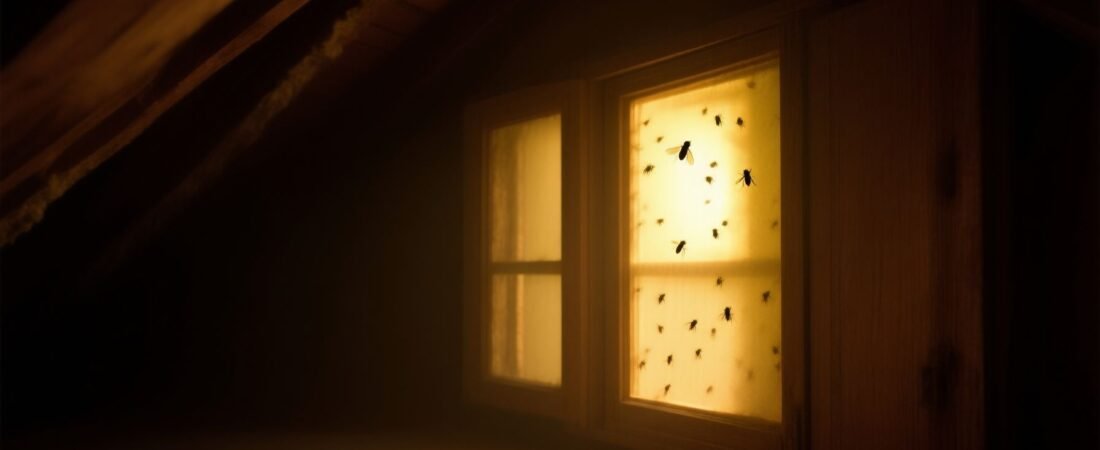
Cluster flies aren’t coming inside because your house is dirty or your food is exposed — they’re coming inside because your house is warm and they need to survive winter. That’s the distinction almost every homeowner misses, and it’s why the sprays aimed at the windows in October do almost nothing to stop the problem the following fall. You’re treating a symptom. The flies that cluster on your south-facing windows and pile up in your attic by the hundreds are following thermal cues baked into their biology, and until you address what’s actually drawing them, they’ll be back every single year without fail.
Why Cluster Flies Keep Coming Back to the Same Windows Every Year
Cluster flies — Pollenia rudis, if you want the scientific name — are parasitic on earthworms during their larval stage, which means they breed outdoors in your lawn, not inside your home. The adults that emerge in late summer spend a few weeks feeding, then instinctively search for a sheltered overwintering site as temperatures drop, typically once nighttime temps fall below 54°F consistently. Your house, with its sun-warmed siding, uninsulated eaves, and south-facing windows, reads to them as the ideal hibernation spot. And here’s what makes them genuinely aggravating: they release an aggregation pheromone that marks the site as “safe” for other cluster flies. That pheromone persists on surfaces long after the flies are gone — sometimes for years — which is exactly why the same windows and the same attic corners get re-colonized season after season even if you killed every fly that entered last fall.
A single cluster fly infestation can involve anywhere from a few dozen to several thousand individuals in one attic space. Picture this: you head up to your attic in early November to grab a storage bin, and the ceiling is literally moving — a slow, sluggish mass of flies awakened by the warmth of the light you just switched on. That’s not a freak occurrence. It’s what happens when pheromone-marked entry points go unsealed for two or three seasons running. The good news is that cluster flies are sluggish by nature once they’ve cooled down, which actually works in your favor when it comes to removal — but only if you understand the right sequence of steps.
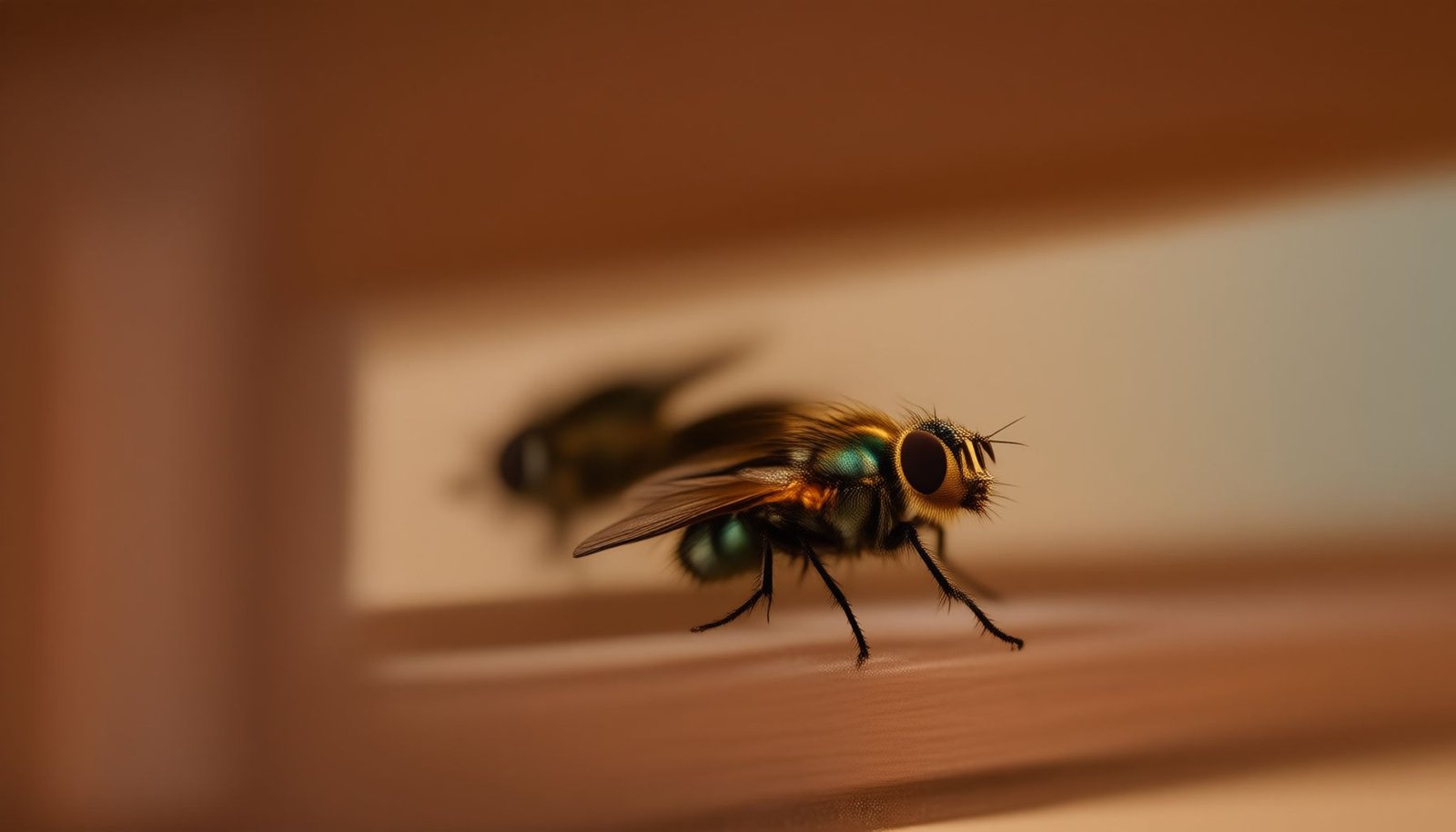
This close-up shows the characteristic golden-yellow hairs on the thorax that distinguish cluster flies from common house flies — a detail that matters because the two species respond differently to control methods, and misidentifying them can lead you to waste money on the wrong products.
How to Tell Cluster Flies Apart From House Flies (Before You Treat)
Treating for the wrong fly is an expensive mistake. Cluster flies are larger than common house flies — typically 8–10mm compared to the house fly’s 6–7mm — and they move slowly, almost groggily, especially in cool temperatures. The most reliable visual marker is the golden-yellow bristly hair on the thorax, visible without magnification if you look closely. Their wings also overlap flat across their back when resting, whereas house fly wings splay out slightly to the sides. Behavior is another giveaway: cluster flies tend to congregate in large numbers on sun-exposed walls and windows on warm autumn afternoons, then retreat toward wall voids and attic spaces as evening cools down.
One counterintuitive detail most people don’t know: cluster flies on your windows in winter aren’t trying to get out — they’re being tricked by the light. They’ve already entered wall voids and attic spaces to overwinter in a semi-dormant state called diapause. On days when interior temperatures rise (from sunlight or your heating system), they warm up, become active, and navigate toward light sources instinctively. That’s why you see them crawling on the glass in January when you haven’t opened a window in weeks. They were already inside the structure. Understanding this changes your control strategy entirely.
“Homeowners often try to treat cluster flies as a window problem or an attic problem, but the real intervention point is the building envelope in late summer, before the flies enter. Once they’re inside wall voids and attic spaces, your options narrow considerably. Exclusion applied between early August and mid-September — before the first sustained cool nights — stops the aggregation before it starts.”
Dr. Renata Kowalski, Board-Certified Entomologist and Urban Pest Management Consultant
The Real Fix: Exclusion Timing Is Everything
Here’s where most DIY cluster fly guides go wrong: they tell you to seal gaps and caulk cracks as a general tip, without telling you that timing this work correctly is the single biggest factor in whether it works. Sealing entry points in November — after the flies have already entered — traps them inside the wall voids, where they’ll die slowly and potentially create secondary pest problems as the bodies decay and attract carpet beetles and larder beetles. The window for effective exclusion is late summer, roughly 6–8 weeks before your region’s first hard frost, when flies are still feeding outdoors and haven’t yet begun seeking overwintering sites.
The specific gaps to target aren’t always obvious. Cluster flies most commonly enter through utility penetrations (where electrical conduit, plumbing, and cable lines pass through exterior walls), under soffit panels, around loose or missing fascia board sections, through gaps where siding meets the foundation, and through unscreened attic vents. A gap as small as 3mm — roughly 1/8 inch — is enough for a cluster fly to squeeze through. Audit these locations on the south and southwest faces of your home first, since those are the sun-warmed surfaces flies preferentially target. The north side of most homes sees far fewer cluster fly entry attempts.
Pro-Tip: Before sealing any gaps in late summer, push a small amount of pest-control-grade pyrethrin dust (like CimeXa or Delta Dust) into the void space first with a hand duster. This kills any flies already clustering near the entry point and neutralizes residual aggregation pheromones inside the void, reducing re-attraction the following season. Don’t skip this step — sealing without treating the void interior means next year’s flies will still detect the pheromone trail and probe aggressively at the sealed areas.
Step-by-Step: Getting Rid of Cluster Flies Already Inside
If you’re reading this in October, November, or later, the exclusion window has already passed for this season. That’s okay — there’s still a logical sequence for dealing with flies that are already inside. The approach depends on whether they’re actively flying around living spaces or still dormant in wall voids and attic spaces, and getting that distinction right determines whether you need a residual spray, a physical trap, or a combination of both.
Just like Asian lady beetles, which overwinter in structures using similar thermal-seeking behavior, cluster flies respond best to a layered control approach rather than one single product or method. Here’s the sequence that actually works, in order of priority:
- Don’t heat the attic. If flies are dormant in your attic, any heat source — a space heater left on, or even excessive warmth from below — activates them and drives them into living spaces. Keep the attic cool until you’ve treated it.
- Apply a residual pyrethroid spray to attic surfaces. Products containing cypermethrin or lambda-cyhalothrin (applied as a crack-and-crevice or general surface treatment) kill dormant flies on contact and leave a residual that’s effective for 4–6 weeks. Focus on wall junctions, rafter areas, and any visible cluster sites.
- Use a vacuum with a HEPA filter for accessible clusters. For flies on windows or visible wall surfaces inside living areas, a vacuum removes them quickly without the dead-fly smell that comes from pesticide kill. Empty the canister into a sealed bag immediately outdoors.
- Install UV light traps in the attic. Electric fly killers (EFKs) with UV bulbs placed in the attic catch flies that become active on warm days throughout winter, reducing the total population progressively. Position them near the peak of the roofline where heat accumulates.
- Treat window frames and sills with a residual contact spray. Cluster flies on windows are already inside, but a residual spray on the sill and frame prevents them from moving further into living areas and kills them before they disperse. Reapply every 3–4 weeks through late winter.
- Mark your calendar for early August. The most important step for long-term control happens next summer. Set a reminder now, while the problem is fresh, so you don’t miss the exclusion window again.
Cluster Fly Products That Actually Work (and What to Skip)
The pest control aisle is full of products marketed for flies, but most of them weren’t designed with cluster flies specifically in mind. Bait stations and food-attractant traps that work well on house flies and fruit flies do essentially nothing for cluster flies, because cluster flies in their overwintering phase aren’t feeding — they’re in a physiological state where food attraction is suppressed. Burning through $40 worth of bait traps to catch three flies and then wondering why the attic is still full of them is a frustration that’s completely avoidable if you know this going in.
Here’s a quick comparison of the product categories most commonly used for cluster flies so you can make an informed decision based on where your problem is concentrated:
| Product Type | Best Location | Effectiveness for Cluster Flies |
|---|---|---|
| Pyrethroid residual spray (cypermethrin, lambda-cyhalothrin) | Attic surfaces, exterior building envelope | High — kills on contact, provides 4–6 weeks residual |
| Insecticidal dust (Delta Dust, CimeXa) | Wall voids, soffit cavities, entry points | High — long residual, works in hard-to-reach voids |
| UV electric fly killer (EFK) | Attic, large enclosed spaces | Moderate — good for ongoing population reduction during winter |
| Food-attractant bait trap | Anywhere | Very low — cluster flies in diapause are not feeding |
For exterior preventive treatment in late summer, a perimeter spray applied to the south and southwest walls — from foundation to roofline — using a pump sprayer with cypermethrin concentrate is one of the most effective single actions you can take. Apply it when temperatures are above 50°F and rain isn’t expected for at least 24 hours. One application timed right can reduce the number of flies that successfully enter by 60–80%, according to data from university extension pest management trials. That’s a meaningful reduction even if it’s not a complete solution on its own.
Lawn treatment is worth mentioning, though with an honest caveat: because cluster fly larvae develop inside earthworms in the soil, treating your lawn with a soil insecticide theoretically reduces the next generation of adult flies. In practice, the reduction is modest and difficult to measure, the treatment needs to cover a large area to be meaningful, and it harms earthworm populations that are beneficial to soil health. It’s an option worth discussing with a licensed pest professional if your infestation is severe and recurring, but it’s not a front-line recommendation for most homeowners. Exclusion and targeted residual treatment will get you further with less collateral impact. Problems with other fall-invading pests like those discussed in our guide on getting rid of yard pests without damaging your lawn illustrate the same principle — sometimes the most aggressive-looking option isn’t the most effective one.
One thing that depends heavily on your specific situation: if you have a very old home with original wood siding, plaster walls, and minimal insulation, your exclusion options are more limited than in a newer, tightly-built house. Gaps are simply more numerous and harder to seal completely. In those cases, annual residual spray treatment of the building envelope in late summer, combined with attic UV traps, is probably more realistic than achieving complete exclusion. Set expectations accordingly and don’t let perfect be the enemy of good.
The facts about cluster flies that most articles skip over are the ones that actually change behavior: they’re not here because of anything wrong with your home’s cleanliness, they’re following a pheromone trail that persists between seasons, and spraying the windows in October is roughly equivalent to closing the barn door after the horses are already inside. Fix the envelope in August, treat the void before you seal it, and you’ll see a dramatic difference within one season. That’s the kind of change that actually sticks — and once you’ve been through one successful exclusion cycle, the annual maintenance becomes a 30-minute job rather than a recurring nightmare.
The flies will try again next year. They always do. But if the pheromone trails are gone and the entry points are sealed, they’ll move on to your neighbor’s house instead — and that’s exactly where you want them.
Frequently Asked Questions
Why do I have cluster flies in my windows every fall?
Cluster flies move indoors when temperatures drop below 50°F, and they’re drawn to south- and west-facing windows because those walls absorb the most heat. They’re not breeding inside your home — they’re just looking for a warm place to overwinter. Once they find a good spot, they release a pheromone that attracts more flies to the same location year after year.
How do I get rid of cluster flies in my attic?
A vacuum is your best first move — it removes live and dead flies without spreading the oily residue they leave behind. For heavier infestations, a pyrethrin-based aerosol spray labeled for cluster flies can be applied directly in the attic space. Seal any gaps larger than 1/8 inch around eaves, vents, and fascia boards before late summer to stop them from getting in next season.
Are cluster flies dangerous to humans or pets?
Cluster flies aren’t a direct health threat — they don’t bite, sting, or transmit diseases to people or pets. They do leave behind a greasy residue and a distinct sour smell when crushed or present in large numbers, which can stain walls and ceilings. The bigger issue is that an untreated infestation can number in the hundreds or even thousands by late winter.
What’s the difference between cluster flies and house flies?
Cluster flies are slightly larger than house flies, about 3/8 inch long, and they have a distinctive golden-yellow hair on their thorax that house flies don’t have. They also move more sluggishly, especially in cooler temps, and tend to cluster together in groups rather than scatter. House flies breed in garbage and decaying matter, while cluster flies develop as parasites inside earthworms outdoors.
How do I keep cluster flies from coming back next year?
The most effective long-term fix is sealing your home’s exterior in late summer before they start looking for overwintering sites — focus on gaps around window frames, roof soffits, utility penetrations, and attic vents. Use silicone or latex caulk for small cracks and steel wool plus expanding foam for larger openings. Some pest control companies also offer perimeter insecticide treatments in early fall that can significantly reduce how many flies make it inside.
Disclaimer: This article is for informational purposes only and isn’t a substitute for professional pest control advice. Always read and follow the product label instructions exactly — label directions are legally binding and vary by brand and active ingredient. Keep all pesticides, baits and traps away from children and pets, ventilate treated areas as directed, and consider calling a licensed pest control professional if an infestation is large, recurring, or involves a structural pest like termites or carpenter ants.