
You don’t have a “rodent problem.” You have either a mouse problem or a rat problem — and treating the wrong one is exactly how people waste three weeks and fifty dollars on traps that never catch a thing. The species matters more than most pest articles let on, because mice and rats don’t just look different; they behave differently, nest differently, and respond to completely different control strategies. Getting the ID wrong from the start is the single most common reason DIY rodent control fails.
Why Misidentifying Mice vs Rats Leads to Failed Traps and Wasted Money
Here’s what nobody tells you up front: mice are curious by nature, and rats are deeply suspicious of anything new in their environment. That biological difference — called neophobia in rats — means a snap trap that works perfectly for mice will sit untouched by a rat for days or even weeks until the rat has grown comfortable enough to approach it. If you’ve set traps and caught nothing, that’s often not bad placement. It’s that you’ve set mouse traps for an animal that isn’t a mouse.
Rats also require much larger, heavier-duty traps and more bait to trigger them. A standard snap trap designed for mice has a hair-trigger that works well on a 20-gram house mouse, but a Norway rat can weigh 12 times that — over 500 grams — and will simply steal bait from a mouse-sized trap without setting it off. This mismatch between pest and product is why the species identification step isn’t just academic. It directly controls whether your control effort works at all.

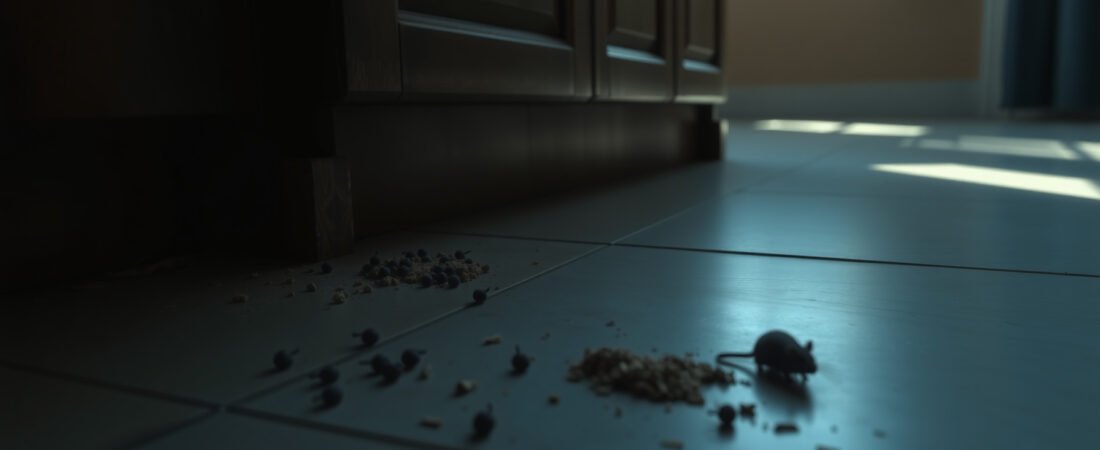
This side-by-side comparison shows the actual size difference between mouse and rat droppings, along with gnaw mark scale — the details that let you identify your rodent before you ever see the animal itself.
What Do Mouse and Rat Droppings Actually Look Like?
Droppings are almost always the first evidence homeowners find, and they’re one of the most reliable ways to tell the two apart — if you know what you’re actually comparing. Mouse droppings are small, roughly 3–6 mm long, dark brown to black, and shaped like a grain of rice with pointed ends. Rat droppings are noticeably bigger: Norway rat droppings run 18–20 mm, and roof rat droppings are slightly smaller at around 12–13 mm but still much larger than anything a mouse leaves behind. The shape matters too — Norway rat droppings are blunt-ended capsules, while roof rat droppings are curved and tapered at both ends.
Fresh droppings are dark and have a slightly moist sheen. Older ones dry out, fade to gray, and crumble when pressed. That age distinction actually tells you something useful: if you find fresh droppings on top of older, gray ones, the infestation is still active right now, not a remnant of something that passed through months ago. One practical tip — if you’re not sure whether an infestation is current, clean up all visible droppings in a confined area and check back within 24–48 hours. New droppings confirm active activity.
| Feature | House Mouse | Norway Rat | Roof Rat |
|---|---|---|---|
| Dropping size | 3–6 mm | 18–20 mm | 12–13 mm |
| Shape | Rice-like, pointed ends | Blunt capsule | Curved, tapered ends |
| Body weight | 15–25 g | 200–500 g | 150–250 g |
| Entry gap needed | 1/4 inch (6 mm) | 1/2 inch (12 mm) | 1/2 inch (12 mm) |
How to Use Gnaw Marks and Damage Patterns to Confirm Which Rodent You Have
Gnaw marks are underrated as an identification tool. Mice have small teeth and leave fine, scratchy gnaw marks — you’ll often see them along the bottom edges of food packaging, on thin wood trim, or on soft materials like insulation and foam. Rat gnaw marks are rougher, wider, and more aggressive — they can chew through soft metals, lead pipes, PVC, and even concrete block over time. A rat’s incisors are hard enough to score aluminum, which is genuinely alarming the first time you see it on a water pipe.
The location of damage also gives you a clue about species. Norway rats are ground-dwelling burrowers — they tend to damage lower areas of walls, foundations, and floor-level cabinets. Roof rats are climbers and prefer elevated spaces like attics, the tops of wall cavities, and areas near the roofline. Mice range everywhere but are especially common inside wall voids, inside kitchen cabinets, and in the spaces between appliances and cabinetry. Picture this: you find shredded insulation in your attic along the top plates of the walls, with droppings that are curved and tapered. That’s almost certainly a roof rat situation — and knowing that changes your whole trapping strategy.
Pro-Tip: Smear a thin layer of flour or baby powder along a baseboard where you’ve seen droppings. Check it the next morning for footprints. Mouse tracks show tiny prints about 3/8 inch across; rat tracks are nearly an inch wide and show a dragging tail mark between the feet.
Size, Body Shape, and Behavior Differences You Can Actually See
If you catch a glimpse of the animal itself, the size difference is obvious once you know what to look for — but a lot of people misjudge it in low light or when they only see the animal for a second. An adult house mouse is about 5–7 inches from nose to tail tip and looks almost delicate, with large rounded ears relative to its head, a pointed snout, and a thin tail roughly equal in length to its body. A Norway rat is 13–17 inches total and looks stocky and heavy, with a thick blunt snout, proportionally smaller ears, and a scaly tail that’s shorter than its body length.
Behavior is where it gets counterintuitive. Mice are bold and exploratory — they’ll investigate new objects within hours of appearance, which is why mouse traps can catch mice on the very first night. Rats do the opposite: a new trap or bait station placed in a rat’s regular run may go untouched for 3–5 days while the rat circles it, sniffs it, and decides it’s safe. This is why pest control professionals often place unset, unbaited rat traps for several days before arming them — a step that feels pointless but actually doubles catch rates. That’s an insight most homeowners never get from the packaging insert.
“The number one mistake I see homeowners make is setting rat-sized bait stations but buying mouse-formula bait blocks — the dose is wrong, the station opening is too small for the rat to enter comfortably, and they conclude ‘nothing works’ when the real issue was a misidentification on day one. Always confirm your species before you buy a single trap.”
Dr. Marcus Heilbron, PhD Urban Entomology, NPMA-Certified Pest Management Professional
How to Tell Which Rodent You Have When You Haven’t Seen the Animal at All
Most people never actually see the rodent. They hear sounds, find evidence, and have to work backward from clues — which is actually fine, because the evidence is often more reliable than a blurry nighttime sighting. Here’s how to read the scene systematically when you’re working with indirect signs only:
- Measure the droppings. Grab a ruler. Under 6 mm with pointed ends = mouse. Over 12 mm = rat. This single measurement eliminates most ambiguity immediately.
- Check the entry points. Look for rub marks — dark, greasy smudges along walls, baseboards, and entry gaps from the oils in rodent fur. Rat rub marks are wider and darker than mouse rub marks and often appear along floor-level wall runs.
- Listen for timing and location of sounds. Mice are active on and off throughout the night and often sound like light scratching or rustling inside wall voids at mid-height. Rats tend to make heavier thumping or running sounds, and Norway rats are often heard at floor or ceiling level between living spaces and crawlspaces.
- Examine food damage. Mice nibble — they make many small holes in packaging and rarely consume large amounts in one spot. Rats eat heavily from a single location, leaving larger, cleaner-edged openings in bags and containers.
- Look for nesting materials. Mouse nests are golf ball to tennis ball sized, made from finely shredded soft material — paper, fabric, insulation fibers. Rat nests are larger, looser constructions often found in burrows under concrete slabs, inside wall voids, or in attic insulation near the eaves.
- Note the height of activity. Damage and droppings concentrated above 4 feet — in attic spaces, drop ceilings, or upper cabinet areas — strongly suggests roof rats. Activity concentrated at ground level, in crawlspaces, or along exterior foundation walls points to Norway rats or mice.
One honest nuance worth knowing: in older multi-unit buildings, especially in dense urban areas, it’s not unusual to have both mice and rats in the same structure simultaneously — just in different zones. Rats dominate the basement and ground floor; mice often work the upper floors where rats don’t typically travel. If you’re a renter dealing with a situation like this and wondering who’s responsible for paying for control, the answer depends on your state and lease — Who Pays for Pest Control in a Rental: Cockroaches and Rodents Explained breaks that down in full detail.
Does It Actually Matter Which Professional Exterminator You Call for Rodents?
Species identification isn’t just a DIY concern — it affects how professional services approach the job, which protocols they use, and frankly, what they quote you. A technician who misidentifies Norway rats as mice will set the wrong bait stations, use the wrong placement logic, and potentially miss exterior burrow sites entirely. The quality gap between pest control companies on rodent jobs is real, and it mostly comes down to whether the technician actually does a proper inspection before recommending a treatment plan or just fills a service call with standard mouse glue boards.
Here’s what to look for when vetting a professional: they should inspect exterior entry points, ask about the location and volume of droppings, and specify in writing which species they’re treating for and why. If a technician gives you a quote without walking your perimeter or asking where you’ve seen evidence, that’s a red flag regardless of which company they work for. For a side-by-side look at how the major national providers handle rodent inspections and what you’re actually paying for, Orkin vs Terminix vs Rentokil: Which Pest Control Service Is Best? covers that comparison in depth.
- A proper rodent inspection should cover interior and exterior — inside only is never enough
- Ask the technician to confirm the species before any product is placed — this should be standard, not a special request
- Exclusion (sealing entry points) matters more than trapping alone — without it, new rodents replace the ones you catch within days
- Norway rat burrow treatments require granular or block bait placed at or near burrow openings — not interior snap traps
- Roof rat control often requires attic-based trapping and securing roof penetrations — a technician who ignores the roofline is missing the source
Getting the species right before you buy anything, set anything, or call anyone is the step that determines whether the next two weeks end in success or frustration. The evidence is almost always there — the droppings, the gnaw marks, the rub stains, the sounds — and once you know how to read it, you’re no longer guessing. You’re diagnosing. And a correct diagnosis is the one thing no rodent can outrun.
Frequently Asked Questions
how do I tell if I have mice or rats in my house?
The easiest way is to look at droppings and size of any damage. Mouse droppings are tiny — about 1/8 to 1/4 inch long with pointed ends — while rat droppings are 3/4 inch or longer with blunt ends. You can also check gnaw marks: rats leave large, rough chew marks on wood and pipes, while mice leave smaller, cleaner damage around food packaging and baseboards.
how big are mouse droppings compared to rat droppings?
Mouse droppings are roughly the size of a grain of rice — about 1/8 to 1/4 inch long — with pointed tips on both ends. Rat droppings are much larger, anywhere from 1/2 to 3/4 inch long, and look more like a small brown capsule with rounded or blunt ends. If you’re finding droppings bigger than 1/2 inch, you’re almost certainly dealing with rats, not mice.
what does mouse damage vs rat damage look like in walls?
Mice tend to gnaw small, clean holes — usually about the size of a dime — to get into walls or cabinets. Rats chew much larger openings, closer to the size of a quarter or bigger, and they’ll often gnaw through harder materials like wood beams, plastic pipes, and even soft concrete. If you’re seeing structural damage or chewed wiring, rats are the more likely culprit.
can you have both mice and rats in your house at the same time?
It’s actually pretty uncommon, because rats will prey on mice and drive them out of shared spaces — this behavior is called muricide. That said, if your home is large enough or has separate entry points, it’s possible to have both in different areas at once. If you’re seeing droppings of two different sizes in different parts of the house, that’s a sign worth calling a pest control professional to assess.
what are the signs of rats vs mice in the attic?
In the attic, rats — especially roof rats — leave larger droppings, grease marks along rafters, and shredded insulation used as nesting material in concentrated spots. Mice leave smaller droppings scattered more widely, smaller nests made from soft materials like fabric or paper, and lighter grease smears if any. Rats also tend to make louder thumping or scurrying sounds at night since they’re 6 to 9 inches long compared to a mouse’s 2 to 4 inches.