

Silverfish aren’t actually fish — and they almost certainly aren’t living where you think they are. Most people who spot one assume it wandered in from outside and leave it at that. The real problem is that silverfish are expert hiders, they breed slowly but steadily, and the places they colonize aren’t the ones most homeowners check first. By the time you see a single silverfish darting across your bathroom floor, there are likely dozens more tucked away somewhere you haven’t looked.
What Does a Silverfish Actually Look Like Up Close?
Silverfish (Lepisma saccharina) are teardrop-shaped insects, wide at the head and tapering to a narrow rear end, usually measuring between ½ inch and ¾ inch in length as adults. Their bodies are covered in flat, metallic scales — silver to bluish-gray in color — that give them a shimmering appearance when light catches them at the right angle. That same scale coating is why they feel so slippery and fast when you try to catch one.
Three long, threadlike appendages extend from the rear: two cerci flanking the sides and one central terminal filament pointing straight back. Six legs carry them in a fluid, wiggling side-to-side motion that genuinely resembles a fish swimming — that’s where the name comes from, not their color alone. Their antennae are equally long, constantly feeling the environment ahead of them, which is part of why they move so decisively even in complete darkness.
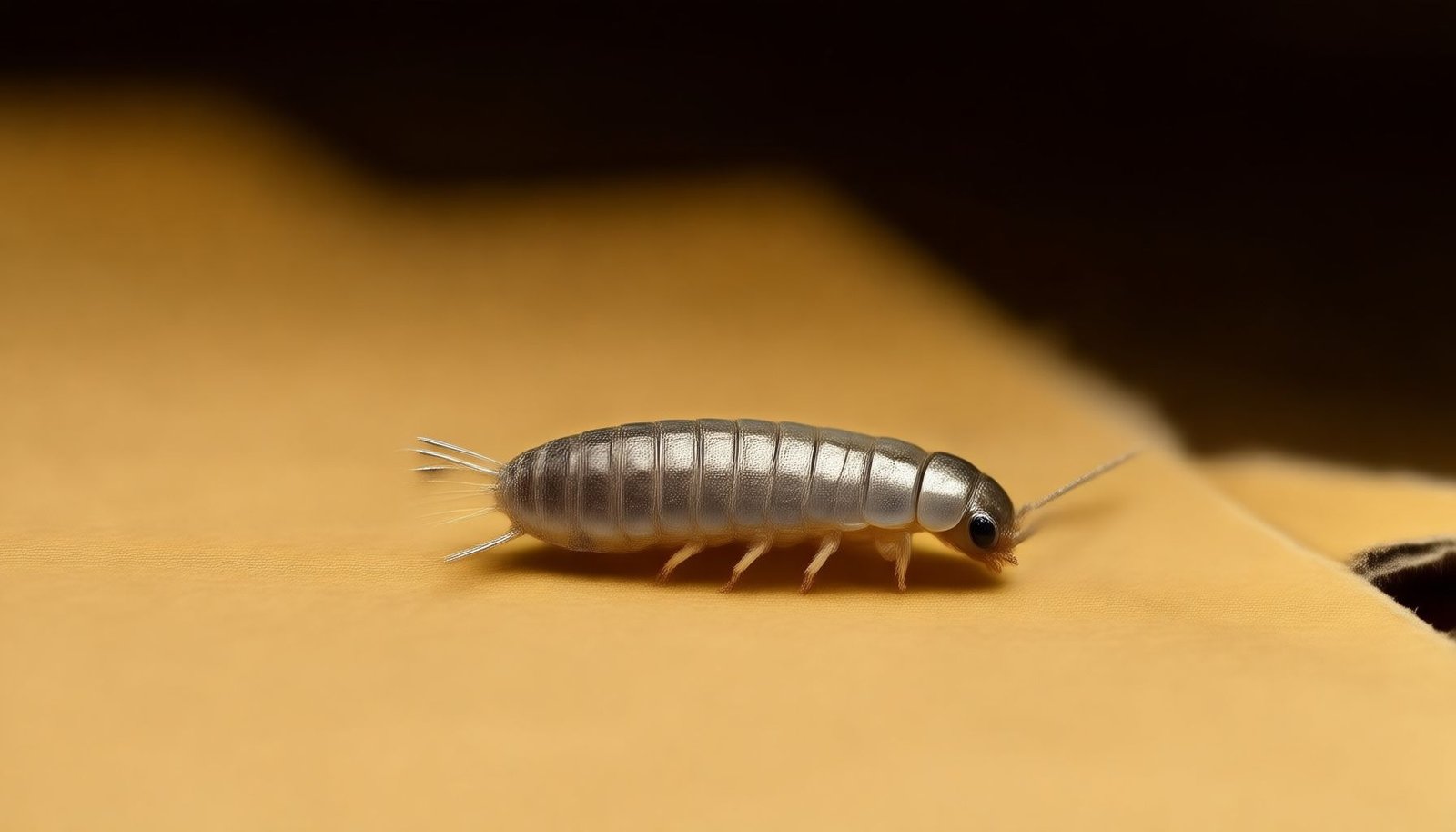
This close-up shows the three rear filaments and the overlapping scale pattern that make silverfish unmistakable once you’ve seen them — details that matter because several other household insects can be misidentified as silverfish at a glance.
How Do You Tell a Silverfish Apart From Similar Bugs?
The bug most commonly confused with silverfish is the firebrat (Thermobia domestica), and the mix-up is understandable — they’re nearly identical in shape and size. The key difference is color: firebrats are mottled brown and gray with a pattern of darker spots or bands across the body, while silverfish are uniformly silver or steel-gray. Firebrats also prefer hot, dry environments like furnace rooms and bakeries, whereas silverfish gravitate toward cool, damp spaces. There’s already a dedicated comparison of firebrats vs. silverfish on this site if you want the side-by-side breakdown.
Earwigs are another frequent source of confusion, but earwigs have a pair of obvious pincer-like cerci at their rear — nothing like the three long, thread-thin filaments on a silverfish. Springtails are sometimes mistaken for silverfish too, but springtails are much smaller (under 2mm) and jump when disturbed, which silverfish never do. If the bug you saw ran fast, moved in a wave-like pattern, and had two visible antennae plus three rear tails, you’re looking at a silverfish.
“Silverfish are one of the most primitive insect groups still alive — they haven’t changed meaningfully in over 400 million years. Their biology reflects that: they’re built for stealth and survival, not speed or aggression. The reason homeowners underestimate them is that they mistake a small sighting for a small problem. In my experience, a single adult silverfish in a finished basement usually means an established population is already living in the wall voids or subflooring nearby.”
Dr. Karen Voss, Entomologist and Urban Pest Specialist, Purdue University Extension
Where Do Silverfish Actually Live Inside Your Home?
Here’s what most articles get wrong: silverfish are not primarily a bathroom pest. Yes, they show up in bathrooms, but that’s usually where they’re foraging, not where they’re nesting. Their actual harborage points tend to be areas with consistent humidity above 75%, minimal foot traffic, and a nearby food source. That description fits attics, wall voids behind insulation, spaces under subflooring, and the backs of closets far more than it fits an open bathroom floor.
A silverfish population needs three things to sustain itself: moisture, warmth (they thrive between 70°F and 80°F), and starchy or protein-rich organic material to eat. Attics with fiberglass insulation, old cardboard boxes, and a small roof leak check every one of those boxes. So do cluttered basement storage areas, laundry rooms with persistent condensation, and the space behind kitchen cabinets where a slow pipe drip has gone unnoticed for months. If you’re finding what looks like tiny irregular notches chewed out of paper, wallpaper, or fabric in areas you rarely disturb, silverfish are the most likely culprit.
Pro-Tip: Pull out the bottom drawer of any dresser or bookcase sitting against an exterior wall or basement wall and look at the underside of the drawer and the floor beneath it. Silverfish frequently colonize this exact gap — it’s dark, rarely disturbed, slightly cooler than the room, and often collects paper debris and dust they can eat. This is one of the first places to check and almost never gets mentioned.
What Signs Confirm a Silverfish Infestation Beyond Sightings?
Spotting a single silverfish is meaningful, but the evidence they leave behind tells you far more about the scale and location of the problem. Silverfish are nocturnal and genuinely shy — they’ll detect vibration through the floor and reverse course before you even enter the room. Relying on direct sightings alone to gauge an infestation is like trying to estimate how many fish are in a lake by counting the ones that jump.
Look for these physical signs, which accumulate even when the insects themselves stay hidden:
- Irregular feeding damage: Ragged, notched edges on paper, book bindings, wallpaper, and fabric — not clean cuts, but scraped-looking surface damage where they’ve grazed the material rather than bitten through it.
- Yellow staining: A pale yellow residue on paper or fabric caused by their scale secretions and waste. Old books and stored documents are a classic location for this.
- Shed scales: Silverfish molt throughout their entire adult lives — up to 30 times — leaving behind tiny, translucent, flattened scale particles in undisturbed corners and under furniture.
- Fecal pellets: Tiny black pepper-like droppings, roughly spherical and about the size of a coarse grain of pepper. Look for them along baseboards, in drawer corners, and under stacked paper.
- Molted exoskeletons: Full shed skins, identical in shape to the live insect but hollow and papery — these are definitive proof of an active population.
One thing worth knowing: silverfish damage to books and papers often gets blamed on humidity alone, or on mice. If you’re finding small irregular surface scrapes on paper products in enclosed spaces but can’t figure out what’s eating them — and you’ve ruled out rodents — check for the other signs above before assuming it’s environmental.
How Fast Do Silverfish Multiply and Why Does That Matter for Identification?
Silverfish reproduce slowly compared to most household pests, and that’s exactly why their infestations go undetected for so long. A female silverfish lays eggs in small clusters — usually 2 to 20 eggs at a time, deposited in cracks, under debris, or inside folded paper — and the eggs take between 19 and 60 days to hatch depending on temperature and humidity. Nymphs then go through multiple molts over a period of 3 months to 3 years before reaching adulthood, again depending on environmental conditions. Adults can live for 2 to 8 years, continuing to reproduce throughout that entire lifespan.
Picture this: a pair of silverfish establishes itself in a cluttered attic storage area after entering through a gap around a pipe penetration. They’re out of sight, conditions are ideal, and nobody disturbs the area. Within 18 months, that population can easily reach into the hundreds — yet the only visible sign in the rest of the house might be an occasional individual spotted in the upstairs hallway at night. This is why the population size matters for identification purposes: how many you’re seeing, and where, gives you real information about how established the infestation is and where the source location likely is.
| Frequency of Sightings | Likely Infestation Stage | Probable Source Location |
|---|---|---|
| 1–2 insects over several weeks | Early or exploratory — may be new arrivals | Entry point nearby; exterior gaps, plumbing chases |
| Several per week, different rooms | Established colony foraging widely | Wall void, attic, or basement with stable humidity |
| Multiple per night, same area consistently | Heavy infestation with nearby harborage | Behind or under the surface nearest the sighting |
One honest nuance: in older homes with stone foundations and naturally high basement humidity in wet climates, some low-level silverfish activity can persist almost indefinitely even after treatment — not because control failed, but because the structural conditions are nearly impossible to fully correct. Sealing cracks and running a dehumidifier matters enormously in those situations, and the bar for “infestation” versus “occasional visitor” looks different in a 1920s New England farmhouse than in a sealed modern townhouse.
What Are the Step-by-Step Ways to Confirm You Have Silverfish and Not Something Else?
If you’ve seen something fast and silver but aren’t completely sure what it was, a methodical check will get you a confident answer. Don’t rely on a single observation — silverfish share some habitats with other small insects, and misidentification leads to wasted effort. If you’ve been finding tiny unidentified bugs in your kitchen and aren’t sure whether silverfish are in the mix, checking out the common tiny kitchen bugs guide can help you rule out lookalikes before you commit to a plan.
Run through this in order to confirm a silverfish identification definitively:
- Check the body shape and color in good light. Silverfish are uniformly silver-gray with a distinct taper from head to tail. If you see any brown coloring, banding, or spots, reconsider whether you’re looking at a firebrat instead.
- Count the rear appendages. Three threadlike tails extending from the rear — two cerci and one terminal filament — is a definitive silverfish feature. Earwigs have only two, and they’re thick pincers, not thin filaments.
- Watch the movement pattern. Silverfish run fast in a lateral wiggling motion. They don’t jump, fly, or stop frequently. A bug that jumps is a springtail. A bug that flies is something else entirely.
- Inspect the habitat. Check damp, dark, undisturbed areas — the back of closet shelves, under sinks, inside cardboard boxes stored against exterior walls. Finding shed scales or yellow staining in these spots seals the identification.
- Set a sticky trap for confirmation. Place unscented glue traps flat on the floor in corners of suspect rooms, especially along baseboards. Silverfish walk the perimeter of rooms consistently. If you catch one, you can examine it closely — and knowing how many you’re catching per night tells you a lot about population size.
One thing worth flagging: silverfish don’t bite humans, and they’re not known to carry disease. But if you’ve been waking up with unexplained skin irritation and you’re trying to figure out what’s responsible, silverfish aren’t the culprit — you’d want to look at a completely different set of insects. The guide on nighttime biting insects covers the actual candidates worth investigating if that’s your situation.
Correct identification is genuinely the hinge point here. Silverfish control requires reducing humidity, sealing harborage points, and eliminating food sources — a completely different approach than what works for most other small household insects. The faster you confirm what you’re dealing with, the faster you can stop the slow, quiet damage they do to your belongings before it becomes irreversible.
Frequently Asked Questions
What does a silverfish look like?
Silverfish are small, wingless insects that grow between 1/2 and 3/4 of an inch long. They’ve got a teardrop-shaped body covered in silvery-gray scales, three long bristle-like tails at the rear, and two antennae up front. They move in a fast, fish-like wriggling motion, which is actually how they got their name.
Where do silverfish hide in your house?
Silverfish stick to dark, damp areas with high humidity — think bathrooms, basements, attics, and kitchens. They’ll squeeze into cracks behind baseboards, under sinks, inside wall voids, and even between stacked books or cardboard boxes. If you’re spotting them in one spot, there are almost always more hiding nearby.
How do I know if I have silverfish or earwigs?
The easiest way to tell them apart is to look at the back end — earwigs have a pair of pincer-like appendages called cerci, while silverfish have three thin, equal-length tail filaments. Silverfish are also covered in shiny scales and have a more flattened, elongated body compared to the darker, harder-shelled earwig. Both like moisture, but silverfish tend to stay away from light more aggressively.
What are signs of silverfish infestation?
Beyond spotting the bugs themselves, look for irregular holes or yellow staining on paper, wallpaper, or fabric — that’s feeding damage. You might also find small pepper-like droppings near bookshelves, in drawers, or along baseboards. Shed skins are another giveaway, since silverfish molt throughout their entire lives, sometimes up to 30 times or more.
Are silverfish harmful to humans?
Silverfish don’t bite, sting, or transmit diseases, so they’re not directly dangerous to people. That said, they can trigger allergies in some individuals because their shed scales and droppings can contaminate indoor air. The bigger problem is the property damage — they’ll chew through books, photos, wallpaper, clothing, and dry foods like flour or oats.