
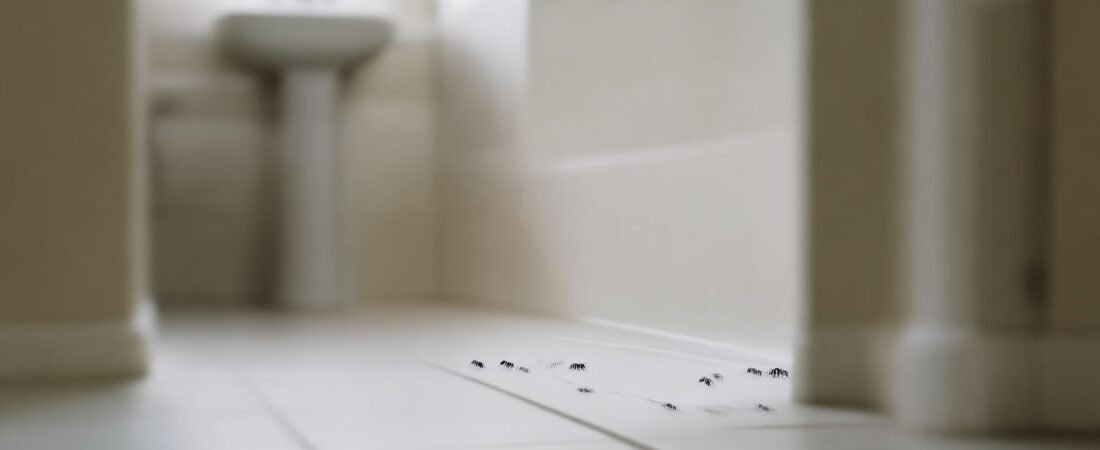
Your bathroom is spotless — no crumbs, no food, no reason for ants to be there — and yet here they are. That’s the part most pest control advice gets completely wrong about bathroom ants: it frames the problem as a sanitation issue, and bathrooms usually aren’t dirty in the way kitchens are. Ants aren’t showing up in your bathroom looking for a snack. They’re showing up because your bathroom is one of the most reliably wet, warm, and structurally accessible rooms in your house. Moisture is the magnet, not food — and once you understand that, fixing the problem gets a lot more targeted.
Why Is My Bathroom Attracting Ants If There’s No Food in There?
Ants need three things to survive: food, water, and shelter. Bathrooms check two of those boxes constantly — and sometimes all three. A slow drip under the sink, condensation on pipes, a leaky toilet seal, or even just the humidity from daily showers creates the kind of persistent moisture that certain ant species actively seek out. Carpenter ants, for example, don’t eat wood — they excavate it — and they’re especially drawn to wood that’s already been softened by water damage inside walls and under subfloors, both of which are common behind bathroom fixtures.
Odorous house ants and moisture ants will literally trail toward a dripping faucet the way other insects trail toward food. A single leaky pipe fitting can attract a scouting ant within hours; once it lays a pheromone trail back to the colony, you can have a visible line of ants within 24–48 hours. The thing that surprises most people is that the colony itself might not even be inside — it could be in a wall void, under the slab, or in the yard, with workers commuting through a gap around a pipe or a crack in the caulk around your tub.
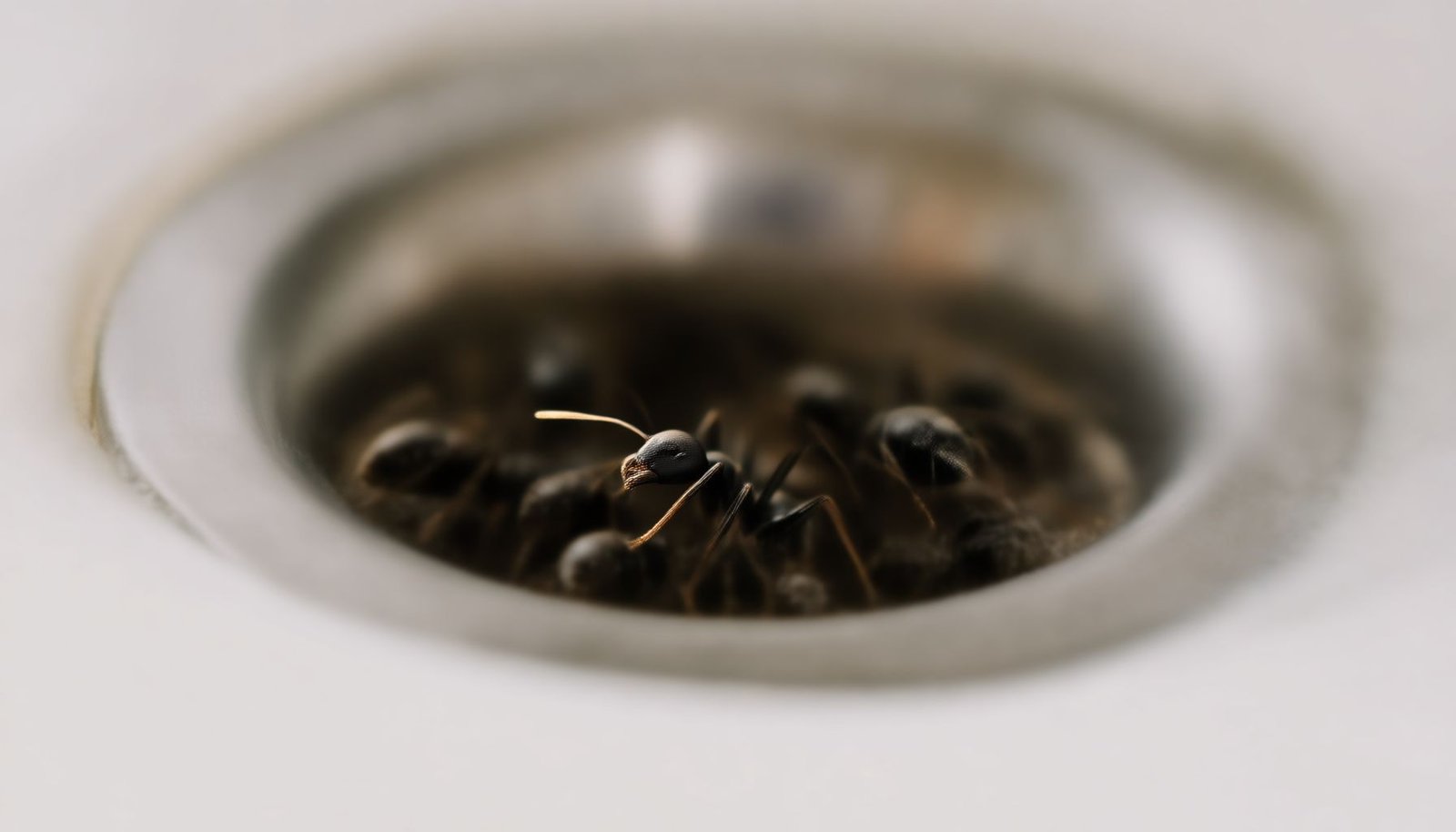
This close-up shows ant workers trailing along a bathroom baseboard near a pipe penetration — exactly the kind of low-profile entry point that’s easy to miss during a casual inspection.
Which Ant Species Are Most Likely to Show Up in a Bathroom?
Not every ant species behaves the same way, and identifying which one you’re dealing with changes how you should respond. Odorous house ants (the tiny dark ones that smell like rotten coconut when crushed) are the most common bathroom invader in the US — they nest in wall voids near moisture and can have multiple queens, which makes them notoriously hard to eliminate with spray alone. Pharaoh ants are smaller, yellowish, and particularly stubborn; they’re common in multi-unit buildings and hospitals and will “bud” — split their colony — if you spray them with a repellent insecticide, making the problem worse, not better.
Carpenter ants are the ones worth taking seriously structurally. They’re large — usually ¼ to ½ inch long — and if you’re seeing them in your bathroom consistently, especially near a window frame or under the vanity, that’s a signal to look for water-damaged wood nearby. They don’t appear randomly; they’re usually already nesting somewhere in compromised wood within 100 feet of where you’re spotting them. Fire ants occasionally invade bathrooms in southern states through plumbing gaps, and pavement ants can trail in from outside through foundation cracks, particularly in slab-on-grade homes.
| Ant Species | Size & Color | Primary Bathroom Draw | Key Warning Sign |
|---|---|---|---|
| Odorous House Ant | 1/16–1/8 in., dark brown/black | Moisture, wall voids near pipes | Rotten coconut smell when crushed |
| Pharaoh Ant | 1/16 in., pale yellow | Warmth, humidity, plumbing channels | Colony splits when sprayed — spreads |
| Carpenter Ant | 1/4–1/2 in., black or bicolored | Water-damaged wood near fixtures | Sawdust-like frass near baseboards |
| Pavement Ant | 1/8 in., dark brown | Slab cracks, pipe penetrations | Soil or sand granules near entry |
Where Are Ants Actually Getting Into Your Bathroom?
This is where most DIY attempts fail — people treat the ants they can see instead of finding where they’re entering. Bathrooms have more structural gaps per square foot than almost any other room in the house, because every pipe, drain line, and electrical conduit has to penetrate the floor or wall somewhere. Ants can squeeze through a gap as small as 1/16 of an inch, and the caulk around your tub surround, toilet base, under-sink plumbing, and wall-mounted fixtures degrades over time, creating exactly those kinds of tiny openings.
Picture this: you’ve been caulking your tub every few years, but the line where the vanity meets the wall hasn’t been touched since the bathroom was built. That’s a 20-year-old seam with cracked grout, a gap behind the baseboard, and a pipe penetration underneath — all within about six inches of each other. That cluster of small vulnerabilities is essentially a welcome mat. Ants also enter through window frames (especially if the sill has any moisture damage), through exhaust fan openings that vent into the attic, and occasionally through shared walls in attached homes or apartments.
Pro-Tip: Before you buy any ant product, spend five minutes with a flashlight tracing the ant trail backward — away from where you see the most ants, toward where they’re disappearing. That endpoint, usually a crack, gap, or pipe collar, is your actual target. Treating anywhere else is just managing symptoms.
How Do You Actually Get Rid of Ants in the Bathroom — Without Making It Worse?
Here’s the counterintuitive part: spraying ants with a repellent insecticide — the kind most people reach for first — is often the worst move you can make for certain species. Pharaoh ants and odorous house ants respond to repellent sprays by scattering, which causes satellite colonies to form in new locations. You end up with three ant problems instead of one. The approach that actually works is slow-acting bait — gel or granular — that worker ants carry back to the colony before it kills them, taking out the queen and the nest rather than just the foragers you can see.
For carpenter ants, bait alone usually isn’t enough if there’s an active nest in water-damaged wood — you’ll need to address the moisture source and potentially treat wall voids with a dust insecticide like boric acid or diatomaceous earth. Getting rid of the conditions that attracted them is just as important as the treatment itself. An honest caveat here: the right fix really does depend on which species you have, how large the colony is, and whether the nest is inside or outside the home. A single trail of pavement ants coming through a foundation crack is a one-afternoon fix; a carpenter ant colony inside a wall void near a leaky shower is a different conversation entirely.
Here’s a step-by-step approach that works for most bathroom ant situations:
- Identify the species first. Dark, small, and coconut-smelling when crushed means odorous house ant. Large and black means carpenter ant. Pale yellow and tiny means Pharaoh ant. This determines whether you bait or treat differently.
- Fix every moisture source you can find. Check under the sink for drips, inspect the toilet base seal, look for condensation on cold pipes, and verify the exhaust fan is actually moving air out of the room (many are clogged and just recirculate humidity).
- Place slow-acting gel bait along the trail, not across it. Terro (borax-based) works well for odorous house ants and pavement ants. For Pharaoh ants specifically, use a protein-based bait since they alternate between sweet and protein preferences. Put bait at the trail’s origin, not where you see the most ants.
- Do not spray anything near the bait. Any repellent product will make ants avoid the bait stations entirely. Keep sprays and bait at least 18 inches apart, and ideally don’t use repellent sprays at all until the bait has had 1–2 weeks to work.
- Seal every entry point you can find. Use silicone caulk (not latex — it shrinks) around pipe penetrations, the tub surround, the toilet base, and any gap where baseboard meets tile. A $6 tube of silicone does more long-term work than most pesticides.
- Reassess after two weeks. If activity persists after proper baiting and sealing, you’re likely dealing with a nest inside a wall void or under the slab — at that point, a professional treatment with non-repellent residual insecticide (like a fipronil- or imidacloprid-based product) applied to wall voids is worth considering.
What Keeps Ants From Coming Back After You’ve Treated?
Treating the ants you have is only half the job. The reason bathrooms get recurring ant problems — sometimes every spring, sometimes after heavy rain — is that the underlying conditions get fixed only temporarily or not at all. Grout and caulk degrade. Pipes develop slow drips. Exhaust fans accumulate lint and stop working properly. Each of those things is a slow rebuild of the original invitation. Staying ahead of bathroom ants long-term is mostly a maintenance checklist, not a pesticide schedule.
There’s also a less obvious factor: if your bathroom shares a wall with the exterior or sits above a crawl space, ants may be nesting in the ground or in structural wood outside and simply re-entering year after year through the same gaps. Sealing interior gaps helps, but if the exterior entry points — where pipes exit the foundation, where the sill plate meets the foundation, gaps in the exterior caulk around the bathroom window — aren’t addressed, you’re just redirecting traffic, not stopping it. Some ant species also produce new queens seasonally, meaning a colony you successfully suppressed in spring can rebound by late summer from an entirely new reproductive cycle.
Keeping ants out of your bathroom for good comes down to a short list of ongoing habits:
- Run the exhaust fan during and for 15 minutes after every shower to reduce ambient humidity — sustained humidity above 70% is one of the most reliable ant attractants in enclosed spaces
- Inspect under-sink plumbing every few months for drips or condensation, especially on cold water supply lines in summer
- Re-caulk the tub and shower surround with silicone whenever you see cracking, shrinking, or discoloration — don’t wait for it to fully fail
- Check the exterior of your home where bathroom plumbing exits the wall and seal any gaps with expanding foam or silicone rated for outdoor use
- If you have a crawl space, keep it dry — a vapor barrier and proper ventilation dramatically reduce the moisture that migrates up into bathroom subfloors and walls
“Bathroom ant infestations are almost always a moisture problem wearing an ant costume. I’ve inspected hundreds of homes where the homeowner was convinced they had a ‘bad ant year’ when what they actually had was a failing toilet wax ring or a slow supply line drip they didn’t know about. Fix the water, and most of the time the ants fix themselves — the ones that don’t are telling you there’s a nest already established inside the structure, and that’s when you need to think about treatment more seriously.”
Dr. Marcus Bellamy, BCE (Board Certified Entomologist), residential pest management consultant with 18 years of field and extension experience
One thing worth knowing if you’re trying to sort out what you’re actually dealing with: ants aren’t the only small, moisture-loving insect that shows up in bathrooms. Silverfish are another common bathroom pest drawn to humidity and darkness — they look completely different from ants but tend to occupy the same spaces, and misidentifying one for the other leads to treatments that don’t work. If you’re seeing fast-moving, silvery, teardrop-shaped insects rather than the segmented, six-legged profile of an ant, that’s a different problem with a different fix.
It’s also worth briefly noting that bathroom pest problems, while less dramatic than a kitchen infestation, aren’t trivial from a health standpoint. Ants themselves rarely cause illness directly, but some species — particularly Pharaoh ants — have been documented traveling through unsanitary areas and potentially transferring pathogens to surfaces. If you’re curious about how pest infestations intersect with actual health risk, the breakdown of what pest infestations can actually do to your health is a useful baseline for understanding how seriously to take any infestation you’re managing.
The honest bottom line is this: bathroom ants are almost always fixable without a professional if you correctly identify the species, use bait instead of spray, and address the moisture conditions driving them in. The cases that escalate to something more serious — structural carpenter ant damage, Pharaoh ant colonies that have budded through multiple walls — are the ones where early mishandling (usually with repellent sprays) turned a manageable problem into a much larger one. Start with the trail, find the entry point, fix the leak, and bait slow. That sequence solves the vast majority of bathroom ant situations without any of the guesswork.
Frequently Asked Questions
Why do I have ants in my bathroom but not in my kitchen?
Bathrooms attract ants mainly because of moisture, not food. Leaky pipes, condensation around the toilet base, and damp grout give ants the water source they need to survive. If you’re seeing them only in the bathroom, check for slow leaks under the sink or around the tub — even a drip that loses just a few drops per minute is enough to draw them in.
what kind of ants are in my bathroom?
The most common ants found in bathrooms are odorous house ants, carpenter ants, and pavement ants. Odorous house ants are tiny (about 1/16 to 1/8 inch) and smell like rotten coconut when crushed. Carpenter ants are much larger — usually 1/4 to 1/2 inch — and are a bigger concern because they tunnel through wet or rotting wood, which is common near bathroom walls and subflooring.
how do I get rid of ants in my bathroom fast?
Start by wiping down all surfaces with a 50/50 white vinegar and water solution to erase the scent trails ants use to navigate. Then place ant bait gel near where you’re seeing them — don’t spray first, because killing the scouts prevents the bait from reaching the colony. Most gel baits take 3 to 7 days to fully knock back a colony, so give it time before switching methods.
can ants in the bathroom mean I have a plumbing leak?
Yes, and this is actually one of the most overlooked signs of a hidden leak. Ants need water to survive, and they’re extremely good at detecting moisture behind walls or under floors. If you’re suddenly seeing ants near the toilet, vanity, or shower with no obvious standing water, it’s worth checking for slow leaks inside the wall or under the subfloor before assuming it’s just a typical infestation.
how do ants get into the bathroom if there’s no food in there?
Ants don’t need food to enter — they follow moisture trails and can squeeze through gaps as small as 1/32 of an inch. Common entry points include gaps around pipes under the sink, cracks in grout or caulk, and spaces where the wall meets the floor. Sealing these entry points with silicone caulk and fixing any moisture issues is the most reliable long-term fix.