

Bed bugs almost certainly won’t send you to the emergency room — but writing them off as “just annoying” is where most people go badly wrong. The real health story of a bed bug infestation isn’t dramatic. It’s slow, subtle, and far more damaging than a handful of itchy bites. Most articles fixate on whether bed bugs transmit disease (the short answer: rarely, and not in any proven meaningful way). What they miss is everything else — the secondary infections, the allergic cascades, the documented mental health fallout, and the way a long-running infestation quietly degrades your physical health before you’ve connected the dots.
Do Bed Bugs Actually Transmit Disease to Humans?
Here’s the part that surprises people: despite feeding exclusively on human blood and being capable of harboring over 40 known pathogens in laboratory settings, bed bugs have not been shown to transmit disease to humans in real-world conditions. Studies have detected traces of hepatitis B, Chagas disease trypanosomes, and MRSA in bed bug bodies — but detection isn’t transmission. The mechanical and biological barriers appear to prevent actual disease spread through bites.
That finding gets weaponized in a way that does real harm. Landlords cite it to minimize infestations. Online forums use it to reassure people that bed bugs are “no big deal.” But the absence of direct pathogen transmission is the least interesting thing about bed bug health effects, not the most interesting. The actual health risks are coming from somewhere else entirely.
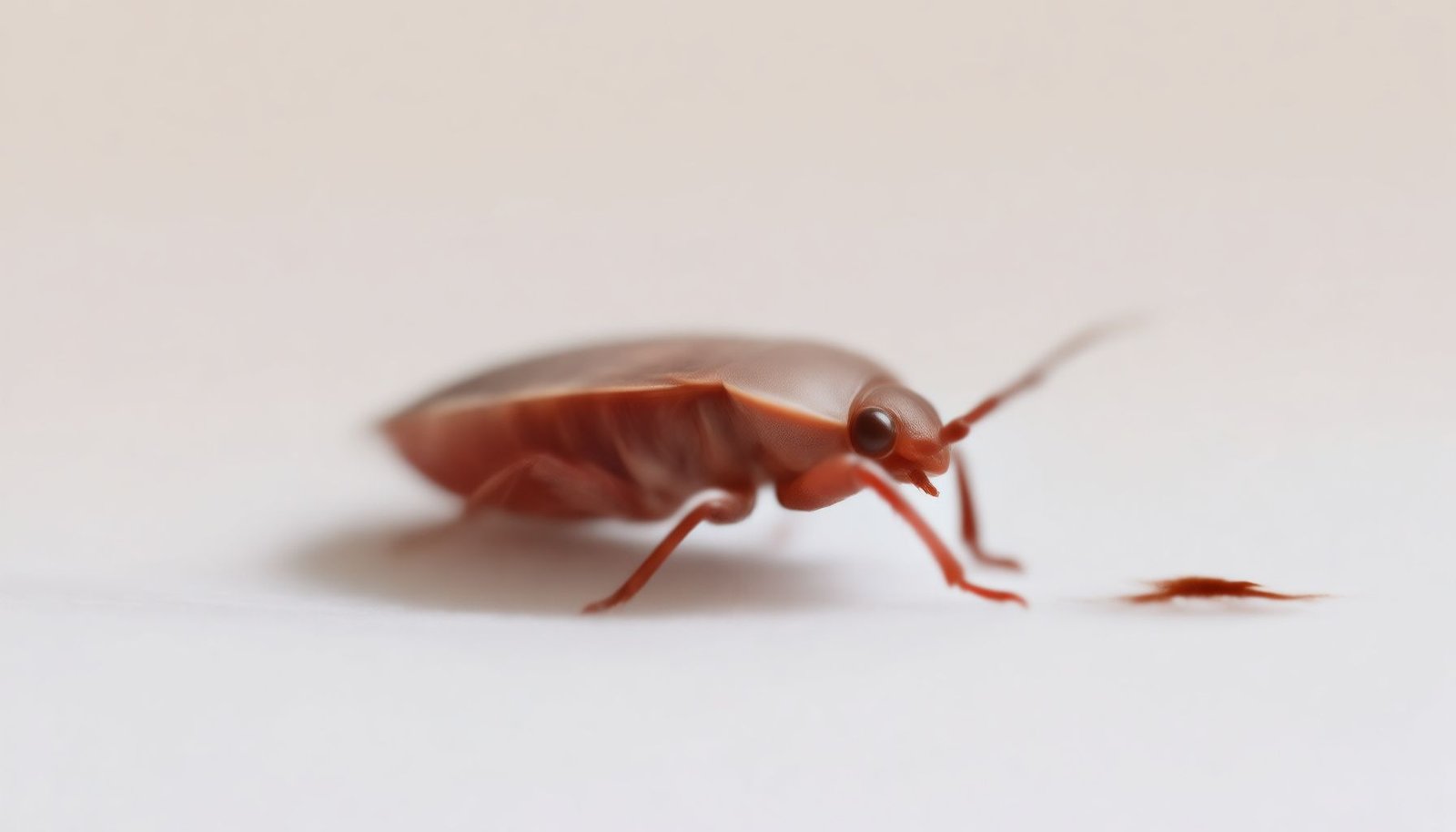
This close-up shows the reddish-brown engorged body of an adult bed bug alongside cast skins and dark fecal spotting on mattress fabric — the kind of evidence that accumulates over weeks before most people realize what’s happening in their own bedroom.
What Do Bed Bug Bites Actually Do to Your Body?
Bed bugs inject an anticoagulant saliva when they feed, and your immune system’s response to that saliva is what produces the welt you see. About 30% of people — particularly older adults — show no visible reaction at all, which is one reason infestations go undetected for so long. The other 70% can have reactions ranging from a small, firm bump to a spreading hive-like rash covering significant skin area.
Repeated exposure changes the equation. With each new feeding cycle — bed bugs typically feed every 5 to 10 days and a single nymph goes through five molts before adulthood — your immune system becomes increasingly sensitized to the saliva proteins. People who had mild reactions in the first weeks of an infestation often develop severe, blistering responses months in. That escalating pattern is the body building an allergic profile, not just reacting to bites.
“The sensitization process is what we should be talking about more. Patients who’ve been bitten hundreds of times over a multi-month infestation can develop systemic allergic responses — not just localized welts. I’ve seen cases where the skin reaction alone required prescription-strength corticosteroids. The biology of repeated exposure is genuinely different from a one-time bite.”
Dr. Sandra Kellerman, Board-Certified Entomologist and Urban Pest Researcher, Rutgers Center for Vector Biology
Secondary Infections: The Health Risk Nobody Warns You About
Picture this: you’ve been waking up every morning for six weeks with new bites. You’ve stopped sleeping well. You scratch at night without realizing it. The bites break open. Within 24 to 48 hours, two or three of those open sites are pink at the edges — the beginning of a bacterial skin infection. This is the most underreported health consequence of bed bug infestations, and it’s not rare.
Impetigo, cellulitis, and secondary staph infections — including MRSA — have all been documented in bed bug infestation cases, not because the bugs carry and transmit those bacteria directly, but because the bite wounds create entry points and sleep deprivation suppresses immune response. Children and elderly individuals face the highest risk, since their skin tends to be thinner and their immune systems less equipped to contain a bacterial breach that starts as a scratch.
Pro-Tip: If you’re treating bite wounds at home, resist the urge to use topical antihistamine creams on broken skin — they can delay healing and increase infection risk. Clean open bites with soap and water, apply a thin layer of antibiotic ointment, and cover with a bandage. If a bite site develops a red streak, warmth, or swelling beyond the immediate area within 48 hours, see a doctor — that’s cellulitis, and it needs oral antibiotics, not a tube of Benadryl cream.
The numbered progression below shows how a typical secondary infection develops in an active infestation — not because the bed bugs did something exotic, but because the chain of events from bite to broken skin to bacterial entry is so predictable:
- Bed bug feeds overnight — injects anticoagulant saliva, withdraws blood meal over 5 to 10 minutes
- Histamine response begins — the bite site swells and itches intensely within hours (or days, for sensitized individuals)
- Repeated scratching breaks skin barrier — especially during sleep when you can’t consciously stop yourself
- Bacteria enter the wound — Staphylococcus aureus and Streptococcus species are common culprits found on skin surfaces
- Localized infection develops — impetigo or early cellulitis appears within 24 to 72 hours of the breach
- Systemic spread becomes possible — in immunocompromised individuals, untreated localized infection can progress to serious illness requiring hospitalization
How Does a Bed Bug Infestation Affect Your Mental Health?
This is the section most pest control articles skip entirely, probably because it’s harder to quantify than a bite welt. But the psychological toll of a bed bug infestation is clinically documented and in many cases more debilitating than the physical symptoms. Researchers have found that people dealing with bed bug infestations report rates of anxiety, depression, and sleep disorder significantly higher than comparable populations facing other household pest problems.
The mechanism isn’t mysterious. Your bedroom — the space that should be associated with safety and rest — becomes the source of the threat. Adult bed bugs can survive over 300 days without feeding, which means the psychological weight of an infestation doesn’t lift quickly even after treatment begins. People report sleeping on couches, leaving lights on all night, compulsively checking mattress seams, and avoiding having guests over for months. One published case study described a 34-year-old woman developing full clinical PTSD-level hypervigilance after a four-month infestation in her apartment — she continued checking her mattress with a flashlight nightly for over a year after the infestation was confirmed eliminated.
| Health Effect | Mechanism | Who’s Most at Risk |
|---|---|---|
| Secondary skin infections (cellulitis, impetigo) | Scratched bite wounds create bacterial entry points | Children, elderly, immunocompromised |
| Severe allergic reaction / anaphylaxis (rare) | Immune hypersensitization from repeated salivary protein exposure | People with existing allergies or asthma |
| Chronic sleep deprivation | Nocturnal feeding disrupts sleep architecture; anxiety prevents restorative sleep | Anyone in an active infestation |
| Anxiety, depression, PTSD-like symptoms | Loss of safety association with sleeping environment; hypervigilance | Renters in multi-unit buildings, people with prior trauma |
Sleep deprivation compounds everything else on this list. Going six or eight weeks on broken, anxiety-interrupted sleep — which is completely normal in an untreated infestation — impairs immune function, elevates cortisol, worsens inflammatory response, and makes the skin more reactive to bites. The physical and psychological effects aren’t separate categories. They feed each other in a loop that gets harder to break the longer the infestation runs.
Are Some People at Significantly Higher Risk Than Others?
Yes — and the honest answer is that it depends on factors most people haven’t thought about. A healthy 28-year-old with no allergies who gets a handful of bites over a few days before catching the problem is in a genuinely different situation than an elderly person in a multi-unit building where the infestation has been active for months. The health calculus isn’t the same for everyone, and treating it like it is leads to dangerous minimization.
The groups where bed bug health effects can cross from “unpleasant” to “medically serious” include people with compromised immune systems — whether from chemotherapy, HIV, diabetes, or corticosteroid therapy — as well as people with eczema or psoriasis, where the skin barrier is already compromised and bite wounds are far more likely to become infected. Infants and toddlers are also higher-risk because they can’t communicate symptoms clearly and because iron-deficiency anemia from repeated blood loss, while requiring an extreme infestation scenario, has been documented in pediatric cases. That last one isn’t theoretical: a published case report documented anemia in an infant in a heavily infested home — it’s rare, but it’s real, and it’s the kind of fact that reframes how seriously a persistent infestation should be taken.
Here’s a breakdown of risk factors that meaningfully change the health picture:
- Existing allergies or asthma — bed bug shed skins and fecal matter contain allergenic proteins that can trigger or worsen respiratory symptoms, similar to dust mite allergens
- Compromised immune function — slower wound healing and reduced ability to contain secondary bacterial infections
- Eczema or psoriasis — disrupted skin barrier dramatically increases infection risk from scratching
- Infants and young children — higher relative blood loss per body weight; inability to communicate symptoms; more vulnerable to sleep disruption effects on development
- Elderly individuals — thinner skin tears more easily; reduced immune response; higher baseline rates of conditions that worsen with sleep deprivation
- Mental health history — pre-existing anxiety or OCD can be significantly exacerbated by the hypervigilance that accompanies an active infestation
It’s worth noting that the health burden also scales with building type and how quickly you can act. A homeowner who discovers bed bugs early and treats aggressively faces a very different trajectory than a renter in a large apartment complex where the first signs of infestation may have been present in adjacent units for months before reaching yours. In multi-unit housing, re-infestation between treatments is common, and that extended timeline is where the cumulative health effects stack up.
One counterintuitive thing most people don’t realize: the allergen load from bed bugs doesn’t disappear when the bugs do. Shed exoskeletons — and a bed bug goes through five nymphal molts before reaching adulthood — along with fecal matter and egg casings remain in mattress seams, box springs, and wall voids long after treatment. People with asthma or allergies can continue experiencing respiratory symptoms from residual allergens for weeks after a successful extermination. Thorough cleaning and encasement aren’t optional extras — they’re part of the health resolution, not just the pest resolution. If you’ve been trying to figure out whether what you’re seeing in your bedroom is bed bug evidence or something else entirely, knowing how to identify what you’re actually dealing with before committing to a treatment plan can save you a lot of time and money.
The real takeaway here isn’t “bed bugs will make you seriously ill” — for most healthy adults in a short-duration infestation, they probably won’t. But they’re not harmless, and the framing of “they don’t transmit disease” has given too many people a false sense of security that delays treatment long enough for the secondary effects to take hold. The faster you identify and eliminate an infestation, the shorter the window for every health effect on this list. That’s not a reason to panic — it’s a reason to act the moment you have any reason to suspect you’re sharing your bed.
Frequently Asked Questions
can bed bugs make you sick?
Bed bugs aren’t known to transmit diseases directly, but they can absolutely make you feel sick in other ways. Their bites cause itching, sleep deprivation, and anxiety, and secondary skin infections from scratching are common. In rare cases, people with severe infestations have developed anemia from repeated blood loss.
can bed bug bites get infected?
Yes, scratching bed bug bites can break the skin and introduce bacteria like Staphylococcus or Streptococcus, leading to infections that require antibiotic treatment. Signs of infection include increasing redness, warmth, swelling, or pus around the bite site. If a bite looks like it’s getting worse after a few days instead of better, see a doctor.
can bed bugs cause allergic reactions?
They can — some people have strong allergic responses to proteins in bed bug saliva, ranging from hives and swollen welts to, in rare cases, anaphylaxis. About 30% of people show little to no reaction at all, while others develop large, intensely itchy welts that last a week or more. If you experience difficulty breathing or throat tightening after bites, treat it as a medical emergency.
can bed bugs cause anxiety and mental health problems?
Yes, and this is one of the most underreported health effects of an infestation. Studies have found that people dealing with bed bugs frequently experience insomnia, hypervigilance, and symptoms that closely resemble PTSD. The stress of not feeling safe in your own bed takes a real psychological toll, especially during infestations that drag on for weeks or months.
do bed bugs carry disease like ticks or mosquitoes?
Unlike ticks and mosquitoes, bed bugs aren’t considered disease vectors — they don’t efficiently transmit pathogens to humans through their bites. Researchers have found over 45 pathogens in bed bugs under lab conditions, but there’s no solid evidence of real-world disease transmission to people. The health risks they do pose are indirect, like infections, allergic reactions, and chronic sleep loss.
Disclaimer: This article is for general informational purposes only and does not constitute medical advice. How a pest-related exposure, bite, or contaminant affects you can depend on age, pre-existing conditions, allergies, and the extent of exposure. If you’re experiencing symptoms you believe are linked to a pest problem in your home, please consult a licensed healthcare provider rather than relying on this article alone.