
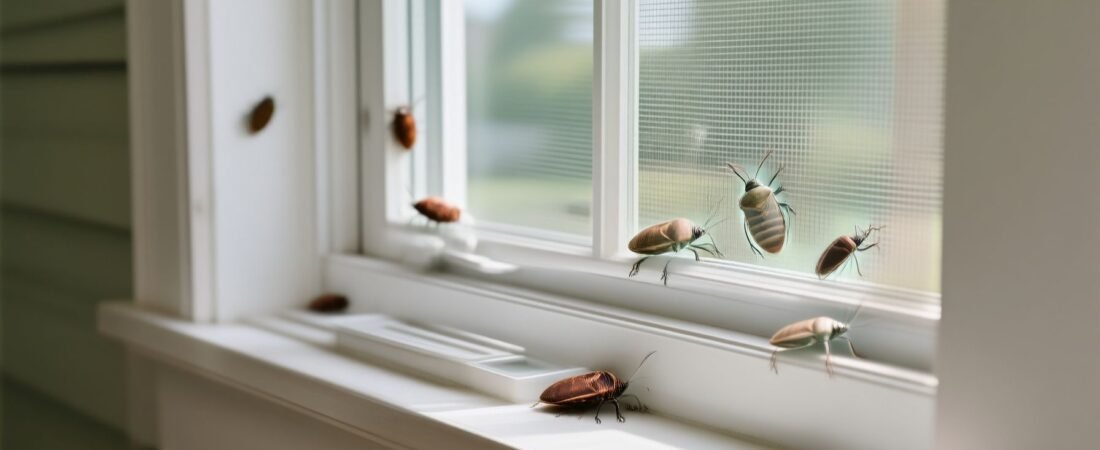
That smell hitting you right now is your answer. Before you see a stink bug clearly, before you catch one crawling across your windowsill, the odor is already telling you exactly what you’re dealing with — and most people either misidentify it entirely or don’t connect it to an insect at all. The real identification problem with stink bugs isn’t that they’re hard to spot. It’s that homeowners keep confusing the warning signs with something else, dismiss the bug as “just a beetle,” and end up with dozens more inside by the following week.
What Does a Stink Bug Actually Look Like Up Close?
Adult stink bugs — specifically the brown marmorated stink bug (Halyomorpha halys), the species most common in US homes — are roughly 5/8 of an inch long and shaped like a medieval shield. That shape isn’t an accident of description. The scientific family name, Pentatomidae, refers to the five-sided shield outline formed by the scutellum, which is the triangular plate between the wings. It’s one of the most reliable field marks you have.
The coloration is mottled brown — not a flat tan, but a blotchy patchwork of dark brown, gray, copper, and black that blends surprisingly well against wood and bark. The edges of the abdomen show alternating light and dark banding, and the antennae have distinct pale bands on them. Legs are brown with faint banding too. Every part of this insect was designed, evolutionarily speaking, to look like tree bark at rest.
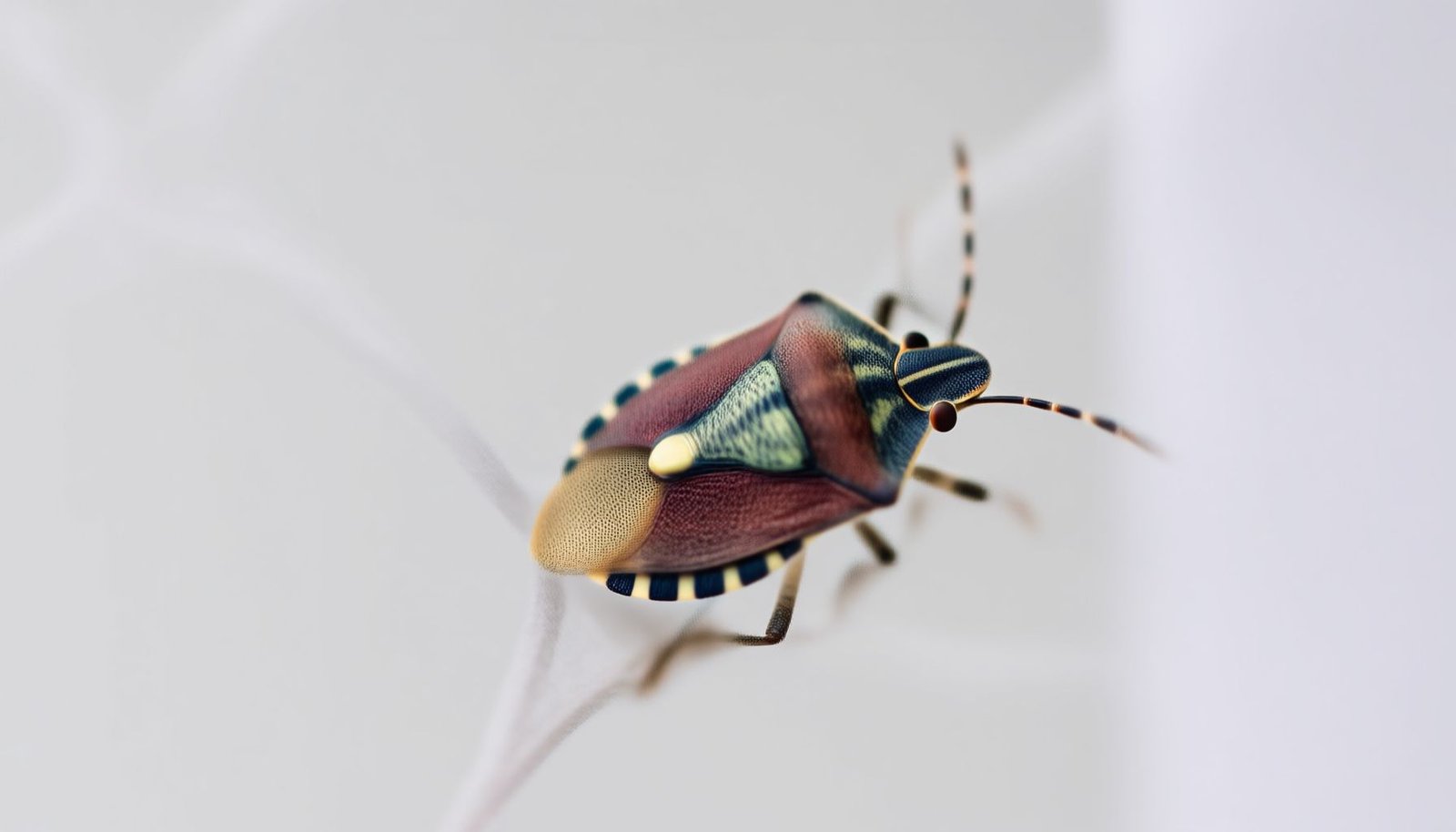
This close-up view highlights the shield-shaped scutellum and banded antennae — the two features that separate stink bugs from beetles and other brown insects you might find on your walls this fall.
Why Does the Stink Bug Smell, and What Exactly Is That Odor?
The smell is the centerpiece of this insect, and it’s badly misunderstood. Stink bugs don’t release their defensive chemical constantly — they release it when threatened, crushed, or startled. The compound responsible is a mix of aldehydes and other volatile chemicals, primarily trans-2-decenal and trans-2-octenal, released from scent glands located on the underside of the thorax. These aren’t perfume glands. They’re defensive weapons that smell, to most people, like a combination of cilantro, dirty gym socks, and something faintly chemical.
Here’s the part that trips people up: the smell can linger on your hands, fabric, or the surface they were on for hours after the bug is gone. If you vacuum one up without a bag or empty the canister inside, the odor spreads. And if you crush one — which is the instinctive reaction — you’ve just dispersed that chemical across the room. The correct move is capture and release (or disposal in a sealed bag), not the satisfying stomp.
“The odor compounds in stink bugs are designed to persist — they bind to surfaces and fabric fibers quickly. Most people make the situation worse by handling the bug aggressively. A gentle scoop into a container, sealed and disposed of outside, prevents the smell from becoming a room-wide problem.”
Dr. Lisa Moreno, Extension Entomologist, Mid-Atlantic Agricultural Research Center
How Do You Tell a Stink Bug Apart From Other Brown Bugs in Your House?
This is where most identification guides fail homeowners. They show a perfect photo of a stink bug and say “look for the shield shape.” But the bugs you actually find in your house are often tucked into a curtain fold, moving fast along a baseboard, or spotted from across a room at dusk. You’re not identifying a museum specimen — you’re IDing a moving target in dim light. Knowing the full list of distinguishing features matters more than any single field mark.
The bugs most commonly confused with stink bugs in US homes include squash bugs, kudzu bugs, boxelder bugs, and certain ground beetles. Each has a distinct tell. Here’s how to separate them quickly:
| Bug | Shape | Key Difference from Stink Bug |
|---|---|---|
| Brown Marmorated Stink Bug | Shield / pentagon | Banded antennae, banded abdomen edge, mottled brown |
| Squash Bug | Oval / elongated | Flatter, darker, no banded antennae, less mottled |
| Kudzu Bug | Round / dome-shaped | Olive-green, much rounder, smaller (4–6mm) |
| Boxelder Bug | Oval | Black with red/orange markings, no shield plate |
Pro-Tip: If you can get close enough, check the antennae. Stink bug antennae have two distinct pale (whitish or cream) bands on them. That banding is unique — squash bugs and ground beetles don’t have it. Grab your phone and zoom in before the bug moves.
Where Do Stink Bugs Hide in a House, and What Does That Tell You?
Picture this: it’s October, the temperature just dropped below 60°F for the first time, and you find a single stink bug on your living room wall. That single bug is almost never alone. Stink bugs are aggregating insects — when one finds a warm overwintering site, it releases an aggregation pheromone that attracts others. Within 48 to 72 hours of that first scout entering your home, more can follow through the same gap. One bug on the wall is an early warning, not a complete picture.
Inside the home, they congregate in specific places based on heat and darkness. Check these locations if you suspect a larger group than what you’ve seen on walls:
- Behind wall plates and electrical outlet covers (they squeeze flat against warm surfaces)
- Inside the folds and hems of heavy curtains near sunny windows
- In attic insulation and wall voids, especially on south and west-facing walls
- Under the lip of baseboards and along door frame gaps
- Inside boxes and bags stored in garages or utility rooms
They’re also occasionally found near pantry areas, especially if there’s fruit or vegetable matter nearby — stink bugs are plant feeders, not scavengers, but food scent can pull them deeper into living spaces. If you’ve been finding unexplained insects near stored food, it’s worth cross-referencing with a guide like Bugs in My Pantry: How to Identify and Eliminate Every Type, since multiple species can be active in the same space at once.
How Many Stink Bugs Is a Problem, and What Should You Do When You Find Them?
Here’s the counterintuitive reality that most pest control articles bury or skip: stink bugs inside your house during fall and winter are not infesting your home the way cockroaches or ants do. They’re not breeding indoors, not eating your food, not damaging your structure. They entered to overwinter — to find a stable 50–60°F spot to go dormant until spring. This matters enormously for how you respond. Spraying pesticides indoors is largely ineffective against overwintering stink bugs because the bugs aren’t active enough to walk through treated areas, and killing them releases the odor.
The scale of what you find, though, genuinely changes the approach. A handful of stink bugs appearing on warm winter days near windows is normal entry-level activity. Dozens emerging daily from walls or attic spaces means a significant aggregation formed before you noticed — and that requires a different strategy. Here’s how to approach it step by step:
- Don’t crush them. Use a plastic bag, cup, or piece of cardboard to capture and remove live bugs. Seal them in a bag before disposing of them outdoors.
- Use a shop vac with a nylon stocking inside the hose. The stocking traps bugs before they reach the canister — empty the stocking outside immediately after.
- Find the entry points. Stink bugs enter through gaps around window frames, utility pipes, soffit vents, and door sweeps. A common entry gap is as small as 1/8 inch — they flatten out to fit.
- Seal exterior gaps in fall before temperatures drop consistently below 60°F. That’s your window. Once they’re inside and dormant, sealing still helps but won’t remove those already in wall voids.
- If large numbers are emerging from walls, call a pest professional for void treatment. Perimeter sprays applied to exterior surfaces in early fall — before entry — are the most effective professional intervention.
One honest nuance worth naming: the severity of a stink bug problem varies significantly by region and building type. Older homes with wood-framed construction and uninsulated wall voids in the Mid-Atlantic, mid-South, and Pacific Northwest states tend to harbor far larger aggregations than newer, well-sealed construction in the same area. Geography and building vintage matter more than most guides acknowledge. Your neighbor two blocks away in a 1950s colonial may have hundreds while you have five — and both situations are “normal” for what the bug does.
Stink bugs also have a well-documented tendency to reactivate on warm winter days and emerge toward light — which is when most homeowners notice them. This is the bug responding to a false spring signal, not a sign of a worsening infestation. Knowing this saves people a lot of unnecessary alarm. It also helps to understand that stink bug activity is often seasonal in a way that other home invaders aren’t — which is meaningfully different from something like a bed bug situation where early detection and fast action are everything. If you’re trying to understand whether what you’re dealing with could be something more serious, the framework in Signs of Bed Bugs Before You See Them: Early Warning Checklist walks through how to read early infestation signs correctly — a different pest, but useful contrast.
Identifying stink bugs correctly is the first step — but understanding what they’re actually doing in your house is what determines your next move. They’re not a threat to your health or structure. They’re a nuisance with one job: survive winter inside your walls and leave in spring. Stop them at the entry point in early fall, handle the ones that do get in without triggering the smell, and you’ve managed the problem on your terms.
Frequently Asked Questions
What does a stink bug look like?
Stink bugs are shield-shaped insects about 3/4 of an inch long with a mottled brown or grayish color. They have six legs, antennae with alternating light and dark bands, and a distinctive triangular plate on their backs called a scutellum. Their edges are lined with a subtle banded pattern that helps distinguish them from similar-looking beetles.
Why do stink bugs smell so bad?
Stink bugs release a chemical compound called trans-2-decenal from glands located on their abdomen when they feel threatened or get crushed. The smell is often described as a mix of cilantro, skunk, and dirty socks. It’s a defense mechanism, and even a single bug can produce enough odor to fill a small room.
How do I know if what I’m seeing is a stink bug or a beetle?
The easiest way to tell them apart is by body shape — stink bugs have that flat, shield-like outline, while most beetles are more rounded or cylindrical. Stink bugs also have a visible triangular scutellum between their wing covers, which beetles typically don’t. If you’re still unsure, look for the banded antennae, which are a reliable identifier on stink bugs.
Where do stink bugs hide in the house?
They tend to cluster in warm, sheltered spots like window frames, door gaps, attics, crawl spaces, and behind baseboards. You’ll usually find them near light sources at night since they’re attracted to light. During winter, they go dormant and can gather in groups of dozens or even hundreds inside wall voids.
Are stink bugs dangerous to humans or pets?
Stink bugs aren’t dangerous — they don’t bite, sting, or transmit diseases to humans or pets. The main risks they pose are the foul odor, potential staining on surfaces where they die, and crop damage if you have a garden. Some people with strong scent sensitivities may experience mild irritation, but there’s no venom or toxin involved.