
You sealed the bag. You checked the date. You stored everything on a clean shelf — and somehow, six weeks later, there are tiny moths circling your ceiling and a fine webbing inside your oatmeal. Here’s the part most people get wrong: the bugs in your pantry almost certainly didn’t come in through a crack in the wall. They came in inside the food you bought at the grocery store. That’s the real source, and missing it is exactly why most people treat their pantry, re-stock it, and find bugs again three months later.
Why Do I Keep Getting Pantry Bugs Even After I Clean Everything Out?
The answer lives in a concept entomologists call “infested at the source.” A female Indian meal moth, for example, can lay between 100 and 300 eggs directly on or inside dried food — flour, cornmeal, bird seed, dried fruit — before that product is ever packaged and shipped. Those eggs are microscopic and survive standard warehouse conditions easily. By the time you bring the bag home, there may already be larvae developing inside it. Cleaning your shelves and spraying the corners does exactly nothing if you re-stock with a new bag from the same infested product line.
The second reason people repeat the cycle is that they treat the adults — the moths flying around, the beetles on the shelf liner — instead of the larvae, which are the ones doing the actual feeding and reproducing. Adult pantry moths don’t even eat. They exist only to mate and lay eggs. Killing the adults you can see while leaving hidden larvae in unopened packages guarantees a second wave in roughly 4 to 8 weeks, which is exactly how long the pupal stage lasts before a new adult generation emerges.
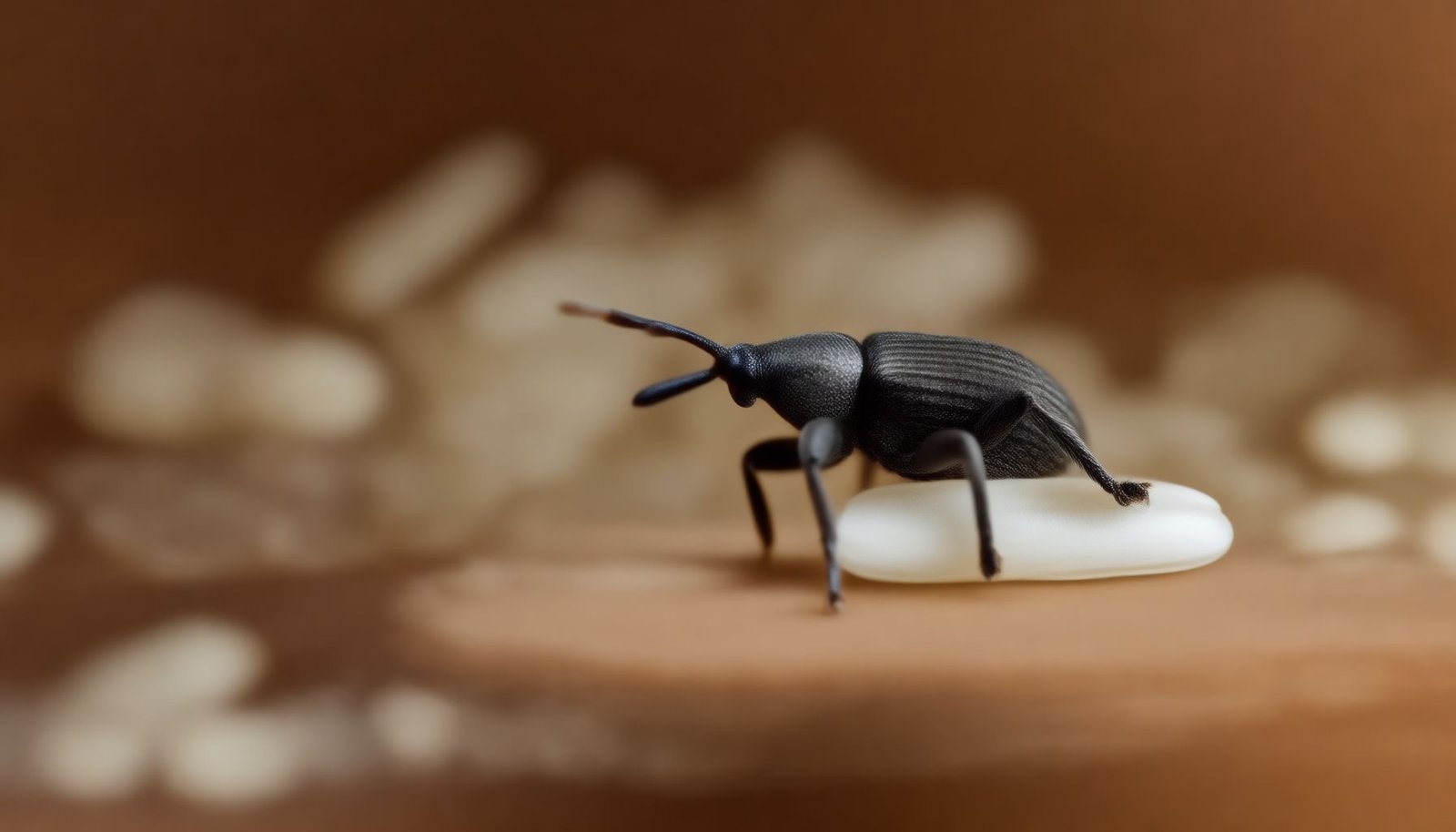
This close-up shows the fine silken webbing and frass (pest waste) that pantry insects leave behind inside packaging — the kind of detail that’s easy to miss until you know exactly what you’re looking for.
How Do I Know Which Bug Is Actually in My Pantry?
Getting the identification right changes everything about how you respond. There are five pantry pests that account for the overwhelming majority of infestations in US homes, and they’re genuinely different creatures with different behaviors, different food preferences, and different weak points. Treating an Indian meal moth problem like a weevil problem — or vice versa — wastes time and money. Here’s how to tell them apart quickly.
| Pest | What It Looks Like | Most Commonly Found In | Key Giveaway |
|---|---|---|---|
| Indian Meal Moth | ¾” wingspan, copper/gray wings with reddish-brown tip band | Flour, cornmeal, dried fruit, pet food, birdseed | Silky webbing inside packaging; larvae crawl up walls to pupate |
| Grain Weevil | ⅛” long, reddish-brown, snout-nosed beetle | Whole grains, rice, wheat berries, pasta | Small round exit holes in individual kernels |
| Saw-Toothed Grain Beetle | ⅛” long, flat, brown, 6 tooth-like projections on each side of thorax | Cereals, sugar, dried fruit, chocolate, pet food | Can chew through sealed plastic bags |
| Drugstore / Cigarette Beetle | ⅛”, rounded, brown, strongly humped | Spices, dried herbs, pet food, dried flowers | Found in spice jars — the only pantry pest that eats dried chili peppers |
| Flour Beetle (Red/Confused) | ⅛–3/16″, elongated, reddish-brown | Flour, cake mixes, cereal, cornstarch | Flour develops a pinkish tint and a musty, inky smell |
One detail that trips people up: the larvae of most pantry beetles are tiny, cream-colored, and nearly identical to each other. If you find larvae but no adults, focus on which food category is affected — whole unprocessed grains versus processed flour versus spices — and use that to narrow down the species. You don’t always need a perfect ID to take action, but knowing whether you have a moth versus a beetle changes your trap and treatment strategy significantly.
What Does a Pantry Bug Infestation Actually Look Like Step by Step?
Picture this: you’re making pancakes on a Sunday morning, you open the flour, and there’s a cluster of tiny moving specks near the top. That’s usually Stage 2. By that point, the infestation has been active for at least 4 to 6 weeks — possibly longer — because Stage 1 is entirely invisible. The eggs hatch into larvae that burrow into the food source and feed internally. The only evidence is a very faint off-smell and, in flour, a slight clumping that most people blame on humidity.
Here’s the progression most people don’t realize is happening:
- Eggs laid in or on food (invisible stage): Eggs are 0.3–0.5mm — far too small to see without a magnifier. They hatch in 2–14 days depending on temperature. Warmer pantries speed this up dramatically.
- Larval feeding (hidden stage): Larvae eat, grow through 5–7 instars, and produce frass (waste) mixed into the food. This is the stage where contamination is highest and visibility is lowest.
- Mature larvae exit food to pupate: For moths specifically, full-grown larvae wander — sometimes traveling several feet — to find a crack, corner, or wall junction to spin a cocoon. You’ll see them on walls and ceilings, which confuses people who don’t realize they came from the pantry.
- Adults emerge: Adult moths or beetles become visible. Adults live 1–4 weeks. Beetles stay near the food source; moths fly toward light.
- Re-infestation begins immediately: Adults mate within 24–48 hours of emergence and begin laying the next generation of eggs. Without intervention, population roughly doubles every generation cycle.
Understanding this cycle matters because it tells you exactly when to act: not when you see the adults, but the moment you find any evidence of larvae or webbing. Every day of delay at Stage 3 is more eggs in more food containers.
How Do You Actually Get Rid of Pantry Bugs for Good?
The counterintuitive truth about pantry pest elimination is that products and sprays are mostly a last resort — and in many cases, unnecessary entirely. This is one of the few pest situations where thorough physical removal of infested material is more effective than any chemical treatment. Pesticide sprays are also not labeled for direct food contact surfaces, and the pantry is nothing but food contact surfaces. The real work is manual.
Here’s what an effective elimination process actually looks like:
- Pull everything out and inspect every single container. Check for webbing, larvae, clumping, off-smells, or exit holes in individual grains. If in doubt, throw it out — a $4 box of cereal isn’t worth a recurring infestation.
- Dispose of infested food in an outdoor trash can immediately. Leaving bags on the counter or in the kitchen garbage gives larvae time to exit the packaging and find new harborage spots.
- Vacuum every shelf surface, crack, and corner. Pay special attention to shelf peg holes, the undersides of shelves, and where the shelf meets the wall. Empty the vacuum bag outside.
- Wipe down shelves with warm soapy water, then white vinegar. Vinegar disrupts pheromone trails and egg adhesion without leaving residues that affect food safety.
- Place pheromone traps to catch remaining adults. Moth pheromone traps (which lure males and break the mating cycle) are highly effective for Indian meal moths. Sticky traps near the base of shelves work for beetles. Traps also function as monitoring tools — if you’re still catching bugs 6 weeks after cleanup, something was missed.
- Re-stock only in airtight hard-sided containers. Glass, thick polypropylene, or stainless steel with locking lids. Saw-toothed grain beetles can chew through zip-lock bags and standard plastic storage bags — hard-sided containers are not optional if you’ve had these beetles before.
Pro-Tip: When you bring new bulk grains, flour, or birdseed home, put them in the freezer for 72 hours before transferring them to pantry storage. Temperatures below 0°F kill eggs, larvae, and adults of every common pantry pest species — including those already inside sealed packaging. It’s the single most effective prevention step that almost nobody does consistently.
“Most homeowners focus on the adult insects they can see and spray, but the biology is working against them — they’re treating the end of the cycle, not the beginning. The eggs and early instar larvae are in the food itself. Until you remove the infested food and break the cycle at that point, any other treatment is just managing adults while a new generation is already developing.”
Dr. Marcus Tilley, Ph.D. Entomology, University Extension Specialist in Stored Product Pests
Are There Other Bugs That Might Look Like Pantry Pests But Aren’t?
This is where misidentification causes real problems. Several insects that have nothing to do with your food supply can show up in or near a pantry and get blamed for contamination that doesn’t actually exist. Psocids (booklice) are a common example — they’re tiny, pale, and look vaguely larva-like, but they feed on mold and microscopic fungi, not your food itself. Finding them signals a humidity problem in the pantry, not an infestation of your groceries. Similarly, earwigs occasionally wander into pantry spaces, especially in homes near garden beds, but they’re not feeding on stored food — they followed a moisture trail or wandered in from outside.
Cockroaches present a more serious case of overlap. They absolutely will feed on pantry foods — flour, sugar, cereals — but they’re a fundamentally different problem requiring a different response. If you’re seeing what looks like a large, fast-moving insect with antennae rather than small, slow-moving beetles or moths, you may be dealing with a cockroach situation rather than a stored product pest. This matters for health reasons beyond just contamination: cockroach allergens in food preparation areas are strongly linked to respiratory problems, and cockroaches can trigger asthma and allergy symptoms in children even after an infestation appears to be resolved. These are not interchangeable problems with interchangeable solutions.
One honest nuance worth acknowledging: what you find in a pantry depends heavily on your climate, the age of your home, and what’s stored there. Homes in humid Southern states tend to see more weevil and beetle activity year-round because warm, moist conditions accelerate all pest development cycles. Older homes with wood shelving and more cracks and crevices give pantry moth larvae more places to pupate, making complete elimination harder. A single cleanup that works perfectly in a newer apartment may need to be repeated two or three times in a 1940s farmhouse with rough-cut lumber shelving and gaps everywhere. Geography and construction matter here.
Once you know what you’re actually dealing with — and where it really came from — you’re no longer guessing. The good news is that pantry pests, unlike cockroaches or termites, are genuinely controllable through physical intervention alone in most cases. Find the source food, remove it completely, break the breeding cycle with traps, and switch to hard-sided airtight storage going forward. That’s the full picture — and it’s more manageable than most people expect once they stop targeting the wrong stage of the infestation.
Frequently Asked Questions
what are the tiny bugs in my pantry?
The most common pantry bugs are Indian meal moths, weevils, flour beetles, and drugstore beetles. Indian meal moths are easy to spot because they leave webbing inside your food packages, while weevils look like tiny dark beetles with a distinct snout. If you’re seeing something very small and reddish-brown, it’s likely a flour or grain beetle.
are bugs in my pantry dangerous to eat?
Accidentally eating pantry bugs won’t make you seriously ill — they’re not venomous and don’t carry the same disease risks as cockroaches or rodents. That said, some people experience mild stomach upset or allergic reactions, especially with heavy infestations. It’s best to throw out any heavily infested food and not knowingly eat it.
how do I get rid of bugs in my pantry fast?
Start by pulling everything out and throwing away any open or infested packages — even ones that just look suspicious. Vacuum the shelves thoroughly, then wipe them down with white vinegar or a diluted bleach solution before putting anything back. For ongoing protection, store dry goods in airtight glass or hard plastic containers, since pantry bugs can chew right through cardboard and thin plastic bags.
how did bugs get into my sealed food packages?
Most pantry bugs actually enter your home already inside the food — they’re often present as eggs or larvae when products are packaged at the facility. Weevils and flour beetles are notorious for this, and their eggs are nearly impossible to see. This is why infestation can show up even in packages that look completely sealed and untouched.
how long does it take to get rid of a pantry bug infestation?
If you do a thorough clean-out and remove all infested food at once, you can usually stop the active infestation within a few days. However, it can take 2 to 3 weeks to confirm it’s fully gone, since eggs and larvae may already be hiding in cracks or lesser-used packages. Check your pantry weekly for at least a month after your clean-out to make sure nothing’s coming back.