

Earwigs are harmless — and that’s exactly the problem with how most people handle them. The pincer-at-the-back design convinces homeowners they’ve found something genuinely threatening, and that fear sends them straight to the wrong products, wrong entry points, and wrong assumptions. The truth is earwigs almost never bite, they can’t “burrow into your ear” (that myth has been running for centuries without a single verified case), and the ones inside your house are not there because you have a hygiene problem. They’re there because your house is damp and your soil is touching your foundation. Once you see them correctly — as a moisture indicator, not a danger — identification and control get a lot simpler.
What Do Earwigs Actually Look Like? (The Specific Details That Separate Them From Everything Else)
An earwig is a slender, flattened insect, typically between ½ and 1 inch long, with a reddish-brown to dark brown body that has a slightly segmented, almost armored appearance. The coloring can fool people — younger nymphs are paler, almost cream-colored, and get mistaken for pale roaches or beetle larvae before they darken. The key features that lock in an ID are the cerci: those curved, forcep-like pincers extending from the rear of the abdomen, which are unique among common household insects.
Earwigs have two pairs of wings, though most people never see them fly — the inner hindwings fold up origami-style under short, leathery forewings called tegmina. Their antennae are thread-like and typically half the length of their body, which helps separate them from similar-looking ground beetles whose antennae are proportionally shorter. Six legs, a clearly segmented abdomen (visible segments 3–8 are exposed below the forewings), and that unmistakable rear pincer set — if you’ve got all of that, you’ve got an earwig.
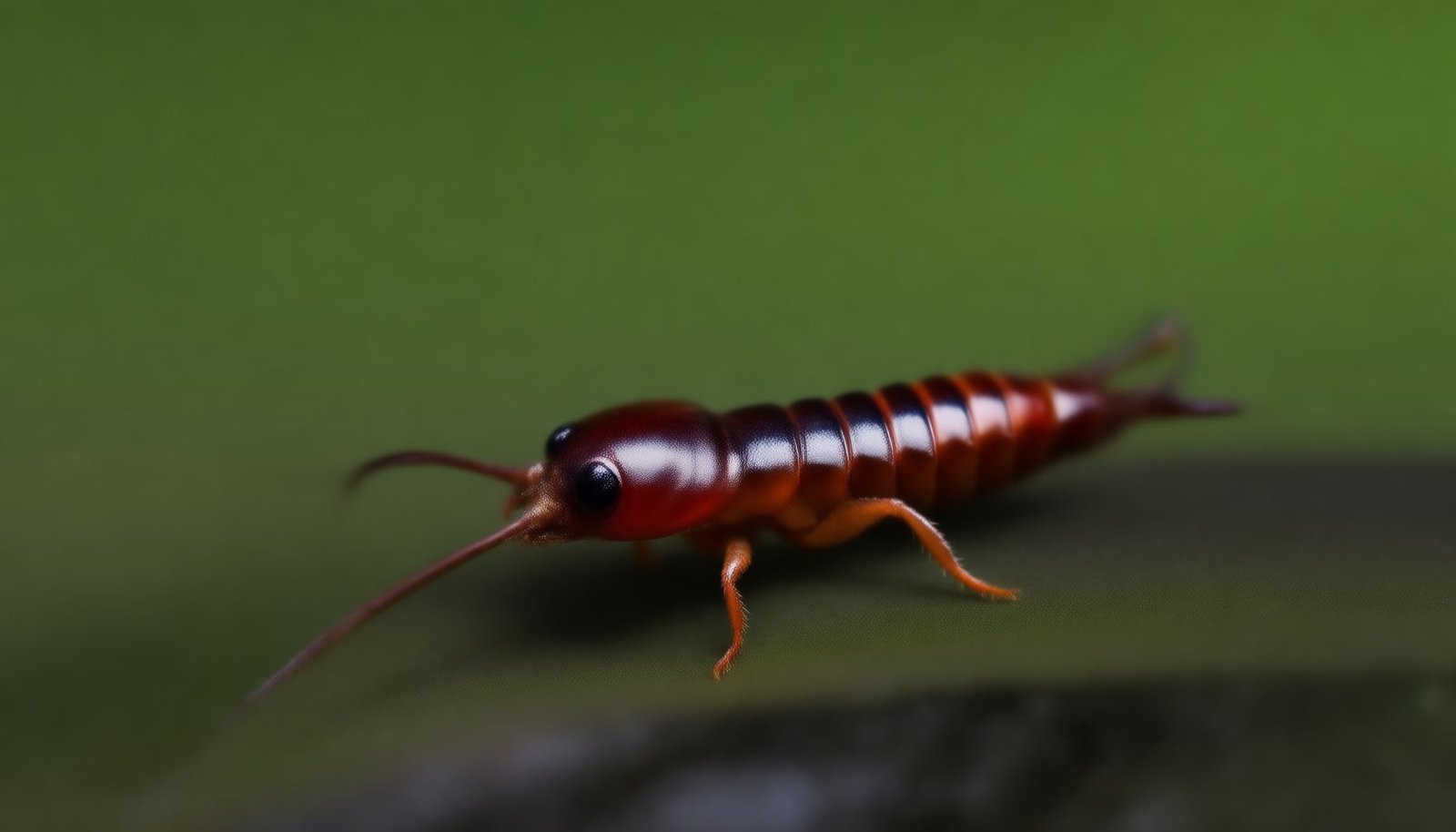
This close-up shows the earwig’s distinctive forcep-like cerci and segmented abdomen — the two features most homeowners either miss or misidentify when trying to figure out what they’re dealing with.
How Do You Tell Male and Female Earwigs Apart? (It Changes How Worried You Should Be)
Here’s the part most pest ID articles skip entirely: the sex of the earwig tells you something useful. Male earwigs have strongly curved, asymmetrical pincers — they’re used for defense and for competition with other males. Female pincers are straighter, more parallel, and shorter in comparison. This matters practically because if you’re finding females, you may be closer to a nesting site, since females actively guard egg clutches and stay near their young for several weeks after hatching — a level of maternal behavior that’s genuinely unusual among insects.
A female earwig can lay between 20 and 80 eggs in a single clutch, deposited in a shallow soil burrow or beneath damp debris, and she’ll actively tend to them — turning, cleaning, and protecting them until they hatch (typically within 7 days in warm conditions). Finding three or four females near a foundation crack in spring is a different situation than finding a lone male wandering a bathroom floor in autumn. One suggests an active breeding population close by; the other is almost certainly a weather-displaced straggler.
What Other Bugs Get Confused With Earwigs? (The Misidentification That Leads to Wrong Treatments)
Getting the ID wrong here has real consequences. Rove beetles are one of the most common earwig lookalikes — they’re similarly elongated and dark, they have short forewings that expose the abdomen, and they move fast in similar habitats. The difference: rove beetles have no cerci at the rear, or if present, they’re tiny and non-pincer-like. If you spray for “earwigs” and you’re actually dealing with rove beetles, you’ve wasted product on a beneficial insect that was actively hunting other pests in your home.
The comparison table below covers the four insects most commonly misidentified as earwigs in US homes:
| Insect | Key Difference From Earwig | Habitat Overlap |
|---|---|---|
| Rove Beetle | No rear pincers; narrower head | Soil, mulch, damp basements |
| Ground Beetle | Fully covered abdomen; shorter antennae | Basements, garages, exterior lights |
| Silverfish | Three rear tails (not pincers); no wings at all | Bathrooms, bookshelves, humid closets |
| Cockroach Nymph | Rounder body; no cerci pincers; longer legs | Kitchens, drains, utility rooms |
Silverfish in particular get confused with earwigs in dim light — both prefer humidity, move quickly when disturbed, and show up in bathrooms and basements. But silverfish have a distinctly carrot-shaped, tapered body with three filaments at the tail end, and no wings whatsoever. If you’re uncertain what’s showing up on your walls after dark, the guide on What Is Crawling on My Bedroom Ceiling at Night? breaks down the most common wall-and-ceiling crawlers in detail.
Are Earwigs Actually Dangerous to Humans, Pets, or Your Home?
The pincers look menacing but function mainly as tools, not weapons — earwigs use them to subdue small prey, to fold their hindwings, and in male-to-male competition. They can pinch skin if handled roughly, and some people feel a faint pressure, but earwig pincers almost never break the skin. There’s no venom, no documented allergic response from earwig contact, and no evidence earwigs transmit any disease to humans. That’s a different profile entirely from something like a brown recluse, where the danger is real and underappreciated.
Pets aren’t at meaningful risk either. A dog or cat that catches and eats an earwig may experience mild gastrointestinal irritation at most — earwigs produce a foul-smelling defensive secretion from abdominal glands, which is more likely to make a pet spit one out than to cause harm. For your home’s structure, earwigs do no damage comparable to what you’d see from wood-destroying insects — they don’t chew wood, tunnel into framing, or destroy fabrics. The only property damage earwigs cause is to soft plant tissue in gardens, where they feed on flower petals, seedlings, and leaf material at night.
“Earwigs are what I’d call a ‘comfort pest’ — they’re almost never dangerous, but their appearance creates genuine alarm. The bigger question I always ask homeowners isn’t ‘how do I kill these’ but ‘why is my foundation damp enough to attract them?’ The earwigs are a symptom. The moisture is the actual problem.”
Dr. Marcus Hale, Board-Certified Entomologist and Urban Pest Management Specialist, University Extension Program (Southeast US)
Why Are Earwigs in My House? (The Real Reason Most Articles Don’t Explain)
Picture this: you’ve sealed your doors, your kitchen is clean, and you still find two or three earwigs every morning near the sliding glass door or in the bathroom. You’re not imagining things, and you’re not failing at pest control — earwigs enter structures seeking the same three things regardless of how tidy a house is: moisture, darkness, and harborage from temperature extremes. They’re especially active in late summer and early fall when outdoor conditions become drier or colder, and they can squeeze through gaps as small as 1/16 of an inch around door sweeps, utility penetrations, and window frames.
The counterintuitive fact that most guides miss: earwigs are strongly attracted to light sources at night despite being nocturnal ground insects. Exterior lights mounted near foundation walls draw them in from the surrounding soil and mulch, which is why earwig problems are often dramatically worse on whichever side of the house faces the porch or floodlight. Here’s the step-by-step picture of how an indoor earwig problem typically develops:
Pro-Tip: Switch exterior bulbs near entry points to warm-spectrum LED or yellow “bug lights” — earwigs (and most insects) are far less attracted to wavelengths above 550nm. This single change can reduce earwig congregation near your doors by 60–70% without any pesticide application.
- Mulch and leaf litter against the foundation — Earwigs spend daylight hours in the top 1–3 inches of moist organic debris within 6–18 inches of your home’s exterior walls. Standard landscaping creates ideal habitat directly at the entry point.
- Exterior light draws them to your walls — Earwigs navigate toward light at night and end up on the exterior surface of the house, where they begin probing gaps and cracks rather than retreating to soil.
- Door sweeps and threshold gaps let them in — A worn or improperly fitted door sweep on a sliding glass door or back entrance is the single most common earwig entry point in residential settings.
- Interior humidity keeps them from leaving — Bathrooms, basements, laundry rooms, and crawl spaces with relative humidity above 60% are hospitable enough that earwigs stop trying to exit and begin establishing a presence.
- Spring nesting near the foundation — If females are already present by late winter, they may burrow into moist soil near the foundation or under concrete slabs and lay eggs. Once eggs hatch (which happens within 7–10 days at temperatures above 60°F), you go from a few stray adults to dozens of nymphs rapidly.
This pathway matters because it tells you exactly where to intervene. Treating the insects themselves without addressing the moisture source and the entry points produces only short-term results. It’s worth noting that damp foundation issues, if left unaddressed, attract more than just earwigs — termites and moisture-seeking wood-destroying insects follow the same trail, and if you want to know how to spot early structural damage before earwigs become the least of your problems, Early Signs of Termites Before Serious Damage Occurs is worth reading alongside this one.
What Should You Do If You’re Finding Earwigs Inside Regularly?
The honest answer is that earwig control depends heavily on your specific situation — a homeowner in a humid coastal climate dealing with a crawl space and dense foundation plantings has a different problem than someone in a dry inland region finding one or two earwigs after heavy rain. That said, there’s a logical sequence that works across most scenarios, starting outside and working inward rather than reaching immediately for indoor sprays.
Here’s what actually moves the needle on earwig numbers:
- Pull mulch 6–12 inches away from your foundation — This is the single highest-impact physical change you can make. Earwig populations in the immediate perimeter drop significantly within one to two weeks when their daytime harborage is removed.
- Fix drainage that pools within 4 feet of the foundation — Downspout extensions, grading corrections, or dry creek beds that move water away from the structure address the root moisture condition that draws earwigs in the first place.
- Replace worn door sweeps and seal utility gaps — Focus on ground-level entry points: sliding door thresholds, gaps around exterior spigots, and where pipes or conduit enter at foundation level.
- Reduce interior humidity below 50% RH in basements and crawl spaces — A dehumidifier in a damp basement removes the interior incentive for earwigs that make it through the perimeter. Many infestations resolve without any pesticide once interior humidity drops.
- Apply a perimeter barrier treatment if populations are large — Pyrethroid-based sprays applied to the foundation band (bottom 2–3 feet of the exterior wall) and the adjacent soil are effective for active infestations. Bifenthrin and deltamethrin products labeled for perimeter use are the most commonly recommended by licensed applicators. Reapplication every 60–90 days through active season is typically required for sustained control.
One thing worth knowing: diatomaceous earth applied along interior baseboards and under appliances works well as a supplementary measure for earwigs that have already made it inside. It damages the waxy cuticle of the exoskeleton and causes dehydration within 24–48 hours of contact — but it loses effectiveness when it gets wet, so it’s not useful in high-humidity areas like under-sink cabinets or bathrooms without good ventilation. Use it where it stays dry, and it’ll do consistent work.
If earwig numbers inside remain high despite perimeter exclusion and moisture control — more than 10–15 individuals per week over several consecutive weeks — that’s usually a signal that there’s a moisture issue inside the structure itself (a leaking pipe, a condensation problem in a wall cavity, or an unvented crawl space) rather than just an outdoor population pushing in. That’s when a professional moisture assessment is worth more than another round of perimeter spray.
Earwigs are one of those pests that respond almost disproportionately well to habitat correction — better than most insects, honestly, because they’re so dependent on very specific moisture and shelter conditions. Fix the conditions, and they largely solve themselves. The ones you’re seeing inside right now are telling you something specific about your home’s perimeter. That’s actually useful information, if you know how to read it.
Frequently Asked Questions
What do earwigs look like?
Earwigs are flat, reddish-brown insects that range from 5 to 25 millimeters long depending on the species. Their most recognizable feature is the pair of curved pincers (called cerci) at the tail end of their abdomen. They also have six legs, long antennae, and some species have wings tucked under short, leathery wing covers — though they rarely fly.
Can earwigs hurt you or are they dangerous?
Earwigs aren’t dangerous to humans — they don’t sting, they’re not venomous, and they don’t spread disease. They can pinch with their cerci if you handle them or corner them, but the pinch is rarely strong enough to break skin. They’re more of a nuisance pest than a health threat.
What is the difference between earwigs and cockroaches?
The easiest tell is the pincers — cockroaches don’t have them, but earwigs do. Cockroaches are also typically larger, ranging from 13 to 53 millimeters, and have a flatter, oval-shaped body compared to the earwig’s more elongated shape. If you see pincers at the back end of the bug, it’s almost certainly an earwig.
Why do I have earwigs in my house?
Earwigs move indoors when outdoor conditions get too hot, dry, or cold — they’re looking for moisture and shelter. They’re commonly found in bathrooms, basements, and kitchens where humidity is higher. Gaps under doors, cracks in the foundation, and damp mulch or leaf piles pressed against the house are the most common entry points.
Do earwigs lay eggs in your ears?
No — that’s a myth, and there’s no documented evidence of earwigs crawling into human ears to lay eggs. The name ‘earwig’ comes from an old European superstition, not actual behavior. These insects prefer to lay their eggs in shallow soil burrows outdoors, and a female typically lays between 20 and 80 eggs per clutch.