
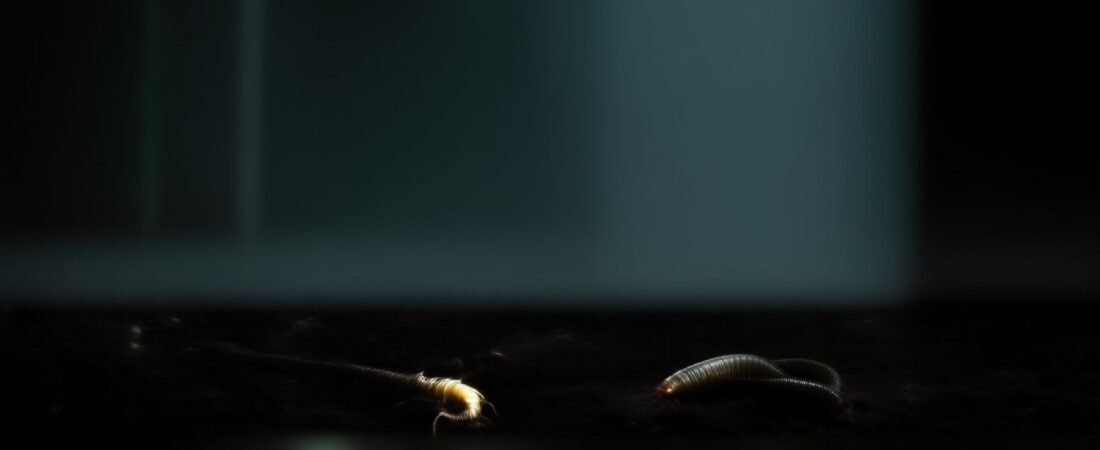
Both of them are long, leggy, and fast enough to make you jump — but centipedes and millipedes are about as different as two bugs can get, and misidentifying one will lead you to completely the wrong response. Here’s the bottom line: if it moves fast and has one pair of legs per body segment, it’s a centipede, and it can bite. If it moves slowly, curls into a ball when threatened, and has two pairs of legs per segment, it’s a millipede — and it’s basically harmless. Most people spend way too much time panicking about the wrong one, or assuming they’re interchangeable. They’re not.
The real mistake homeowners make isn’t failing to know the Latin names — it’s assuming both creatures mean the same thing about their home. A millipede showing up in your basement after a rainstorm is a moisture and landscaping problem. A centipede in the same spot might mean you have other insects it’s hunting. Those are two very different problems requiring two very different fixes. Knowing which one you’re looking at changes everything.
How Do You Tell a Centipede From a Millipede Just by Looking?
The fastest visual tell is leg placement. Centipedes have one pair of legs per body segment, and those legs stick out dramatically to the sides — they look almost like a living fringe, wide and splayed. Millipedes have two pairs of legs per body segment, but those legs are tucked underneath the body, making the animal look more like a smooth, rounded tube. Hold that image in your head and you’ll never confuse them again.
Body shape gives it away almost as quickly. Centipedes are flat — dorsoventrally flattened, if you want the technical term — which lets them squeeze into gaps as thin as a credit card. Millipedes are cylindrical and rigid, almost worm-like in cross-section. Color varies by species, but house centipedes are typically yellowish-brown with dark banding on their legs, while common millipedes are brownish-black with a matte, segmented shell that looks almost armored.
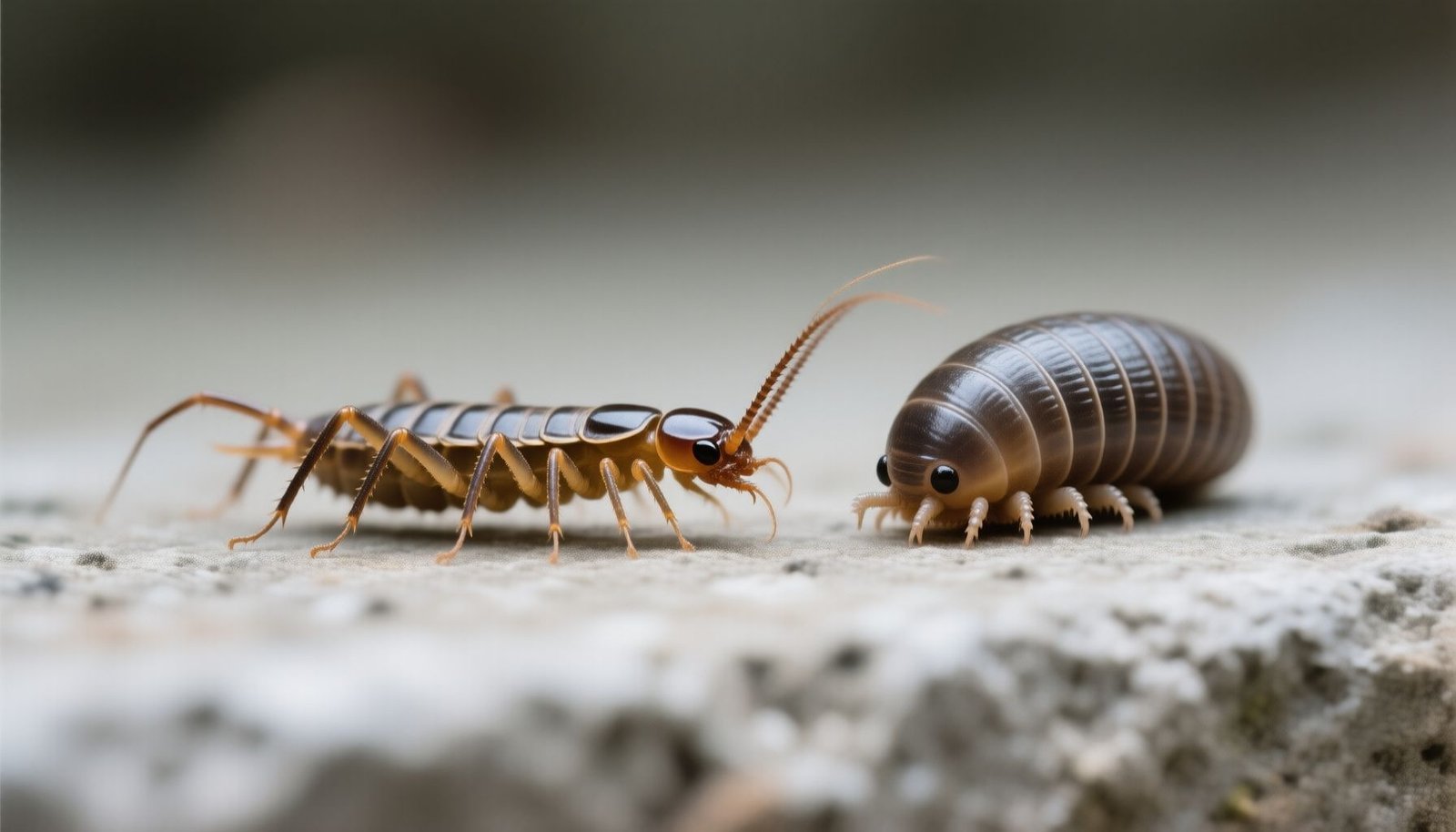
This side-by-side close-up shows exactly what separates these two creatures at a glance — the centipede’s wide, outward-reaching legs versus the millipede’s compact, tucked-under limbs — which is the single most reliable identification feature you can use in low light or a quick sighting.
What Does a House Centipede Actually Look Like Up Close?
The house centipede (Scutigera coleoptrata) is the one most Americans encounter indoors, and it genuinely looks alarming — 15 pairs of legs, each pair longer than the last toward the rear, with the back legs so long they can be mistaken for antennae. Adults reach about 1 to 1.5 inches in body length, not counting leg span, which can push the full silhouette to over 3 inches. That’s a lot of creature skittering across a bathroom wall at midnight.
Picture this: you reach under your bathroom sink to grab a cleaning product and something fast — impossibly fast for its size — shoots straight up the wall and disappears behind the medicine cabinet. That’s the house centipede. They can move at roughly 1.3 feet per second, which is part of why they feel so shocking to encounter. Their speed isn’t random; they’re active hunters using compound eyes and long, sensitive antennae to track prey. They’re not running from you casually — they’re navigating.
What Does a Millipede Look Like, and How Many Species Show Up in US Homes?
The millipede most common in US homes is the North American millipede (Narceus americanus) or more often the smaller flat-backed millipedes in the order Polydesmida — both dark, slow-moving, and cylindrical. Despite the name, no millipede actually has 1,000 legs. The species with the most documented legs (Eumillipes persephone) hits 1,306, but the ones you’ll find in your house typically have somewhere between 40 and 400 legs depending on age and species. A juvenile millipede hatches with only 6 legs and adds segments — and leg pairs — with each molt.
Millipedes have one behavioral trait that’s a dead giveaway when you poke one: they coil into a tight spiral. This is a defensive reflex, and while they’re coiled, some species release hydrogen cyanide or quinones from glands along their sides — enough to stain skin yellow or orange and cause irritation if rubbed into eyes. That said, the amounts involved are negligible for most adults and they won’t pierce skin. The bigger issue is that some North American species can release these secretions onto surfaces or pets, so picking one up bare-handed and then touching your face isn’t a great plan.
“Most people are surprised to learn that the house centipede is actually one of the more beneficial arthropods you can have indoors — it’s actively killing cockroach nymphs, silverfish, and moths. The millipede, on the other hand, is a decomposer and poses essentially no predatory risk. Treating them the same way is a diagnostic error that often leads homeowners to skip the real question: why are these arthropods finding their way inside in the first place?”
Dr. Michael Raupp, Extension Entomologist, University of Maryland Department of Entomology
Can Either One Bite or Sting You — and Should You Actually Be Worried?
Centipedes can and do bite. Their front legs are modified into forcipules — claw-like appendages connected to venom glands — and they use them to immobilize prey. A house centipede bite on a human typically causes localized pain, redness, and mild swelling similar to a bee sting, resolving within a few hours. Larger outdoor species like the giant desert centipede (Scolopendra heros), which can reach 8 inches, can deliver a much more painful bite, though fatalities in healthy adults are essentially unheard of in the US. People with venom allergies should treat a centipede bite with the same respect they’d give a bee sting.
Millipedes don’t bite at all — they have no mechanism to do so and no reason to. Their mouth is designed for chewing decaying plant matter, not defense. The secretion issue mentioned earlier is real but minor for most encounters. Here’s the nuance worth knowing: severity depends on the species and your region. In the desert Southwest, some larger millipede species produce more potent secretions, while in the humid Southeast, you’re more likely to encounter the flat-backed varieties whose secretions are milder. The response — don’t handle them barehanded, wash hands after contact — is the same either way.
Pro-Tip: If you’re finding centipedes regularly inside your home, don’t immediately reach for a spray — the centipede is telling you that something it eats is already there. Check for signs of other small insects like silverfish, cockroach nymphs, or drain flies first. Eliminating the prey population is far more effective than chasing centipedes around with a can of Raid, and you’ll solve two problems instead of one.
What’s the Real Difference Between Finding One vs. Finding Many?
One centipede in your home is almost certainly a random entry — they don’t colonize indoors the way cockroaches or ants do. They need high humidity, and while they can reproduce inside under the right conditions, a single sighting usually means one wandered in through a gap around a pipe or foundation crack. Finding five or more centipedes in a short period is a different signal entirely: your home has both a moisture problem and enough insect prey to support a local population. That’s worth investigating, the same way you’d investigate unexpected tiny bugs appearing in your bedroom — multiple sightings demand a root-cause search, not just a surface response.
Millipedes are a different story. They almost always show up in groups, especially after heavy rain. A mass migration of millipedes into a basement or crawl space — sometimes hundreds at a time — is a well-documented phenomenon. They’re not infesting in the traditional pest sense; they’re refugees from waterlogged soil. Once indoors, they die quickly because homes are too dry for them. You’ll often find dead or dying millipedes scattered near entry points. The entry points themselves — gaps in the sill plate, cracks around basement windows, unscreened vents — are the problem to address, not the millipedes per se.
| Feature | Centipede | Millipede |
|---|---|---|
| Legs per segment | 1 pair | 2 pairs |
| Body shape | Flat, wide | Round, cylindrical |
| Movement speed | Very fast (up to 1.3 ft/sec) | Slow, deliberate |
| Can it bite? | Yes — venom-delivering forcipules | No biting mechanism |
| Defense mechanism | Bite + escape speed | Coils up, may release secretions |
| What finding many means | Prey insects present + moisture | Heavy rain, saturated soil outside |
What Specific Physical Features Should You Look for to ID Them Quickly?
Here’s a practical ID checklist for that moment when something is moving fast and you need to decide what you’re looking at before it disappears. Focus on these features in order of what’s easiest to see:
- Speed of movement: Centipedes move in fast, erratic bursts. Millipedes move slowly and steadily, almost mechanically. If it’s gone before you can track it, centipede.
- Leg visibility from above: Centipede legs extend visibly beyond the body width on both sides. Millipede legs are barely visible from above — they’re underneath.
- Body profile (flat vs. round): Crouch down to floor level if you can. A centipede looks ribbon-thin from the side. A millipede looks like a cylinder or rounded tube.
- Reaction to threat: Poke gently near (not at) it. A centipede bolts. A millipede coils into a C or O shape and stays put.
- Antenna length: Centipede antennae are long — sometimes nearly as long as the body itself. Millipede antennae are short and stubby by comparison.
- Where it was found: Centipedes are often in bathtubs, on walls, or near drains. Millipedes are more commonly found near exterior doors, in basements along the perimeter, or clustered at entry points after rain.
Do Centipedes and Millipedes Prefer Different Parts of the House?
Centipedes are active hunters, so they follow their prey. They’re most commonly found in bathrooms (silverfish, drain flies, moisture), basements (a buffet of insects), and occasionally kitchens. They don’t nest in clusters — you won’t find a centipede colony under a box. They’re solitary predators that establish loose territories based on where food is available. Outdoors, they live under logs, leaf litter, and stones where prey is dense and moisture is consistent.
Millipedes concentrate at entry points and die quickly once inside because indoor air is too dry for them — they require 80–90% relative humidity to thrive, and most homes sit well below that. Their preferred outdoor habitat is decaying organic matter: mulch beds, leaf piles, rotting logs, and soil within a few inches of the surface. This is why heavy mulching right against a home’s foundation is one of the most reliable ways to build a millipede population that eventually tries to move inside. Keeping mulch pulled back at least 6 inches from the foundation wall reduces pressure significantly — a fact that applies to a surprisingly wide range of pest problems, not just millipedes. The same way you’d investigate indirect signs pointing to a bigger pest issue, a sudden millipede surge usually signals that something in the landscape around the home needs attention.
Are There Look-Alikes That Get Confused for Both?
Yes — and this is where people waste the most time. Pill bugs (also called roly-polies, technically isopods) are not millipedes, but they get called millipedes constantly. They’re gray, oval, and also curl into a ball when disturbed. The difference: pill bugs have 7 pairs of legs and a visibly segmented, armored back that looks almost like a tiny armadillo. They’re crustaceans, not myriapods at all. Symphylans — tiny, fast, white, and multi-legged — get mistaken for small centipedes but are primarily soil dwellers that most homeowners never encounter indoors.
Wire worms, which are actually beetle larvae, occasionally get called millipedes because of their segmented, cylindrical appearance and similar size. The tell is that wireworms have only 3 pairs of true legs near the head — the rest of the body is legless. Earwigs also occasionally get lumped into the centipede category by people who see the pincers and long body and assume it’s the same kind of creature. They’re not even close — earwigs are insects with 6 legs and distinctive cerci (the rear pincers), while centipedes are myriapods with many more legs and no pincers at the rear.
- Pill bugs / roly-polies: Gray, armored, 7 leg pairs, curl into perfect spheres — isopods, not millipedes
- Wireworms (beetle larvae): Cylindrical and segmented like millipedes, but only 3 leg pairs near the head, rest legless
- Symphylans: White, fast, multi-legged — look like tiny centipedes but are soil-dwellers rarely seen indoors
- Earwigs: Long body and rear pincers cause confusion with centipedes, but they’re 6-legged insects with no venom
- Sowbugs: Similar to pill bugs but can’t curl fully — often found alongside millipedes in damp basements
Getting this right matters because the response to each creature is different. Treating a pill bug problem as a centipede problem — or vice versa — means you’re addressing the wrong environmental conditions entirely. The counterintuitive truth about both centipedes and millipedes is that neither one is truly a pest in the biological sense. They don’t eat your food, damage your structure, or reproduce in colonies that take over your home. What they’re actually doing — hunting insects or decomposing organic matter — is telling you something specific about conditions inside or immediately outside your home. Learn to read that signal correctly, and you’ve already solved most of the problem before you’ve opened a single product.
Frequently Asked Questions
how many legs do centipedes vs millipedes have?
Centipedes have one pair of legs per body segment, typically ranging from 30 to 354 legs depending on the species. Millipedes have two pairs of legs per segment, which can add up to anywhere from 40 to over 400 legs. The easiest way to tell them apart is to count the leg pairs on a single segment — one pair means centipede, two pairs means millipede.
can centipedes or millipedes bite you?
Centipedes can bite and inject venom, which causes pain, redness, and swelling — similar to a bee sting for most people. Millipedes don’t bite at all, but some species secrete a defensive fluid that can irritate your skin or cause mild chemical burns if handled. If you’re finding either pest in your home, it’s best not to handle them with bare hands.
what is the difference in body shape between centipedes and millipedes?
Centipedes have a flat, elongated body that lets them move fast and squeeze into tight spaces. Millipedes have a rounded, cylindrical body that looks almost worm-like and causes them to move much more slowly. When threatened, millipedes also curl into a tight coil to protect themselves, which centipedes never do.
what do house centipedes look like?
House centipedes are yellowish-gray with dark stripes running along their body and have 15 pairs of long, banded legs that extend well beyond their body length of about 1 to 1.5 inches. Their legs get progressively longer toward the back, giving them a distinctive, almost spider-like appearance. They move extremely fast, which makes them easy to spot scrambling across floors, walls, and ceilings.
where do you usually find centipedes vs millipedes in your house?
Centipedes prefer damp areas where they can hunt prey, so you’ll most often find them in bathrooms, basements, and crawl spaces. Millipedes typically stay outdoors in mulch, leaf litter, and soil, but migrate inside in large numbers when conditions outside get too wet or too dry. If you’re seeing millipedes indoors, it’s usually a sign of excess moisture buildup around your home’s foundation.