

Nine out of ten people who find tiny black bugs in their bed immediately Google “bed bugs” — and nine out of ten of them are looking at something else entirely. That’s not reassuring, but it’s actually good news, because most of the bugs that end up in your sleeping space are easier to deal with than bed bugs and far less likely to follow you to a hotel, a friend’s house, or your next apartment.
Here’s the angle most pest articles get completely wrong: they treat “tiny black bugs in bed” as a bed bug identification problem. It isn’t. It’s a source problem. The bug in your bed is almost always a clue about what’s happening somewhere else in your home — your carpets, your stored clothing, a bird nest above your roofline, even your houseplants. Identifying the bug is step one, but understanding where it came from is what actually stops the problem.
This article will walk you through the most likely culprits, what distinguishes each one, and — critically — what their presence in your bed is telling you about a larger issue you haven’t found yet.
Why Tiny Black Bugs in Your Bed Are Rarely Bed Bugs
Bed bugs are notorious, but they have a very specific appearance: oval, flat, reddish-brown, and roughly the size of an apple seed when adult. They are almost never described as truly black. If you’re finding something distinctly dark — close to black — and small enough that you’re squinting to see it, you’re most likely not dealing with bed bugs at all. Adult bed bugs are also visible to the naked eye without much difficulty, which means the “tiny” part of your description is already pointing away from them.
What makes this confusing is that people find bugs in their beds and assume the bed is where they live. Bed bugs do live close to where you sleep — in mattress seams, bed frames, and nearby wall cracks — but most other small black insects end up in your bed by accident. They fell from a ceiling, wandered in from a window, or hitched a ride on clothing you tossed onto the mattress. The bed is the crime scene. It’s almost never the home base.
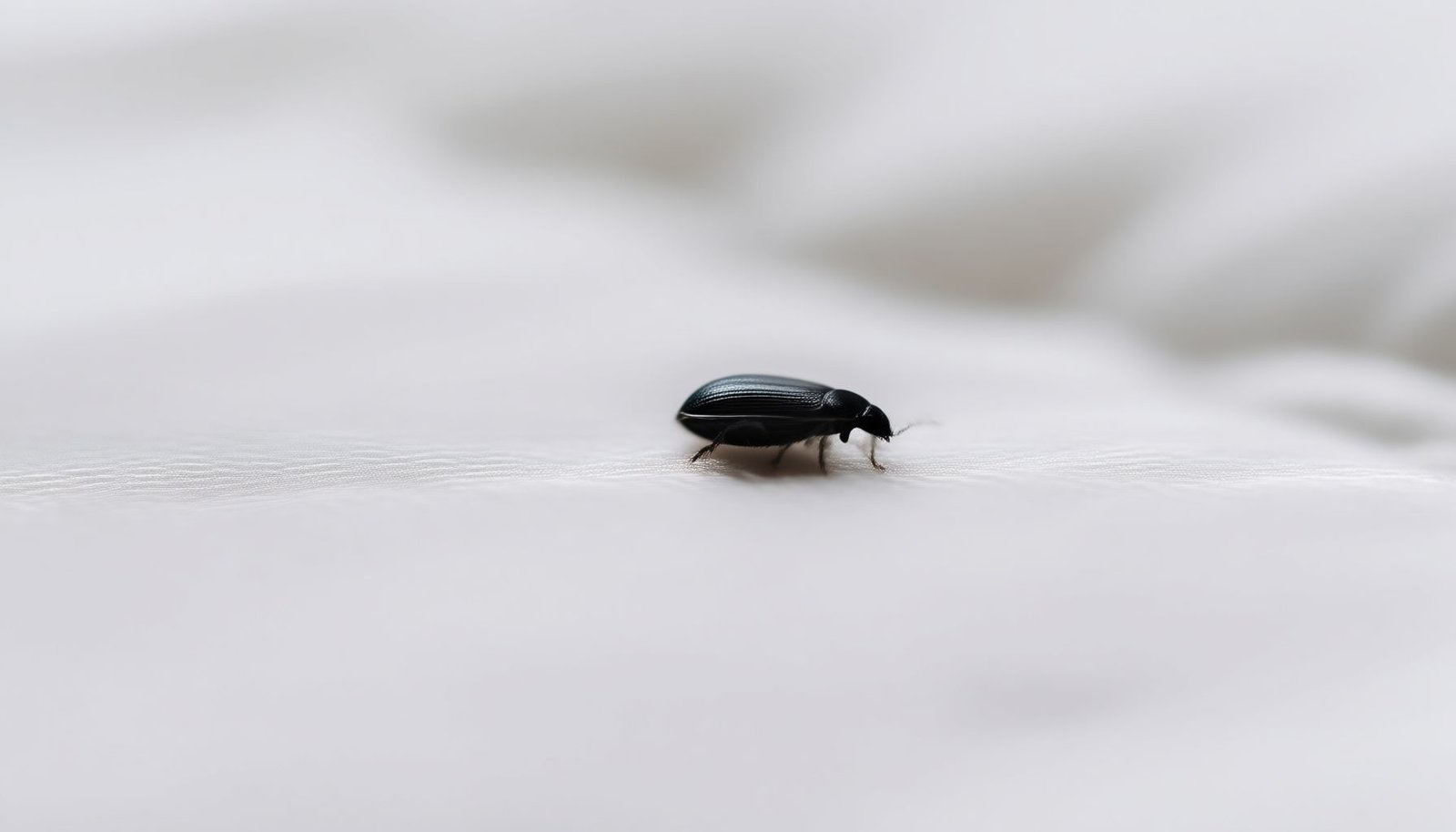
This close-up shows the kind of size and color variation between common tiny black bed insects — noticing whether your bug is round, elongated, or oval-shaped is the single fastest way to narrow down what you’re actually dealing with.
What Are the Most Likely Culprits? A Practical Identification Guide
Picture this: you pull back your sheets in the morning and spot a handful of specks — some moving, some not. Before you panic, take one and look at it under the flashlight on your phone camera. The shape and movement pattern tell you almost everything. A round bug that tucks into a ball is completely different from a long, fast-moving one, and treating them the same way wastes time and money.
Below are the most common tiny black bugs found in beds, with the key traits that separate them from each other. Pay close attention to body shape, whether it flies, and whether you’re seeing them in clusters or as scattered individuals — those details matter more than color alone.
| Bug | Size | Key Identifier | Where It Actually Lives |
|---|---|---|---|
| Carpet Beetle Larva | 1–4 mm | Brown/black, hairy, slow-moving | Carpets, stored wool, closets |
| Flea | 1–3 mm | Flat side-to-side, jumps suddenly | Pet bedding, carpet, upholstery |
| Spider Beetle | 1–4 mm | Round, shiny, spider-like legs | Pantry, stored grain, bird nests |
| Bat/Bird Mite | Under 1 mm | Nearly invisible, causes intense itching | Attic, wall voids near nests |
How Do You Tell the Difference Between These Bugs Without a Microscope?
You don’t need lab equipment — you need a systematic approach. Most people skip straight to treatment, which is exactly why they keep seeing bugs weeks later. Taking five minutes to properly observe what you’ve found saves you from buying the wrong product and potentially making the infestation worse by scattering a population that was previously contained.
Use this sequence when you find an unidentified bug in your bed:
- Capture it. Use a piece of clear tape to pick up the bug without crushing it, then press it against a white index card or piece of paper. This gives you a preserved specimen you can actually examine.
- Check the body shape. Is it round like a poppy seed, oval and flat, or long and narrow? Round and shiny almost always means spider beetle. Flat and jumpy means flea. Hairy and slow means carpet beetle larva.
- Count the legs if you can. Insects have six legs. Mites and spider beetles have eight. If your bug looks like a tiny spider, it’s either a mite or a spider beetle — not a true insect.
- Note where in the bed you found it. On top of the sheet, it likely fell or wandered in. In the mattress seam or behind the headboard, that’s more concerning and warrants a full bed bug inspection regardless of color.
- Look for secondary evidence. Skin rashes or bites that appear overnight, shed skins, or dark fecal spotting on the mattress surface are each diagnostic clues for different bugs.
Pro-Tip: Put your captured specimen in a small zip-lock bag and take it to your local cooperative extension office or a pest control supply store. Many university extension programs offer free or low-cost identification — and knowing exactly what you have before you treat is worth far more than the 20 minutes it takes.
What Is the Bug in Your Bed Actually Telling You About Your Home?
This is the insight most pest articles completely skip over: a bug in your bed is a symptom, not the diagnosis. Carpet beetle adults, for example, feed outdoors on pollen — but their larvae are what you find inside, and those larvae feed on keratin. Wool blankets, down pillows, shed human hair trapped in mattress fibers, natural-fiber rugs nearby. Finding carpet beetle larvae in or near your bed almost certainly means you have an established population somewhere in your bedroom that’s been quietly feeding for weeks or months before you noticed.
Spider beetles are another one that catches people off guard. They look unsettling — round bodies, long legs, genuinely spider-like at a glance — but they’re scavengers that follow a food trail. Finding them near your bed usually means there’s something attracting them nearby: a forgotten food item, a bird nest in the wall or attic directly above your bedroom, or stored materials in a closet adjacent to where you sleep. Treat the spider beetle and ignore the nest, and you’ll be finding them again within a few weeks. For a broader sense of how pest appearance can mislead you, the same identification logic applies when you’re trying to figure out how to identify stink bugs — shape and context matter more than color alone.
“People focus on killing what they see and miss the infestation they can’t. With carpet beetles especially, by the time larvae show up on a mattress or bedding, there’s almost always a secondary harborage site — typically in stored fabrics, a vent, or a wall void with old nesting material — that needs to be addressed first. Treating the bed alone is just managing the symptom.”
Dr. Rachel Fenwick, Urban Entomologist and NPMA-Certified Pest Management Professional
Which Tiny Black Bed Bugs Actually Bite — and Which Are Just Unsettling to Look At?
Not everything you find in your bed is after your blood. This is a genuinely underappreciated distinction because the instinct when you find any bug in your sleeping space is to assume it’s biting you. Carpet beetle larvae do not bite — but their bristly hairs cause a skin reaction that feels almost identical to bites, which is why so many people get misdiagnosed (even by themselves) for months. The rash tends to appear in lines or patches where skin made contact with infested fabric rather than in the scattered, random pattern that actual bites produce.
Fleas and mites do bite, and they’re the ones worth treating most urgently. A single female flea can lay up to 50 eggs per day, meaning a small flea problem can become a severe infestation within two to three weeks if untreated. Bat mites and bird mites — which migrate into living spaces after a roost or nest is abandoned — are less than 1 mm long and almost impossible to see without magnification, but they cause intense, localized itching that’s disproportionate to their tiny size. The health implications of an untreated infestation aren’t always dramatic, but they’re real — similar to how people underestimate exposure risk when they think about something like what happens if you eat food contaminated by cockroaches. Small exposures, repeated over time, add up.
Here’s a quick reference for what bites and what doesn’t among the common culprits:
- Fleas — Bite humans and pets; prefer lower legs and ankles; jump visibly when disturbed
- Bird/bat mites — Bite humans when their primary host is gone; cause intense localized itching; nearly invisible to the naked eye
- Carpet beetle larvae — Do NOT bite; cause a bristle-triggered allergic rash that mimics bites; often misdiagnosed for weeks
- Spider beetles — Do NOT bite; completely harmless to humans; presence signals a nearby food or nesting source
- Psocids (booklice) — Do NOT bite; occasionally found in humid bedrooms; signal a moisture problem more than a pest problem
One honest nuance worth acknowledging: how urgently you need to act depends heavily on what you’ve found. In a dry climate with no pets, a single carpet beetle larva near a wool blanket is a low-level housekeeping issue. In a humid apartment building with shared walls and a neighbor who has cats, a flea spotted in your bed warrants faster, more aggressive action — because reinfestation from adjacent units is a real possibility regardless of how thoroughly you treat your own space.
Once you’ve correctly identified what’s in your bed and traced it back to its actual source, the elimination strategy becomes much clearer. You’re not fighting a bed problem — you’re fighting a carpet problem, an attic problem, or a pet problem that happened to show up in the most alarming possible location. That shift in perspective is what separates people who solve this once from people who keep seeing bugs in their sheets every few months without ever understanding why.
Frequently Asked Questions
what are tiny black bugs in my bed that are not bed bugs?
The most common culprits are bat bugs, spider beetles, carpet beetle larvae, fleas, and book lice. Each one looks slightly different up close — bat bugs have longer hairs, spider beetles are round and shiny, and carpet beetle larvae are fuzzy. A magnifying glass and a good flashlight can help you tell them apart before you spend money on treatment.
how do I know if tiny black bugs in my bed are fleas or bed bugs?
Fleas are narrower, jump when disturbed, and leave bites mostly on your ankles and lower legs rather than your upper body. Bed bugs are flat, oval-shaped, and don’t jump at all — they also leave rusty brown stains on sheets from digested blood. If you have pets in the house and the bugs are jumping, fleas are almost certainly what you’re dealing with.
can carpet beetles live in your bed?
Yes, carpet beetles are one of the most underdiagnosed causes of tiny black bugs found in beds, and people often mistake the damage for bed bug bites. They don’t actually bite, but their bristly larvae cause skin irritation that looks a lot like bite marks. They’re attracted to natural fibers like wool and cotton, so bedding, mattress seams, and pillowcases are common hiding spots.
what do tiny black bugs in bed look like compared to bed bugs?
Bed bugs are reddish-brown, not true black, and they’re flat and oval — roughly the size of an apple seed at about 5–7mm as adults. Truly black bugs found in beds are more likely to be flea beetles, spider beetles, or bat bugs. Checking for the classic bed bug signs — shed skins, dark fecal spots, and a musty odor — helps confirm whether you’re actually dealing with bed bugs or something else.
should I call an exterminator for tiny black bugs in my bed?
It depends on what you’re dealing with — fleas and bed bugs almost always need professional treatment if the infestation is beyond a few insects, while carpet beetles and spider beetles can often be handled with thorough vacuuming, washing bedding at 120°F or higher, and removing food sources. If you’re seeing more than 10–15 bugs or finding them consistently over several days, calling a pest control professional is worth it. Misidentifying the bug is the biggest mistake homeowners make, so getting a correct ID first saves you time and money.