
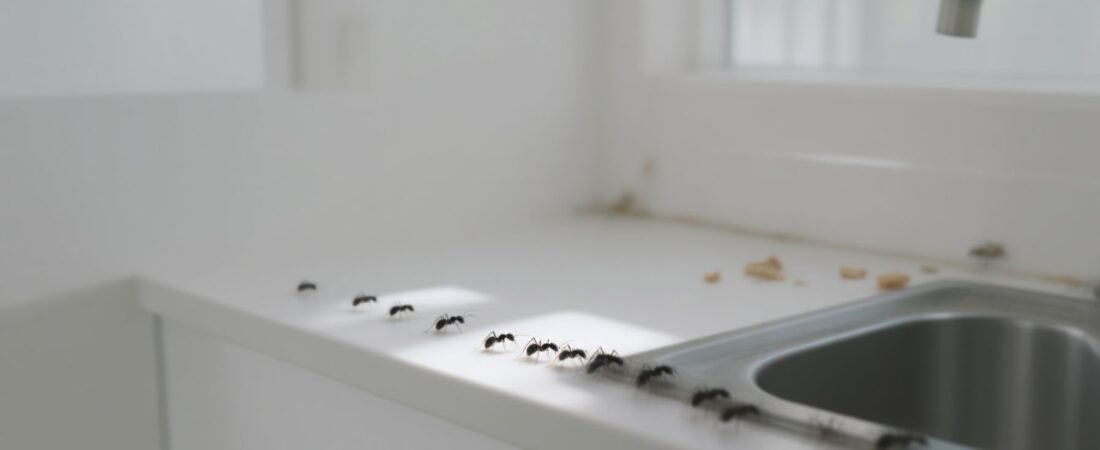
A clean kitchen can still have ants — and that’s not a contradiction, it’s just biology. The assumption that ants show up because someone left dishes in the sink or crumbs on the counter is one of the most persistent myths in home pest control, and it causes people to scrub their kitchens obsessively while completely ignoring the actual reasons the ants keep coming back. The truth is that ants are not evaluating your cleaning habits. They’re following invisible chemical trails laid by scouts who found something your kitchen is offering that has nothing to do with visible mess.
Why Do Ants Come Into a Kitchen That Has No Visible Food?
Scout ants — the ones you see wandering around seemingly at random — are not lost. They’re actively exploring, and they’re sensitive to food sources at concentrations so low that no human nose or eye would register them. A few drops of juice that dried and were wiped down hours ago can still carry enough residual sugar to trigger foraging behavior. The ant isn’t finding your mess; it’s finding trace chemistry you didn’t know was there.
There’s also a water angle that almost nobody talks about. Many ants — particularly pavement ants and odorous house ants, two of the most common kitchen invaders in the US — are just as motivated by moisture as by food. A slow drip under the sink, condensation collecting around a refrigerator line, or even a damp sponge sitting in a tray is enough to make your kitchen attractive. Your kitchen could be spotless and still be a reliable water source for a colony of several thousand workers.
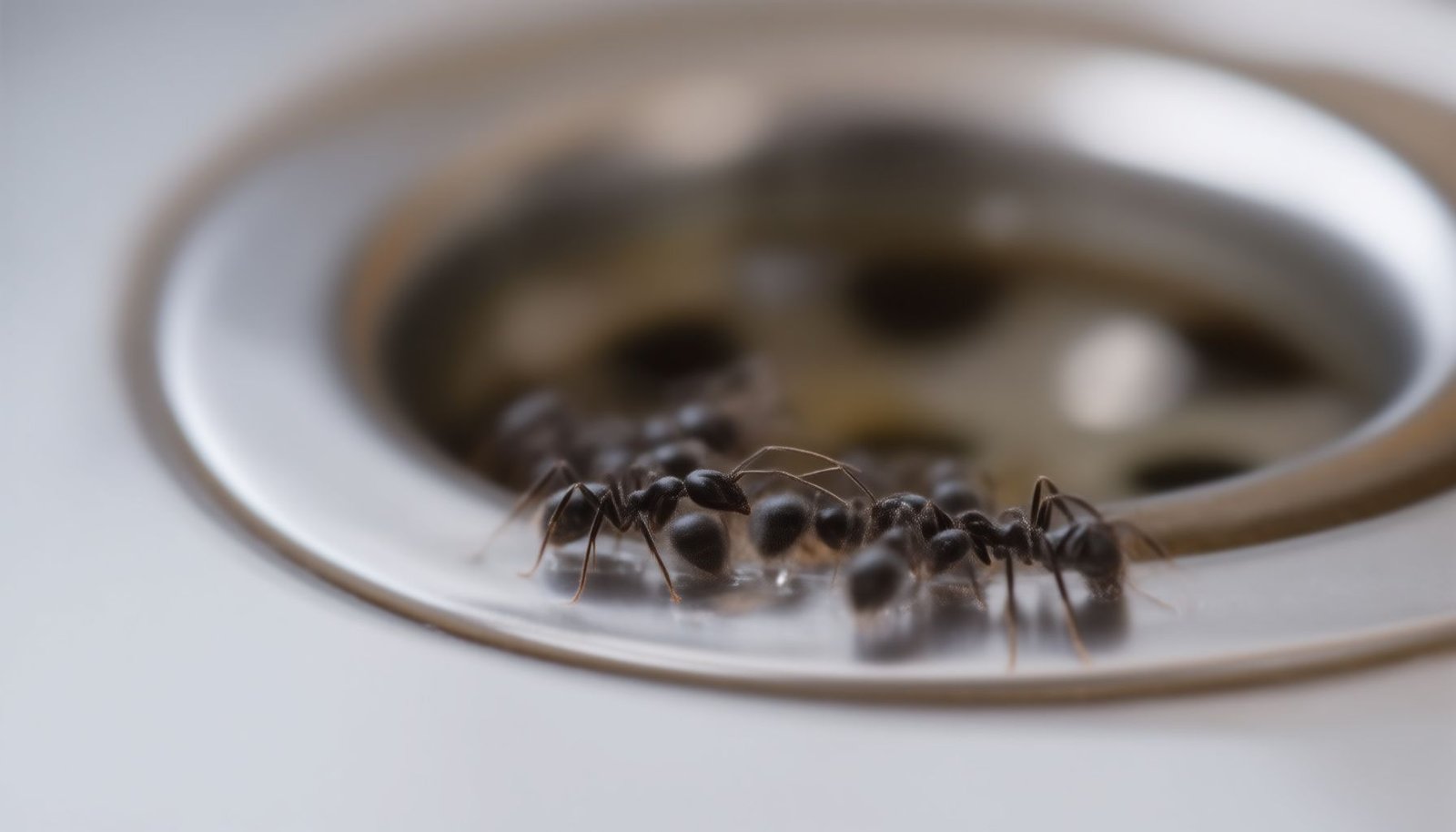
This close-up shows ant scouts moving along a kitchen surface near a sealed appliance — a reminder that ants don’t need open food to navigate your countertops, just a chemical signal left behind from something that was there hours or days earlier.
What Are Ants Actually Smelling That You Can’t See?
Ants have roughly 400 to 500 distinct olfactory receptors — compared to about 400 in humans — and they use them to detect food-related volatile compounds at parts-per-billion concentrations. That means the faint residue from a banana peel that sat on your counter for twenty minutes, or the microscopic film of cooking oil that settled on the backsplash during dinner, is broadcasting a signal you’ll never pick up but a scout ant absolutely will. Cleaning removes what you can see. It doesn’t always break down the chemical markers that ants are actually responding to.
Pet food bowls are a classic example of this gap. Picture this: you feed the dog in the morning, rinse the bowl, and set it on the mat to dry. By afternoon, there’s a trail of ants circling the mat. The bowl looks clean. But the mat has absorbed moisture and trace proteins, and the bowl itself may have a thin biofilm around the rim that’s undetectable to you. Ants found it in under a few hours because a scout left a pheromone trail back to the colony within minutes of the discovery. This is how a “clean” kitchen becomes a foraging destination — not because of negligence, but because ants operate at a different sensory scale than we do.
“Homeowners often feel embarrassed when they see ants in a clean kitchen, but sanitation is only one variable in a much larger equation. Colony size, proximity of the nest, seasonal food stress, and moisture availability all determine whether ants will forage indoors. A perfectly clean kitchen located near a large outdoor colony under drought conditions is going to see ant activity regardless of how often it’s mopped.”
Dr. Sandra Elkins, Board-Certified Entomologist and University Extension Pest Management Specialist
Which Types of Ants Are Most Likely Invading a Clean Kitchen?
Not all ants behave the same way, and identifying the species matters because it tells you where the colony actually is and what the ants are really after. The three species most commonly found in clean US kitchens — odorous house ants, pavement ants, and Argentine ants — are all opportunistic moisture and sugar seekers that nest outdoors but forage aggressively inside. Carpenter ants are a different situation; finding them in your kitchen could indicate a structural moisture problem rather than a food attractant issue.
Here’s a quick breakdown of the most likely culprits and what they’re actually after in your kitchen:
| Ant Species | Primary Attractant in Clean Kitchens | Typical Nest Location |
|---|---|---|
| Odorous House Ant | Sugar residues, moisture, sweet liquids | Under mulch, stones, or wall voids near plumbing |
| Pavement Ant | Grease, protein residue, water sources | Under concrete slabs, sidewalk cracks near foundation |
| Argentine Ant | Any food trace, moisture; highly adaptable | Shallow outdoor soil, often within 30 feet of entry point |
| Carpenter Ant | Protein, sweet foods; presence signals moisture damage | Wet or decaying wood inside or adjacent to structure |
Knowing which ant you have helps you understand whether you’re dealing with a nuisance foraging problem or something more serious. Carpenter ants finding their way into a clean kitchen repeatedly — especially if you’re seeing them near the sink or a window frame — warrant a closer look at the wood around your plumbing. That’s not a food problem. That’s a structural one.
How Are Ants Getting Into a Kitchen That Seems Sealed?
Ants don’t need a gap you can see. Most ant species can exploit openings as small as 1/32 of an inch — roughly the thickness of a credit card’s edge. The common entry points in a well-maintained kitchen are almost never the ones people think to check. It’s rarely the front door or an obvious crack in the wall. It’s the caulk line where the backsplash meets the countertop, the gap where the plumbing enters the cabinet floor, the channel where the refrigerator’s water line passes through the wall, or the weatherstripping at the bottom of a door that has slightly compressed over time.
One counterintuitive entry route worth knowing about: electrical outlets and switch plates on exterior walls. Ants can travel inside wall voids and emerge through the small gaps around outlet boxes without ever touching the floor. If you’re seeing ants appear on a countertop near an outlet but can’t find a trail leading from anywhere obvious, that’s worth investigating. It’s more common than most people expect, and it’s one of the reasons why simply sealing the baseboards doesn’t always solve the problem.
Pro-Tip: Before reaching for a spray, spend five minutes watching the ant trail backward — away from the food source and toward where they’re coming from. Following the trail to the entry point is far more valuable than killing the ants you can see, because spraying a trail without addressing the entry point just slows things down by a day or two. Scout ants can re-establish a new pheromone trail within 24–48 hours of losing the old one.
What’s Actually Pulling Ants Into Your Kitchen Right Now?
Beyond food residue and moisture, there are several attractants in a typical clean kitchen that most people never think to address. These aren’t signs of poor housekeeping — they’re just features of how kitchens are built and used that happen to work in ants’ favor.
- The drip tray under your refrigerator. That plastic tray is designed to catch condensation from the defrost cycle. It stays warm and wet, and unless you pull the fridge out and clean it (which most people do once every few years, if ever), it accumulates a film of organic material that ants will locate reliably.
- Recycling bins stored in or near the kitchen. Rinsed cans and bottles still carry residue. Even a “clean” recycling bin has trace sugar and protein on its walls, and unlike a trash can with a lid, many recycling containers are open-top and unlined.
- The underside of the dish drying mat. The bottom of silicone or rubber drying mats traps moisture and organic debris. It’s one of the dampest, most food-adjacent surfaces in a kitchen, and it often goes weeks between real cleanings.
- Fruit that appears fully intact. Ants can detect the earliest stages of fermentation inside fruit before any bruising or soft spots are visible. A bowl of apples that looks perfectly fine may already be emitting enough volatile compounds to attract scouts.
- Honey, maple syrup, or any sealed sticky bottle. The threads of a honey jar lid, even when tightly closed, often have residue that’s invisible but extremely detectable to ants. Same goes for syrup bottles and any condiment with a pour spout.
- Dry goods stored in their original packaging. Paper flour bags, cardboard cereal boxes, and paper-wrapped sugar all allow scent to escape. Ants don’t need to breach the packaging to know what’s inside — they can detect it through it.
The honest nuance here is that how many of these factors matter to you depends heavily on your geography and the time of year. In dry climates during late summer, colonies under water stress will forage indoors far more aggressively than they would in a mild spring — meaning a kitchen that never sees ants in April might get hit repeatedly in August despite being equally clean. Seasonal pressure from the colony, not your kitchen’s cleanliness, is often the deciding factor.
How Do You Stop Ants in a Clean Kitchen Without Making Things Worse?
The most common mistake people make when dealing with ants in a clean kitchen is reaching for a contact killer spray. It feels satisfying because it kills the ants you can see immediately. But it also destroys the pheromone trail — which sounds like a win until you realize that the trail was the only map you had to find where the ants were entering and where the colony is located. You’ve also just killed worker ants, which the colony will replace within days from a population that can exceed 100,000 individuals in established Argentine ant supercolonies.
Slow-acting bait is the approach that actually works on foraging ants, and it works precisely because it doesn’t kill immediately. Workers carry the bait back to the colony and share it through a process called trophallaxis — mouth-to-mouth food transfer — spreading the active ingredient through the population before anyone knows something’s wrong. Gel baits with borax or fipronil, placed directly on or near the active trail rather than sprayed over it, are consistently more effective for kitchen ant problems than any contact spray. It’s also worth noting that not all baits work on all species: pavement ants and odorous house ants both prefer sweet baits, while carpenter ants and some pavement ant populations will respond better to protein-based options.
On the prevention side, these are the changes that actually reduce ant pressure in a clean kitchen:
- Transfer dry goods into airtight glass or hard plastic containers — this cuts off scent transmission through packaging.
- Fix any drips under the sink or around appliances; even minor moisture accumulation is a consistent draw, especially during dry weather.
- Clean the refrigerator drip tray every few months — pull the fridge out, locate the tray near the compressor at the bottom rear, and rinse it thoroughly.
- Store ripe fruit in the refrigerator during peak ant season rather than on the counter, especially if you’ve already seen ant activity.
- Recaulk or reseal any gaps where plumbing lines enter kitchen cabinets — this is one of the highest-traffic entry corridors for ants and is almost never addressed during routine cleaning.
It’s also worth thinking about what’s happening outside, not just inside. If you’re noticing other small flying insects around your kitchen drains in addition to ants, you may have overlapping pest pressure from completely different sources — How to Identify Fruit Flies vs Fungus Gnats vs Drain Flies can help you sort out what else might be going on. And while ants themselves don’t pose the same health risks as some kitchen pests, any pest drawing attention to moisture issues in your kitchen is worth taking seriously — chronic dampness creates conditions that attract a broader range of insects over time, and understanding Are Drain Flies Dangerous to Human Health? gives useful context on why moisture control in a kitchen matters beyond just the ants you can see.
The ants in your kitchen aren’t there because you failed at cleaning. They’re there because a colony of potentially tens of thousands of insects found something worth pursuing at a sensory level you can’t compete with using a sponge. Redirect your energy toward cutting off entry points, eliminating moisture sources, and using slow-acting bait rather than spray — and you’ll get ahead of the problem in a way that scrubbing the counters three times a day never will.
Frequently Asked Questions
Why do I have ants in my kitchen even though it’s clean?
Ants can invade a spotless kitchen for reasons that have nothing to do with food debris. They’re often searching for water, especially during dry spells, and even a dripping faucet or condensation under the sink is enough to attract them. They can also enter through cracks as small as 1/16 of an inch while scouting for shelter, particularly in hot or cold weather.
What smell attracts ants in a clean kitchen?
Ants pick up on scents humans can’t detect, including residue from fruit juice, grease splatter on the stovetop, and even scented dish soap or candles. A surface that looks clean can still carry enough of an odor trail to bring ants in from outside. Wiping counters with white vinegar disrupts their chemical scent trails and can help break the cycle.
Where are ants coming from if I can’t find the entry point?
Common hidden entry points include gaps around plumbing pipes under the sink, spaces behind outlet covers, and the seam where your countertop meets the wall. Ants can also travel through wall voids and emerge inside cabinets far from where they actually entered. Try placing a few bait stations near where you see them most — worker ants will lead you back toward the trail source.
How do I get rid of ants in my kitchen without chemicals?
Food-grade diatomaceous earth applied along baseboards and under appliances kills ants by damaging their exoskeleton, with no toxic risk to people or pets. You can also use a boric acid bait mixed with sugar water, which workers carry back to the colony and typically eliminates it within 1 to 2 weeks. Sealing entry points with caulk is essential — otherwise new scouts will keep finding their way in.
Why do ants suddenly appear in the kitchen after rain?
Heavy rain floods underground ant colonies and forces thousands of ants to relocate quickly, making your kitchen an attractive dry refuge. This is one of the most common reasons homeowners see sudden, large ant invasions with no obvious food source involved. The surge usually lasts 3 to 7 days as the colony re-establishes, but perimeter treatment with an ant spray around your foundation can stop them from getting inside.