
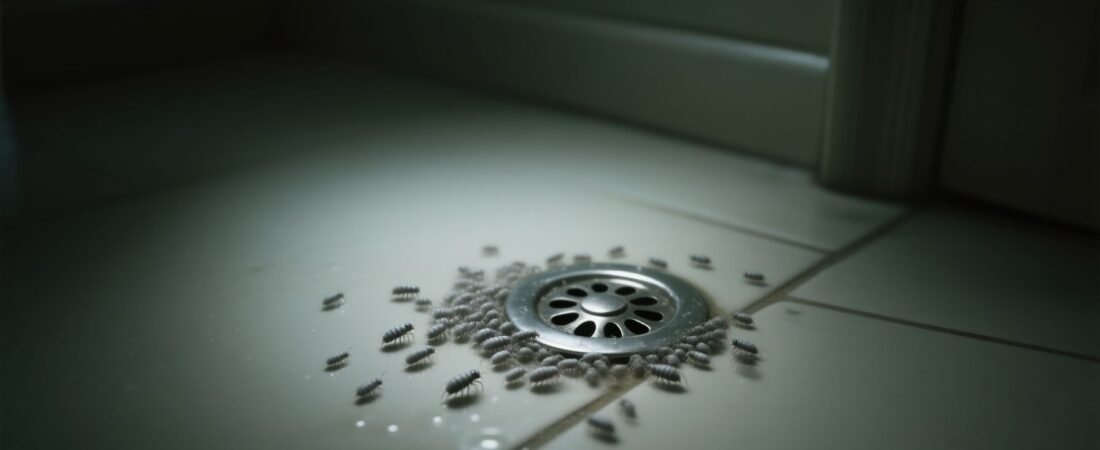
Springtails aren’t a sign your bathroom is dirty — and that’s the thing almost every panicking homeowner gets wrong. These tiny insects show up in spotless, freshly renovated bathrooms just as readily as neglected ones, because what draws them isn’t grime. It’s moisture. If your bathroom has a slow-draining tub, a sweating pipe under the sink, or grout that never fully dries, you’ve already built the perfect springtail habitat — and you’d probably never know it until you spot something jumping.
What Do Springtails Actually Look Like Up Close?
Springtails are tiny — most species measure between 1 and 2 millimeters long, though a few reach up to 6mm. They’re usually white, gray, blue-gray, or dark brown, with soft, elongated or oval-shaped bodies that look almost flea-like at a quick glance. The key physical feature that sets them apart is a forked appendage tucked under their abdomen called a furcula, which they release like a spring to launch themselves into the air when disturbed — that’s where the name comes from.
Up close, springtails have six legs, two short antennae, and no wings at all. Their eyes, if present, are simple clusters of individual lenses rather than compound eyes like most insects. The jump can send them several inches into the air — impressive for something smaller than a sesame seed — which is usually the first thing people notice before they even register what they’re looking at.
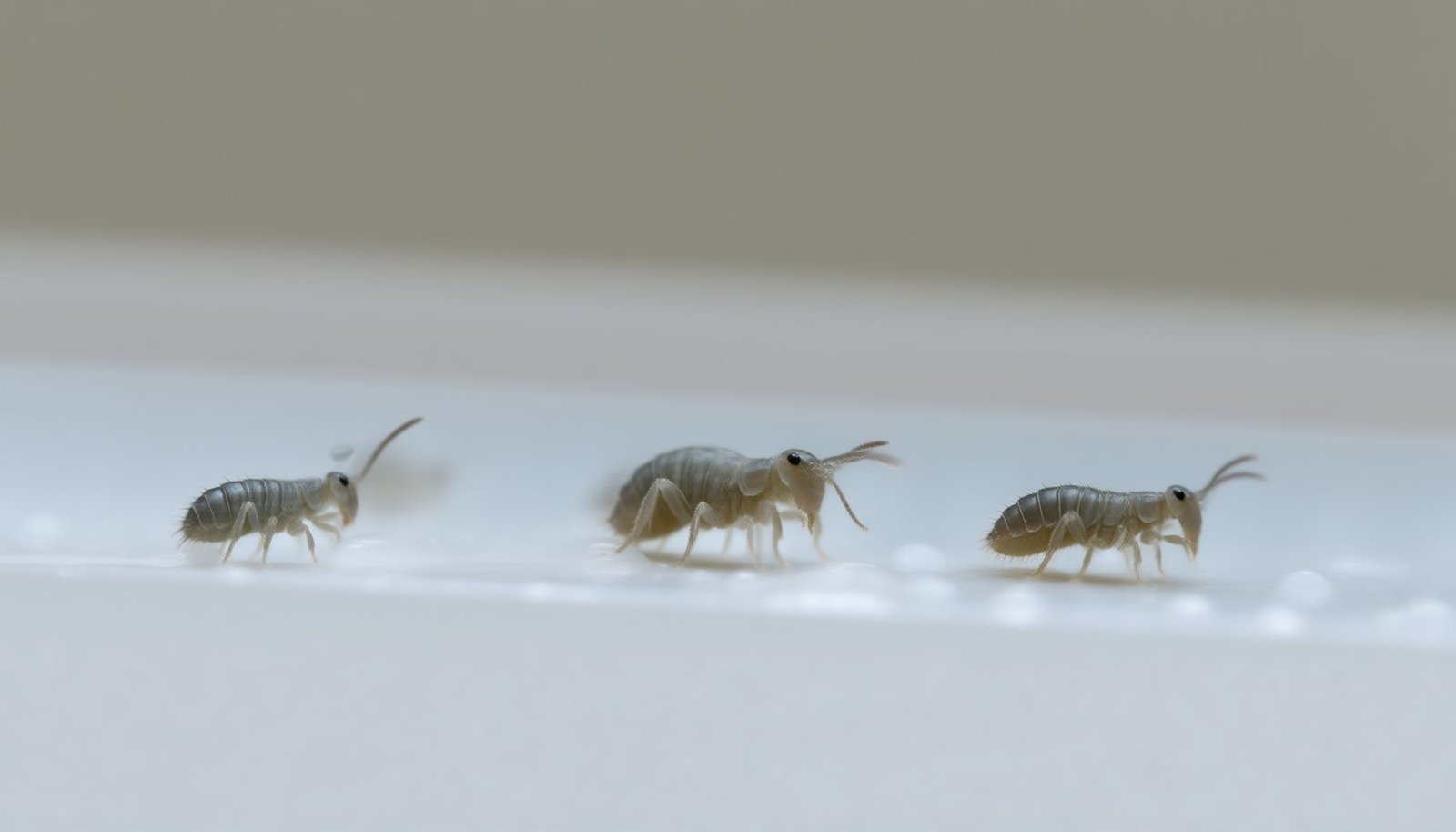
This close-up shows the furcula appendage folded beneath the abdomen — the single most identifying feature that separates springtails from every other tiny bug you might mistake them for in your bathroom.
How Do You Tell Springtails Apart From Other Tiny Bathroom Bugs?
The jump is your fastest ID. No other common household bug that tiny launches itself that dramatically when you disturb it. Drain flies don’t jump — they flutter slowly and clumsily. Psocids (booklice) crawl in tight groups but don’t jump. Fleas jump, but fleas are reddish-brown, flattened side-to-side, and considerably larger than most springtail species. If the tiny thing in your bathroom just launched itself three inches sideways off the tile, you’re almost certainly looking at a springtail.
Color and location also help narrow it down. White or pale springtails found in soil or near drains are often confused with root aphids or soil mites — if you’ve ever looked at Tiny White Bugs in Soil of Houseplants: What They Are, you know those two get mixed up constantly. Springtails, unlike mites, always have exactly six legs. If you can count more than six legs, you’re not looking at a springtail.
| Bug | Size | Jumps? | Common Location |
|---|---|---|---|
| Springtail | 1–6mm | Yes — dramatically | Drains, wet grout, soil |
| Drain fly | 2–5mm | No — flutters | Around drains, on walls |
| Flea | 1.5–3.3mm | Yes — but larger, reddish | Carpets, pet bedding |
| Psocid / Booklice | 1–2mm | No | Damp walls, paper, grout |
Why Are Springtails Showing Up in Your Bathroom Specifically?
Here’s the part most articles skip: springtails don’t “invade” bathrooms the way ants invade a kitchen looking for food. They end up in bathrooms because the bathroom’s structural conditions accidentally replicate their natural habitat — decomposing organic matter and persistent moisture. They eat mold, algae, fungi, and decaying plant material. Your bathroom drain biofilm, wet caulk with a hint of mildew, or a leaky pipe fitting underneath the sink can provide everything they need to survive indefinitely.
Picture this: a slow drip under a bathroom vanity goes unnoticed for three weeks. The particle board cabinet bottom absorbs the moisture, a thin layer of mold develops, and within that same period, a small springtail population that entered through a gap around the drain line has established itself inside the cabinet. By the time you open the cabinet and see them, there can easily be hundreds. They’re not coming from outside every day — they’re already breeding inside your bathroom’s hidden wet spots.
Pro-Tip: Run your hand along the underside of your bathroom sink cabinet floor and around the base of your toilet. If the wood feels soft, spongy, or slightly damp to the touch, you likely have an undetected moisture source — and that’s the exact condition springtails are exploiting, not your cleanliness.
Are Springtails Dangerous or Just Annoying?
Springtails don’t bite, don’t sting, don’t spread disease, and don’t damage your home’s structure. They’re among the most genuinely harmless insects that ever set foot in a bathroom. What they are is an indicator species — their presence reliably signals a moisture problem that could eventually lead to mold growth, wood rot, or structural damage if left unchecked. In that sense, the springtail itself isn’t your problem; it’s the symptom pointing to the problem.
“Springtails are essentially biological moisture meters. When I see a client with a springtail population inside their home, my first question is never ‘how do we kill them’ — it’s ‘where is the water coming from?’ Eliminate the moisture source and the springtails disappear on their own within days. Skip that step and no amount of spray will keep them gone long-term.”
Dr. Marcus Albright, Board-Certified Entomologist and Structural Pest Management Consultant
Some people do report mild skin irritation from large numbers of springtails — this is rare and typically affects people with very sensitive skin who come into contact with high concentrations of them. It’s not a toxic reaction, just a mechanical irritation. For the overwhelming majority of people, springtails are a nuisance pest and nothing more.
What Steps Actually Stop a Springtail Problem in the Bathroom?
The counterintuitive truth here is that spraying insecticide at springtails is almost always a waste of time and money if you haven’t found and fixed the moisture source first. Sprays will knock down the visible ones, but new springtails will emerge from the wet area within 24 to 48 hours because the conditions that support them haven’t changed. The moisture fix comes first — everything else is secondary.
That said, there’s a logical sequence to follow that actually works, and the order matters. Unlike Signs of a Spider Infestation: More Than Just Webs, where the problem is often driven by prey insects entering your home, springtail problems are almost always self-contained to whatever wet zone you have — fix that zone, and the problem solves itself. Here’s the sequence that consistently works:
- Locate every moisture source. Check under the vanity, around the toilet base, inside the wall behind the shower, and along any pipe penetrations through the floor. Use a cheap moisture meter (under $20 at any hardware store) if you’re not sure — wood reading above 20% moisture content is prime springtail territory.
- Fix the leak or ventilation issue. This might mean tightening a drain fitting, replacing cracked caulk around the tub, or running the exhaust fan consistently during and after showers. If your bathroom exhaust fan doesn’t clear steam within 15 minutes, it’s undersized or clogged.
- Remove any moldy or water-damaged material. Springtails feed on mold and decaying organics. Replacing a swollen cabinet floor or scrubbing out mold from grout eliminates their food source at the same time as the moisture.
- Apply a residual insecticide only after steps 1–3 are complete. A product containing bifenthrin or deltamethrin applied along baseboards and around drain areas gives a knockdown effect on any remaining springtails. Diatomaceous earth works well in dry, enclosed spaces like under-sink cabinets.
- Seal exterior entry points. Springtails often enter through gaps around pipe penetrations, window frames, or foundation cracks during wet weather — particularly after heavy rain drives them out of saturated soil. A silicone sealant around pipe entries through the floor or wall takes about 10 minutes and cuts off a major entry route.
One honest nuance worth naming: if you live in a high-humidity climate — coastal areas, the Gulf South, Pacific Northwest — springtail pressure from outside is consistently higher than in arid regions. In those areas, you may need to treat the perimeter of your home with a granular insecticide in addition to fixing interior moisture, because ambient humidity keeps drawing them toward the structure regardless of what you do inside.
When Should You Actually Call a Professional About Springtails?
Most springtail problems in bathrooms are genuinely DIY-solvable once the moisture source is identified and corrected. A professional becomes worth calling when you’ve fixed what you can find and the springtails keep coming back, or when the numbers are large enough — thousands visible at once — to suggest a moisture source you can’t access. Inside a wall cavity, beneath a concrete slab, or within a subfloor are places where a moisture problem can be significant but completely invisible without thermal imaging or a moisture probe.
There’s also a scenario worth flagging: if your bathroom has a slab foundation and you’re consistently seeing springtails emerge from around the toilet base or floor drain, there may be a plumbing leak beneath the slab itself. Springtail populations in the tens of thousands can exist in saturated soil under a concrete slab — one pest management company in Florida documented a case where over 80,000 springtails were identified in a 10-square-foot zone beneath a bathroom slab after a slow supply line leak went undetected for several months. That’s not something a can of spray addresses. A plumber and a moisture remediation specialist are the right calls.
- Springtails keep returning within a week after treatment — suggests an inaccessible moisture source
- You can’t identify any visible moisture source but population persists — thermal imaging may be needed
- Numbers are in the hundreds to thousands concentrated in one spot — possible subfloor or slab moisture
- You notice soft or discolored flooring near the springtail zone — potential water damage requiring remediation, not just pest control
- Springtails are appearing in multiple rooms simultaneously — suggests a systemic moisture issue like a roof leak or HVAC condensation problem rather than a single bathroom source
Getting a professional moisture assessment — separate from a pest control visit — is often the smarter first move when the source isn’t obvious. A pest control technician can treat the symptom; a building inspector or plumber finds the cause. The fastest path to a springtail-free bathroom runs straight through whoever can find your water problem.
Frequently Asked Questions
What do springtails look like to the human eye?
Springtails are tiny — most are between 1/16 and 1/8 inch long — so they’re easy to miss or mistake for specks of dirt. They’re usually white, gray, or dark brown, with a rounded or elongated body and no wings. The easiest way to confirm what you’re seeing is to watch for that signature jump: springtails launch themselves into the air using a forked appendage under their abdomen called a furcula.
Why are springtails in my bathroom?
Springtails show up in bathrooms because they need moisture to survive, and bathrooms give them exactly that — damp grout, leaky pipes, wet towels on the floor, and humid air. They’re also drawn to mold and mildew, which often grow in the same wet conditions. If you’re seeing them consistently, there’s almost always an underlying moisture problem that needs to be fixed, not just the bugs themselves.
Are springtails harmful to humans or pets?
No — springtails don’t bite, sting, or spread disease, and they’re not harmful to humans or pets. They’re considered a nuisance pest, not a dangerous one. That said, a large infestation can be a sign of serious moisture damage or mold growth in your home, which is worth investigating.
How do I know if I have springtails or fleas?
Both springtails and fleas jump, which is why people confuse them, but there are clear differences. Fleas are darker, have a flattened oval body, and bite — you’ll notice red itchy welts on your skin. Springtails are rounder, lighter in color, and won’t bite you at all. If you’re finding the bugs only in wet areas like the bathroom or basement and you have no bite marks, springtails are the much more likely culprit.
How do I get rid of springtails in my bathroom fast?
Start by eliminating the moisture source — fix any leaky pipes, run a dehumidifier, and let the bathroom dry out fully between uses. Wipe down wet surfaces and check for mold or mildew behind the toilet, under the sink, and around the tub. For a quick knockdown, a spray of diluted white vinegar or a store-bought insecticide labeled for springtails can help, but they’ll keep coming back if the moisture problem isn’t solved first.