

Three spiders walk into your basement — and you have no idea which one could actually hurt you. That’s the real problem. Brown recluse bites send roughly 7,000 to 10,000 Americans to the emergency room each year, yet the spider most commonly misidentified as a brown recluse is a completely harmless cellar spider hanging in a corner. The identification mistake isn’t just embarrassing — it drives people to bomb their homes with pesticides for a spider that poses zero medical threat, while occasionally ignoring the one that actually does. Here’s how to tell them apart correctly, the first time.
Why Do People Keep Misidentifying These Three Spiders?
The honest answer is that most spider ID guides start with color, and color is a terrible primary identifier. Brown recluses, wolf spiders, and cellar spiders are all some shade of tan, brown, or gray — which describes roughly half the spiders in North America. Lighting conditions, age, and whether a spider just molted can all shift its apparent color enough to throw you off completely.
What actually separates these three spiders are structural features: eye arrangement, leg thickness, body proportion, and web architecture. These don’t change based on the light in your garage. Once you know what to look for structurally, you’ll make the right call in under 30 seconds — no magnifying glass required.
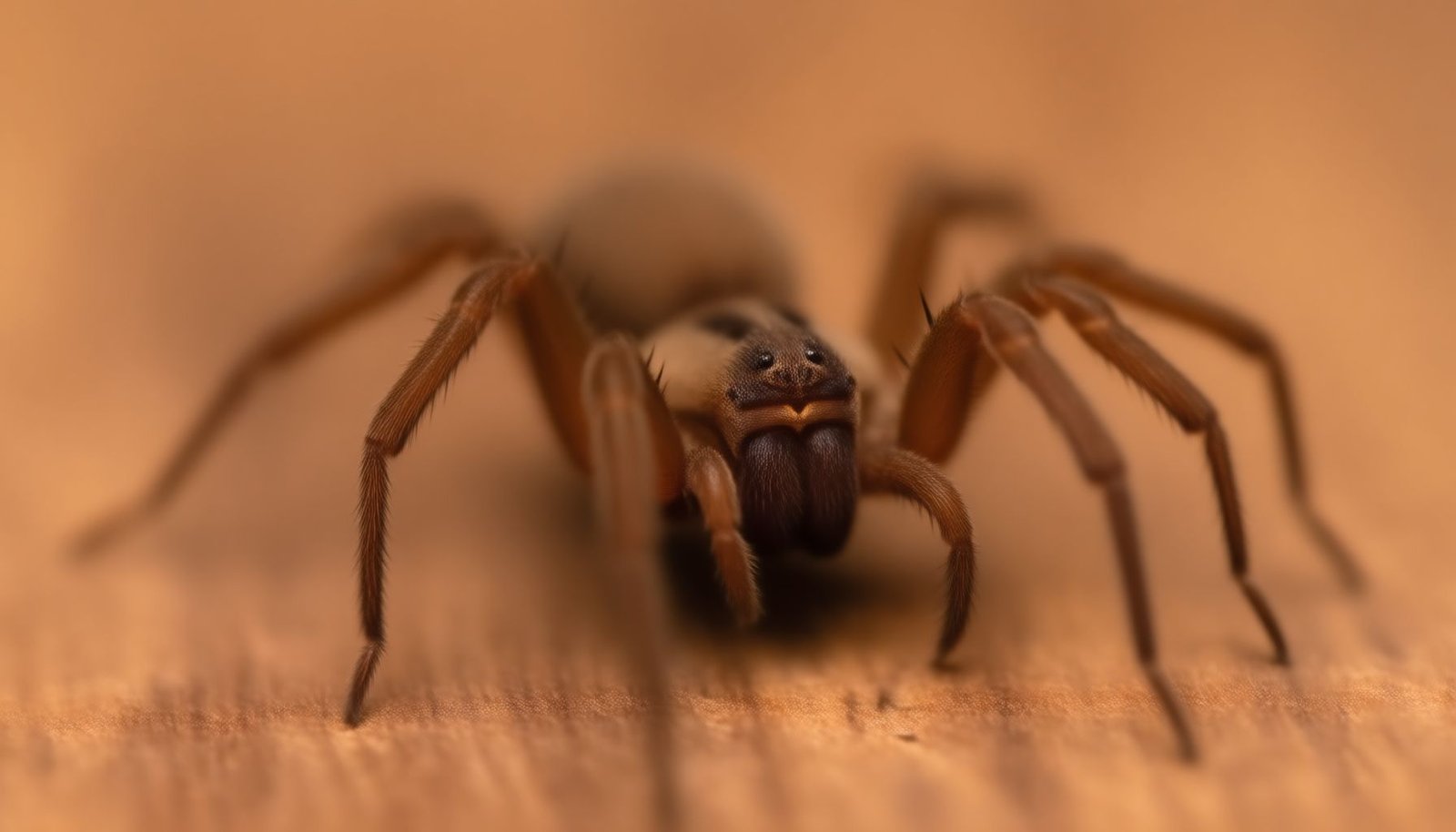
This side-by-side comparison shows the three spiders at similar scale — pay attention to leg thickness, body shape, and the visible eye cluster differences that make each species identifiable without lab equipment.
What Does a Brown Recluse Actually Look Like Up Close?
The violin marking on a brown recluse’s back — the detail every article leads with — is real, but it’s also unreliable as a solo identifier. Young recluses have faint violins. Older spiders can have dark, smeared-looking ones. And several harmless spiders have vague fiddle-shaped markings that send people into full panic mode. The violin is a supporting clue, not a verdict.
The definitive brown recluse identifier is its eye arrangement: six eyes arranged in three pairs of two, spread in a slight arc. Almost every other common house spider has eight eyes. If you can get close enough to count — and a macro photo with your phone is enough — six eyes in that specific paired pattern confirms a brown recluse more reliably than any body marking. Adults range from 6 to 20 mm in body length, have uniformly colored legs with no banding or stripes, and move in a slow, deliberate manner rather than a sudden burst.
How Is a Wolf Spider Different From a Brown Recluse?
Wolf spiders are the spider that most frequently gets mistaken for a brown recluse — and the mix-up makes a kind of sense, since both are brownish, ground-dwelling, and found in similar indoor spots. But a wolf spider is built like a linebacker compared to a recluse’s slim build. Their legs are thick, heavily bristled, and powerful-looking. A recluse’s legs are thin and smooth.
Wolf spiders have eight eyes arranged in a very distinctive pattern: four small eyes in a bottom row, two large forward-facing eyes in the middle, and two medium eyes on top — almost like a face. At night, those large middle eyes reflect flashlight beams with a greenish eyeshine, which is a quick field test no brown recluse can replicate. Wolf spiders are also significantly larger; a fully grown female can reach 35 mm in body length, nearly twice the maximum size of a brown recluse. They don’t build webs — they actively hunt — so a web is an immediate disqualifier for wolf spider identification.
Pro-Tip: Point a small flashlight at floor level in a dimly lit room at night. If you see tiny greenish reflections near baseboards or under furniture, those are almost certainly wolf spider eyes — a harmless but startling discovery. Brown recluses won’t produce that eyeshine, and cellar spiders won’t be on the floor at all.
What Makes a Cellar Spider Easy to Identify and Why Is It Everywhere?
Cellar spiders — the ones people commonly call “daddy long-legs” — are arguably the easiest of the three to identify, yet they generate the most false alarms. Their legs are extraordinarily long and thin relative to their tiny body, giving them a fragile, almost translucent appearance. No other spider commonly found indoors looks quite like them. The body itself is only about 2 to 10 mm, pale gray or tan, and hangs suspended upside-down in a loose, irregular web.
Here’s the counterintuitive part that most pest guides skip entirely: cellar spiders actively benefit you. They prey on other spiders, including occasionally catching and eating brown recluses in overlapping territory. Eliminating every cellar spider in your basement because you’re worried about recluses can actually make a recluse infestation easier to establish — you’ve just removed a natural predator. That’s not a reason to love them, but it’s a reason to pause before reaching for the spray.
“The majority of brown recluse misidentifications I see come from people looking at the abdomen pattern rather than the eye structure. Teach people to count eyes in a photo — that single habit eliminates probably 80% of false positives and prevents a lot of unnecessary chemical treatments.”
Dr. Melissa Korman, Board-Certified Entomologist and Urban Pest Management Specialist, University Extension Program
How Do You Tell Them Apart Fast Without Catching the Spider?
You don’t always get a cooperative spider sitting still on a white background. Most of the time you’re working from a quick glimpse, a blurry phone photo, or the web left behind. The good news is that each of these three spiders leaves very different behavioral and environmental evidence.
Use this four-step field identification sequence when you can’t get a clear look at the spider itself:
- Check the web structure first. Cellar spiders build messy, three-dimensional webs in upper corners. Brown recluses build flat, irregular “retreat” webs in undisturbed low spaces — behind boxes, inside shoes, in folded fabric. Wolf spiders build no web at all.
- Note the location and height. Cellar spiders prefer ceiling corners and upper wall junctions. Brown recluses stay low and hidden — cardboard piles, closet floors, garage clutter. Wolf spiders roam floor level and are often seen crossing open spaces.
- Observe movement style. Wolf spiders move in fast, confident bursts when disturbed. Brown recluses move slowly and try to retreat rather than run outward. Cellar spiders vibrate rapidly in their web when threatened — a defensive shake that makes them look blurry.
- Use a phone macro shot and zoom in on the eyes. Even a mediocre photo from 6 inches away will often show eye count. Six eyes in pairs means recluse. Eight eyes with two large central ones means wolf spider. Cellar spiders have eight eyes in two tight clusters close together on a small head.
- Consider geography. Brown recluses are genuinely common only in a specific band of the US — roughly Missouri, Kansas, Oklahoma, Arkansas, Tennessee, and neighboring states. If you’re in New England, the Pacific Northwest, or most of Florida and you think you found a brown recluse, the odds are strongly against it being one.
That last point matters more than most guides acknowledge. Thousands of spider specimens get sent to university extension labs each year labeled “brown recluse” from states where the species doesn’t even have an established population. Geography won’t rule out a recluse in a confirmed range state, but it should dramatically lower your suspicion index elsewhere.
Which One Is Actually Dangerous and What Should You Do If You’re Bitten?
Wolf spiders can bite — they have fangs capable of breaking skin — but their venom causes nothing more than localized redness and mild pain in healthy adults, comparable to a bee sting. Cellar spiders are essentially harmless; their fangs are too small to reliably penetrate human skin. Brown recluses are the genuine medical concern, and even then, the picture is more nuanced than most people realize.
Around 90% of confirmed brown recluse bites heal without medical intervention, producing only a small red mark. The remaining roughly 10% develop necrotic tissue — the skin damage people associate with recluse bites — and that subset genuinely warrants prompt medical attention, ideally within 2 to 4 hours of noticing a wound that’s expanding or developing a pale center surrounded by redness. Here’s what to watch for across all three spiders, and what it tells you:
| Spider | Bite Risk | Typical Reaction | When to See a Doctor |
|---|---|---|---|
| Brown Recluse | Will bite if trapped against skin | Mild initially; potential necrosis in ~10% of cases | If wound expands, blisters, or turns necrotic within 24–72 hours |
| Wolf Spider | Will bite if handled or cornered | Local pain, redness, mild swelling; resolves in 24–48 hours | Rarely necessary; seek help if severe allergic response occurs |
| Cellar Spider | Rarely bites; fangs too small for most skin | Minor irritation if any | Not typically needed |
One thing worth knowing: brown recluses almost never bite unless compressed directly against skin — rolled over in bed, pressed by a shoe being put on, or trapped inside a glove. Picture this scenario: you reach into a cardboard box that’s been sitting undisturbed in your garage for eight months, and you feel a sharp pinch on your hand. That’s a recluse bite context. Randomly walking through your living room, you’re not in serious danger from one — they retreat from open exposure. Just as people who spot a spider crossing the floor in an unfamiliar room might wonder if other pests are lurking, it helps to look at the full picture; for instance, if you’re noticing other unexplained marks or pests, checking for signs of bed bugs on furniture that isn’t a mattress might also be worth ruling out before assuming spider bites are your only concern.
Here’s a quick summary of the physical traits to compare side by side before you make any pest control decisions:
- Brown recluse: 6–20 mm body, six eyes in three pairs, smooth thin legs, violin marking on cephalothorax, low-profile retreat web in dark undisturbed spots
- Wolf spider: Up to 35 mm body, eight eyes with two large central ones, thick bristled legs, no web, active ground hunter with greenish eyeshine at night
- Cellar spider: 2–10 mm body, eight eyes in two tight clusters, extremely long thin legs relative to body, pale coloring, loose 3D web in upper corners
- Key disqualifier for recluse: Eight eyes of any arrangement = not a brown recluse, full stop
- Key disqualifier for wolf spider: Any web present = not a wolf spider
- Key disqualifier for cellar spider: Found at floor level, moving fast, body wider than legs are long = not a cellar spider
Spider identification intersects with a broader habit of carefully reading what’s actually in your home environment before reacting. If you’ve been noticing multiple mystery finds around the house — not just spiders, but other small crawlers near windows or on surfaces — it might be worth methodically ruling things out, the same way you’d check whether tiny red bugs on a windowsill are mites, clover mites, or something else entirely rather than assuming the worst.
Getting the ID right doesn’t just prevent unnecessary stress — it determines whether you need a licensed pest control professional, a simple sticky trap, or genuinely nothing at all. A wolf spider crossing your basement floor is doing you a favor by hunting other insects. A cellar spider in the corner of your laundry room is essentially self-maintaining pest control. A brown recluse hiding in a pile of boxes in a confirmed range state warrants methodical reduction of harborage points, sticky traps placed at floor level in closets and storage areas, and potentially a professional inspection. Those are three completely different responses to three completely different spiders — and they all start with one clear-eyed look at what’s actually in front of you.
Frequently Asked Questions
how do I tell if a spider is a brown recluse or a wolf spider?
The easiest way is to look at the eyes and body shape. Brown recluses have 6 eyes arranged in 3 pairs and a violin-shaped marking on their back, while wolf spiders have 8 eyes in a distinctive pattern — 4 small on the bottom row, 2 large in the middle, and 2 medium on top. Wolf spiders are also noticeably bulkier and more athletic-looking, often reaching 1 to 1.5 inches in body length, while brown recluses stay smaller at around 0.25 to 0.75 inches.
are cellar spiders dangerous compared to brown recluse spiders?
Cellar spiders are not dangerous to humans — their fangs are too small to puncture skin effectively, and their venom is harmless to people. Brown recluses, on the other hand, deliver a venomous bite that can cause necrotic skin lesions in some cases, and bites should be evaluated by a doctor. If you’re seeing long, spindly legs and a tiny body in your basement, that’s almost certainly a cellar spider, which is harmless.
what does a brown recluse vs wolf spider bite look like?
A wolf spider bite typically causes mild redness, swelling, and localized pain that clears up within a few days — similar to a bee sting. A brown recluse bite can start the same way but may develop into a bull’s-eye pattern with a central blister, and in serious cases the tissue around the bite can begin to break down within 24 to 72 hours. If a bite site is growing, blistering, or developing a dark center, get medical attention right away rather than waiting it out.
where do brown recluse wolf spider and cellar spiders typically live in a house?
Brown recluses prefer dry, undisturbed spots like inside cardboard boxes, closets, under furniture, and in attics or crawl spaces. Wolf spiders are ground hunters and usually stay at floor level — you’ll find them near doors, in garages, and along baseboards rather than in webs. Cellar spiders love high humidity and are almost always found in corners of basements, crawl spaces, and bathrooms, where they build loose, messy webs.
can wolf spiders be mistaken for brown recluse spiders?
Yes, and it happens all the time — both are brown, similarly sized, and found indoors. The key difference is that wolf spiders don’t build webs and are often seen actively running across floors, while brown recluses are shy and hide in tight spaces. Check for the violin marking on the back and count the eyes if you can get close enough safely — no violin shape and 8 eyes almost always means you’re looking at a wolf spider, not a brown recluse.