
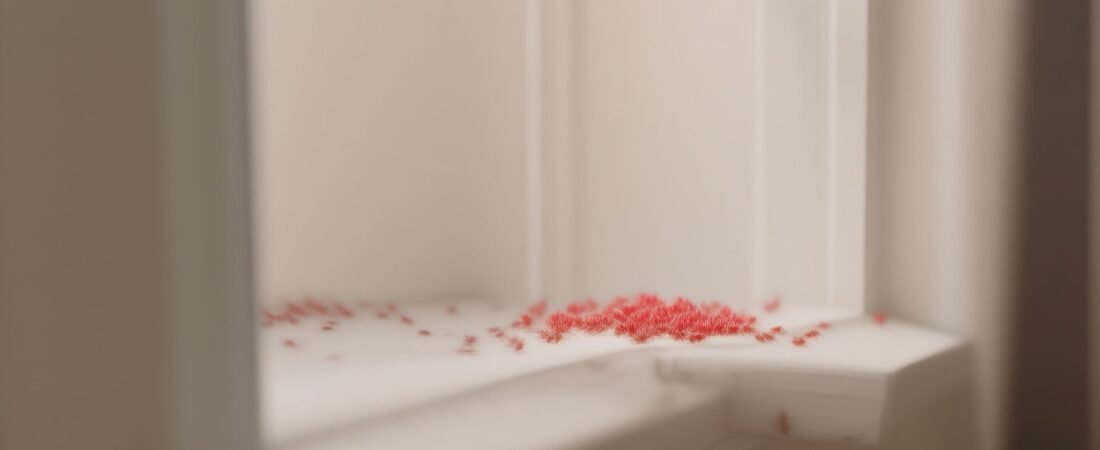
Those tiny red specks crawling across your windowsill aren’t random — and the most common mistake people make is assuming they’re baby spider mites or some exotic tropical pest that blew in through an open window. Nine times out of ten, what you’re seeing are clover mites, and the reason they’re on your windowsill specifically isn’t a coincidence. They’re not trying to get into your home because it’s warm or because there’s food inside. They’re trying to escape a lawn that’s become inhospitable — which means your yard is the problem, not your house. That distinction matters enormously for how you deal with them.
Are the Tiny Red Bugs on Your Windowsill Actually Dangerous?
The short answer is no — clover mites don’t bite humans, don’t transmit disease, and don’t infest furniture, food, or clothing. They’re plant feeders, and once they wander indoors they’re essentially lost and will die within a day or two without access to grass or plant material. What they will do is leave a red-orange smear if you crush them, which looks alarming and can stain light-colored window trim, curtains, or walls if you’re heavy-handed when cleaning them up.
That said, “harmless” doesn’t mean “ignore them.” A windowsill with 20 visible mites usually means thousands more are massing on the exterior wall just outside, waiting for a gap to crawl through. The mites you can see are a fraction of the population you’re actually dealing with. Understanding that early is what separates a one-afternoon fix from a problem that returns every spring for years.
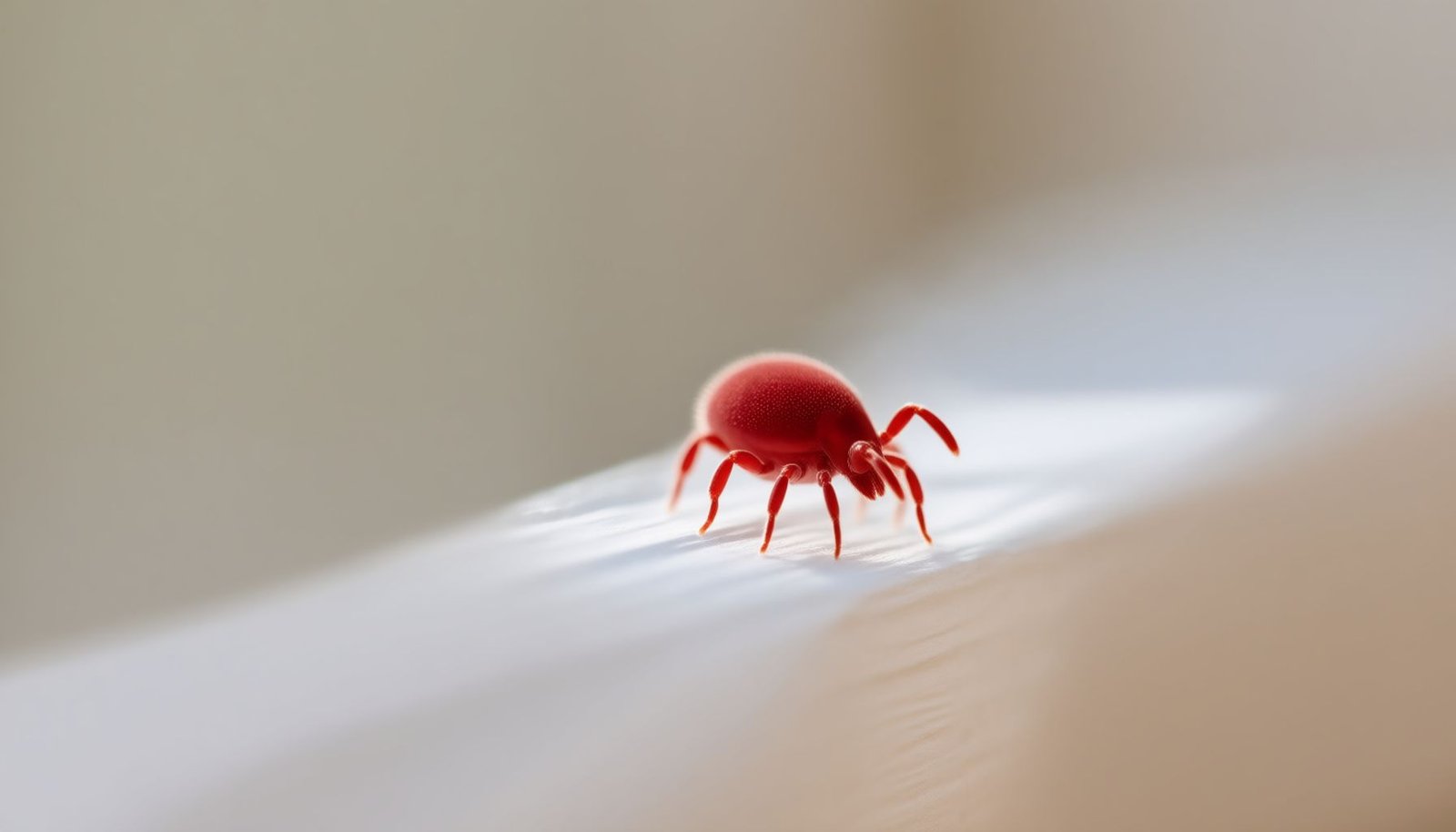
This close-up view shows the characteristic oval body shape and deep brick-red coloring of clover mites — details that help you distinguish them from the other red bugs that occasionally show up on windowsills, which require completely different responses.
How Do You Tell Clover Mites Apart from Other Tiny Red Bugs?
This is where most homeowners go wrong. “Tiny red bug” actually describes several very different pests, and treating for the wrong one is a waste of time and money. The identification step takes about 60 seconds and can save you a lot of frustration. Here’s what to look for under a magnifying glass or the zoom camera on your phone.
Clover mites are roughly 0.75mm long — smaller than a pinhead — with an oval body and eight legs like all mites. The front pair of legs is noticeably longer than the other three pairs and extends forward like antennae, which is a dead giveaway. They move slowly in a steady, deliberate crawl. If the red bugs on your windowsill are jumping, those are probably springtails with a red pigmentation variant. If they’re faster and more spider-like, you might be looking at predatory mites or chigger larvae tracking in from outdoor vegetation.
| Bug Type | Size | Key Feature | Bites Humans? |
|---|---|---|---|
| Clover Mite | ~0.75mm | Long front legs, oval red body, slow crawl | No |
| Chigger Larva | ~0.15mm | Extremely tiny, causes intense skin irritation | Yes |
| Spider Mite | ~0.4mm | Found on plant leaves, fine webbing nearby | No |
| Predatory Mite | ~1mm | Faster movement, teardrop body shape | Rarely |
Pro-Tip: Place a piece of white printer paper on the windowsill and gently nudge one of the mites onto it. Clover mites will leave a distinct rust-red smear when pressed with a fingertip — no other common red windowsill bug does this as reliably. It’s the fastest field confirmation method there is.
Why Are They Specifically on Your Windowsill — and Not Elsewhere in the House?
Here’s the counterintuitive part that most pest control websites gloss over: clover mites aren’t attracted to your home’s interior at all. They end up on your windowsill because windows are the warmest exterior surface on a sunny day, and clover mites are thigmotactic — they press themselves against warm surfaces as a behavioral reflex. The south- and west-facing windows of a house will almost always show more mite activity than north-facing ones, simply because of sun exposure. If you’ve noticed the problem is worse on one side of your house, that’s exactly why.
Picture this: it’s late March, the soil is still cool, and a dense patch of grass grows right up to your foundation. That grass hosts a booming clover mite population all winter in its root layer. As temperatures swing, the mites migrate upward and outward — following the warmth gradient — and your south-facing brick wall becomes the warmest surface in their world. They follow it upward, hit the window frame, find a gap around the caulking or a worn weatherstrip, and suddenly you have red bugs inside. The lawn-to-window migration route is the core of the problem, and it’s why interior treatments alone will never fully solve this.
What Conditions in Your Yard Are Making This Worse?
Clover mite populations don’t just appear out of nowhere — they explode under specific conditions that most people inadvertently create right next to their house. Heavily fertilized lawns near the foundation are a primary driver. Nitrogen-rich grass is essentially a clover mite banquet, and a single female clover mite can lay up to 70 eggs without mating — the species reproduces parthenogenetically, meaning females don’t need males at all. A population can go from manageable to massive in a few weeks of warm weather.
The following yard conditions are known to accelerate clover mite buildup against a foundation wall:
- Dense, lush grass growing directly against the foundation with no bare-soil buffer zone
- Heavy application of lawn fertilizer within 18–24 inches of the house perimeter
- Overgrown groundcover plants — ivy, creeping phlox, dense clover patches — pressed against siding
- Mulch laid flush against the exterior wall, retaining moisture and providing habitat
- South or west exposure that keeps exterior walls warm for extended periods in spring and fall
- Lack of overhanging eaves, which allows rain to splash mites and eggs up the wall surface
“Clover mites are almost always a landscape management issue masquerading as a pest control issue. Homeowners call us expecting a spray treatment, but the real fix is a 12-to-18-inch gravel or bare-soil barrier along the foundation. Mites won’t cross exposed dry ground — it desiccates them within minutes. That structural change outperforms any chemical treatment by a wide margin for long-term control.”
Dr. Patricia Mullen, Extension Entomologist, University of Maryland Cooperative Extension
How Do You Actually Get Rid of Tiny Red Mites on the Windowsill — For Good?
The good news is that this is one of the more solvable pest problems you’ll encounter. The bad news is that the fix has two distinct phases — interior cleanup and exterior prevention — and skipping the exterior phase means you’ll be doing the interior cleanup again next season. Most DIY approaches focus only on what’s already inside, which is why the same people Google “tiny red bugs windowsill” every spring for five years in a row.
Work through these steps in order, and you’ll address both the symptom and the source:
- Vacuum, don’t crush. Use a vacuum with a hose attachment to remove mites from the windowsill and surrounding trim. Dispose of the bag or canister contents immediately in an outdoor trash bin. Crushing them leaves stains that are difficult to remove from painted surfaces.
- Clean the sill with soapy water. A diluted dish soap solution kills residual mites on contact and removes the pheromone trails that may attract more. Wipe, don’t spray — excess moisture around window frames creates other problems.
- Seal the entry points. Inspect the caulking around every window frame on the exterior. Gaps as narrow as a credit card thickness are enough for clover mites to enter. Use a paintable silicone-latex caulk and replace any compressed or cracked weatherstripping on the sash.
- Create a dry barrier zone. Pull back any mulch, soil, or grass from the foundation to leave a 12–18 inch strip of coarse gravel or bare earth. Clover mites dehydrate and die when forced to cross it — this single step reduces interior invasions more than any spray.
- Apply a perimeter insecticide if the infestation is heavy. A bifenthrin or permethrin-based spray applied to the exterior wall surface and foundation band creates a contact-kill zone. Apply in a 2–3 foot band up the wall and 2 feet out along the ground. Reapply after rain.
- Adjust your fertilization schedule. Stop fertilizing within 2 feet of the foundation. The reduction in grass density and nitrogen content in that zone makes it significantly less hospitable for mite colonies.
One honest nuance worth flagging: the effectiveness of the gravel barrier depends heavily on your climate and how your foundation is built. In humid climates with high rainfall, coarse gravel can still retain enough surface moisture to remain traversable. In that case, combining the barrier with a residual perimeter spray is the more reliable approach. A slab foundation with a wide concrete apron already provides a natural dry barrier — if you have one and you’re still seeing mites, the entry point is probably around utility penetrations or a poorly sealed garage door, not the main windows.
It’s also worth knowing that clover mites peak in spring and again in fall — they go semi-dormant in hot summer months. So if you’re dealing with them now and don’t address the yard in the next few weeks, you’ll very likely see the same problem return in September when temperatures cool again. It’s not a reinfestation — it’s the same population completing its seasonal cycle. That timing also matters for pesticide application: treating in mid-summer when mites are inactive wastes product and provides little benefit.
One thing worth keeping in mind while you’re sorting out the pest situation around your windows: not every uninvited visitor crawling through a gap is as benign as a clover mite. Some people dealing with windowsill bugs later realize their home has other entry-point vulnerabilities that have let in more serious pests. If you’ve been noticing sounds or signs of activity in the walls at night, it may be worth reading about Can Rats Bite You in Your Sleep? How to Protect Yourself — not because clover mites and rats are related, but because a home with poor perimeter sealing often has more than one uninvited guest.
Similarly, while you’re inspecting around your windows and pulling things away from walls, check your curtains and any stored woolens nearby for signs of a different kind of small pest. Fabric-feeding pests like to settle undisturbed near windows where humidity fluctuates — if you see irregular holes or silky webbing in fabric near the window area, it’s worth a look at What Do Clothes Moths Look Like and How to Spot Larvae Damage? before assuming the red mites are your only issue.
The clover mite problem is ultimately a yard management issue wearing the costume of an indoor pest problem. Fix the conditions that make your foundation a mite habitat, seal the gaps that let them inside, and you’re not just solving this year’s problem — you’re making your home structurally less welcoming to a whole range of small invaders that use the same entry points and the same warm-surface migration routes. That’s the kind of fix that actually lasts.
Frequently Asked Questions
What are the tiny red bugs on my windowsill?
Those tiny red bugs on your windowsill are most likely clover mites, which are extremely common in US homes during spring and fall. They’re about 1/30 of an inch long — smaller than a pinhead — and they don’t bite or carry disease. If you crush them, they leave a reddish stain, so it’s better to vacuum them up instead.
Are tiny red bugs on windowsills harmful to humans or pets?
Clover mites aren’t harmful to humans or pets — they don’t bite, sting, or transmit any diseases. They’re purely a nuisance pest. That said, if the bugs you’re seeing are larger or actually biting you, they could be chiggers or another mite species, and you’d want to get a closer look or contact a local extension office to confirm the ID.
Why are there so many red bugs suddenly appearing on my window?
Clover mites tend to show up in large numbers because they reproduce fast — a single female can lay up to 70 eggs without mating. They’re drawn to warm surfaces like sun-facing windowsills, especially in spring and early fall when temperatures swing between cool nights and warm days. Overfertilized lawns right next to your foundation are a major driver of infestations.
How do I get rid of tiny red bugs on my windowsill?
Start by vacuuming them up carefully to avoid the red staining that comes from crushing them. Seal any cracks or gaps around window frames with caulk to cut off their entry point. For heavy infestations, applying a residual insecticide like bifenthrin around the exterior perimeter of your home — especially within 10 feet of the foundation — can knock populations down quickly.
How do I keep tiny red bugs from coming back to my windows?
The most effective long-term fix is to remove dense vegetation and thick grass within 18 to 24 inches of your home’s foundation, since that’s where clover mites breed. Avoid over-fertilizing your lawn with nitrogen-heavy fertilizers, which cause the lush grass growth these mites thrive in. Re-caulking your windows every couple of years also helps block the entry points they use to get inside.