

Thrips are on your plant right now and you probably can’t see them — not because they’re invisible, but because most people don’t know what to look for. These insects max out at about 1/20 of an inch, they hide in flowers and leaf folds during the day, and by the time the damage is obvious enough to notice, an infestation is already well underway. Here’s the core problem with most thrips articles: they describe what thrips look like in isolation, under a magnifying glass, in ideal conditions. What they skip is teaching you how to actually spot them on a real plant, in your house, without special equipment. That’s what this article is actually about.
What Do Thrips Actually Look Like on a Plant (Not in a Lab)?
On a plant, thrips look like tiny slivers — almost like animated eyelashes or flecks of pepper that move when you disturb them. Adult thrips are roughly 1–2 millimeters long, with slender, fringed wings folded flat against their bodies, which gives them a needle-like silhouette. The most common species you’ll find on houseplants, Frankliniella occidentalis (western flower thrips), ranges from pale yellow to light brown to nearly black depending on its life stage and sex — females are typically darker than males.
The color confusion is real and it trips people up constantly. Young nymph-stage thrips are almost translucent white or pale yellow, which makes them nearly impossible to see against light-colored leaves. Older adults are darker and more visible, but they spend most daylight hours tucked inside flower petals or along the midrib of a leaf. Your best shot at seeing them is to hold a sheet of white paper under a branch and give it a sharp tap — if thrips are present, they’ll fall onto the paper and start crawling within seconds.
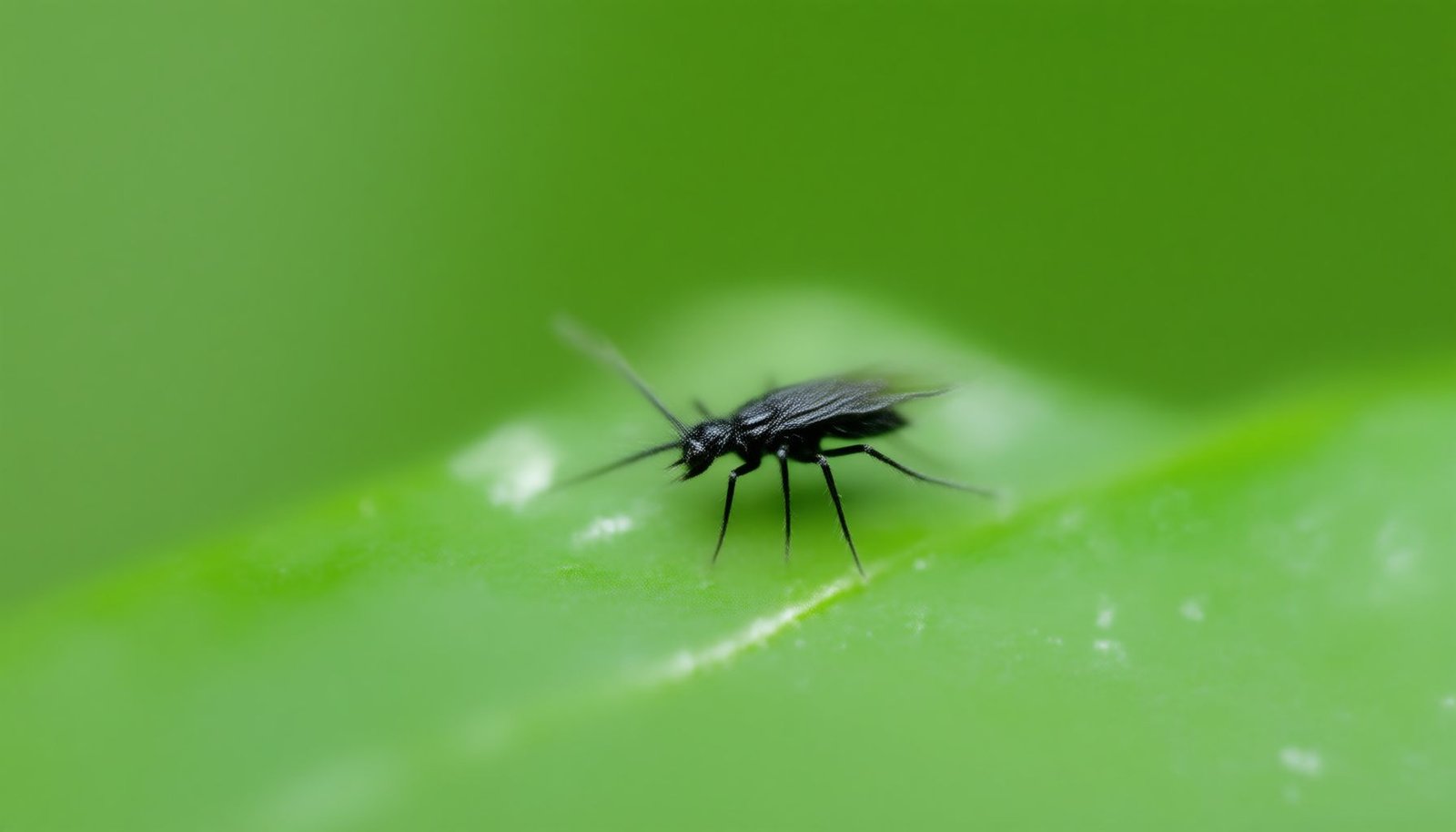
This close-up shows the needle-thin body, fringed wings, and darker coloration of an adult thrip against a leaf surface — the kind of detail you need to recognize before damage becomes severe enough to mistake for a watering problem.
Why Thrips Damage Is What You See Before the Bugs Are
Here’s the thing that most people get completely backwards: you will almost always identify a thrips problem by the plant damage first, not by spotting the insect itself. Thrips feed by puncturing plant cells and sucking out the contents — a process called “rasping.” Each individual feeding wound is microscopic, but thousands of them together create a distinctive silvery or bronzed streaking on leaves, sometimes described as a stippled or “sandpapered” appearance.
The damage looks strikingly similar to spider mite damage, low humidity stress, or even a magnesium deficiency, which is why thrips infestations get misdiagnosed and mistreated for weeks. One clear diagnostic marker: thrips leave tiny black specks of excrement alongside the silvery feeding scars. Those black dots on otherwise healthy-looking leaf tissue are a giveaway. If you see silver streaks and black dots together, you almost certainly have thrips, not a nutrient problem.
How to Tell Thrips Apart From Other Tiny Plant Bugs
Not every tiny insect on your plant is a thrip, and misidentifying the pest means using the wrong treatment — which wastes time and can stress the plant further. The body shape is your most reliable clue. Thrips have that distinctive elongated, narrow body. Fungus gnats are more fly-like with long legs. Aphids are plump and pear-shaped. Spider mites aren’t insects at all — they’re arachnids and look more like moving specks of dust without a visible body shape at normal magnification.
| Pest | Body Shape | Color | Key Tell |
|---|---|---|---|
| Thrips | Narrow, elongated (1–2mm) | Pale yellow to dark brown/black | Silver streak + black fecal dots on leaves |
| Fungus Gnats | Fly-like, long legs | Dark gray to black | Fly near soil surface, not on leaves |
| Aphids | Plump, pear-shaped | Green, black, or white | Clusters on new growth, sticky residue |
| Spider Mites | Round, tiny (under 1mm) | Red, brown, or yellow | Fine webbing under leaves |
One thing worth knowing: thrips can jump and fly short distances when disturbed, which aphids and spider mites don’t do. If you tap a leaf and tiny specks scatter in multiple directions — some flying, some crawling — that behavior alone narrows it down to thrips pretty quickly. No other common houseplant pest moves quite like that.
Where Thrips Hide on Plants and How to Find Them
Picture this: you’ve checked three leaves on your peace lily, seen nothing, and concluded your plant is clean. Meanwhile, a thrips population of several hundred is living almost entirely inside the flower spathe and along the base of each leaf where it meets the stem. Thrips are genuinely photophobic — they avoid light and congregate in protected, darker areas of a plant. Checking flat leaf surfaces and calling it good is exactly why infestations stay hidden so long.
Here’s where you should actually be looking, in order of likelihood:
- Inside flowers and flower buds — this is the number one hiding spot; pull open a bud gently and look for pale nymphs
- Along the midrib and vein channels on the underside of leaves — the grooves provide cover and direct access to vascular tissue
- At the base of leaves where they meet the stem — another sheltered zone, especially on broad-leaved tropicals
- In leaf folds and new unfurling growth — young tissue is preferred because cell walls are thinner and easier to pierce
- In the top layer of potting soil — thrips pupate in soil, so the population extends below the plant, not just on it
That last point about soil is something most articles gloss over entirely. Thrips have a unique life cycle where late-stage nymphs drop off the plant and burrow into the top inch of soil to pupate. If you’re only treating the plant and ignoring the potting medium, you will keep seeing reinfestation every 8–15 days like clockwork — because the new adults are emerging from the soil right under your nose.
Pro-Tip: Press a piece of double-sided sticky tape flat against the top of your potting soil for 48 hours. If you catch tiny pale specks on it — especially after treating the foliage — you’ve confirmed soil-stage thrips and need to address the growing medium, not just the leaves.
How Fast Do Thrips Spread and When Does It Become a Real Problem?
Speed is what makes thrips genuinely dangerous to a plant collection. A single fertilized female thrip can produce 80–100 eggs over her lifetime, and at room temperature (around 75°F), a generation completes in as little as 16–20 days. That means a small founding population of a dozen or so thrips can grow to several thousand within 6–8 weeks under warm indoor conditions. Plants under any kind of stress — overwatered, underlit, root-bound — will show damage from even modest thrip populations because their natural defenses are already compromised.
The honest nuance here is that severity depends heavily on what plants you’re growing and where. A thrips population that barely bothers a mature monstera can completely deform new growth on a gardenia or an orchid in the same room, because softer, more delicate tissue is far more vulnerable to cell-piercing damage. Climate matters too — in drier climates or during heating season when indoor humidity drops below 40%, thrips thrive while plants weaken faster, accelerating visible damage. And unlike some pests that stay put, thrips fly and can spread from one plant to others in your collection within days of a population boom. This is a genuinely different threat profile than something like cockroaches that show up in one room but not another — thrips can colonize an entire windowsill in a single week.
“The mistake I see most often is treating thrips as a surface pest. Homeowners spray the leaves, see improvement, and stop. But the soil-dwelling pupal stage is untouched, and 10 days later the adults re-emerge and the whole cycle restarts. You have to treat the entire system — foliage, stems, and growing medium — simultaneously, or you’re not actually getting ahead of it.”
Dr. Melissa Harte, Board-Certified Entomologist and Extension Specialist, Urban Plant Pest Management
What to Do Once You’ve Confirmed Thrips on Your Plants
Confirmation is step one — and now that you know what to look for, that step is a lot faster. Once you’ve verified thrips (the white paper tap test, the black fecal dots, the silver streaking), here’s a logical sequence that addresses all life stages, not just the visible adults:
- Isolate the affected plant immediately. Thrips fly. Put physical distance between the infested plant and anything else in your collection right now — not after you’ve finished reading, right now.
- Remove and bag heavily damaged leaves and flowers. Flowers especially harbor dense nymph populations. Don’t compost them — seal them in a plastic bag and put them in the trash outside.
- Treat foliage with insecticidal soap or spinosad. Spinosad (derived from soil bacteria) is particularly effective on thrips and has low toxicity to humans and pets. Coat all leaf surfaces, especially undersides, and get into the crevices where thrips hide.
- Drench the top inch of soil with the same treatment. This targets pupating nymphs in the growing medium — the step that most treatments skip entirely.
- Repeat the treatment every 7–10 days for at least 3 cycles. One treatment kills active adults and nymphs; it does not kill eggs. You need subsequent applications to catch each new hatch before they reach reproductive age.
- Consider sticky blue traps near the plant. Thrips are specifically attracted to blue (unlike many other insects that prefer yellow). These won’t eliminate an infestation alone, but they’re an excellent monitoring tool — when you stop catching thrips, your treatment is working.
One thing that catches people off guard: thrips can develop resistance to synthetic pyrethroids surprisingly quickly when the same product is used repeatedly. Rotating between spinosad, insecticidal soap, and neem-based products across treatment cycles is smarter than sticking with one product because “it worked before.” The underlying biology of resistance means consistent exposure to the same active ingredient essentially selects for survivors that can tolerate it — and those survivors reproduce.
It’s also worth remembering that just because you’ve solved a thrips problem doesn’t mean your detective work is done. Pest issues in one part of the home often signal conditions that attract others — the same way figuring out how to tell if you have roaches when you never see them requires looking at evidence rather than the insect itself. With thrips, the evidence is always on the plant before the pest becomes visible — and now you know exactly what that evidence looks like.
Start with one infested plant, confirm with the tap test, and work through that six-step cycle with discipline. Most houseplant thrips infestations, caught before they spread to the whole collection, are entirely manageable without calling in professional help — but only if you treat the whole system, not just what you can see.
Frequently Asked Questions
What do thrips look like on plants?
Thrips are tiny, slender insects that are usually 1–2 millimeters long — about the size of a sewing needle’s eye. Most species are yellowish, pale brown, or black, and their bodies look almost like a splinter or a moving thread. You’ll often see them clustered inside flowers, along leaf veins, or hiding in new growth where they’re hard to spot without a magnifying glass.
How do I know if my plant has thrips and not another pest?
The clearest sign of thrips is silver or bronze streaking on leaves, caused by their rasping mouthparts scraping out plant cells. You’ll also notice small black specks of frass (droppings) scattered across the leaf surface, which look like ground pepper. Unlike spider mites, thrips don’t produce webbing, and unlike aphids, they move fast when disturbed.
Can thrips infest indoor houseplants?
Yes, thrips are one of the more common indoor plant pests in the US, especially on tropical houseplants like pothos, peace lilies, and fiddle leaf figs. They typically hitch a ride indoors on new plants, cut flowers, or even on your clothing. Indoor conditions with low humidity can actually make infestations worse since thrips thrive in warm, dry environments.
Are thrips harmful to humans or pets?
Thrips aren’t dangerous to humans or pets — they don’t bite in a way that causes real injury, though some species may cause a minor skin irritation if they land on you in large numbers. They’re primarily a plant pest and pose no health risk to your household. The main concern is the damage they do to your plants, not any threat to people or animals.
How do I get rid of thrips on my plants fast?
Start by isolating the affected plant immediately to prevent the infestation from spreading to nearby plants. Spray the entire plant — top and bottom of leaves — with insecticidal soap or neem oil, repeating every 5–7 days for at least 3 weeks to break the egg cycle. For heavy infestations on outdoor plants, spinosad-based sprays are more aggressive and work well when other treatments haven’t kept up.