
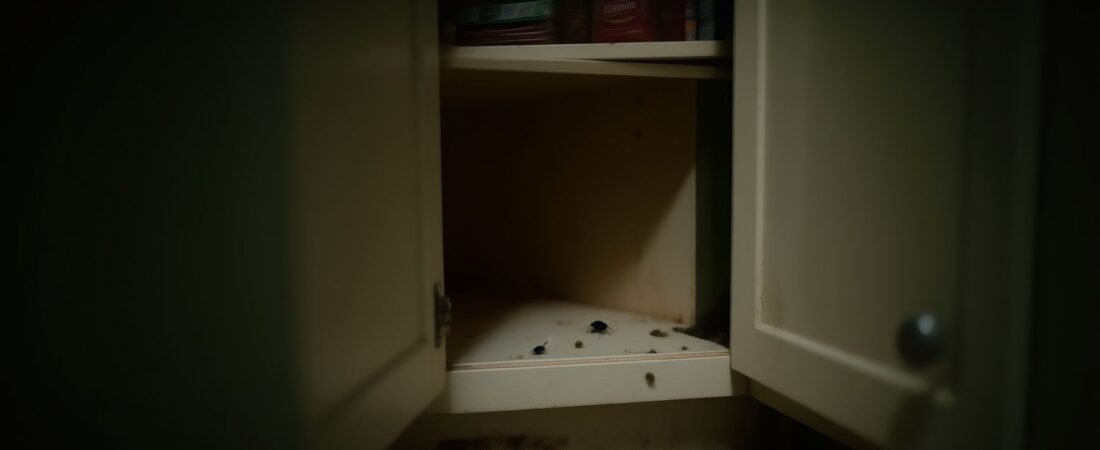
You’ve never seen a single roach in your home — and that’s exactly why you should be worried. The cockroaches that are easiest to spot are usually the sick, dying, or displaced ones. A healthy, thriving roach population stays almost entirely hidden, moving during the two or three hours after midnight, feeding, molting, and reproducing inside your walls without ever making an appearance. By the time you see one during the day, entomologists estimate the hidden population behind it could number in the hundreds.
That’s the part most articles skip. They treat roach detection like a visual confirmation problem — either you see one or you don’t. But the real signs of a roach infestation are almost never the roaches themselves. They’re the residue, the smell, the structural evidence left behind by insects that are very, very good at not being seen.
Why Not Seeing Roaches Is Actually a Red Flag, Not Reassurance
German cockroaches — the most common indoor species in US homes — are thigmotactic, meaning they actively seek tight, dark spaces where both sides of their body touch a surface simultaneously. That behavior keeps them pressed inside cabinet hinges, behind refrigerator motor compartments, inside wall voids around pipes, and underneath dishwasher insulation. They don’t need much. A gap as narrow as 3/16 of an inch is enough for a German cockroach to live and breed indefinitely.
What makes this worse is their reproductive rate. A single female German cockroach produces an egg capsule called an ootheca that holds 30 to 40 eggs, and she can produce a new one roughly every three to four weeks. A population can go from 10 roaches to over 300 within two months — entirely inside your walls — before a single individual gets displaced enough to wander into your line of sight. If you’ve never seen one, that doesn’t mean they’re not there. It may just mean they’re well-fed and undisturbed.
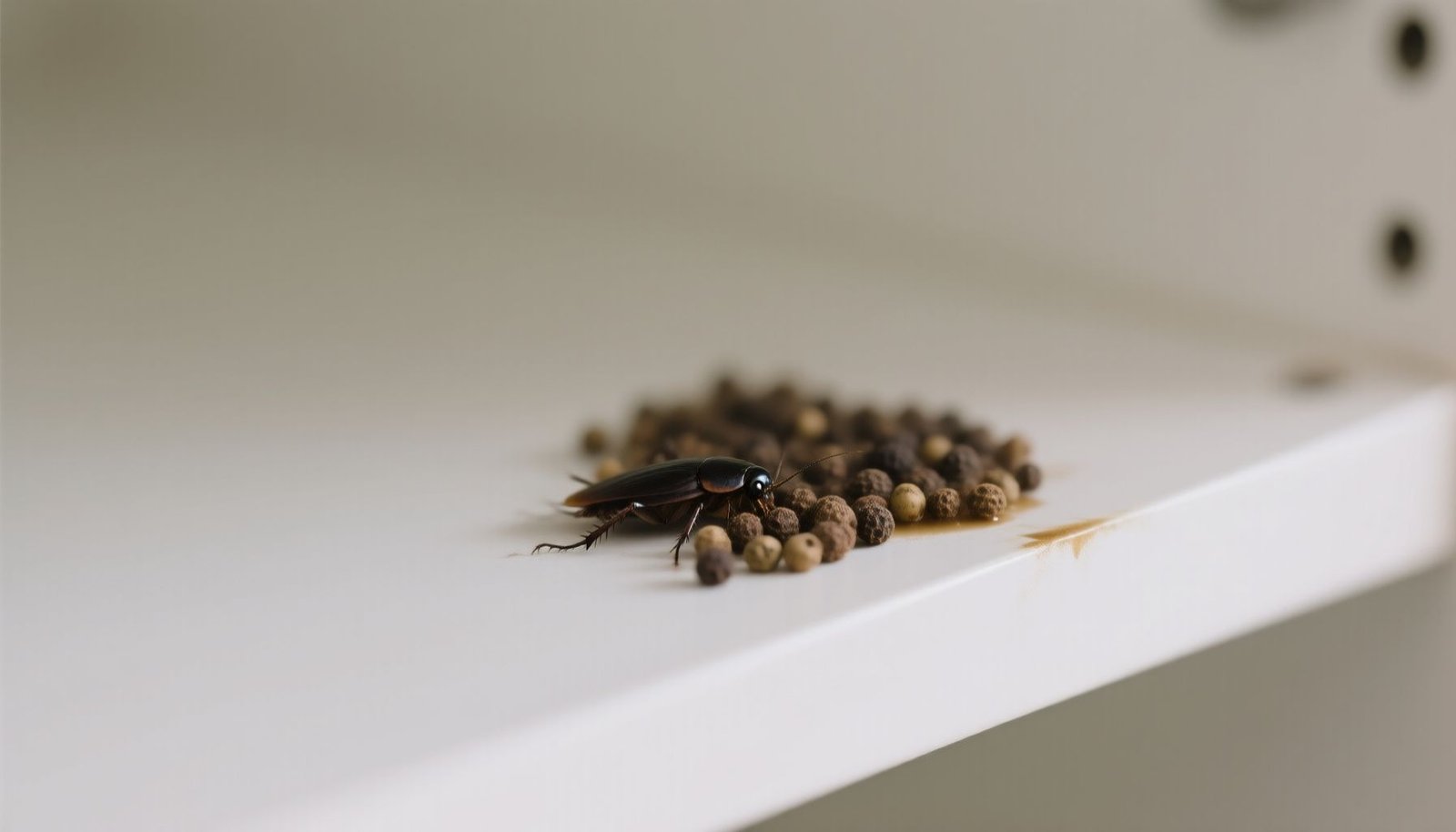
This close-up shows the kind of physical evidence — droppings, smear marks, and shed exoskeletons — that accumulates in roach harborage zones long before a homeowner ever spots a live insect.
What Does Roach Evidence Actually Look Like Up Close?
Roach droppings are the most reliable early indicator, and they look nothing like what most people expect. German cockroach droppings are tiny — roughly the size of a ground black pepper flake — dark brown or black, and cylindrical with ridged edges. They accumulate in clusters, not scattered randomly. You’ll find them in corners of cabinet shelves, along the top inner edge of a drawer, behind the kickplate under your stove, and inside the channel where a refrigerator door seal meets the frame. If you’re finding what looks like coffee grounds or pepper in places you haven’t put either of those things, that’s a serious signal.
Beyond droppings, roaches leave smear marks — dark, irregular brown streaks — in areas where they repeatedly travel along a surface, especially near moisture. These are caused by their bodies dragging across a surface as they move through tight spaces, and they’re common along baseboards, the underside of cabinet edges, and around pipe penetrations in walls. Shed exoskeletons, called exuviae, are another key sign: roaches molt five to six times before reaching adulthood, and each molt leaves behind a hollow, translucent shell the exact shape of the insect. Finding these in a cabinet corner confirms long-term habitation, not just a passing visitor.
Can You Smell a Roach Infestation Before You See One?
Yes — and this is a sign that gets almost no attention in mainstream pest articles. Cockroaches produce aggregation pheromones, chemical compounds they release to signal safe harborage locations to other roaches. In small numbers, these pheromones are undetectable to humans. But as a population grows and concentrates in a specific area, the smell becomes unmistakable: a musty, oily, slightly sweet odor that some people describe as similar to almonds or crayons, or as a stale grease smell that doesn’t go away even after cleaning. It’s not a subtle “something’s off” smell. When an infestation is established, it has a distinct, unpleasant character all its own.
The smell tends to be strongest near the harborage zone — directly behind or underneath appliances, inside lower kitchen cabinets, or in the wall space around plumbing fixtures. If you pull out your refrigerator and there’s an odor that cleaning doesn’t fix, that’s worth taking seriously. Worth noting: the smell alone won’t tell you how large the infestation is, since building type, ventilation, and cabinet layout all affect how much scent accumulates and where it concentrates. A heavily ventilated kitchen might mask an advanced infestation, while a tightly built apartment might smell noticeable with far fewer roaches.
“Most people wait for visual confirmation before they act, but by the time you’re seeing roaches during the day, you’ve already lost the early window. The olfactory and physical evidence — smear marks, droppings, egg casings — typically precede any daytime sighting by weeks or months. Train yourself to inspect the right places with the right tools, and you’ll catch an infestation when it’s still manageable.”
Dr. Patricia Callahan, Board-Certified Entomologist and Urban Pest Management Specialist, Purdue University Extension
Which Spots in Your Home Should You Inspect First?
Roaches don’t distribute themselves evenly through a home. They cluster tightly around three things: warmth, moisture, and food proximity. That means the highest-probability harborage zones are almost always within a few feet of each other in your kitchen, with secondary locations in bathrooms. Knowing exactly where to look — and what to look for — is what separates an early catch from a full-blown infestation.
Use a flashlight and a thin tool like a butter knife or a credit card edge to check the following locations systematically. Don’t just look — look at angles, inside hinges, and behind panels. Roach evidence in even one of these zones confirms activity and warrants immediate action.
- The motor compartment behind and underneath your refrigerator — Pull it away from the wall and check the compressor area. This is the warmest, darkest spot in most kitchens and one of the most common initial harborage sites.
- Inside the hinge side of lower kitchen cabinet doors — The gap where the hinge plate meets the frame is narrow, dark, and rarely disturbed. Droppings accumulate here without being visible until you look directly at the hinge.
- The underside of your dishwasher insulation blanket — Moisture, heat, and food residue from the drain line make this a prime location. Lift the insulation flap if accessible.
- Around pipe penetrations under the sink — The gap where supply lines or drain pipes pass through the cabinet floor into the wall void is a direct highway between roach harborage in walls and your kitchen interior.
- Inside the drawer below your stove — The warming or storage drawer accumulates crumbs and is directly adjacent to warm oven components. Pull it completely out and inspect the drawer cavity and the wall behind it.
- Behind the toilet and underneath bathroom vanity cabinets — German cockroaches will move to bathrooms when kitchen populations grow or when moisture is more accessible there. Check where supply lines enter the floor.
Pro-Tip: Do your inspection between midnight and 2 a.m. with a red-tinted flashlight or a red cellophane cover over a regular flashlight. Cockroaches cannot see red wavelength light the same way they process white light, so they won’t scatter immediately — giving you several seconds to observe harborage areas while they’re still active. This one technique can reveal a hidden infestation that a daytime inspection would completely miss.
How Do You Tell Roach Evidence Apart From Other Common Pest Signs?
This is genuinely tricky, and misidentification is more common than most people realize. Mouse droppings, beetle frass, and even watermarks can be mistaken for roach droppings at a glance. The table below breaks down the key physical differences so you can narrow down what you’re actually dealing with before you do anything else.
| Evidence Type | Roach Droppings | Mouse Droppings | Beetle Frass |
|---|---|---|---|
| Size | 1–2 mm, pepper-grain sized | 6–8 mm, rice grain sized | Fine powder, varies by species |
| Shape | Cylindrical with ridged ends | Spindle-shaped with pointed tips | Irregular, granular or powdery |
| Color | Dark brown to black | Dark brown to black | Light brown, tan, or cream |
| Clustering pattern | Dense clusters in corners and edges | Scattered along travel paths | Near damaged food packaging or wood |
Roach egg casings — the oothecae — are another distinctive and unambiguous sign. German cockroach oothecae are about 8 mm long, brown, rectangular, and ridged along one long edge. They’re often found in concealed locations like behind cabinet wall panels, tucked into the insulation around pipes, or glued to the underside of a drawer. Finding even a single empty ootheca means breeding has already occurred in that location. Unlike droppings, which could theoretically be misidentified, an ootheca is completely diagnostic — there’s nothing else it could be.
It’s also worth remembering that some pest signs overlap in ways that complicate identification. Skin reactions from nighttime exposure to roach allergens, for example, can produce marks that people sometimes attribute to other causes entirely — just as some people confuse various unexplained skin irritations with bites from spiders or bed bugs when the actual culprit is something else entirely. Getting the identification right matters before you treat, because roach protocols and bed bug protocols are completely different.
How Do You Confirm an Infestation Without Catching One in the Act?
Sticky glue monitors are, hands down, the most underused tool for homeowners trying to confirm a hidden infestation. These are simple cardboard traps with a sticky interior surface that cockroaches walk across and get stuck on. They’re not primarily meant to eliminate roaches — their real value is as a monitoring and counting tool. Place them flat against walls in the high-probability zones listed earlier: inside lower cabinet corners, behind the refrigerator, underneath the stove drawer. Leave them for 72 hours undisturbed.
What the traps catch tells you a great deal about the scope of the problem. Industry pest management guidelines use capture rates to estimate population size: catching 0–1 roaches per monitor per week suggests a very early or minor infestation, while 10 or more per monitor per week indicates a heavy, established population. Even catching a single roach on a monitor after 72 hours is confirmation enough to act — it means they’re active and foraging in that zone. The monitors also reveal which species you’re dealing with, which matters because German cockroach treatment protocols differ significantly from American cockroach approaches. Homeowners who rely on pest-control products designed for one species and apply them to a different species often find that nothing seems to work, which is a frustrating and expensive lesson.
One thing worth flagging: if you’ve recently used any kind of aerosol spray or fogger in the kitchen, sticky monitor results for the next week or two will be artificially low. Roaches are extremely sensitive to repellent compounds and will retreat deeper into wall voids after aerosol exposure, which means your monitor captures drop — not because the infestation is gone, but because they’ve moved. This is one of the reasons pest professionals consistently warn against using consumer foggers without professional guidance. The appearance of success can delay effective treatment by weeks.
It’s also a reminder that pest identification across the board requires looking at the full picture. Just as whiteflies on houseplants leave behind indirect evidence — sticky residue, yellowing, the white dusty coating on leaves — before you ever spot the insects themselves, roaches leave a detailed signature across your kitchen long before a single one crosses your counter. The evidence is there. You just have to know what you’re looking at.
Here’s a quick summary of the passive and active confirmation methods, ranked roughly by reliability:
- Sticky glue monitors placed in harborage zones — Most reliable passive tool; provides population density data, not just yes/no confirmation
- Ootheca (egg casing) inspection — Completely diagnostic; a single empty casing confirms breeding activity in that specific location
- Dropping pattern and location analysis — High reliability when clusters are found in characteristic locations; can be confused with other pest signs in isolation
- Odor detection near appliances — Useful for narrowing harborage zones but not reliable as standalone confirmation; varies too much by ventilation and building type
- Nighttime red-light observation — Active method that provides direct evidence of movement and harborage zones without disturbing the population
Once you’ve confirmed activity through any combination of the above, the specific approach you take — gel bait placement, boric acid application, IGR (insect growth regulator) treatment, or professional intervention — should be calibrated to the population size your monitoring suggests. A small, early infestation caught through smart inspection is a weekend project. The same infestation ignored for another two months is a much harder conversation to have.
Frequently Asked Questions
What are the signs of roaches you never see?
The most common signs of roaches you never see include dark brown droppings that look like ground pepper or coffee grounds, smear marks along baseboards, a musty oily smell in cabinets or under appliances, and shed skins near cracks and crevices. If you’re spotting more than a few droppings in one area, you likely have an active infestation rather than a one-off visitor.
What do roach droppings look like?
Small roach droppings look like tiny black or dark brown specks, similar to coarsely ground black pepper, and are usually found in clusters. Larger species like American roaches leave cylindrical droppings about 1/4 inch long with blunt ends and ridges along the sides. Finding them inside drawers, along cabinet hinges, or behind the refrigerator is a strong indicator roaches are active in that area even if you’ve never spotted one.
Can you smell roaches before you see them?
Yes, a heavy roach infestation produces a distinct musty, oily, or slightly sweet smell that’s hard to ignore once you know what it is. The odor comes from pheromones roaches use to communicate and from their droppings accumulating over time. If a cabinet or closet smells off and you can’t find a food source causing it, that smell alone is worth investigating further.
Where do roaches hide during the day?
Roaches are nocturnal and spend daylight hours squeezed into tight, warm, dark spaces like behind refrigerators, inside wall voids near plumbing, under stove burner pans, and inside the motor housings of appliances. They prefer areas where two surfaces touch, so gaps where walls meet floors or where pipes enter walls are prime hiding spots. Sliding a flashlight along these areas at night gives you a much better chance of confirming their presence.
How do I know if I have roaches or just one roach?
Seeing one roach during daylight hours is a red flag because roaches avoid light and only come out when competition for food forces them into the open — that usually means the population is already large. Finding egg cases, called oothecae, is another clear sign you’re dealing with more than a single bug since one case can contain 16 to 50 eggs depending on the species. If you’re also finding droppings in multiple locations rather than just one spot, treat it as an active infestation.