

Flea bites are not the first sign of a flea infestation — they’re a late one. By the time your ankles are itching, a flea population has already been cycling through your home for weeks, possibly longer. The eggs, larvae, and pupae hiding in your carpet fibers are what you should be looking for, and almost nobody talks about how to spot those before the adults start feeding.
That’s the core problem with most flea detection advice: it’s entirely bite-centric. You’re told to watch your skin. But a single female flea lays up to 50 eggs per day, and those eggs roll off your pet and scatter across every surface your pet touches. The infestation builds silently for 2 to 3 weeks before enough adults hatch to start biting consistently. If you wait for bites, you’ve already lost significant ground.
Why Fleas Are Already Established Before You Feel Anything
The flea life cycle is the reason early detection is so hard — and why it matters so much. Adults make up only about 5% of a flea population at any given time. The other 95% are eggs, larvae, and pupae tucked into carpet loops, bedding seams, floor cracks, and upholstery. You can walk through a room daily and never see any of them.
Flea pupae, in particular, are built for invisibility. The cocoon is sticky and collects debris, making it nearly indistinguishable from a dust particle. Pupae can lie dormant for up to 5 months, waiting for warmth, vibration, and carbon dioxide — the signals that tell them a host is nearby. When you move back into a home that’s been vacant, or when the heat turns on in fall, that dormant population can hatch in waves within 24 to 48 hours of re-occupancy.
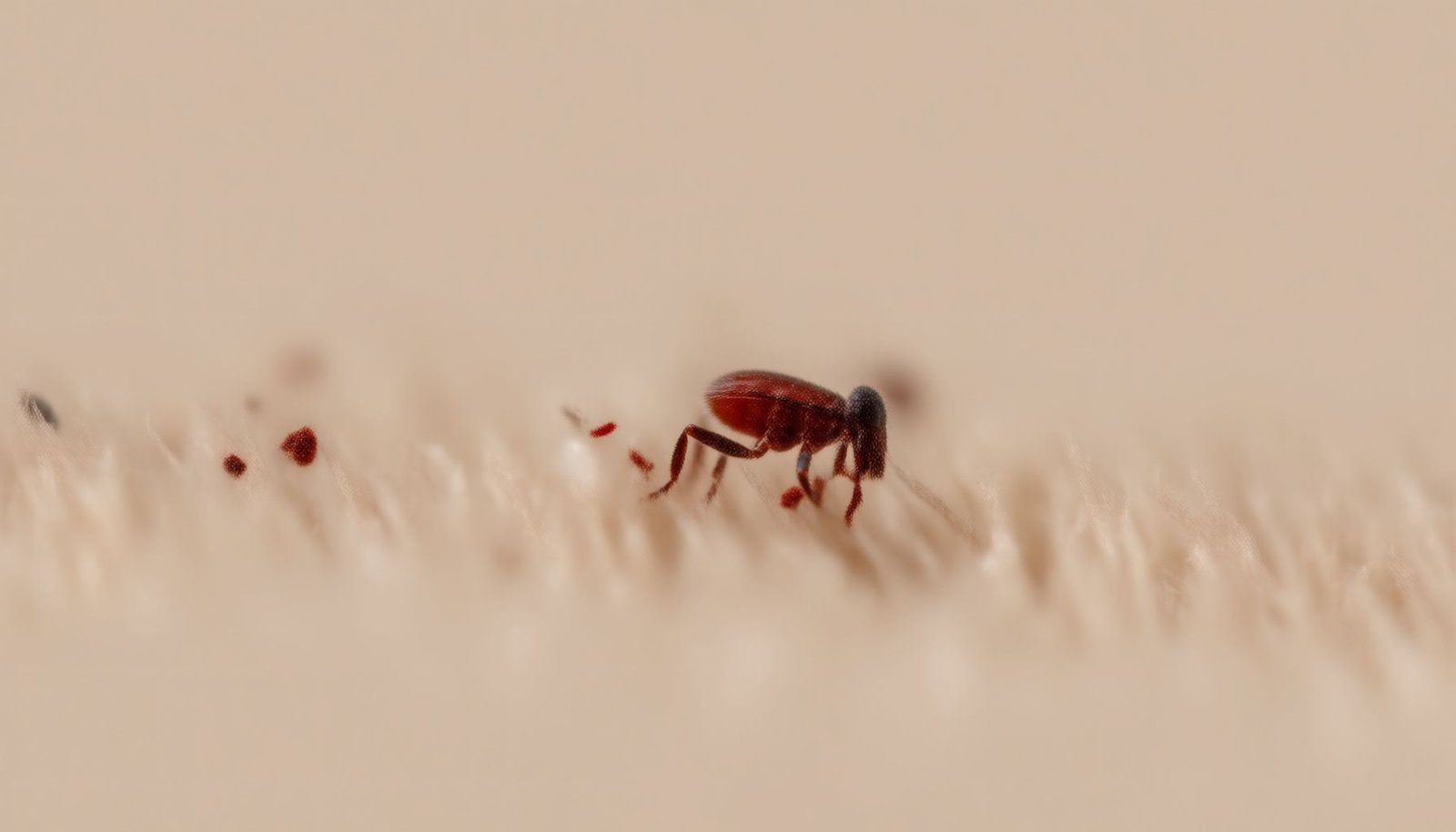
This close-up shows flea dirt and eggs against carpet fiber — the two pre-bite clues that most homeowners walk right past without recognizing what they’re looking at.
What Does Flea Dirt Look Like and Where Do You Find It?
Flea dirt is digested blood excreted by adult fleas, and it looks like coarsely ground black pepper. You’ll find it concentrated wherever a pet rests: dog beds, the base of a favorite couch cushion, the spot on the carpet where your cat sleeps near the window. The simplest test is to collect a few specks on a damp white paper towel. If the specks dissolve into rust-colored smears, that’s blood — and that’s flea dirt. Regular dirt or debris won’t do that.
The distribution of flea dirt tells you a lot about the size of the problem. A few specks on a pet bed might mean you caught it early. Finding flea dirt in multiple rooms, especially in areas your pet doesn’t frequent heavily, suggests a well-established population that’s been spreading for a while. Check along baseboards too — adult fleas stay close to their host, but flea dirt can get kicked into corners during normal pet movement.
Can You Spot Flea Eggs in Carpet Before an Infestation Takes Hold?
Flea eggs are white, oval, and about 0.5 millimeters long — roughly the size of a grain of salt but rounder. They’re not sticky like lice nits, which is why they don’t stay on a pet’s fur. They slide off and land wherever the pet goes, making carpet one of the highest-concentration areas. Getting down and looking closely at carpet fibers in strong raking light is genuinely one of the most effective early-detection moves you can make.
Here’s where most homeowners make a mistake: they look in one spot and either find nothing or find something they can’t identify, then give up. The right approach is to check multiple zones systematically. Run your fingers against the carpet nap to expose the base of the fibers. Focus especially on the areas your pet spends the most time and any spots near entryways where your pet first comes inside after outdoor time. That’s where egg density will be highest.
Pro-Tip: Wear white knee-high socks and slowly walk through carpeted areas, particularly near pet resting spots. If fleas are present, adults will jump onto the white fabric and become immediately visible as dark, sesame-seed-shaped specks. This works best in the evening when fleas are more active, and it can detect live adults before you’ve had a single bite.
What Are the Non-Bite Signs of Fleas in a Room-by-Room Breakdown?
Different rooms give different clues, and knowing what to look for where saves a lot of time. Fleas don’t distribute themselves evenly — they concentrate in the spaces their hosts use most. That means the signs you find in a bedroom will look different from what you’d find in a hallway, even in the same home.
Use this room-by-room checklist to systematically check your home before bites become your first alert:
- Pet resting areas and dog beds: Flea dirt accumulates fastest here. Shake the bedding over a white surface and check for black specks that smear red when wet. These areas also collect the highest egg density — up to hundreds of eggs per square foot in a heavy infestation.
- Carpeted bedroom floors: Even if pets aren’t allowed in the bedroom, you can carry eggs in on clothing. Check carpet near the foot of the bed and along walking paths between doorways. Adult fleas will jump toward warmth and CO2 from sleeping humans.
- Under and behind upholstered furniture: Larvae actively avoid light and move toward the base of furniture, into floor seams, and under couch cushions. Flea larvae look like tiny translucent worms, about 1 to 5 millimeters long, and are rarely seen without kneeling down and looking with a flashlight.
- Hardwood and tile gaps: People assume fleas only live in carpet, but eggs and larvae do just fine in floor gaps, under baseboards, and in the cracks between hardwood planks. If you have hard floors and a pet, check these areas specifically.
- Entryways and mudrooms: This is where outdoor fleas first come inside, hitchhiking on pets or even on your pants. Flea dirt near a front door mat or in a mudroom can indicate regular reintroduction from the yard rather than an established indoor colony.
How Do You Tell Flea Signs From Other Pest Evidence?
The wet-paper-towel test for flea dirt is the gold standard for distinguishing flea evidence from general debris, but there are a few other look-alikes worth knowing. Carpet beetle frass, rodent droppings, and even mold spores can all be mistaken for flea dirt at a glance. The difference is that none of them dissolve into a reddish-brown stain the way dried blood does.
Picture this: a family moves into a rental home with no pets, begins finding small dark specks on the light-colored carpet near the bedroom closet, and immediately assumes it’s dirt tracked in by movers. It’s not until the first itchy ankles a week later that they realize the previous tenant had cats. Vacant homes with former pets are one of the most common sources of sudden flea outbreaks, precisely because dormant pupae hatch en masse when new occupants bring warmth and movement back into the space. Just as you’d want to research unusual findings before dismissing them — the way you would with something like white fuzzy spots on houseplants that turn out to be mealybugs rather than harmless dust — flea dirt deserves a proper ID test before you assume it’s nothing.
| What You Found | Likely Source | Wet Paper Towel Test Result |
|---|---|---|
| Black/dark brown specks, pepper-like | Flea dirt (digested blood) | Dissolves into rust-red smear |
| Brown crumbly granules near fabric | Carpet beetle frass or debris | No color change, just smears gray |
| Tiny white oval specks in carpet | Flea eggs (possible) | Doesn’t dissolve; check with magnification |
| Fine black powder near baseboards | Rodent droppings or mold | No red bleed; smell test may apply |
“Most people think a flea problem starts when they get bitten, but by that point the population is already 20 times larger than it was when it was completely detectable by other means. The egg-to-adult cycle in warm indoor conditions takes as little as 14 days, so a problem that’s invisible on a Monday can be biting you by the following Monday. Checking for flea dirt and doing the sock walk-test monthly in pet households is genuinely the most underused early-detection strategy I see.”
Dr. Marcus Ellison, Board-Certified Entomologist and Urban Pest Management Specialist
Does Your Pet’s Behavior Give Away a Flea Problem Before You Spot One?
Your pet is essentially a live flea detector, and behavioral changes can precede any visible sign of infestation by several days. A dog that suddenly starts biting at the base of its tail, shaking its head repeatedly, or scratching at its neck and hindquarters more than usual is worth paying attention to. Cats show it differently — excessive grooming to the point of hair thinning along the spine and belly is a classic early signal, especially in cats with flea allergy dermatitis, which can develop from even a small number of bites.
What most homeowners don’t realize is that pets with high grooming behavior — particularly cats — can remove fleas from their own coat so efficiently that you’d find almost no live fleas on the animal itself, even with a heavy home infestation. The fleas are there, biting, then being groomed away. The evidence is in the home environment, not on the pet. Checking the fur with a fine-toothed flea comb over white paper will sometimes reveal flea dirt caught in the comb even when no live fleas are visible.
It’s also worth noting that the signs don’t always align with what you’d expect depending on the season and your home’s conditions. Warm, humid environments accelerate the entire flea life cycle — in ideal conditions (around 70–85°F with 70% humidity), development from egg to adult can happen in as few as 12 to 14 days. In cooler or drier conditions, that same cycle might stretch to 180 days. So what qualifies as “early detection” in a Florida home in summer is a completely different timeline than in a drafty Minnesota home in October. That context matters when you’re deciding how urgently to act on what you’ve found — just as the severity of a contamination risk depends heavily on the specific pest and setting, the way exposure risk varies dramatically with something like deer mice and hantavirus depending on location and exposure type.
Here are the behavioral and environmental signs to track even before visual evidence appears:
- Increased scratching or biting at the tail base and neck in dogs — these are the areas fleas preferentially feed on
- Patchy hair loss along a cat’s spine or belly from repeated grooming — often a sign of flea allergy, not just fleas
- Restlessness or reluctance to lie in a favorite spot — pets sometimes abandon infested resting areas before you notice anything
- Sudden onset of itching on human ankles or lower legs, even before visible bites form — flea saliva causes a reaction that can precede a visible welt by several hours
- Finding tiny jumping specks near floor level when you crouch down in a carpeted room — adult fleas jump up to 7 inches vertically and 13 inches horizontally, which is how they reach a host from floor level
Acting on these signals before waiting for a confirmed bite pattern is the entire point. A flea population doesn’t plateau — it compounds. One female flea that’s been feeding for 48 hours begins laying eggs, and she can produce 50 eggs per day for the duration of her life, which averages 60 to 100 days. The math on that is uncomfortable: a single pregnant flea can be responsible for thousands of offspring within a few weeks if conditions are right. The earlier you catch the signs, the smaller the population you’re dealing with — and the simpler the solution becomes.
Frequently Asked Questions
What are the first signs of fleas in your home before you get bitten?
The earliest signs are usually flea dirt and excessive scratching in your pets — not bites on you. Flea dirt looks like tiny black or reddish-brown specks on your pet’s skin, bedding, or carpet. If you drop some on a damp white paper towel and it turns reddish, that’s digested blood and you’ve got fleas.
How do I know if I have fleas if I don’t have pets?
Fleas can enter your home on used furniture, clothing, or through gaps around doors and windows — no pets required. Check carpet edges, baseboards, and any soft furniture for tiny dark specks or small jumping insects no bigger than 1/8 inch. If you moved into a home where pets previously lived, fleas can survive in dormant cocoons for up to a year waiting for a new host.
What does flea dirt look like on carpet?
Flea dirt on carpet shows up as scattered black or dark brown flecks, similar to ground pepper, usually concentrated where pets rest or sleep. You’ll often find it in clusters rather than spread evenly. Run a white cloth or damp paper towel across the carpet — if the debris smears red or rust-colored, it’s flea dirt and not just regular dust.
Can you see flea eggs in your carpet?
Flea eggs are tiny — only about 0.5 mm — white, oval, and nearly impossible to spot with the naked eye unless you’re looking very closely in bright light. They don’t stick to surfaces, so they fall off pets into carpet fibers, cracks in flooring, and furniture seams. A flea comb dragged through carpet near a pet’s favorite spot will sometimes pull up eggs, but most people miss them entirely without magnification.
How can I tell if my house has fleas using a simple home test?
The white sock test works well — put on white knee-high socks and slowly shuffle through each room, especially near carpet edges, pet bedding, and under furniture. Fleas are attracted to movement and warmth, so they’ll jump onto the socks where you can easily spot them against the white fabric. Do this in multiple rooms over 5 to 10 minutes for the most accurate results.