
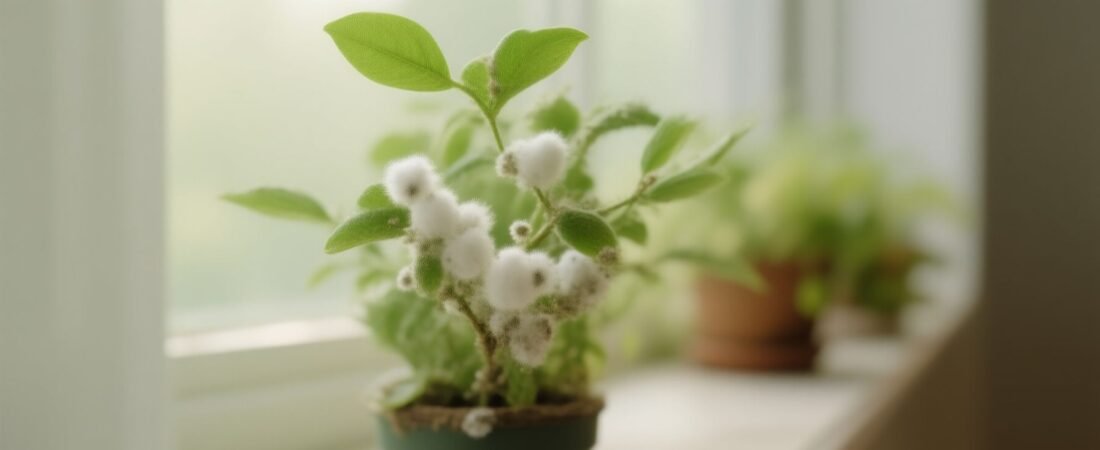
White fluff on your houseplant is not cotton. It’s not mineral residue from your water, and it’s definitely not a fungus — though those are the three things most people assume before they finally realize they’re looking at mealybugs. That misidentification window, sometimes days or weeks, is exactly how a minor problem becomes a whole-collection problem.
Mealybugs look like tiny white or pale gray ovals coated in a powdery, waxy fuzz that resembles lint or dried foam. They move — slowly — which is usually the moment people stop assuming it’s a water stain. A single female can lay between 300 and 600 eggs in her lifetime, and those eggs are hidden inside the same cottony mass that camouflages her body. By the time you notice one cluster, there are almost always several more you haven’t found yet.
Here’s the angle almost every mealybug article skips entirely: most people are identifying the wrong thing. They spot the cottony white wax and think that IS the bug. It’s not. The wax is a secretion. The bug is hiding underneath it, and understanding that distinction changes everything about how you check your plants, confirm an infestation, and treat it correctly.
What Do Mealybugs Actually Look Like Under the White Fuzz?
Strip away the waxy coating and you’re looking at a soft-bodied, oval insect roughly 1/16 to 1/5 of an inch long — about the size of a sesame seed. The body is pale yellow, cream, or light pink, with faint segmentation visible along the sides and short filaments of wax projecting around the edges like stubby legs. They look vaguely prehistoric up close, almost like a tiny armadillo without the armor.
The white fuzz itself is a protective wax secreted from glands along the insect’s body. It serves several purposes: it repels water, which makes many contact sprays less effective, it traps moisture so the insect doesn’t dry out, and it provides physical camouflage. This is why mealybugs are so much harder to kill than their slow movement and soft bodies suggest — the wax is essentially a shield you have to defeat before the insecticide even reaches the pest.
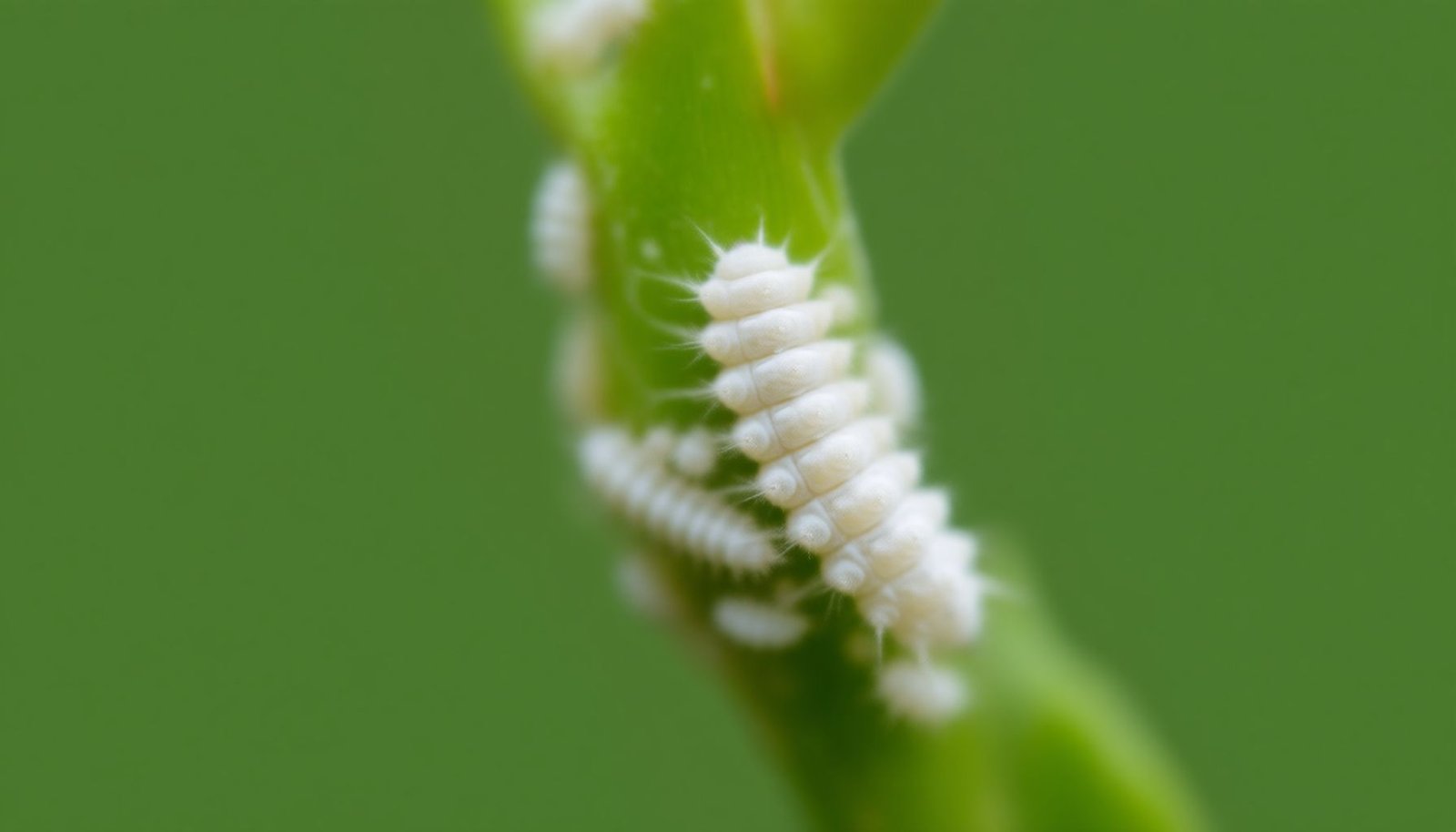
This close-up shows the segmented body beneath the waxy secretion — the detail most people never see because they mistake the white coating for the insect itself, which is exactly why early treatments often fail.
Where Do Mealybugs Hide on Houseplants?
Picture this: you bought a pothos from a hardware store, set it on your shelf, watered it twice, and two weeks later noticed white smudges in the angle where a leaf stem meets the main vine. You wiped one off with your finger and it smeared, leaving a faint yellow-orange residue. That’s a mealybug colony in its early stage — and the smear is a combination of crushed insect bodies and their honeydew excretion.
Mealybugs are strategic about where they feed. They target the softest, least-exposed tissue on a plant because those areas have the highest concentration of phloem sap with the least structural resistance. Here’s exactly where to look, in order of likelihood:
- Leaf axils — the tight angle where a leaf stem attaches to a main stem. This is the single most common hiding spot on most houseplants because it’s sheltered and rarely disturbed by watering.
- Undersides of leaves — especially near the central vein. Mealybugs prefer the waxy underside because it’s protected from overhead water and indirect light.
- New growth — tender unfurled leaves and shoot tips are targeted first because the sap is most concentrated and the tissue is easiest to pierce.
- Root zone — root mealybugs (a distinct but related group) live entirely underground on the roots and are almost never diagnosed until the plant begins collapsing for no visible reason.
- Stem crevices near the soil line — the base of the plant where stems cluster together, especially on succulents and cacti with tight rosette structures.
One thing worth knowing: mealybugs will also hide on the outer surfaces of plastic pots and even underneath pot saucers. If you treat the plant and skip the pot, you’ll see a re-infestation within two to three weeks almost every time.
How Do You Tell Mealybugs Apart From Things That Look Similar?
Several things on houseplants produce white material, and not all of them are mealybugs. Getting this wrong means treating for the wrong pest — or treating when you don’t need to at all. The table below breaks down the key differences between the most commonly confused culprits.
| What You’re Seeing | Likely Cause | Key Distinguishing Feature |
|---|---|---|
| White cottony clusters in leaf joints | Mealybugs | Smears yellow-orange when crushed; moves slowly if disturbed |
| White powdery coating on leaf surfaces | Powdery mildew (fungus) | Cannot be wiped off cleanly; no insects present; spreads across surface |
| White oval bumps firmly attached to stems | Scale insects | Hard shell; does not smear; no visible body when scraped |
| Fine white webbing between leaves | Spider mites | Webbing is stringy, not fluffy; tiny moving dots visible with magnification |
The crush test is genuinely useful here. Press a cotton swab or your fingernail against one of the white clusters. Mealybugs will leave a yellow, orange, or pale pink smear because you’re crushing both the waxy secretion and the soft body inside it. Powdery mildew leaves a dry, chalky residue. Scale insects either pop off cleanly or leave a dark, sticky smear with no soft material. That color tells you what you’re dealing with in about two seconds.
Pro-Tip: Use a 10x jeweler’s loupe or even your phone’s camera in macro mode to examine the white material up close before you treat. At that magnification, mealybug legs and body segments are visible even under the wax coating — and you’ll also catch early-stage crawlers (juveniles) that look like moving yellow-green specks rather than white fuzz, which are the most vulnerable stage and the easiest to kill.
What Does a Mealybug Infestation Look Like Beyond the Bugs Themselves?
The bugs themselves are only part of what you should be looking for. Mealybugs feed by inserting a needle-like stylet into plant tissue and extracting phloem sap — a process that damages cells, injects saliva that disrupts plant growth, and produces a sugar-rich waste product called honeydew. Each of these has a visible signature on the plant.
Secondary infestation signs to look for include:
- Sticky residue on leaves or the surface beneath the pot — this is honeydew. It feels tacky and may appear as a faint gloss on otherwise healthy-looking leaves.
- Sooty mold — a gray-black powdery coating that grows on top of honeydew deposits. It doesn’t directly harm the plant, but it blocks light and signals that honeydew has been accumulating long enough to culture a mold colony.
- Distorted or cupped new growth — mealybug saliva contains compounds that interfere with cell division. New leaves that emerge twisted, undersized, or with irregular edges are a classic sign of active feeding at shoot tips.
- Yellowing leaves that drop without wilting first — this differs from overwatering drop (which produces limp, soft leaves) and from underwatering drop (which produces dry, crispy edges). Mealybug-induced leaf drop tends to look sudden and unexplained.
- Ants congregating on the plant — ants actively farm mealybugs for their honeydew, protecting them from predators and sometimes physically moving them to new plant hosts. If you see ants on a houseplant, check immediately for mealybugs.
That last one surprises a lot of people. Just as ants in spaces they shouldn’t logically be — say, the way rat damage in attic insulation reveals a larger hidden problem — ants on your houseplants are almost always a symptom of something else happening on the plant, not the primary issue. Find what’s producing the honeydew and you’ve found the real infestation.
“Most people treat mealybugs on the plant they can see and miss the population that’s already migrated. Mealybug crawlers — first-instar nymphs — are mobile and can travel several feet across a surface to reach a new host. In a room with multiple houseplants positioned within two feet of each other, it’s essentially a connected ecosystem from the mealybug’s perspective.”
Dr. Sandra Tillman, Extension Entomologist, University of Florida IFAS
Can You Confirm Mealybugs Just by Looking, or Do You Need a Closer Inspection?
For a moderate to heavy infestation, visual confirmation from normal viewing distance is usually enough. The white cottony masses are distinctive, the slow movement is visible to the naked eye if you watch for ten or fifteen seconds, and the honeydew stickiness is immediately obvious on touch. But early-stage infestations — particularly those brought in on a newly purchased plant — can be missed entirely without a deliberate close inspection.
There’s a counterintuitive thing about mealybug timing worth understanding: the life stage you can most easily see (the waxy adult female) is actually the hardest to kill. The stage you can barely see without magnification — the mobile first-instar crawler, roughly the size of a pinhead and pale yellow — is the most vulnerable. Crawlers have minimal waxy coating, no protective egg mass, and absorb contact insecticides readily. This is why experienced growers check new plants obsessively in the first two weeks after purchase. That’s when you’re most likely to catch crawlers before they mature and produce a wax shield that reduces the effectiveness of most treatments by 60 to 80 percent.
The honest nuance here is that the severity of what you’re dealing with genuinely changes your approach. A single small colony on one plant in a home with well-spaced collections is a very different situation from a whole shelf of tropical plants crowded together in a humid bathroom — the kind of environment where mealybugs can cycle through a generation every 30 days at room temperature. Just as some pest situations require professional assessment — the same way unusual sounds or damage in areas like your walls or ceiling sometimes warrant a broader inspection, similar to what’s described in resources like bugs in an attic identification — a severe or rapidly spreading mealybug infestation across multiple plants sometimes genuinely benefits from systemic treatment rather than spot control.
The key takeaway is to trust the crush test, trust the smear color, and always inspect the entire plant — not just the spot where you first noticed white fuzz. Check the roots if the plant has been declining without explanation. Turn the pot over and look at the drainage holes. Mealybugs will use every available hiding spot, and finding them all in the first pass is what separates a problem you solve in a week from one that keeps coming back for months.
Frequently Asked Questions
What do mealybugs look like on houseplants?
Mealybugs look like tiny white or light gray ovals covered in a waxy, cottony fuzz — they’re often described as looking like small pieces of lint or cotton stuck to your plant. Adult females are about 1/10 to 1/5 of an inch long and tend to cluster in groups, especially where leaves meet stems. If you see white fluffy buildup in those tight crevices, there’s a good chance you’re dealing with mealybugs.
How do I know if my plant has mealybugs or powdery mildew?
The easiest way to tell them apart is to look at where the white stuff is and whether it moves. Mealybugs cluster at leaf joints and stem crevices and you can actually see the individual bugs if you look closely — sometimes they’ll move when disturbed. Powdery mildew spreads in a flat, dusty coating across the surface of leaves and doesn’t move at all. You might also notice sticky residue or yellowing leaves with mealybugs, which isn’t typical of mildew.
What do mealybug eggs look like?
Mealybug eggs are laid inside a white, cottony sac that the female produces — the whole egg mass can look like a small tuft of cotton or a fuzzy white blob about the size of a pea. A single female can lay 300 to 600 eggs inside that sac, so one cottony clump can turn into a serious infestation fast. The eggs themselves are pale yellow and tiny, but you’ll rarely see them without pulling apart the waxy casing.
Can mealybugs live in soil?
Yes, some species like the ground mealybug (Rhizoecus species) live in the soil and feed on plant roots rather than leaves, which makes them much harder to spot. If your plant’s yellowing and declining but you don’t see any white fuzz on the stems or leaves, it’s worth unpotting it to check the roots and soil for small white clusters. Root mealybugs are less common than the foliar kind, but they’re just as damaging and trickier to treat.
Are mealybugs harmful to humans or pets?
Mealybugs don’t bite, sting, or transmit diseases to people, so they’re not a direct health threat to you or your family. However, some pets — especially cats — may chew on infested plants, and while mealybugs themselves aren’t toxic, the pesticides you use to treat them can be, so always check product labels before spraying around animals. The bigger concern is that mealybugs can spread from one houseplant to every plant in your home surprisingly quickly if you don’t catch them early.