
Rat damage in attic insulation is not subtle once you know what you’re actually looking at — but here’s the thing most homeowners get completely wrong: they’re scanning for bite marks and droppings when the real red flag is the insulation’s compression pattern. Rats don’t just chew through insulation; they collapse, burrow, and rearrange it in ways that destroy its thermal resistance long before you ever spot a single rodent. By the time the damage is obvious enough to trigger alarm, your energy bills have already been climbing for weeks and the structural risk has quietly compounded.
Why Rat Damage in Attic Insulation Looks Nothing Like What You’d Expect
Picture this: you finally pull down the attic hatch after noticing scratching sounds late at night, and what you see looks less like animal damage and more like someone ran a lawnmower through your insulation. That’s because rats — particularly Norway rats and roof rats — don’t nibble delicately at the edges of a batt. They tunnel. They compress entire sections flat to create travel highways and nesting chambers. A compressed batt of R-38 blown-in insulation can drop to the effective thermal performance of R-10 or less without a single visible bite mark on the surface.
The reason this matters so much is that most homeowners and even some inspectors evaluate insulation damage by looking for obvious physical destruction — torn material, exposed joists, and scattered debris. Compression damage is invisible from a casual glance. You have to get in there, look at the depth across multiple zones, and compare it to what the manufacturer’s installed depth chart says. If you’re seeing uneven depth across the floor of the attic — some spots fluffy and full, others flattened like a pancake — that unevenness is the fingerprint of rodent activity, even if you haven’t found a single dropping yet.
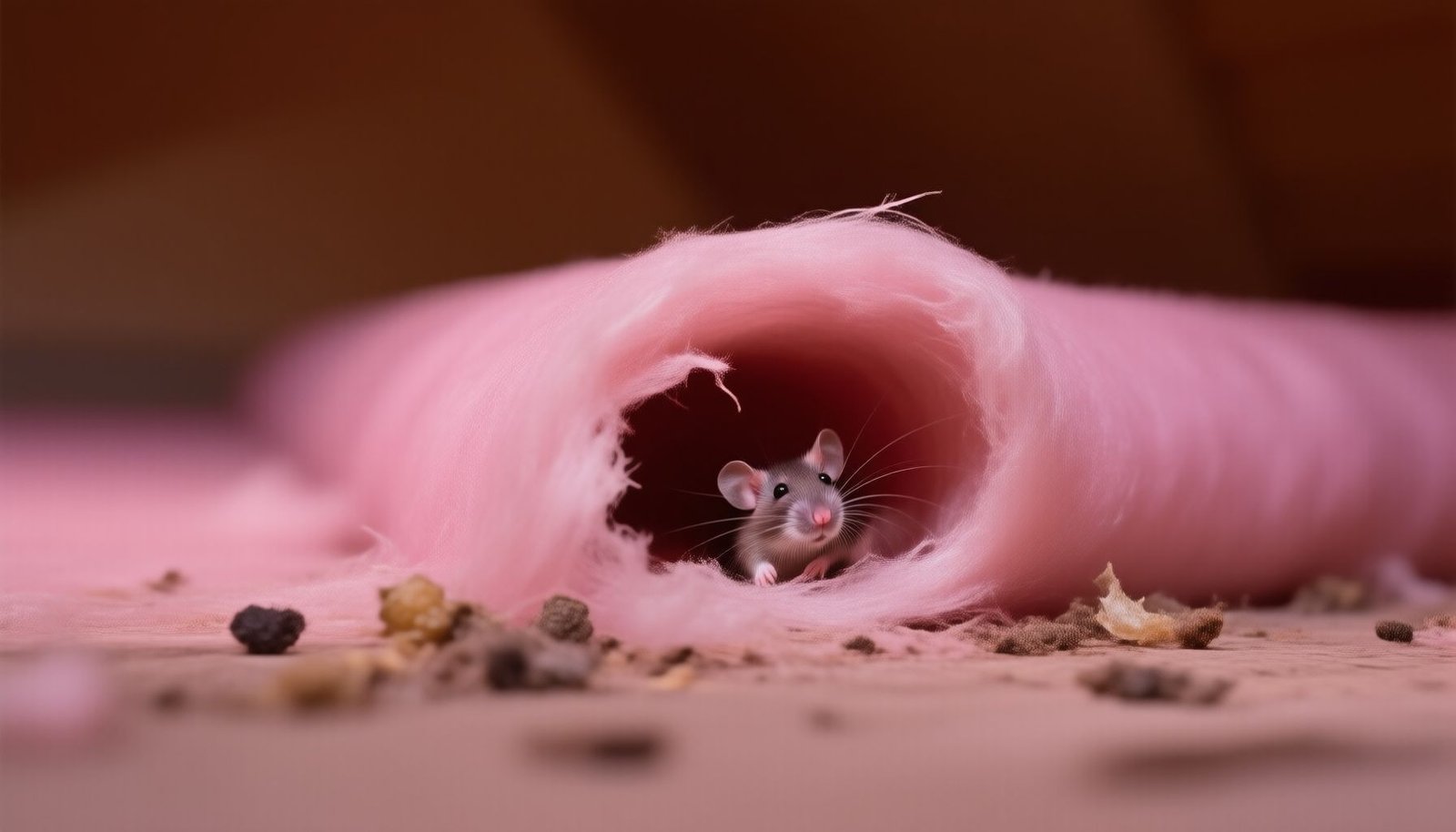
This close-up shows the flattened, matted texture of blow-in insulation that’s been used as a rat runway — notice how the compressed zones form a clear linear path, which is exactly the kind of pattern you should be scanning for during your own attic inspection.
What Does a Rat Nesting Site Actually Look Like Inside Your Insulation?
A rat nest inside attic insulation is not a neat little pile — it’s a dense, matted bowl roughly 6 to 12 inches across, packed with shredded insulation fibers, pieces of cardboard, fabric threads, chewed electrical wire sheathing, and sometimes food scraps carried up from below. Roof rats in particular prefer elevated nesting sites and will excavate a cavity directly into fiberglass batts or blown-in cellulose, creating a hidden pocket that’s completely invisible from above unless you probe the insulation with a gloved hand. These nests are warm, humid, and structurally compacted — which is why they can sit undetected for months.
The nest site itself is usually surrounded by a web of compressed rat runs radiating outward in multiple directions, almost like spokes on a wheel. Each run is 2 to 3 inches wide — just wide enough for a rat body — and smooth along the bottom from repeated use. Fresh nests will also have a distinctive musky, ammonia-heavy odor that hits you the moment you open the hatch on a warm day. If the smell is sharp and immediate, the activity is likely current. A stale, faded smell suggests the nest has been abandoned, though that doesn’t mean the rats are gone — it may just mean they’ve relocated to a different section of the attic.
How to Tell Rat Damage Apart from Mouse Damage or Squirrel Damage
Not every small animal that gets into your attic leaves the same evidence, and misidentifying the culprit will send you down the wrong control path entirely. Rats leave gnaw marks that are roughly 1/8 inch wide with two parallel grooves from their incisors — measurably larger than the 1/16 inch marks left by mice. Squirrel damage tends to be concentrated at entry points and along roof edges, with deeper, cleaner chewing into wood rather than the scattered, irregular chewing pattern rats leave across insulation and wiring. The table below breaks down the key visual differences.
| Damage Type | Rat | Mouse | Squirrel |
|---|---|---|---|
| Gnaw mark width | ~1/8 inch, rough edges | ~1/16 inch, fine grooves | Larger, splinter-heavy |
| Nesting material | Shredded insulation + debris mix | Fine fibers, soft material | Leaves, twigs, insulation strips |
| Runway pattern | Defined 2–3 inch tunnels in insulation | Shallow surface trails | No consistent runway pattern |
| Dropping size | 3/4 inch, capsule-shaped | 1/4 inch, pointed ends | 3/8 inch, barrel-shaped |
Dropping size and shape is often the fastest way to confirm you’re dealing with rats specifically. Norway rat droppings average 3/4 inch long with blunt ends, while roof rat droppings are slightly smaller and curved. Finding droppings concentrated along a joist run or near a wall-top plate almost always indicates a rat travel route, not a random visit. Mice spread droppings far more broadly and randomly — 50 to 75 droppings per day scattered across a wide area — whereas rats tend to defecate along established paths.
Which Types of Attic Insulation Show Rat Damage Differently?
The type of insulation in your attic changes both how rats interact with it and how easy the damage is to spot. Fiberglass batts are the most vulnerable to nesting damage because rats can grab and pull the material apart to excavate a cavity. Blown-in fiberglass or cellulose is easier for rats to tunnel through but harder to nest in cleanly, so the damage pattern is more diffuse — you’ll see broad areas of depression and disturbance rather than a single compact nest. Spray foam insulation is the most rat-resistant in terms of nesting, but rats will still gnaw through it to create entry paths, leaving ragged-edged channels that are unmistakable once you’re looking at them directly.
One honestly underappreciated factor here is climate and attic humidity. In humid climates like the Southeast, rat-damaged cellulose insulation absorbs moisture from rodent urine and nesting activity and can begin to compact and mold within weeks — which compounds the thermal damage with an air quality problem. In drier climates, the same damage may remain dry and stable for much longer, making it easier to miss because there’s no visible mold or discoloration flagging the problem. The severity of secondary damage really does depend on where you live and what season the infestation peaked in.
Pro-Tip: Before you enter the attic for an inspection, use a flashlight from the access hatch opening and scan across the entire floor of the attic at a low angle — this raking light technique makes flattened runways and compressed zones dramatically more visible than shining light straight down. You’re looking for shadow patterns in the surface texture, not just color differences.
What Secondary Damage Should You Expect Alongside the Insulation Destruction?
Insulation damage is almost never the only problem in a rat-infested attic. Rats chew wiring because their incisors grow continuously at roughly 5 inches per year and they must gnaw constantly to wear them down — your electrical wiring is just a convenient target. The National Pest Management Association estimates that rodents are responsible for up to 25% of unexplained house fires in the United States, primarily because gnawed wiring arcs and ignites insulation material nearby. Finding exposed copper or frayed wire sheathing during your attic inspection should be treated as a fire hazard requiring an electrician before any pest control work begins.
Beyond wiring, check these specific areas for secondary damage signs during any rat damage inspection:
- HVAC ducts: Rats chew through flexible ductwork to access the warm air inside; look for small punctures or gnawed edges where ducts pass through the attic floor.
- Roof decking and joists: Long-term gnawing on wood members near entry points weakens structural integrity; look for splintered wood edges along the rafters near exterior walls.
- Vapor barriers: Rats puncture and tear plastic sheeting, which allows moisture intrusion from below that then accelerates insulation degradation.
- Stored items: Cardboard boxes, holiday decorations, and stored fabric are prime nesting material targets; heavily chewed boxes are a reliable indicator of active rats nearby.
- Attic ventilation screens: Entry points are almost always a chewed or bent vent screen — finding the breach is as important as documenting the damage already done.
It’s also worth knowing that rat urine soaks into insulation and doesn’t evaporate cleanly — it leaves crystallized urine salts embedded in the material that continue to off-gas ammonia long after the rats are gone. This is a real indoor air quality concern, particularly in homes where the ceiling below the attic is not airtight. The health effects from prolonged low-level ammonia exposure are genuinely underappreciated in most pest control discussions, in the same way that some people don’t connect flea infestations with systemic health effects until they read something like Can a Flea Infestation Make You Anemic? What Vets and Doctors Say and realize the cumulative biological impact of a pest problem they’ve been living with.
“The insulation damage itself is rarely what homeowners need to worry about first. It’s the contamination layer underneath — the urine, feces, and pathogen load soaked into the material — that makes remediation a public health issue, not just a home improvement one. We routinely find hantavirus-risk levels of contamination in attics where the homeowner had no idea they’d had a significant rat population.”
Dr. Marcus Ellroy, Urban Wildlife and Vector Biology Specialist, Virginia Cooperative Extension
How Do You Confirm Active vs. Old Rat Damage in Your Attic?
Old damage and active damage look similar at a glance, but there are reliable ways to tell them apart without having to catch a rat in the act. Fresh rat droppings are dark brown to black, shiny, and have a damp-clay consistency when you prod them gently with a stick — they’ll smear slightly. Droppings that are gray, dry, and crumble easily are old, typically more than three weeks past. The same applies to gnaw marks: fresh gnawing on wood has a light, almost cream-colored appearance because the exposed wood hasn’t oxidized yet. Older gnaw marks are gray or brown and blend closer to the surrounding surface.
Here’s a step-by-step method for confirming active rat activity in an attic without having to spend hours up there:
- Place tracking powder or talc: Sprinkle a thin layer of non-toxic tracking powder, flour, or baby powder along the compressed runway paths you’ve identified. Return 24 to 48 hours later and look for footprints — rat tracks show four toes on the front feet and five on the back, with a tail drag line between them.
- Use a UV flashlight on suspected urine areas: Fresh rat urine glows bright blue-white under UV light. Old urine still fluoresces but appears more yellow-orange and faded. This is one of the fastest ways to gauge how recent the activity is.
- Check for grease marks on joists and rafters: Rats have oily fur and deposit a dark grease smear on any surface they brush repeatedly — these smear marks appear on the top of joists or along wall plates exactly where their travel routes pass. Fresh smears are dark and slightly tacky.
- Place unset snap traps as monitors: Bait a few snap traps with peanut butter and leave them unset for three to five days. Rats are neophobic — deeply suspicious of new objects in their environment — but will eventually investigate and sometimes take the bait even without the trap being set. Disturbed bait or moved traps confirms active movement.
- Listen at different times of day: Roof rats are primarily nocturnal and Norway rats are crepuscular (most active at dawn and dusk). Scratching, rolling, or thumping sounds that follow a consistent daily pattern are a stronger indicator of active infestation than sounds that happen randomly.
One thing worth acknowledging here: distinguishing between very recent and genuinely old damage can be genuinely difficult in an attic that has been colonized more than once. Some homes in rat-dense urban or suburban areas get re-colonized seasonally — particularly in fall when outdoor food sources dry up — and you can end up looking at layered damage from multiple separate infestations at different stages of decay. That layered quality is itself a clue worth noting, and it’s a situation where professional assessment is likely to give you a more accurate picture than a solo inspection. This is different from identifying something like How to Identify Sowbugs and Pillbugs: The Difference Explained, where the evidence is static and stable — rat damage evidence degrades, transforms, and accumulates in ways that require an experienced eye to properly sequence.
Once you’ve confirmed active damage, the remediation scope becomes clearer. Spot-replacement of a few compressed batts isn’t enough if the entire attic floor has been used as a rat highway for multiple seasons. Full insulation removal and replacement — combined with thorough decontamination using an enzymatic cleaner designed to break down organic material — is often the only approach that actually eliminates the pathogen load and odor cues that attract new rats to the same attic. Rats are drawn back to spaces that smell like established rat territory, and leaving contaminated insulation in place essentially leaves out a welcome mat for the next wave.
Frequently Asked Questions
What does rat damage in attic insulation look like?
Rat damage in attic insulation usually shows up as flattened or compressed batts, shredded material pulled into nesting clumps, and visible tunnels or runways burrowed through the insulation. You’ll often see dark grease smears along the edges where rats travel the same paths repeatedly. In severe cases, large sections of insulation can be completely hollowed out or displaced.
How do I know if rats are nesting in my attic insulation?
Look for golf ball-sized to softball-sized nests made from shredded insulation fibers mixed with other materials like fabric, paper, or plant debris. These nests are usually tucked into corners, along rafters, or near wall gaps where rats feel protected. You’ll almost always find droppings nearby — rat droppings are about 1/2 inch long, dark, and capsule-shaped.
Can rat urine ruin attic insulation?
Yes, rat urine soaks into fiberglass and cellulose insulation and doesn’t dry out or neutralize on its own. Over time, saturated insulation loses its R-value, meaning it insulates less effectively and costs you more in energy bills. Any insulation with heavy urine contamination typically needs to be fully removed and replaced, not just spot-treated.
How much does it cost to replace attic insulation damaged by rats?
Full attic insulation replacement after a rat infestation typically runs between $1,500 and $4,000 for most homes, depending on attic size, insulation type, and how bad the contamination is. That price usually includes removal, sanitizing, and reinstalling new insulation. If you also need pest control and exclusion work done first, budget an additional $300 to $600 on average.
Is rat-damaged attic insulation a health hazard?
It absolutely can be. Rat droppings, urine, and nesting debris can carry Hantavirus, leptospirosis, and salmonella, all of which are serious health risks for humans. Never handle contaminated insulation without an N95 respirator, gloves, and eye protection — and if the infestation was large, it’s safer to hire a professional remediation service rather than DIY the cleanup.