
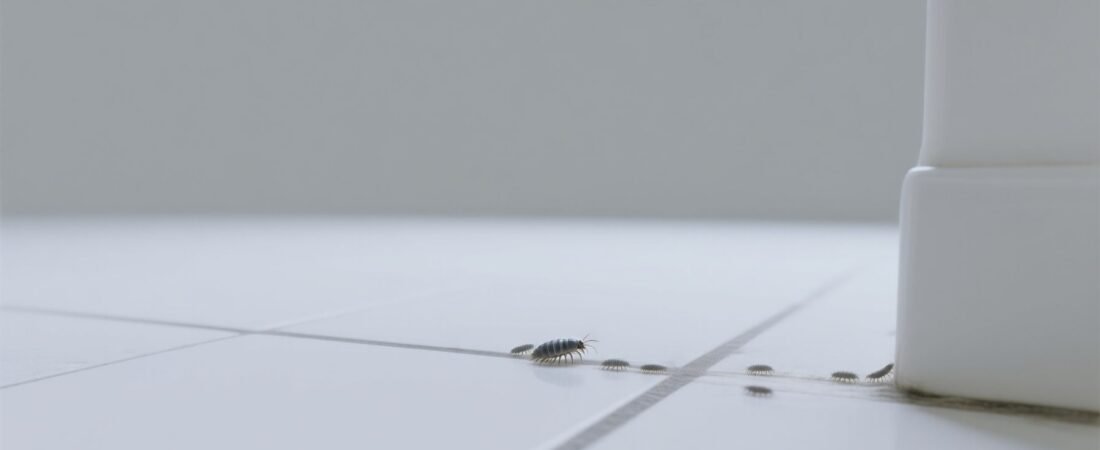
Grout doesn’t attract bugs — moisture does. That distinction matters more than most bathroom pest guides let on, because if you’re scrubbing the grout lines thinking cleanliness is the fix, you’re solving the wrong problem entirely. Those tiny gray specks moving around your tile seams are there because your bathroom has a humidity or moisture condition that’s making it genuinely hospitable, and the grout is just where you happen to notice them first.
The most common culprits are psocids (booklice), springtails, and occasionally mold mites — three very different insects that get lumped together because they’re small, gray-ish, and show up in damp spaces. Telling them apart changes everything about how you fix the problem. Treating springtails like booklice, or booklice like mold mites, is how people end up spraying half a can of insecticide and still seeing bugs six days later.
Why Your Grout Is the Hotspot (and Not the Actual Problem)
Grout is porous. Even sealed grout holds micro-pockets of moisture, and in bathrooms with poor ventilation, those pockets stay wet for hours after a shower. That sustained dampness feeds mold and mildew growth — often invisible to the naked eye at first — and that microbial layer is what tiny arthropods are actually feeding on, not the grout itself. The tile seam is a feeding ground, not a nesting site.
This is the part most articles skip: the bugs you’re seeing in the grout are a symptom of a humidity problem, not a sanitation problem. Bathrooms that get wiped down daily can still have this issue if the exhaust fan is undersized, the window stays closed, or the room takes more than 30 minutes to drop below 70% relative humidity after a shower. A cheap hygrometer (under $12 at any hardware store) will tell you in real time what your bathroom air is doing — and that number is more useful than any pesticide label.
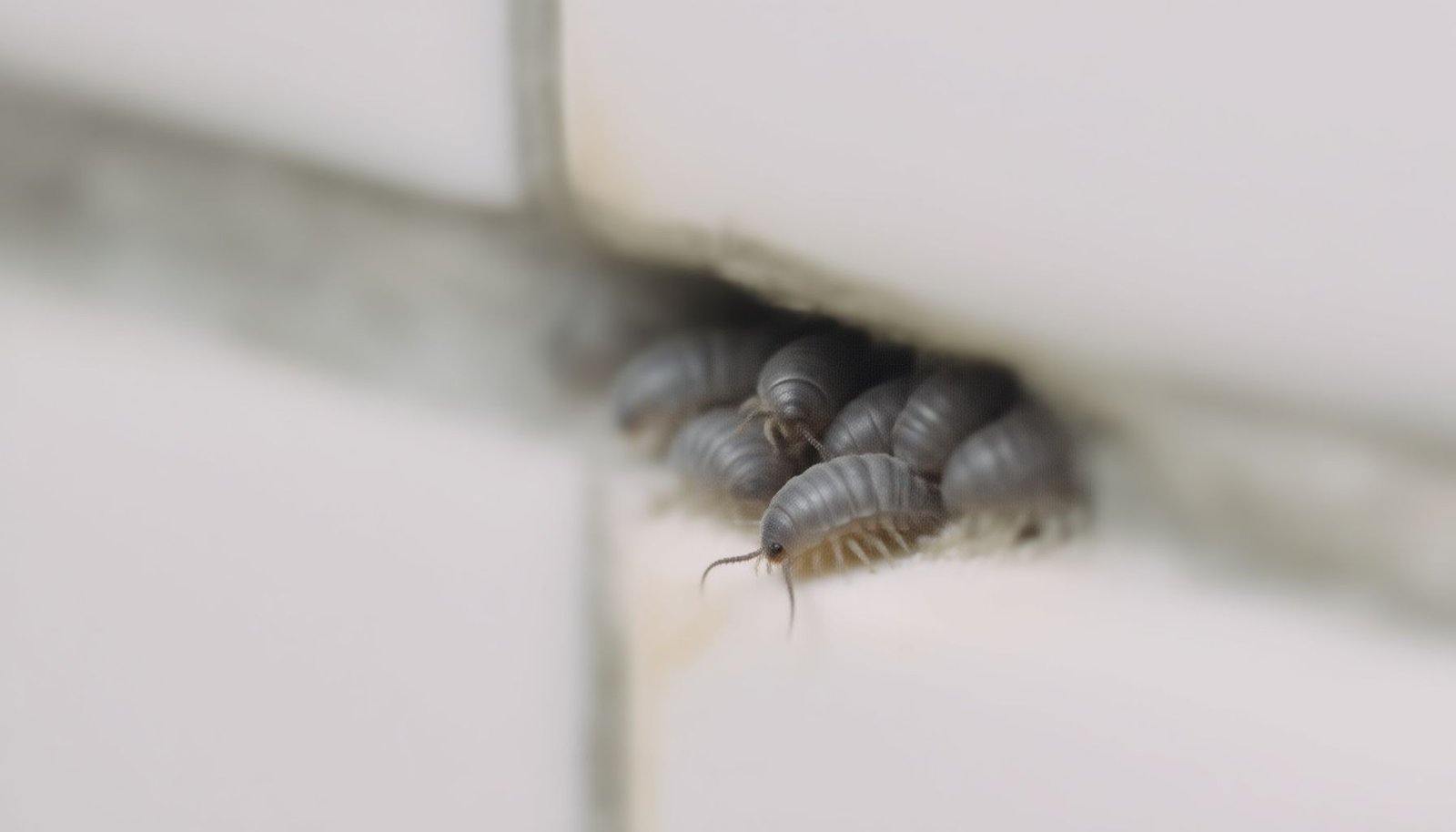
This close-up shows the typical clustering pattern of moisture-dependent insects in grout lines — notice how they concentrate along the seam rather than the tile face, which is a reliable clue that surface humidity, not food contamination, is driving their presence.
Which Tiny Gray Bug Is Actually in Your Bathroom Grout?
Getting the ID right is the entire game here. Picture this: you get down on one knee, phone flashlight on, squinting at a cluster of maybe 30 tiny gray-white specks near the base of your shower wall. Some are moving. Some look almost powdery. That scene plays out differently depending on what you’re actually looking at, and the behavior is your best diagnostic tool without a magnifying lens.
Here’s how the three most common bathroom grout insects compare at a glance:
| Bug | Size | Movement | Key Visual Clue |
|---|---|---|---|
| Psocids (Booklice) | 1–2 mm | Slow, deliberate crawling | Soft-bodied, pale gray or translucent; visible head |
| Springtails | 1–2 mm | Jumps when disturbed | Rounded body, jumps several inches; may appear white or gray |
| Mold Mites | 0.5 mm or less | Barely perceptible crawl | Often look like moving dust; cluster densely near mold patches |
The jump test is the fastest field ID you have. Tap the tile near the bugs with your fingertip — if even one or two launch themselves an inch or more into the air, you’ve got springtails. Psocids and mold mites don’t jump. They either scatter slowly or barely react at all. That single behavior narrows your identification to one candidate without needing a microscope or an entomologist.
What Psocids, Springtails, and Mold Mites Are Actually Feeding On
None of these insects are eating your grout, your tile, or your caulk. That’s worth saying plainly because a surprising number of homeowners assume structural damage is happening — it isn’t. What they’re feeding on is biological material that grows on and inside damp surfaces: mold spores, algae, fungal filaments, and decomposing organic matter that accumulates in tile seams over time. Your grout is essentially a buffet table for moisture-dependent microorganisms, and these insects are just following the food chain.
Psocids specifically feed on mold and fungi with a preference for high-humidity environments above 75% relative humidity — below that threshold, their populations collapse within days because they desiccate quickly. Springtails eat decaying organic matter and fungal growth too, but they also need moisture for a different reason: they breathe through their skin via a process called cutaneous respiration, which means a dry environment is literally suffocating to them. Mold mites, as the name suggests, live almost exclusively in active mold colonies. Finding mold mites in your grout in large numbers is a strong indicator that visible or hidden mold growth is already established — worth investigating behind the wall if your grout is adjacent to a shared pipe or exterior wall.
“Most of the calls I get about ‘tiny gray bathroom bugs’ turn out to be springtails or psocids, and in nearly every case the underlying issue is a ventilation deficit — not an infestation in the traditional sense. These insects don’t colonize a bathroom the way cockroaches colonize a kitchen. They move in because the conditions invite them, and they leave just as quickly when you change those conditions. I’d fix the humidity before I’d even think about a pesticide.”
Dr. Marcus Ellroy, Board-Certified Entomologist and Urban Pest Management Consultant, University Extension Program
How to Confirm Which Bug You Have (Without Sending a Sample to a Lab)
You don’t need a professional inspection to figure out what’s in your grout — a few simple at-home tests will narrow it down reliably. The key is making observations in sequence, not all at once, so you don’t confuse the results.
- The tap test: Tap the tile surface near the insects sharply. Springtails will visibly jump; psocids and mold mites will not. This single test rules out or confirms springtails immediately.
- The size check: Use your phone camera zoomed in or a 10x hand lens. If the bugs are barely visible and appear almost dusty or powdery in clusters, strongly suspect mold mites — they max out at about 0.5 mm. If you can see distinct body segments or a recognizable insect shape, you’re likely looking at psocids or springtails.
- The dryout test: Run your exhaust fan continuously for 48 hours and avoid hot showers during that window. If the population noticeably drops or disappears within 24–48 hours, the bugs are almost certainly psocids or springtails — both are extremely moisture-dependent and die off or leave rapidly when humidity drops.
- The mold check: Inspect the grout with a flashlight at a low angle. Dark gray, black, or greenish discoloration in the seams that you can’t wipe off with a dry cloth suggests active mold, which points toward mold mites as a primary suspect.
- The scope check: If bugs persist after humidity reduction, look at whether they’re appearing near the floor drain or the base of the toilet. Springtails specifically follow moisture gradients and will often trace back to a slow leak or condensation on a cold pipe.
One honest note here: in older homes with poorly sealed subfloors beneath tile, springtail populations can be large enough — sometimes hundreds visible at once — that humidity reduction alone isn’t sufficient. That’s a scenario where you’re dealing with moisture in the subfloor or wall cavity, not just surface bathroom air. If reducing humidity doesn’t cut the population by at least 70% within a week, the moisture source is below or behind the visible surface, and that’s a different conversation.
Pro-Tip: Tape a 6-inch square of plastic wrap flat against the grout overnight with all four edges sealed to the tile. If moisture beads on the underside of the plastic by morning, you have active moisture wicking through the grout — a strong sign that the tile substrate or backing is wet, not just the air. This matters because surface drying won’t fix a wet substrate; that requires finding and stopping the water source first.
How to Actually Get Rid of Tiny Gray Bugs in Bathroom Grout
The counterintuitive truth that most pest control guides won’t lead with: chemical treatment is almost never the first step — and in many cases it’s not needed at all. Springtails, psocids, and mold mites don’t respond to pesticides in any lasting way if the humidity problem stays in place. You’ll kill the visible population, fresh individuals will move in within days, and you’ll conclude that the spray “didn’t work” when the real issue is that the environment is still welcoming. Fix the conditions first, then reach for a product only if needed.
Here’s a prioritized approach that addresses both the bugs and the conditions creating them:
- Ventilation first: Run your exhaust fan during every shower and for at least 20–30 minutes after. If your fan doesn’t bring the room below 60% humidity within 30 minutes, it’s undersized — the standard recommendation is 1 CFM per square foot of bathroom space, and most builder-grade fans fall short.
- Regrout or reseal compromised grout: Cracked, porous, or discolored grout holds moisture disproportionately. Applying a penetrating grout sealer (not a surface coating) every 1–2 years significantly reduces the moisture-retention that feeds both mold and the insects eating it.
- Treat visible mold directly: A solution of 1 part hydrogen peroxide to 2 parts water applied to grout lines and left for 10 minutes before scrubbing will kill surface mold without the harsh fume profile of bleach — relevant if the bathroom is small and poorly ventilated during treatment.
- Check for hidden leaks: Inspect supply lines, the base of the toilet, and caulk around the tub or shower pan. Even a slow drip that evaporates before you see standing water can maintain enough subfloor moisture to sustain a springtail population indefinitely.
- Targeted desiccant if needed: Diatomaceous earth applied in a thin layer along the base of walls and grout seams works physically — it dehydrates soft-bodied insects on contact — without leaving chemical residue. It loses effectiveness if it gets wet, so it’s most useful after the humidity issue is under control.
If you’ve addressed all of the above and still have a persistent population after two weeks, it’s worth considering whether the bugs are entering from an exterior source. Springtails, in particular, migrate indoors in large numbers during heavy rain events — they’re pushed out of saturated soil and follow moisture gradients right through foundation gaps, door sweeps, and gaps around pipe penetrations. That’s a different problem from a bathroom-born population, and it usually resolves on its own within a few days once the soil outside dries. Just as bugs like flying ants inside the house are often a seasonal migration event rather than an established colony, springtail invasions after rain are frequently a temporary pressure event, not a sign of a permanent infestation.
It’s also worth remembering that not every small invader in your home poses a health threat. The tiny gray bugs in your grout are a nuisance and an indicator of a moisture problem, but they’re not in the same risk category as something like a venomous pest — the concern there is different in kind, not just degree, as anyone who’s researched whether scorpion stings are dangerous to adults, kids, and pets can confirm. For grout bugs, the urgency is about fixing the underlying condition, not emergency treatment.
Getting to the root of the moisture issue is what separates people who solve this problem once from people who keep solving it every few months. A bathroom that consistently stays below 60% relative humidity after showers, has intact grout and caulk, and has no hidden plumbing leaks simply won’t sustain a population of psocids, springtails, or mold mites — the biology doesn’t allow it. That’s the durable fix, and it costs less than a professional pest treatment.
Frequently Asked Questions
What are the tiny gray bugs in my bathroom grout?
The tiny gray bugs in your bathroom grout are most likely psocids (also called booklice), springtails, or silverfish. Psocids and springtails are both drawn to damp, moldy grout and are usually under 2mm long, making them look like moving specks of dust. Silverfish are a bit larger — up to 3/4 inch — and you’ll notice a distinctive fish-like wriggling motion when they move.
are tiny bugs in bathroom grout harmful to humans?
Most of the bugs you’ll find in bathroom grout — like psocids and springtails — don’t bite, sting, or transmit disease, so they’re not a direct health threat. Silverfish are also harmless to humans but can damage paper, fabric, and stored items over time. The bigger concern is that a large infestation usually signals a moisture or mold problem that does need to be addressed.
how do I get rid of tiny bugs in bathroom grout?
Start by cutting off their moisture source — fix any leaks, run a bathroom exhaust fan during and for 15 minutes after showers, and use a dehumidifier to keep humidity below 50%. Scrub the grout with a stiff brush and a bleach-based cleaner to remove mold and mildew, which is the main food source for most of these bugs. If the infestation persists after drying things out, a residual spray insecticide applied along the grout lines will usually clear them out within a few days.
why do I suddenly have tiny bugs in my bathroom grout?
A sudden appearance almost always comes down to a change in moisture levels — a slow leak behind the wall, a failing caulk seal around your tub, or a bathroom exhaust fan that stopped working properly. Bugs like springtails and psocids can multiply fast once conditions are right, so what starts as a few bugs can become hundreds within a couple of weeks. Check under your sink cabinet, around the toilet base, and along the tub surround for any soft spots or visible moisture.
can tiny bathroom grout bugs spread to the rest of my house?
Yes, they can spread — especially springtails and silverfish, which will migrate toward other damp or dark areas like basements, laundry rooms, and under kitchen sinks. Silverfish in particular are known to travel through wall voids and show up far from their original entry point. Treating the bathroom infestation quickly and sealing gaps around pipes with caulk or expandable foam will help keep them contained.