

Seeing wings on ants inside your house doesn’t mean you have a flying ant problem — it means you have an ant colony problem, and the wings are just the messenger. That distinction matters more than most pest control guides ever bother to explain. Flying ants, properly called alates or swarmers, aren’t a separate species invading your home. They’re the reproductive members of a colony that already exists somewhere nearby — often somewhere inside your walls, your subfloor, or the soil directly under your foundation. The wings are temporary. The colony is not.
What Flying Ants Inside the House Actually Are (and Why This Distinction Changes Everything)
Swarmers are winged male and female ants produced by a mature colony specifically to reproduce and start new colonies. A carpenter ant colony, for example, doesn’t produce swarmers until it’s at least 3 to 6 years old and contains several thousand workers. So if you’re seeing swarmers inside your house, you’re not watching a colony begin — you’re watching one that’s already well-established announce itself. That’s a fundamentally different situation than finding a trail of workers, and it demands a different response.
The wings themselves are diagnostic. Flying ants have two pairs of wings, with the front pair noticeably longer than the rear pair — that unequal sizing is one of the clearest visible tells. Their bodies also remain distinctly ant-shaped: a narrow, pinched waist and elbowed antennae. These two features alone will save you a lot of misidentification panic, which we’ll cover in detail shortly. What most people miss is that the presence of swarmers inside — not outside, not on a window screen, but actively emerging from a wall or floor crack — is one of the strongest structural infestation signals a home can produce.
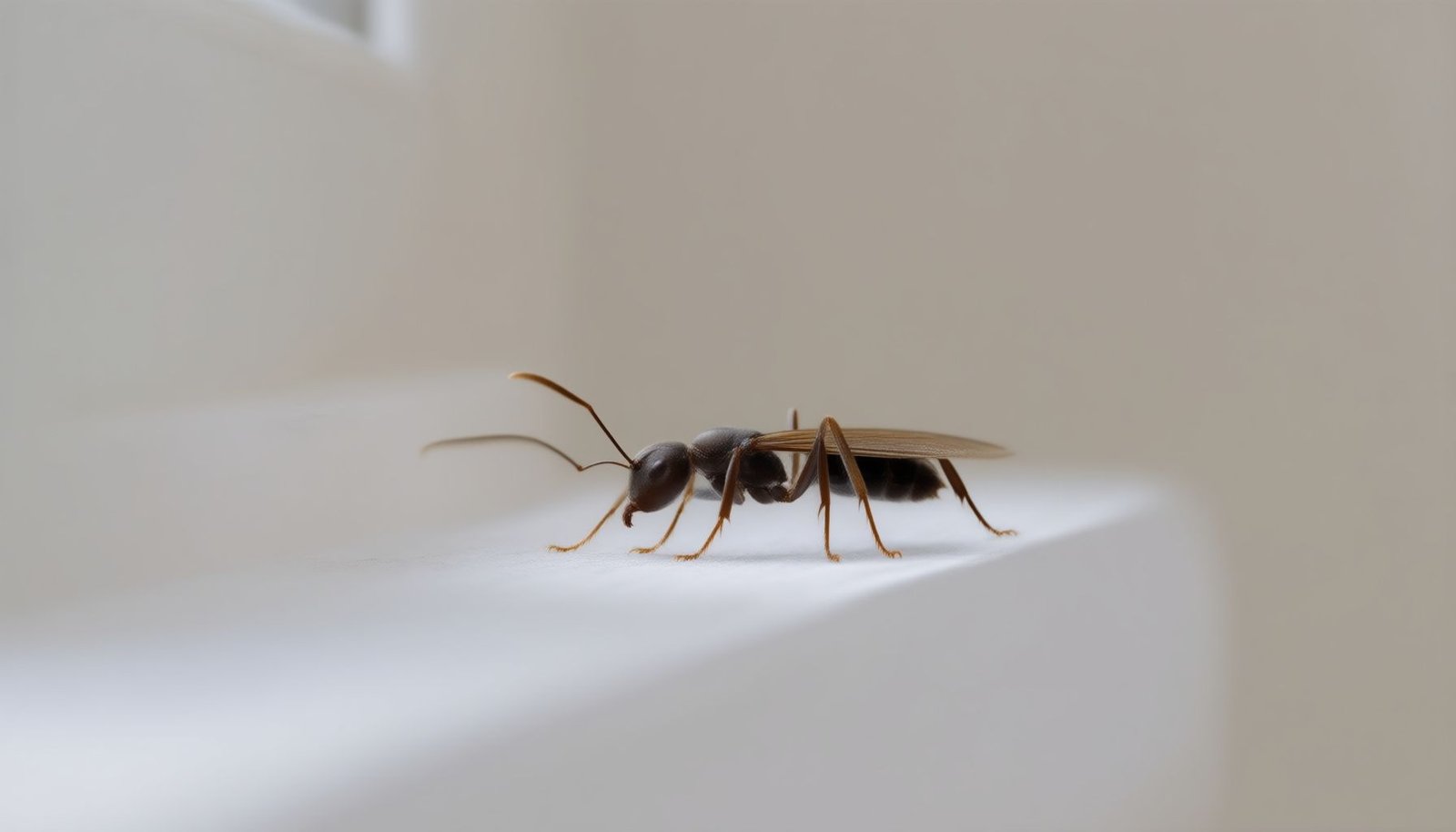
This close-up shows the unequal wing length, pinched waist, and elbowed antennae that distinguish flying ants from termite swarmers — features that are easy to miss at a glance but critical for figuring out what you’re actually dealing with.
Flying Ants vs. Termite Swarmers: The ID Mistake That Costs Homeowners Thousands
Here’s the identification error that causes the most real-world damage: flying ants and termite swarmers look similar enough at a panicked glance that homeowners routinely misidentify one for the other, then either over-treat or under-treat accordingly. Getting this wrong in either direction is expensive. Treating for ants when you have termites means structural damage continues undetected. Triggering a full termite remediation when you have carpenter ants means spending thousands on the wrong problem.
| Feature | Flying Ant (Alate) | Termite Swarmer |
|---|---|---|
| Waist | Narrow, pinched (node visible) | Broad, no visible constriction |
| Antennae | Elbowed (bent at angle) | Straight, bead-like |
| Wing length | Front wings longer than rear | All four wings equal length |
| Wing texture | Veined, slightly tinted | Pale, almost translucent |
The antennae are your fastest field ID. Bend your finger at the knuckle — that’s what an ant’s antennae look like. Termite antennae are straight, like a string of tiny beads. You can see this difference with the naked eye if the insect is still or dead; use your phone camera to zoom in if it’s moving. Collecting a few specimens in a zip-lock bag before calling an exterminator is genuinely worth the 30 seconds it takes.
Which Ant Species Swarm Indoors — and What Each One Signals
Not all flying ants inside the house carry the same implications. The species matters enormously because each one points to a different nesting situation, a different level of structural risk, and a different treatment approach. Lumping them all together as “flying ants” and reaching for a can of Raid is exactly how small infestations turn into large ones.
- Carpenter ants (Camponotus spp.) — Large black or black-and-red ants, 1/2 to 3/4 inch long. Indoor swarmers almost always mean an established satellite colony is living inside your home’s wood, often in moisture-damaged areas like window frames, roof eaves, or subfloor joists. A mature carpenter ant colony can contain 3,000 or more workers before it produces a single swarmer.
- Pavement ants (Tetramorium immigrans) — Small, dark brown ants, about 1/8 inch. Swarmers typically emerge in late spring to early summer. Finding them inside usually means a colony is nesting in the foundation, under a concrete slab, or in wall voids near ground level. Less structural risk than carpenter ants, but colony sizes can reach 5,000 workers.
- Odorous house ants (Tapinoma sessile) — Tiny, dark brown to black, 1/16 to 1/8 inch. Their swarmers are easy to miss because they’re so small. Indoor swarms often indicate a budding colony that formed when the original outdoor colony got too large and split. Crush one and you’ll smell something like blue cheese or rotten coconut — that’s your confirmation.
- Fire ants (Solenopsis invicta) — Found in the southern US. Swarmers are reddish-brown, 1/4 to 3/8 inch. If fire ant swarmers are coming from inside the home, the colony is likely under a slab or in soil adjacent to a foundation crack. This is an aggressive species that warrants faster professional response than most.
- Acrobat ants (Crematogaster spp.) — Small, 1/8 inch, with a distinctive heart-shaped abdomen they raise over their body when disturbed. Indoor swarmers frequently signal nesting inside foam board insulation or in wood that was previously damaged by termites or moisture. They’re often misidentified and overlooked.
Picture this: it’s late February, you live in the Mid-Atlantic, and you’re suddenly seeing large black winged ants crawling up your living room wall. Outside it’s 30 degrees — no ant would be swarming outdoors in those conditions. That’s the scenario that tells you definitively the colony generating those swarmers is living inside your heated home’s structure, not in the yard. Season and temperature context is something most identification guides skip entirely, but it’s often the clearest clue you’ll get.
Where Are Flying Ants Coming From Inside the House?
Swarmers don’t materialize out of thin air — they exit through very specific openings, and those exit points tell you exactly where to investigate. The colony produces swarmers in enormous numbers over a short window, usually 24 to 72 hours during prime swarming conditions (warm, humid, often following rain). If you see them streaming from a gap, a crack, or an outlet, that gap is the mouth of the tunnel system leading back to the nest.
Common indoor emergence points include expansion joints in concrete slabs, gaps around plumbing penetrations, electrical outlet covers (carpenter ants in particular are known to colonize wall voids that run alongside wiring — worth reading about why ants end up in electrical outlets if you’re finding them there), gaps between baseboards and flooring, and around window or door frames where wood has softened from moisture. The swarmer exit point is almost never the actual nest — the nest is deeper in, sometimes 10 to 20 feet away through a wall void or structural timber. Plugging the hole without addressing the colony accomplishes nothing.
Pro-Tip: After swarmers emerge, they shed their wings almost immediately — often within minutes of landing. If you’re finding piles of small wings on windowsills or along baseboards but no live insects, that’s not a sign the problem resolved itself. It means the swarm already happened and you missed it. Shed wings near a wall crack or vent are as diagnostic as live swarmers, so don’t vacuum them up before you’ve photographed and noted the exact location.
What to Do Right After You Spot Flying Ants Inside — and What Not to Do
The instinct to grab a spray can is understandable, but it’s the wrong move at exactly the wrong moment. Spraying the swarmers you can see kills maybe a few hundred individuals out of a colony that could contain tens of thousands. Worse, some repellent sprays will cause certain ant species — odorous house ants and carpenter ants in particular — to “bud,” meaning the queen splits the colony into multiple satellite nests to escape the chemical pressure. One nest becomes three. That’s not a hypothetical: it’s a documented behavioral response to inappropriate pesticide use.
“Homeowners almost always treat the symptom and ignore the source. Flying ants inside the house are reproductive caste members — they’re the most visible part of a colony event, but they represent the smallest fraction of the actual population. The colony producing them is what requires attention, and it typically takes professional inspection to locate it accurately without making the infestation worse.”
Dr. Marcus Ellroy, Board-Certified Entomologist and NPMA-affiliated Structural Pest Specialist
Here’s what actually helps in the immediate term — and what you should avoid:
- Do collect 5 to 10 specimens in a sealed bag or jar — a pest control professional or university extension office can ID the species definitively, which determines the entire treatment path.
- Do note exactly where the swarmers are emerging from, and photograph it. This is the single most useful piece of information for whoever investigates next.
- Do check for moisture damage around the emergence point — soft drywall, stained wood, or efflorescence on concrete often points to the environmental condition feeding the colony.
- Don’t use a repellent spray at the emergence point. If treatment is needed, non-repellent insecticides (like those containing fipronil or imidacloprid) are far more effective because workers carry them back to the colony.
- Don’t assume the swarm means the colony is new. A colony that’s just produced swarmers is mature, established, and has been present for years in most ant species.
- Don’t confuse a one-time swarm with an ongoing infestation — swarming is a single seasonal event, but the underlying colony remains active 365 days a year.
One honest nuance worth flagging: the urgency here genuinely depends on species. Finding pavement ant swarmers coming through a basement floor crack is a real problem, but it’s not the same category of emergency as carpenter ant swarmers emerging from a load-bearing wall in a 1920s wood-frame house. The former is a nuisance infestation; the latter may be paired with years of structural wood damage that needs to be assessed before it’s treated. Climate matters too — in warm, humid climates like the Gulf Coast or Pacific Northwest, moisture-dependent ant species can establish and expand much faster than the same species would in an arid western state.
If you’re renting, the calculus around reporting and documentation becomes especially important. A swarming event that you photograph, report in writing, and document with specimen samples creates a clear record of when you identified a structural pest issue — something worth knowing about if you’ve ever had to navigate landlord response timelines. The same principle applies to any pest discovery when you first move in; the approach is similar to what’s described in our guide on how to check an apartment for bed bugs before moving in, where documentation at the right moment is the thing that protects you later.
Flying ants inside the house aren’t the problem — they’re the proof of a problem that’s been building, quietly, for years. The swarm is the colony’s way of expanding; your job is to treat it as an inspection trigger, not an isolated event to swat away. Find where they’re coming from, identify the species, and address the colony. Everything else is just wing-chasing.
Frequently Asked Questions
how do I know if I have flying ants inside the house or termites?
The easiest way to tell them apart is by looking at the wings and waist. Flying ants have pinched, narrow waists and two pairs of wings where the front wings are noticeably longer than the back ones. Termite swarmers have thick, straight waists and wings that are all the same length. If you’re still not sure, collect a few in a sealed bag and take them to a pest control pro or your local extension office for a free ID.
what causes flying ants to suddenly appear inside my house?
Flying ants inside the house almost always means an established ant colony nearby has reached maturity and is sending out reproductive swarmers to start new colonies. This typically happens when a colony is at least 3 to 5 years old and contains thousands of workers. Warm temperatures, high humidity, and heavy rain often trigger mass swarming events, which is why you’ll sometimes see dozens appear at once near windows or lights.
are flying ants inside the house dangerous?
Most flying ants aren’t dangerous to people, but carpenter ants are a serious exception since they tunnel through wood and can cause structural damage over time. If you’re seeing large black flying ants inside the house — especially near window frames, baseboards, or wooden beams — that’s a red flag worth investigating. Regular pavement ants or odorous house ant swarmers are nuisance pests, but they won’t damage your home.
where do flying ants come from inside the house?
Flying ants you see indoors are usually emerging from a hidden colony somewhere inside or immediately outside the structure. Common indoor nesting spots include wall voids, insulation, crawl spaces, and rotting or moisture-damaged wood. If you’re seeing swarmers consistently near one area of the house, that’s usually close to where the nest is located and worth checking carefully.
how do I get rid of flying ants inside the house fast?
Vacuuming up swarmers is the quickest short-term fix, but it won’t solve the problem if there’s an active colony. Finding and treating the nest directly — using a residual insecticide dust or gel bait labeled for ants — is what actually stops them from coming back. If you can’t locate the nest or the infestation is large, calling a licensed pest control company is worth it, especially if carpenter ants are involved.