
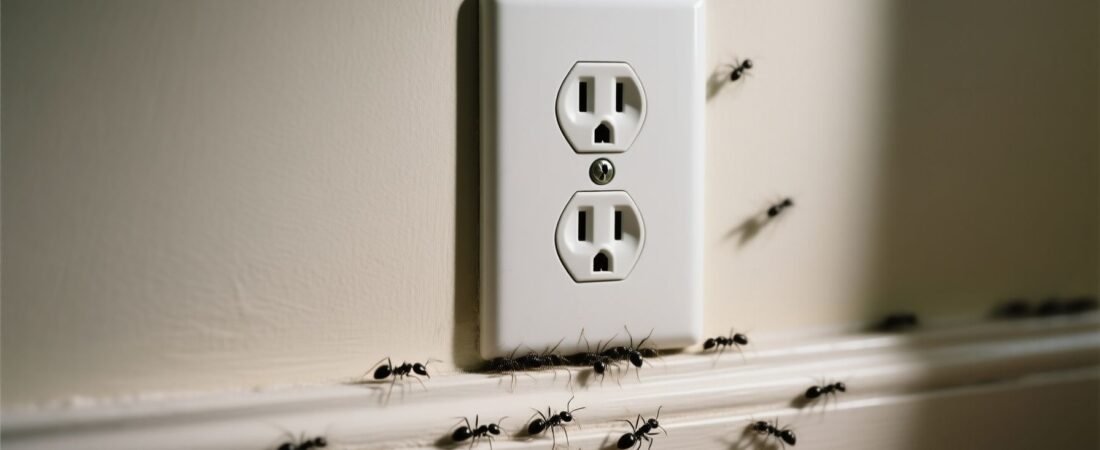
Ants aren’t going to your electrical outlets because they’re confused — they’re going there on purpose, and treating the outlet is the last thing you should do. That’s the mistake most people make: they spray the outlet, the ants disappear for a day or two, and then they’re back. The real problem isn’t the outlet itself. It’s what’s inside your wall, and what the outlet represents to a colony that’s already moved in.
Electrical outlets are warm, protected, and often connect to wall voids that run straight to the foundation or exterior. A colony doesn’t need much — a gap as small as 1/16 of an inch around a junction box is enough for small ant species to pass through freely. So if you’re seeing ants emerge from an outlet faceplate, what you’re actually seeing is a foraging trail from a nest that’s already established somewhere deeper in the structure.
Why Are Electrical Outlets Specifically Attractive to Ants?
The warmth generated by electrical wiring is a genuine draw — but it’s not the whole story, and most articles stop there. The bigger factor is that wall voids near outlets are almost always dry, dark, and undisturbed for years at a time. For ant species that prefer to nest in enclosed spaces — like pavement ants, odorous house ants, and Argentine ants — that combination is exactly what they’re looking for in a satellite colony location.
There’s also an electromagnetic component that researchers have documented, though it’s still debated how significant it is in practice. Some ant species, particularly fire ants (Solenopsis invicta), are demonstrably attracted to electrical fields and have caused power outages by nesting inside junction boxes, air conditioning units, and utility meters across the southern US. This isn’t a fringe observation — it’s well-documented enough that electric utility companies in Texas and Florida have specific protocols for ant intrusion in infrastructure.
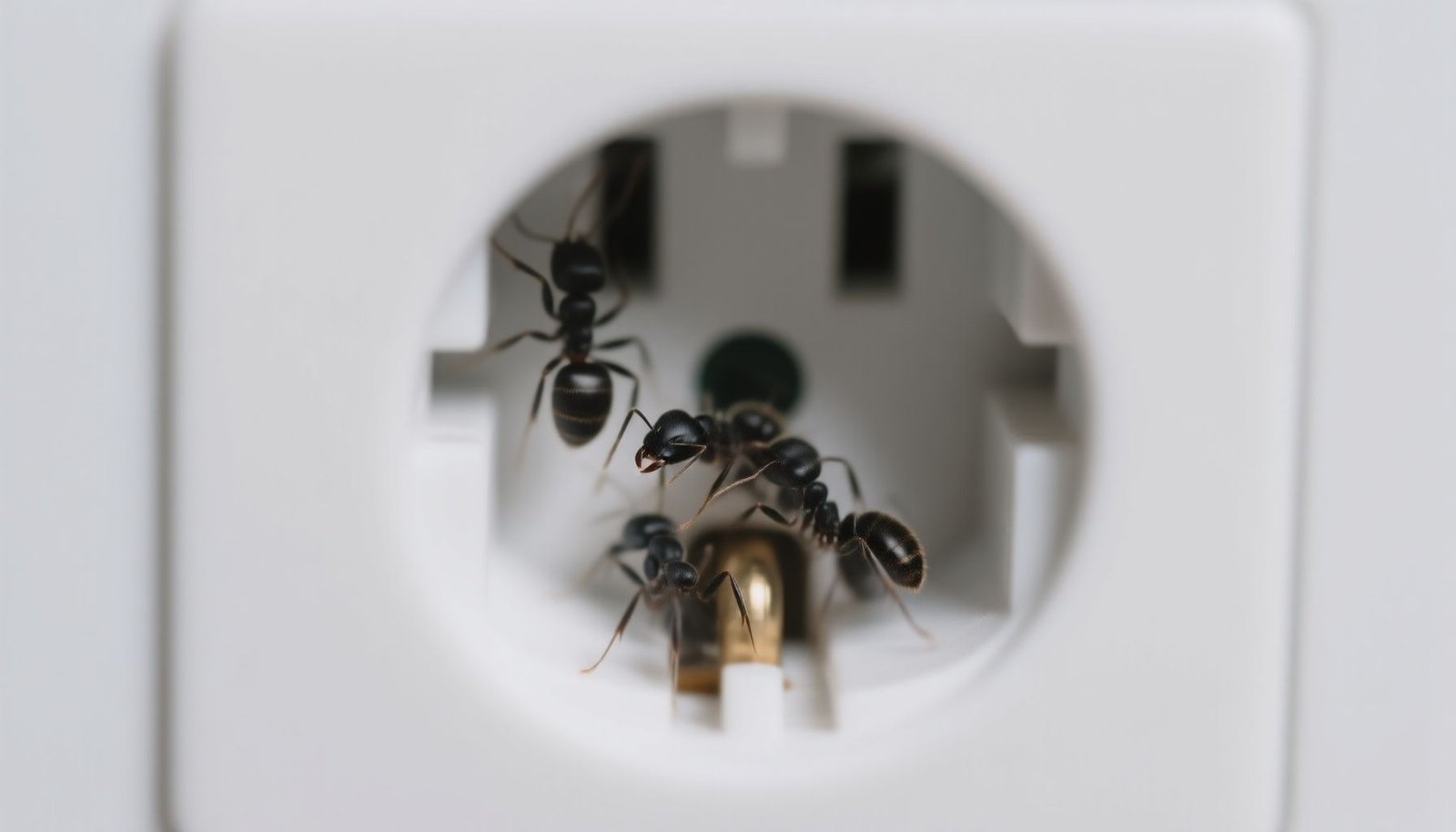
This close-up shows how ants cluster around the gap between the outlet faceplate and the wall — a detail that reveals where the colony’s access point actually is, which matters enormously when you’re deciding where to place bait versus where not to spray.
Which Ant Species Are Most Likely to Nest Near Electrical Outlets?
Not every ant species behaves the same way around electrical systems, and identifying what you’re dealing with changes your entire approach. Picture this: you’ve got a tidy kitchen, no crumbs, no exposed food — and yet ants keep streaming out of the outlet near your refrigerator. That scenario almost always points to odorous house ants (Tapinoma sessile) or Argentine ants (Linepithema humile), both of which form massive multi-queen colonies with dozens of satellite nests spread throughout a structure.
Fire ants are a special case. They’re not just opportunistically nesting near warmth — they’re genuinely drawn to electrical equipment in a way that other species aren’t, and they can damage wiring insulation when their colony grows large enough inside a junction box. The table below gives you a quick breakdown of the species most commonly found in and around electrical outlets and what makes each one behave differently.
| Ant Species | Why Outlets Attract Them | Nest Location Clue |
|---|---|---|
| Odorous House Ant | Warmth, enclosed void, moisture nearby | Multiple satellite nests; sweet smell when crushed |
| Argentine Ant | Large colonies need many nest sites | Supercolonies; trails visible along baseboards |
| Fire Ant | Genuine electromagnetic attraction | Often outdoors first; enters via utility conduits |
| Pavement Ant | Narrow gaps near foundation walls | Fine soil or debris pushed out near outlet base |
What Does It Mean If Ants Are Coming Out of Multiple Outlets?
One outlet with ants could be a foraging trail from outside. Multiple outlets — especially on the same wall or along the same run — almost always means the colony has established a nest inside the wall void itself. This is a meaningful distinction because it changes the severity of the problem and how you treat it. A foraging trail can often be interrupted with bait placed along the trail. An in-wall nest requires a completely different approach.
Argentine ant colonies, for reference, can contain hundreds of thousands to millions of workers spread across interconnected satellite nests, all sharing queens and workers freely. That’s not hyperbole — it’s why a single perimeter spray does nothing to them long-term. If you’re seeing ants in three or four outlets across a room, you’re likely dealing with a colony that has already subdivided inside your wall system and is using the outlets as foraging exits, not entry points from outside.
“Homeowners make the mistake of treating the outlet as the source of the problem when it’s really just the symptom. The outlet is an exit — the nest is behind it, sometimes two or three feet away in the wall cavity. Spraying at the opening almost always makes the infestation harder to treat because it scatters the colony deeper into the structure.”
Dr. Patricia Hensley, Urban Entomologist and Extension Pest Management Specialist, Cooperative Extension Service
Why Spraying Directly Into Electrical Outlets Makes the Problem Worse
This is the counterintuitive core of this whole topic: the instinct to spray directly into an outlet where you see ants is not just ineffective — it actively fragments the colony and spreads the problem. Most liquid insecticides are repellent to ants. When you spray a repellent product near a nest site, the ants don’t die immediately; they scatter, and the colony responds by budding — splitting into two or more new satellite nests deeper in the structure. Within 72 hours, you can go from one problem area to three.
There’s also a real electrical hazard. Spraying any liquid — even water-based pesticides — into a live outlet is genuinely dangerous and can cause shorts or corrosion in the wiring. Beyond the safety issue, it doesn’t reach the nest cavity anyway. The only products that work inside wall voids are non-repellent dusts (like diatomaceous earth or borate-based insecticide dusts) applied through the outlet gap with the breaker off, or slow-acting gel baits placed along the foraging trail outside the outlet so workers carry it back to the nest.
Pro-Tip: Before placing any bait near an outlet, turn off the circuit breaker for that outlet and use a non-contact voltage tester to confirm it’s dead. Then apply a pea-sized amount of gel bait on a small piece of cardboard placed directly in front of — not inside — the outlet. This keeps the bait accessible to foragers without introducing moisture into the electrical box.
How Do You Actually Get Rid of Ants Nesting Inside Walls Near Outlets?
Getting rid of an in-wall ant colony requires patience, the right product category, and an understanding that you’re not killing ants — you’re eliminating the queen. Workers are replaceable. A colony can lose thousands of workers and recover within days. What it can’t survive is a queen that stops reproducing, which is exactly what slow-acting bait is designed to deliver. The workers pick up the bait, carry it back, and feed it to the colony including the queen, over the course of several days.
Here’s a step-by-step approach that actually works for in-wall ant infestations around outlets:
- Identify the ant species first. Odorous house ants prefer sweet baits; grease ants and pavement ants often respond better to protein-based baits. Using the wrong bait type cuts effectiveness dramatically — workers will ignore it entirely.
- Do not spray any repellent product near active trails. This includes essential oil sprays, vinegar, and most off-the-shelf aerosol insecticides. All of them scatter the colony before the bait has a chance to work.
- Place gel bait on the foraging trail, not at the outlet. Identify where the trail exits onto a baseboard or floor surface and place bait there. Give it 48-72 hours before assessing. Fresh bait should show increased ant activity initially — that’s a good sign.
- Apply insecticide dust inside the wall void if the colony is established. With the circuit off and confirmed dead, remove the outlet cover and use a hand duster to apply a thin layer of food-grade diatomaceous earth or a labeled borate dust into the wall cavity. This creates a residual barrier without repelling foragers.
- Seal the gap around the outlet box with fire-rated caulk after treatment is complete — not before, or you’ll trap the colony and push it toward other exit points.
- Treat the exterior perimeter with a non-repellent insecticide (imidacloprid or fipronil-based products are well-suited for this) around the foundation, utility entries, and conduit access points. This cuts off reinforcement from outdoor parent colonies.
One honest nuance worth flagging: results vary significantly depending on the ant species and how established the in-wall colony is. A fresh infestation with a small satellite nest may clear up within a week of proper baiting. A multi-year Argentine ant supercolony that’s threaded through the entire wall cavity of an older home with open utility chases — that’s a different animal entirely, and may require a licensed pest control professional with access to commercial-grade non-repellent liquid treatments injected directly into the wall void.
Are Ants in Electrical Outlets Actually Dangerous to Your Home?
For most ant species — odorous house ants, pavement ants, Argentine ants — the answer is no, not directly. They don’t chew through wire insulation the way rodents do, and their presence won’t cause a short circuit on its own. The real risk from common species is that a large colony nesting in a wall void near plumbing can accelerate moisture damage, and ants foraging through walls can find their way into food-storage areas in ways that are hard to track until the infestation is well established.
Fire ants are the genuine exception. Their attraction to electrical fields means they actively congregate inside junction boxes, electrical panels, and HVAC components in large enough numbers to cause equipment failures. This isn’t a hypothetical — fire ant damage to electrical infrastructure costs an estimated $146 million annually in the United States, and it’s concentrated in the same warm-climate regions where fire ants are most prevalent. If you’re in the South or Southwest and you’re seeing reddish-brown ants emerging from outlets, treating that as an electrical hazard — not just a pest nuisance — is the right call.
It’s also worth remembering that ants foraging through wall voids aren’t just looking for shelter — they’re following pheromone trails laid by scouts that found something worth returning to. That might be a moisture source from a slow pipe leak behind the wall, condensation around a poorly insulated exterior outlet, or even a food source in an adjacent cabinet. Identifying what’s pulling them into that specific area of the wall is as useful as any pesticide treatment, and understanding how pests use environmental cues to find resources — whether it’s aphids on a plant or ants in a wall — consistently leads to better long-term solutions than reactive treatment alone.
Here’s what to watch for if you’re assessing whether the outlet situation is a simple foraging trail or something more entrenched:
- Ant activity that continues even after removing all visible food sources in the room — suggests an in-wall nest rather than food-motivated foraging
- Fine soil, sawdust-like debris, or dead ant bodies pushed out from beneath the outlet faceplate — indicates active nest maintenance inside the wall
- Ants appearing at the outlet even in winter — a colony that’s inside a heated wall void doesn’t go dormant the way outdoor colonies do
- Swarmers (winged ants) emerging from the outlet area — this means the colony is mature and reproductive, which is a later-stage infestation indicator
- Multiple outlet locations affected along the same wall — points to a network of satellite nests connected through the wall void, not a single localized nest
It’s also worth noting that some pest pressures that seem unrelated can be interconnected in ways that aren’t obvious. Just as tick-borne illnesses extend well beyond what most people associate with ticks, structural pest problems like ants in walls often signal broader issues — moisture intrusion, foundation gaps, or utility penetrations that are also letting in other pests you haven’t noticed yet.
If you’ve confirmed ants in your outlets and proper baiting hasn’t moved the needle after two weeks, that’s your threshold for calling a professional. Not because DIY can’t work — it absolutely can for most cases — but because an entrenched colony behind finished walls sometimes requires injection treatments or wall void access that isn’t realistic without proper tools. Getting it right the first time is worth more than six months of repeated partial treatments that keep the colony suppressed without ever eliminating it.
Frequently Asked Questions
why are there ants in my electrical outlets?
Ants are attracted to the warmth and electromagnetic fields that electrical outlets produce. They’re also looking for shelter, especially during cold snaps or heavy rain. If you’re seeing ants in outlets, it usually means there’s a colony nesting inside your walls nearby — the outlet is just the entry point they’re using.
can ants in electrical outlets cause a fire?
Yes, they can. Ants — especially fire ants — can trigger short circuits by chewing through wire insulation or by getting crushed between electrical contacts, which creates a conductive bridge. A large enough infestation inside your walls or outlet boxes can cause arcing, tripped breakers, or in serious cases, an electrical fire. If you’re seeing ants consistently coming from outlets, treat it as an urgent problem, not just a nuisance.
what kind of ants get into electrical outlets?
Fire ants and crazy ants (also called Rasberry crazy ants) are the most notorious for infesting electrical systems — crazy ants in particular are drawn to electrical equipment in a way scientists still don’t fully understand. Odorous house ants and pavement ants will also move through outlets if they’re nesting inside wall voids. Where you live in the US matters a lot: crazy ants are mostly a problem in the Southeast, while fire ants are common across the South and Southwest.
how do I get rid of ants coming out of electrical outlets?
Don’t spray liquid pesticides directly into outlets — that’s a shock and fire hazard. Instead, use ant bait stations placed near the affected outlets so worker ants carry the poison back to the colony. For heavy infestations inside wall voids, a licensed electrician and a pest control professional may need to work together — the electrician can safely open the outlet box while the exterminator treats the nest. Gel baits with active ingredients like indoxacarb or hydramethylnon work well in these situations.
how do ants get inside walls and outlets in the first place?
Ants can squeeze through gaps as small as 1/32 of an inch, so even a tiny crack where your wiring enters the wall is enough. They often get in through exterior gaps around conduit, utility lines, or where siding meets the foundation, then follow the wiring through the wall to reach outlets. Sealing those exterior entry points with caulk or expanding foam is one of the most effective long-term prevention steps you can take.