
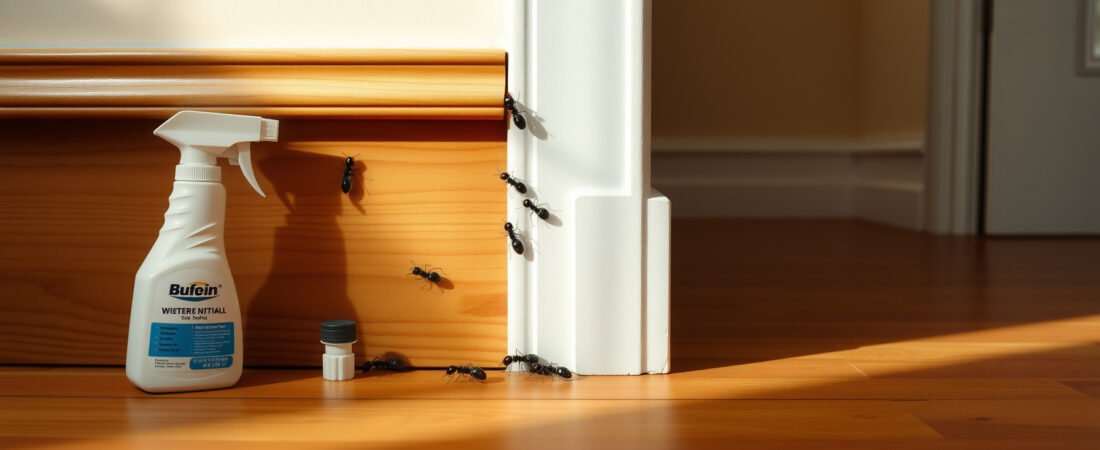
Killing the ants you can see does almost nothing. That’s the hard truth about carpenter ant control, and it’s why so many homeowners spend an entire summer going through cans of spray with zero lasting results. The workers foraging across your counter are expendable — the colony, which can hold 3,000 to 10,000 individuals and a queen tucked deep inside a satellite nest, keeps right on running. The only products that actually eliminate a carpenter ant problem are ones designed to reach where you can’t see. Here’s how to pick the right one.
Why Most Carpenter Ant Sprays Fail (and What to Use Instead)
Contact sprays kill on touch, which sounds effective until you understand carpenter ant colony structure. A mature carpenter ant colony almost always has a parent nest outside — typically in a dead tree, rotting stump, or moisture-damaged wood — and one or more satellite nests inside the house. The workers you see are traveling between those two locations. Spraying them is like cutting a few leaves off a weed and expecting it to die.
The products that reliably work do so through what entomologists call “trophallaxis” — the transfer of food between colony members. A worker picks up a slow-acting bait, carries it back to the satellite nest, shares it with other workers and eventually the queen, and the whole structure collapses from inside. That mechanism is why bait is almost always the right starting point for a carpenter ant problem, and why fast-acting sprays — satisfying as they are — usually just scatter the colony temporarily.
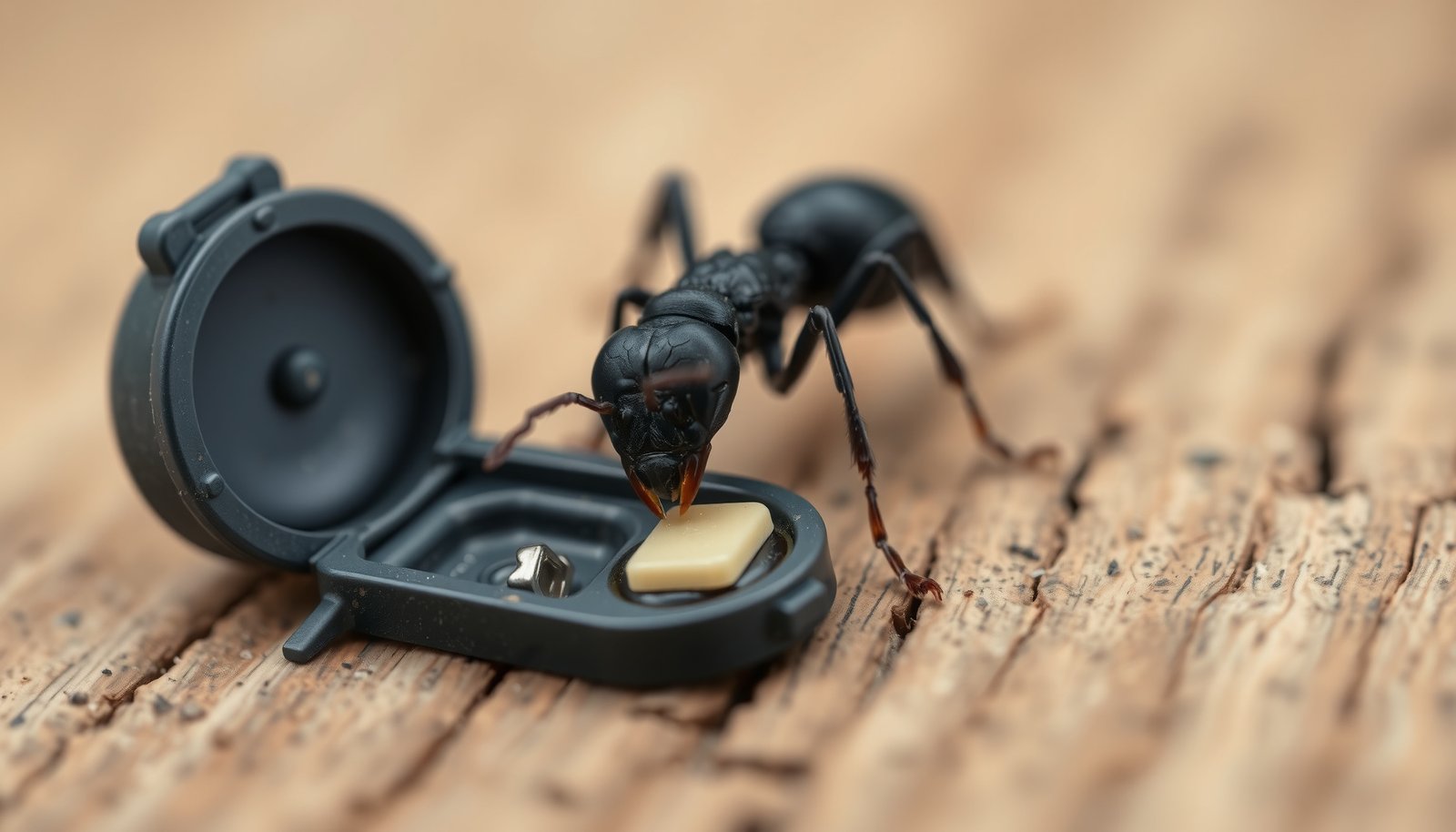
This close-up shows the difference between a granular bait formulation and a gel bait station — understanding which format suits your situation (indoor vs. outdoor, active trail vs. suspected nest location) is the single most important buying decision you’ll make.
Which Carpenter Ant Baits Actually Work?
Not every ant bait works on carpenter ants, and this trips people up constantly. Most grocery-store ant baits are formulated with sweet liquid attractants — borax in sugar syrup — which work well on odorous house ants and pavement ants. Carpenter ants, however, are protein and fat feeders for much of the year, especially in spring when the colony is expanding. A sweet bait placed in spring may be completely ignored while a protein-based gel gets picked up within hours.
The most field-tested products for carpenter ants include Advance Carpenter Ant Bait (granular, protein-based, widely recommended by pest management professionals), Maxforce Carpenter Ant Bait Gel, and Intice 10 Perimeter Bait. For outdoor perimeter use, granular baits like Advance 375A scatter well along foraging trails near the foundation. Gel baits like Maxforce work better for indoor placements near wall voids and junction points where workers are actively traveling.
“Homeowners consistently underestimate the protein preference of carpenter ants. They buy the wrong bait, it sits untouched for two weeks, and they conclude that bait doesn’t work — when really they just needed a different formulation. Matching the bait matrix to the ant’s dietary phase in the season is something even a lot of general pest techs miss.”
Dr. Patricia Nguyen, Board-Certified Entomologist and Urban Pest Management Consultant, University Extension Program
When a Spray Is the Right Tool (and Which Ones to Choose)
Sprays aren’t useless — they’re just misused. The scenario where a spray genuinely helps is perimeter treatment: applying a non-repellent residual insecticide around the foundation, entry points, and foraging trails so that workers walk through it, pick up a lethal dose, and carry it back toward the nest before dying. The key word is “non-repellent.” Repellent sprays like pyrethrins cause ants to scatter and avoid the treated area, which can actually split the colony and make your problem worse. You want them to walk through it without knowing it’s there.
The best non-repellent sprays for carpenter ants are fipronil-based (Taurus SC, Termidor SC) and bifenthrin-based products labeled for perimeter use (Bifen IT, Bifen I/T). Taurus SC in particular has a transfer effect similar to bait — ants that contact it carry the active ingredient back to nestmates. For active indoor trails where you need quick knockdown while the bait takes hold, a pyrethroid spray like Temprid FX can work as a supplemental tool, not the primary strategy.
Pro-Tip: Apply non-repellent perimeter spray in a 3-foot band up the foundation wall and 3 feet out onto the ground, focusing on areas within 10 feet of where you’ve seen foragers entering. Reapply after heavy rain. Bait inside, spray the perimeter — that combination is what pest management professionals actually use.
Carpenter Ant Killers Compared: Formats, Active Ingredients, and Best Use Cases
Choosing a product without matching it to your specific situation is where most DIY attempts fall apart. A granular bait left inside a kitchen cabinet does nothing. A gel bait placed outside in direct afternoon sun dries out within hours and stops working. The format matters as much as the active ingredient.
| Product Type | Active Ingredient | Best Use | Speed of Action |
|---|---|---|---|
| Granular Bait (e.g., Advance Carpenter Ant Bait) | Abamectin | Outdoor perimeter, foraging trails | 3–7 days to colony effect |
| Gel Bait (e.g., Maxforce Carpenter Ant Gel) | Fipronil | Indoor placements, wall voids, baseboards | 3–5 days to colony effect |
| Non-Repellent Liquid Spray (e.g., Taurus SC) | Fipronil | Foundation perimeter, entry points | Residual effect up to 90 days |
| Residual Pyrethroid (e.g., Bifen IT) | Bifenthrin | Outdoor perimeter, wood piles, stumps | Fast knockdown, 30–60 day residual |
One honest nuance worth stating: in a large, established infestation — especially one where the colony has been nesting inside wall voids for more than one season — DIY products alone sometimes can’t reach deep enough to collapse the entire colony. If you’re seeing carpenter ants emerging from multiple locations inside the house and you suspect carpenter ants in walls and ceilings, the structural access that a professional has (drilling and injecting dust directly into the void) is genuinely different from what a spray or bait placement can accomplish from the outside.
How to Use Carpenter Ant Killers Correctly (Step by Step)
Picture this: you’ve bought a quality bait and a non-repellent spray, and you set the bait directly on top of a cleaned counter next to where you saw ants. Nothing happens for a week. The problem isn’t the product — it’s the placement. Carpenter ants follow established pheromone trails, and if your bait isn’t on or right next to an active trail, workers won’t encounter it. Finding and respecting the trail is the technique most instructions skip entirely.
Follow this sequence for the best outcome with any carpenter ant killer:
- Locate active trails first. Watch where foragers are traveling — early morning and after dark are peak activity times for carpenter ants. Follow the line of movement rather than just treating where you saw a single ant.
- Place bait directly on or within 1–2 inches of the active trail. Don’t wipe the area down first — you’ll destroy the pheromone signal that’s drawing workers to that path.
- Use multiple small placements rather than one large pile. Three pea-sized drops of gel spaced along a trail outperforms one large placement every time.
- Apply perimeter spray outside after baiting, not before. If you spray first, you can disrupt foraging trails and reduce the number of workers picking up the bait.
- Check and refresh bait every 3–4 days. Gel baits dry out and granular baits can be disturbed by moisture or other insects. A bait station that’s been picked clean is a good sign — replenish it.
- Address the moisture source. Carpenter ants don’t eat wood — they excavate it, and they choose wood that’s already soft from moisture damage. No product eliminates the infestation long-term if the leak, wet sill, or rotting beam that attracted them in the first place is still there.
What to Avoid: Products That Waste Your Time and Money
There’s an entire category of carpenter ant products that sell well at hardware stores and accomplish almost nothing on an established infestation. Knowing what to skip saves you weeks of frustration — and the creeping suspicion that carpenter ants are somehow invincible.
Here’s what consistently underdelivers specifically for carpenter ants:
- Repellent contact sprays (pyrethrins, essential oil-based sprays): These kill on contact but drive the colony deeper or cause it to split, sometimes creating two active satellite nests where you had one.
- Sweet liquid ant baits (Terro-style borax traps): Formulated for sugar-feeding ants. Carpenter ants will occasionally take sweet bait in late summer, but in spring and early summer — peak activity — they’ll ignore it entirely.
- Bug bombs and foggers: The aerosol doesn’t penetrate wall voids where satellite nests live. It kills exposed workers, scatters the rest, and leaves residue on surfaces you’ll have to clean anyway.
- Diatomaceous earth used alone: DE works as a supplemental dust in dry wall voids and can kill individual ants that cross it, but it has no colony-transfer effect and won’t eliminate a nest.
- Ultrasonic repellers: No peer-reviewed evidence supports their use against any ant species, and carpenter ants specifically show no behavioral response to ultrasonic frequencies in controlled studies.
One thing that surprises a lot of people: carpenter ants are often misidentified, especially when winged. Flying carpenter ants are sometimes confused with termite swarmers, and the wrong identification leads to the wrong treatment entirely. If you’re ever uncertain about what you’re dealing with — especially if you’re also noticing what might be bug-related marks or reactions that don’t match what you’d expect — ruling out other insects is worth the time. (For reference, if you’re also seeing unexplained skin reactions and want to rule out other culprits, chigger bites vs. scabies vs. bed bug bites breaks down what each looks like so you’re not chasing two problems at once.)
The counterintuitive insight that most pest control articles won’t tell you: seeing more ants in the days after you place bait is actually a good sign. Increased trail activity means workers are recruiting others to the bait source — which is exactly the behavior that leads to colony collapse. The instinct is to panic and spray. Don’t. Give the bait 10–14 days to work through the colony before deciding it has failed.
Carpenter ant control rewards patience and method more than it rewards the strongest chemical you can find. A slow-acting bait placed correctly on an active trail, backed by a non-repellent perimeter spray and a fix to whatever moisture problem drew them in, is genuinely more effective than any single “maximum strength” product applied without a plan. Get those three things right, and a carpenter ant infestation that’s felt unsolvable for months can be gone in under three weeks.
Frequently Asked Questions
What is the best carpenter ant killer that actually works?
Slow-acting baits like Advion Ant Gel or Terro Liquid Ant Bait are the most effective because workers carry the poison back to the colony and kill the queen. Sprays like Taurus SC (fipronil) work well for perimeter treatments around the foundation. For serious infestations, combining a bait with a non-repellent spray gives you the best results.
How long does it take carpenter ant bait to work?
Most carpenter ant baits take anywhere from 3 to 7 days to start visibly reducing activity, and full colony elimination can take 2 to 6 weeks. Don’t rush it — if you kill forager ants too fast, the poison never reaches the queen. Keep bait fresh and resist the urge to spray near it, since repellent sprays will stop ants from feeding on the bait.
Can I use regular ant spray to kill carpenter ants?
You can use it to knock down individual ants on contact, but most over-the-counter sprays like Raid won’t eliminate a carpenter ant colony. Repellent sprays actually push the colony deeper into wood or to a new location, making the problem harder to solve. For real control, you need a non-repellent product or a bait that workers bring back to the nest.
Where do you put carpenter ant bait inside the house?
Place bait stations along ant trails, near entry points, and in dark corners close to where you’ve spotted activity — under sinks, along baseboards, and near window frames are common hotspots. Don’t put bait in the middle of open areas where ants aren’t actively foraging. Use small amounts in multiple spots rather than one big pile, and check every few days to replace dried-out or consumed bait.
Do carpenter ants come back after treatment?
They can, especially if there’s a parent colony outside in a tree stump or rotting wood that keeps sending satellite colonies into your home. Sealing entry points, fixing moisture problems, and treating the perimeter with a residual spray every 90 days helps prevent re-infestation. If you’re seeing winged carpenter ants inside, that’s a sign of a well-established colony that may need a professional to locate and treat.