
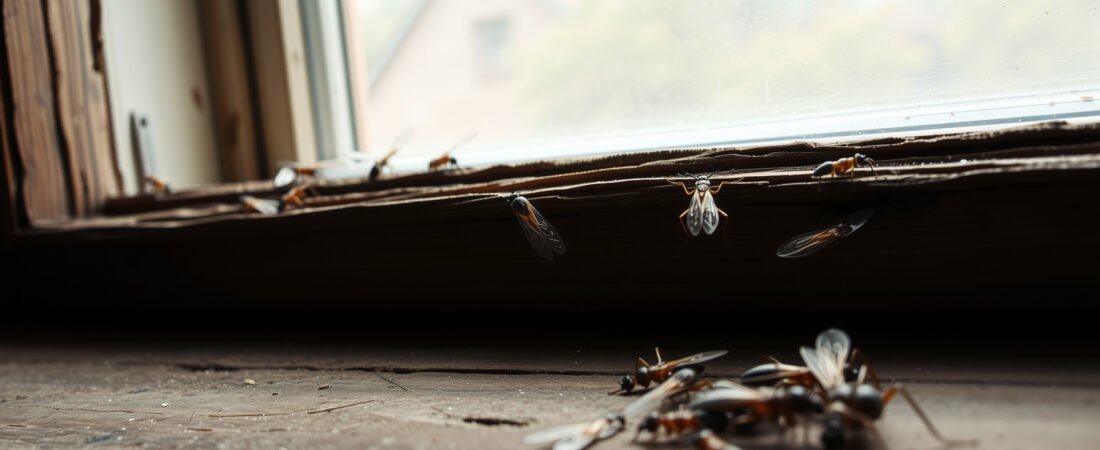
Here’s the answer most people find too late: seeing wings on the floor indoors almost never means you’ve caught a problem early — it means a colony has already been established nearby long enough to produce reproductives. Whether those wings belonged to termite alates or flying ants changes everything about what you do next, but the window to act quickly is the same for both. Most identification guides online walk you through the visual differences like a field manual, which is useful but misses the bigger issue: the two species trigger completely different responses, different costs, and different levels of urgency, and confusing them in the first few days after a swarm can cost you months of structural damage.
Why Seeing Either One Indoors Is a Bigger Red Flag Than Most People Realize
A common assumption is that winged insects indoors just wandered in through an open door or window. That’s almost never true for termite alates or carpenter ant swarmers found in numbers — both species only produce winged reproductives when a parent colony is mature, and that maturity takes years. Subterranean termite colonies typically need three to five years before they generate alates, and a single thriving colony can contain over one million individuals by that point.
Finding a small pile of discarded wings near a windowsill, a basement drain, or a wall crack is the colony announcing itself, not previewing an arrival. The swarm itself lasts only 30 to 40 minutes, so if you’re seeing the aftermath — shed wings, dead or sluggish insects on the floor — the swarm already happened, likely within the past 24 to 48 hours. That timing matters because it tells you the source colony is almost certainly inside the structure or immediately adjacent to it, not just passing through your yard.
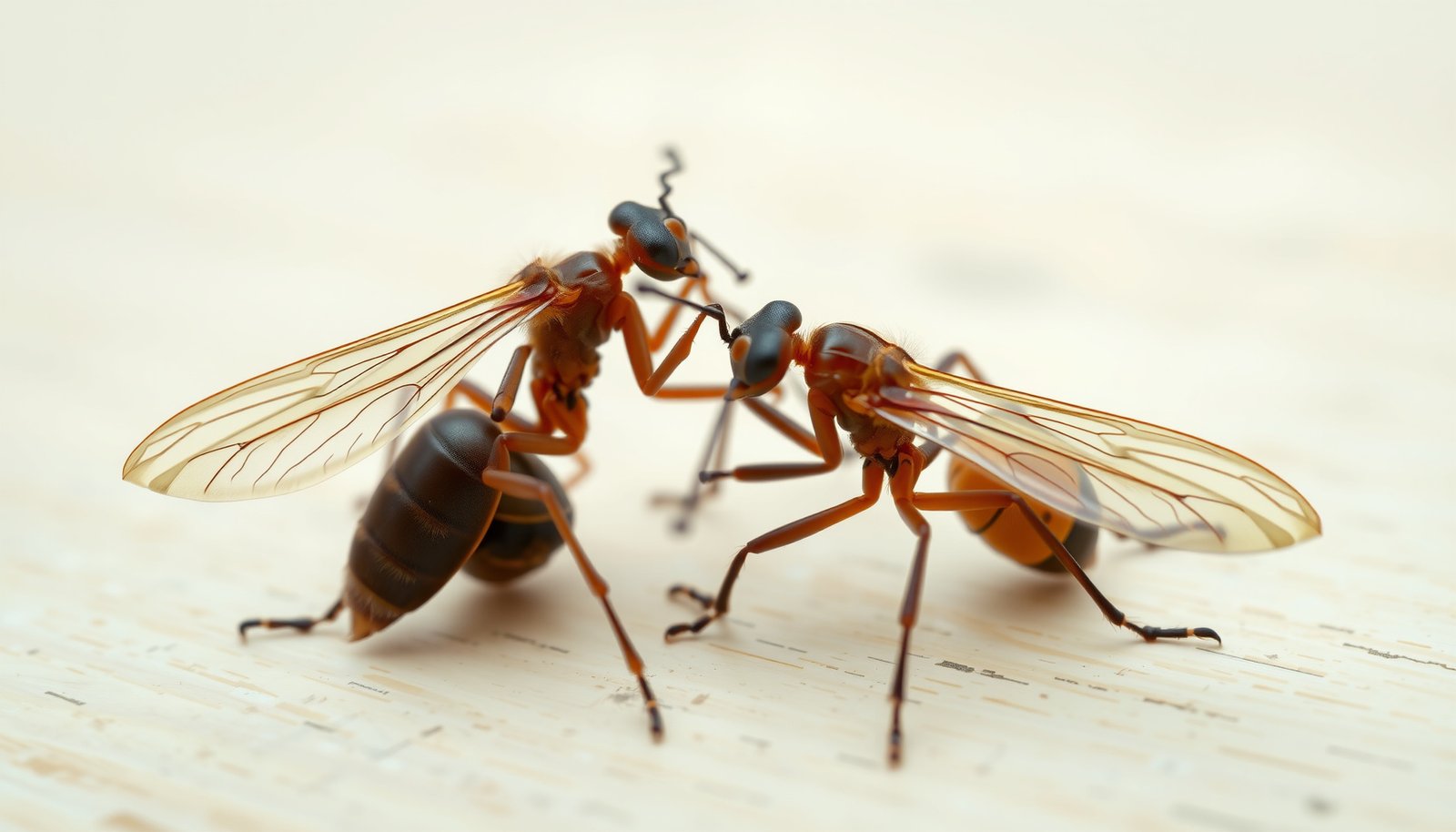
This close-up comparison shows the key structural differences between termite alates and flying ants side by side — the wing size ratio, body segmentation, and antennae shape are the three features that will let you make a confident ID without a magnifying glass.
What Do Termite Alates Actually Look Like Up Close?
Termite alates — the winged reproductive caste — have a body shape that looks almost uniform from head to tail. There’s no visible waist constriction. The abdomen, thorax, and head are roughly the same width, giving the whole insect a slightly soft, cylindrical appearance. Body color varies by species, but most subterranean termite alates are dark brown to nearly black, ranging from about 3/8 to 1/2 inch long including the wings.
The wings are the most reliable field marker. Termite alates carry four wings of nearly identical length — both the front and rear pairs extend well past the abdomen, often doubling the insect’s total length. The wings themselves are translucent, faintly veined, and lay flat along the body when at rest. After a swarm, termites shed all four wings almost immediately, which is why you’ll often find just a pile of uniform, same-size wings with no insect in sight.
How Flying Ants Look Different — and Why the Distinction Is Easy to Miss
Flying ants — technically called alate ants or ant swarmers — share the same basic mission as termite alates: leave the colony, mate, and start a new one. But physically, they’re built differently in ways you can confirm with nothing more than a good phone camera zoomed in. The most obvious difference is the waist. Ants have that sharp, pinched waist (called a petiole) between the thorax and abdomen, and the winged version is no different — it’s still clearly visible even at a glance.
Ant antennae are elbowed, meaning they bend at roughly a 90-degree angle partway along their length. Termite antennae are straight and bead-like, sometimes described as a string of tiny pearls. The wing difference is also significant: flying ants have a noticeably larger front pair of wings compared to the smaller rear pair — unequal in size. That asymmetry alone, once you’ve seen it once, makes the ID fast and reliable.
A Side-by-Side Breakdown of the Physical Differences That Actually Matter
Rather than reading through paragraph descriptions hoping something sticks, it helps to have the features stacked directly against each other. Here’s a comparison of the traits most useful for a fast indoor identification:
| Feature | Termite Alate | Flying Ant |
|---|---|---|
| Body shape | Uniform, no visible waist | Clearly pinched waist (petiole) |
| Wings | Four equal-length wings, flat at rest | Front wings longer than rear wings |
| Antennae | Straight, bead-like segments | Elbowed at roughly 90 degrees |
| Color (common) | Dark brown to black | Black, reddish-brown, or bicolored |
Here’s an honest nuance worth knowing: carpenter ants specifically can complicate this identification in older homes in the Northeast and Pacific Northwest, where they swarm indoors in late winter or early spring. Their swarmers are larger than most other ant species — up to 3/4 of an inch — and the dark coloration can fool someone who’s doing a quick glance. The pinched waist and unequal wings still hold as reliable markers, but if you’re in a region with heavy carpenter ant pressure, it’s worth taking the extra thirty seconds to zoom in on the antennae before making a call.
What To Do Immediately After Finding Winged Insects Indoors
Picture this: you come downstairs on a Sunday morning and find thirty or forty small winged insects clustered around the inside of a sliding glass door, half of them already dead. Your first instinct might be to sweep them up and open a window — don’t. Collect five to ten specimens in a sealed zip-lock bag or a small container before touching anything else. A pest control inspector or your county extension office can make a definitive identification from even a few specimens, and that ID will determine whether your next phone call is to a general pest company or a termite specialist.
The steps below are listed in order of priority for anyone dealing with an indoor swarm:
- Photograph the insects in place before disturbing them — capture the wings, waist, and antennae from as close as your phone will focus. Overexposed or blurry photos are nearly useless for ID purposes.
- Collect a physical sample in a sealed bag or container. Live specimens help most, but dead ones work. Crushed or smeared insects make ID significantly harder.
- Note the exact location — which room, which wall, near which feature (window, door frame, baseboard, drain). The location often points directly to the colony source.
- Check nearby wood surfaces for mud tubes, hollow-sounding wood when tapped, or frass (termite droppings look like tiny wood-colored pellets, while ant debris looks like coarse sawdust).
- Contact a licensed inspector within 48 hours — not because the swarmers themselves are destructive (they aren’t), but because the clock on colony damage doesn’t pause while you’re deciding what to do.
Pro-Tip: If you find only wings and no insect bodies, look along the nearest baseboard or window frame — termites drop their wings almost immediately after landing, within seconds of touching a surface. A trail of equal-length wings leading away from a window is one of the clearest possible signs of a termite swarm rather than ants, which tend to keep their wings longer during the reproductive flight.
Does It Actually Matter Which One You Have? (Yes — Here’s Why the Response Is Totally Different)
Flying ants indoors, while alarming to find, don’t necessarily mean your home is under structural threat. Pavement ants and odorous house ants swarm seasonally and often enter through gaps around doors and windows — their colonies are typically outdoors, and the swarm is just an incidental indoor event. Carpenter ants are the exception; they excavate galleries in wood and can cause real structural damage over time, though they work far more slowly than subterranean termites and are usually easier to locate and treat.
Termite alates indoors, on the other hand, almost always indicate an established colony within the structure or in soil directly beneath or beside it. Subterranean termites cause an estimated $5 billion in structural damage across the U.S. each year, and the damage is almost always invisible until it’s extensive. Termite treatment options — bait systems, liquid soil treatments, or full fumigation for drywood species — are significantly more involved and expensive than ant control, which is why understanding whether you need a professional or can handle it yourself with pest products starts with getting the identification right before spending a dollar on treatment.
“The single biggest mistake I see is homeowners treating an indoor termite swarm with an over-the-counter ant spray and thinking the problem is solved. The swarmers you see are reproductives — they’re not the workers doing structural damage. Killing the swarmers doesn’t touch the colony, and it doesn’t stop the feeding. Getting a proper identification and a thorough inspection within a week of an indoor swarm is what actually protects the structure.”
Dr. Marcus Ellory, Board-Certified Entomologist and NPMA-Certified Pest Management Professional
Here’s the counterintuitive part that most guides don’t say plainly: the swarmers themselves are essentially harmless. They don’t bite, they don’t eat wood, and they die within hours if they don’t find a mate and suitable soil. The danger is entirely in what they represent — a colony that’s been quietly feeding on your structure long enough to produce a reproductive caste. By the time you see alates indoors, the colony has usually been active for at least three to five years.
Where Each Species Tends to Swarm Indoors — Location Clues That Narrow the ID
Location inside the home is an underused diagnostic tool. Termite alates are strongly attracted to light and almost always swarm near windows, glass doors, or light fixtures — they navigate toward brightness during the reproductive flight. Finding a cluster of winged insects piled up against a south-facing window in a basement or crawlspace-adjacent room is a strong behavioral indicator of termites before you’ve even looked closely at the insect.
Flying ants, depending on species, tend to emerge from different locations. Carpenter ant swarmers often appear near wood structures — inside wall voids, near roof soffits, or through gaps in wood trim. Pavement and odorous house ant swarmers may emerge from cracks in flooring, around pipes, or from beneath appliances. Here are the location-based clues worth noting before an inspector arrives:
- Clustered at windows or light fixtures — more consistent with termite alates, which orient toward light during flight
- Emerging from wall cracks or baseboards near wood framing — possible indicator of a carpenter ant gallery or subterranean termite entry point
- Near plumbing penetrations, basement drains, or crawlspace vents — subterranean termites frequently follow moisture gradients toward these areas
- Coming from behind kitchen or bathroom cabinets — both species can be present near moisture-damaged wood, but this is a more common carpenter ant location
- Appearing after rain or warm weather in spring — subterranean termites in most U.S. regions swarm heavily after rain events in spring, while carpenter ant swarms peak slightly later in warm, humid conditions
Timing also matters. Subterranean termite swarms typically happen during daylight hours, most often in late morning or early afternoon following rainfall. Carpenter ant swarms most often occur in late afternoon or evening. Finding insects in the morning that were clearly there overnight slightly favors a different species altogether — though this is a soft clue that should support, not replace, a physical ID.
What Renters Should Know Before Reporting an Indoor Swarm to a Landlord
Renters face a specific challenge here: if you report “flying bugs” without documentation, a landlord’s response is unpredictable and often inadequate. Reporting a confirmed termite swarm is a different conversation entirely — most state habitability codes treat structural pest infestations, including termites, as a landlord’s repair obligation. Knowing which insect you’re dealing with before you send that first message changes the legal weight of your communication significantly.
Document everything before reporting: photos with timestamps, a description of the location, any wings or specimens collected, and whether you noticed mud tubes or damaged wood nearby. If your lease has a pest control clause — and you should check it carefully, since pest control clauses in leases vary widely in what they require of landlords versus tenants — the specific language around structural pests like termites may give you clear grounds to request treatment in writing and establish a timeline for response. Vague “bugs indoors” complaints are easy to defer; a documented termite swarm with photos is much harder to ignore.
One thing that genuinely surprises renters: even if a landlord disputes responsibility, a licensed termite inspector from your county extension office will often do an initial visual inspection at low or no cost, and their written report carries real weight in any landlord dispute. That external documentation — from someone with no financial stake in the outcome — is often more persuasive than any photos you take yourself.
Getting the identification right the first time isn’t just about knowing what’s in your house. It’s the first decision in a chain that determines what treatment gets used, who pays for it, how urgently it needs to happen, and whether your home’s structure is at serious risk or just hosting a nuisance. The wings on your floor are small, but what they’re telling you is worth taking seriously.
Frequently Asked Questions
how do I tell the difference between termite alates and flying ants indoors?
The easiest way is to check the waist and wings. Termite alates have a broad, straight waist with no pinch, while flying ants have that classic narrow, pinched waist. Termite wings are also equal in length and about twice as long as the body, whereas ant wings are unequal, with the front pair noticeably larger than the back.
do termite alates lose their wings and where do I find them?
Yes, termite alates shed their wings shortly after landing, so you’ll often find small piles of equal-length wings near windowsills, door frames, or light sources. If you’re seeing detached wings indoors, that’s a serious red flag — it means swarming already happened and the colony may be established nearby. Flying ants do drop wings too, but their discarded wings are uneven in size.
what color are termite alates compared to flying ants?
Termite alates are typically dark brown to black with translucent, milky-white wings that have a veined pattern. Flying ants are usually black, reddish-brown, or a mix of both, with clearer, more transparent wings. Subterranean termite alates, which are the most common species indoors in the US, tend to be uniformly dark with very little color variation on the body.
are termite alates dangerous if I find them inside my house?
Termite alates themselves don’t bite or cause direct harm to people, but finding them indoors almost always means there’s an active colony somewhere in or around your home. A single swarm can include hundreds to thousands of alates, and if even a few pairs successfully mate and find wood, a new colony can form. It’s worth calling a licensed pest control professional for an inspection rather than waiting to see if it was a one-time event.
what time of year do termite alates swarm inside homes?
Most subterranean termite species in the US swarm in spring, typically between March and May, often on warm days after rain. Drywood termites, which are more common in southern states like Florida, Texas, and California, tend to swarm in late summer through fall. If you’re seeing winged insects indoors during these windows, there’s a much higher chance they’re termite alates rather than flying ants.