
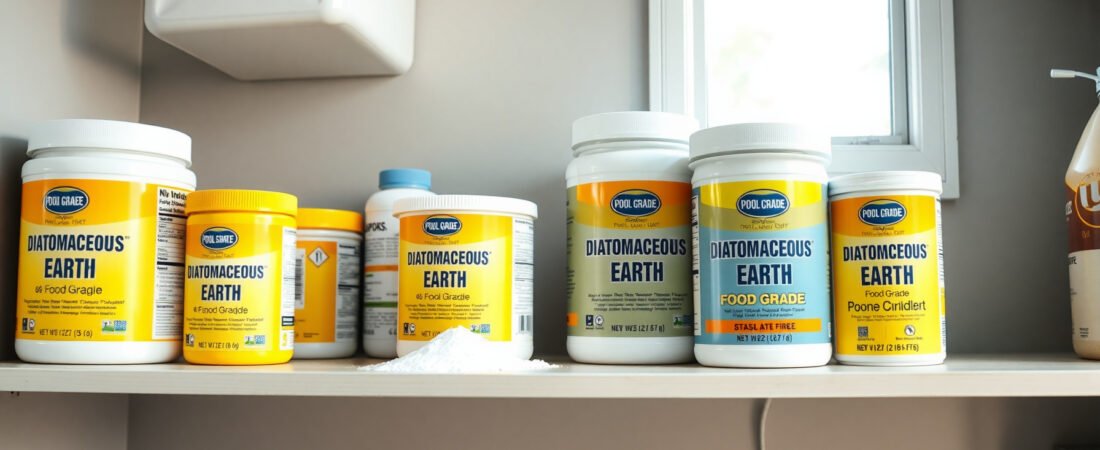
Pool grade diatomaceous earth will absolutely kill insects — and it might also send you to the ER. That’s the real dividing line between the two grades, and it’s one that countless product comparison articles gloss over in favor of brand rankings. The food grade vs. pool grade distinction isn’t a marketing upsell. It’s a safety classification that determines whether you can safely apply DE around your kitchen, your pets, and your kids without causing respiratory damage. Get that wrong, and you’re trading a bug problem for something worse.
Why Pool Grade Diatomaceous Earth Is Not a Pest Control Product
Pool grade DE — sometimes called “calcined” DE — is heated to extremely high temperatures during processing, which converts its amorphous silica into crystalline silica. That structural change is exactly what makes it useful for pool filtration: the crystalline form is harder, more porous, and filters more efficiently. But crystalline silica is classified as a human carcinogen by IARC, and particles small enough to become airborne will lodge deep in lung tissue. OSHA sets workplace exposure limits for crystalline silica at 50 micrograms per cubic meter over an 8-hour shift — and casual DIY application can easily exceed that in an enclosed space.
Food grade DE stays amorphous — that’s the naturally occurring form mined from fossilized algae called diatoms. Amorphous silica is far less hazardous, which is why the FDA has approved food grade DE as a feed additive and anti-caking agent in grain storage. For pest control purposes, both grades kill insects the same way: the microscopic sharp edges of the diatom shells abrade the waxy outer layer of an insect’s exoskeleton, causing it to dehydrate and die within 24–72 hours of sustained contact. But only one of them belongs inside a home where people breathe the air.
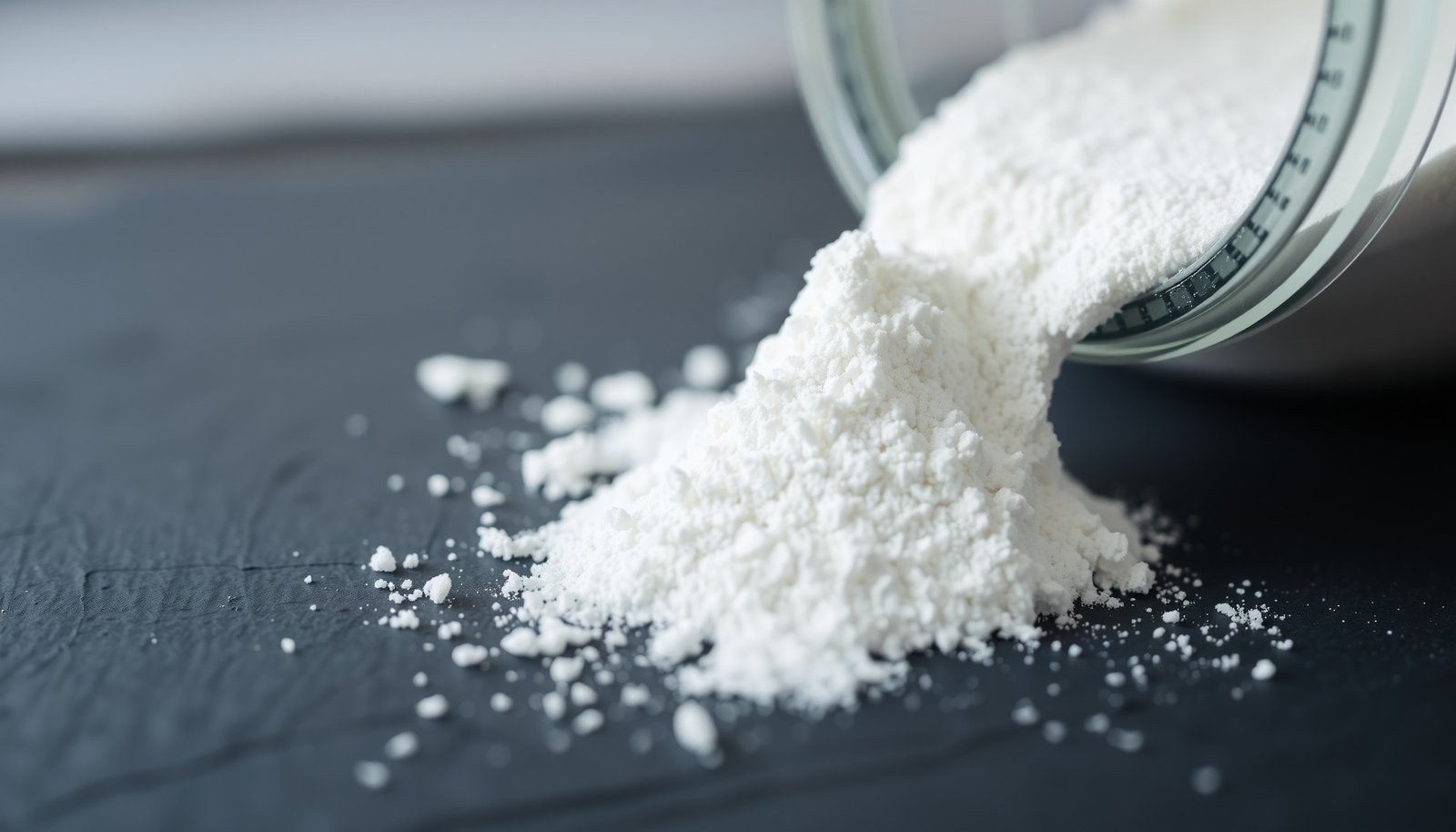
This close-up shows the powdery texture of food grade diatomaceous earth — the fine particle size that makes it effective against insects but also means you need to take basic precautions like wearing a dust mask during application.
What Actually Makes a Diatomaceous Earth Brand Worth Buying?
Here’s the thing most brand comparison lists skip: the “brand” matters far less than the silica content, particle size, and moisture level of the product you’re buying. Higher silica content — typically 85–90% in quality food grade DE — means more abrasive material per ounce and better kill rates. Moisture is the enemy of DE’s effectiveness; once it absorbs ambient humidity, it clumps and loses its ability to coat an insect’s body evenly. A cheap bag of DE from a local feed store with proper storage can outperform a premium brand that’s been sitting in a humid warehouse.
That said, the best diatomaceous earth brands for home pest control do differ in meaningful ways — primarily purity testing, particle consistency, and whether the product carries EPA registration for pest control use. An EPA-registered label means the product has been evaluated for efficacy and safety claims, which matters when you’re comparing DE marketed as “garden amendment” versus DE specifically formulated and tested for killing crawling insects. The brands below represent the strongest options across those real criteria.
Best Diatomaceous Earth Brands for Home Pest Control: Ranked and Compared
These are the brands that consistently deliver on purity, packaging, and actual pest control performance — not just the ones with the most Amazon reviews.
- Harris Food Grade Diatomaceous Earth — One of the most widely available food grade options, Harris DE is EPA-registered for pest control and carries an OMRI listing for organic use. It comes with a powder duster applicator in most sizes, which matters more than people realize — loose application from a bag is wasteful and far less effective than dusting directly into cracks and voids. Silica content sits around 85–90%. Works against cockroaches, bed bugs, ants, silverfish, and stored product pests.
- Safer Brand Diatomaceous Earth — Also OMRI-listed and EPA-registered, Safer Brand positions itself toward the garden-pest crossover market but performs equally well indoors. The particle consistency is excellent. One honest note: the bag design makes precise indoor application awkward without a separate duster, so budget for a bulb duster if you go this route.
- Perma-Guard Fossil Shell Flour — The original food grade DE brand and still one of the purest on the market, with amorphous silica content verified at 89–90%. Perma-Guard sources from a specific freshwater deposit in Nevada that produces unusually consistent particle size. It’s more expensive per pound than Harris but preferred by pest control professionals who mix it into void treatments.
- DiatomaceousEarth.com Brand (DE Food Grade) — This direct-to-consumer brand sells large quantities at competitive prices and publishes third-party lab testing on its silica content. Good for homeowners dealing with a widespread infestation across multiple rooms or doing a full attic/crawl space treatment where you’ll go through several pounds. Quality is consistent batch to batch.
- Grandpa’s Diatomaceous Earth — A smaller brand with a loyal following, particularly among homeowners treating grain storage and pantry pests. The particle size skews finer than some competitors, which improves coverage in tight spaces but also means it becomes airborne more easily during application — wear a mask without exception.
One thing none of these brands will tell you on the front of the bag: DE does not work well as a barrier treatment on smooth surfaces or in high-traffic areas where it gets swept away. Its real strength is in undisturbed voids — wall cavities, the gap behind your refrigerator, beneath baseboards, inside electrical outlet boxes. Applied correctly in those spots, it remains lethal to crawling insects for months or years as long as it stays dry.
“Food grade diatomaceous earth is genuinely effective against hard-bodied crawling insects when applied in low-disturbance zones, but the single biggest reason it fails for homeowners is over-application. People assume a thick layer works better — it actually works worse. A thin, barely visible dust coat is what insects walk through and pick up on their bodies. A pile of DE just gets walked around.”
Dr. Michael Waldvogel, Extension Specialist in Structural Pest Management, North Carolina State University Department of Entomology
Food Grade vs. Pool Grade: The Side-by-Side Numbers You Need
People still ask whether pool grade DE is “okay to use outside.” Technically it’s less dangerous outdoors where air disperses the particles — but it’s still not approved for pest control use under FIFRA, and most pool grade products contain no EPA registration for insecticidal application. You’d be using it in a way that’s both legally unsupported and medically riskier than necessary. The efficacy gain is zero: pool grade doesn’t kill insects any faster than food grade.
| Feature | Food Grade DE | Pool Grade DE |
|---|---|---|
| Silica Type | Amorphous (natural) | Crystalline (heat-processed) |
| IARC Carcinogen Classification | Not classified | Group 1 (crystalline silica) |
| EPA Pest Control Registration | Yes (most brands) | No |
| Safe for Indoor Use | Yes, with basic dust mask | No |
| Kills Insects | Yes | Yes (but not legal for this use) |
The mechanism of insect death is purely physical — DE doesn’t poison insects, it desiccates them by destroying their cuticle’s water-retention layer. This means insects cannot develop resistance to it, which is one of DE’s genuine advantages over chemical insecticides where resistance is a documented problem. A cockroach population that’s immune to pyrethroid sprays is still fully vulnerable to food grade DE, which is worth knowing if you’re dealing with a stubborn infestation.
Pro-Tip: Store your DE in an airtight container — a sealed plastic bin or even a mason jar — rather than leaving the bag open between applications. DE absorbs moisture from the air and loses effectiveness fast in humid climates. If your DE clumps when you tap the bag, it’s already compromised. Spread it on a baking sheet in a warm oven at 250°F for 20 minutes to re-dry it before use.
Where and How to Apply DE for Maximum Effectiveness at Home
Picture this: you’ve bought a quality food grade DE, applied it in a thick ring around your kitchen cabinets, waited two weeks, and still have ants marching across your counter. That’s not a product failure — it’s an application failure, and it’s the most common reason people conclude that DE “doesn’t work.” Ants, cockroaches, and other crawling insects navigate by antenna contact and preferred pathways. If you dust DE somewhere they’re not traveling, they’ll simply route around it. Effective application requires you to identify actual insect travel corridors first.
The right approach is targeted, thin-layer application in specific zones. A quality bulb duster or puffer bottle — not the bag itself — is the right tool for every indoor application.
- Behind and beneath appliances — the gap under the refrigerator, behind the stove, and behind the dishwasher are high-traffic cockroach zones that stay undisturbed for months
- Inside wall voids via electrical outlets — remove the outlet cover, dust inside the void, replace the cover; this is one of the best treatments for German cockroaches nesting inside walls
- Beneath and behind baseboards — apply into the gap where the baseboard meets the floor, particularly in bathrooms and kitchens where moisture pests are active
- In attic insulation and crawl spaces — broadcast DE across attic insulation to control stored product pests, certain beetles, and even mosquitoes that overwinter indoors in warmer climates; use a respirator in confined spaces
- Bed frame joints and furniture crevices — for bed bug control, dust lightly into the joints of the bed frame, inside box spring seams, and under furniture legs; combine with a quality mattress encasement
One honest nuance here: DE works much better in dry climates and dry spaces than in humid ones. A bathroom in South Florida with 80% ambient humidity in August is not where DE performs at its best — the particles lose their desiccating power quickly in consistently wet air. In those conditions, DE is a supplement to a chemical treatment, not a standalone solution. In an arid climate or a climate-controlled interior, it’s legitimately effective as a primary control for crawling insects over a period of weeks.
If you’re renting and dealing with an ongoing infestation that your landlord hasn’t addressed, it’s worth knowing that landlords are legally required to address pest infestations within specific timeframes under most state habitability codes — using DE on your own doesn’t waive those rights or relieve the landlord of responsibility.
The bottom line on the best diatomaceous earth brands isn’t really about brand loyalty — it’s about buying food grade only, storing it dry, applying it thin, and putting it where insects actually walk. Harris, Perma-Guard, and DiatomaceousEarth.com are all strong choices for different use cases. But the biggest upgrade most people can make isn’t switching brands — it’s switching from dumping DE from a bag to using a proper bulb duster and treating the voids and crevices that a cockroach actually calls home. Do that right, and food grade DE genuinely earns its reputation as one of the most durable, resistance-proof tools in the home pest control kit.
Frequently Asked Questions
what is the best diatomaceous earth brand for killing bugs indoors?
Harris Food Grade Diatomaceous Earth is one of the most popular picks for indoor pest control, and it’s widely available at Home Depot and on Amazon. It’s OMRI-listed, comes with a powder duster, and works well against roaches, bed bugs, fleas, and ants when applied in thin, dry layers along baseboards and entry points.
is food grade or pool grade diatomaceous earth better for pest control?
Food grade is the only type you should use for pest control inside your home. Pool grade DE has been heat-treated and chemically altered, which raises its crystalline silica content to around 60% or higher — that makes it a serious inhalation hazard and it’s not registered as a pesticide for household use.
how long does diatomaceous earth take to kill bugs?
It typically takes 24 to 72 hours to kill insects after they make direct contact with the powder. Results can be slower in humid conditions because moisture reduces DE’s effectiveness, so you’ll want to reapply after rain, cleaning, or any moisture exposure.
can you use diatomaceous earth around pets and kids?
Food grade DE is generally considered safe around pets and kids once it’s settled, but you should keep everyone out of the treated area while you’re applying it and until the dust has settled. The main risk is respiratory irritation from inhaling the fine particles, so wear a dust mask during application and avoid using it near air vents.
how much diatomaceous earth do I need to treat my house for fleas?
For a moderate flea infestation, a 4-pound bag is usually enough to treat the main living areas of an average-sized home. Apply a thin, barely visible layer — piling it on thick actually makes it less effective because fleas can walk around the clumps rather than through the powder.