
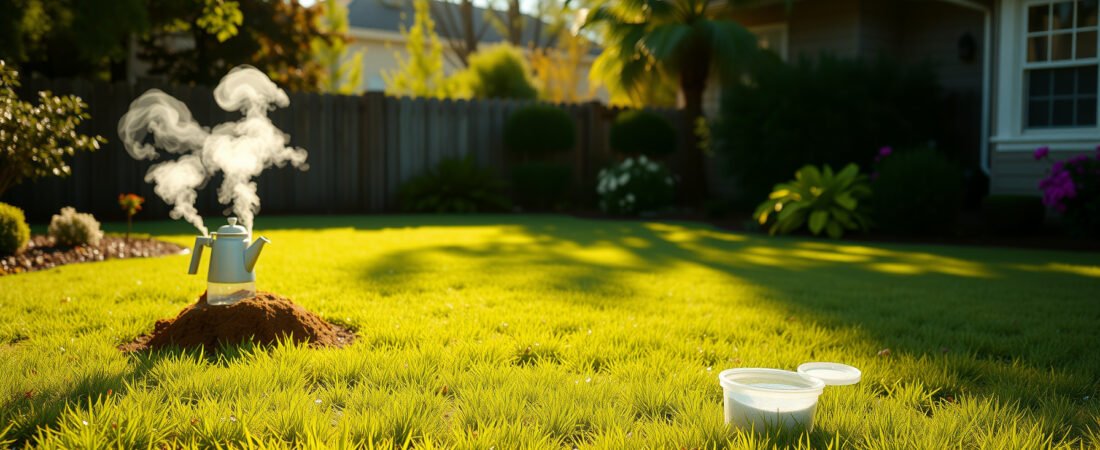
Boiling water kills fire ants. So does dish soap drench. So does diatomaceous earth, orange peel extract, and a long list of other chemical-free methods you’ll find on page one of Google. Most of them work — temporarily. The part nobody tells you is that treating the mound you can see is almost always the wrong place to start, and that’s exactly why chemical-free fire ant control fails for so many people who try it.
A fire ant colony can contain anywhere from 100,000 to 500,000 workers, and the queen — the only one who actually matters — sits deep in the ground, often 3 to 6 feet below the surface. Every method that attacks the mound from the top is essentially knocking on the front door of a building where the target lives in the basement. The ants scatter, relocate 3 to 10 feet away, and rebuild within days. You haven’t solved the problem. You’ve just rearranged it.
The real secret to getting rid of fire ants without chemicals is understanding that you need to reach the queen — and that the only non-chemical methods that consistently do that are the ones designed to work from the inside out, not the top down. This article focuses on that specific problem: how to choose and apply chemical-free treatments that actually travel deep enough to matter.
Why Do Most Chemical-Free Fire Ant Treatments Fail?
The failure rate of DIY fire ant control isn’t really about the method — it’s about the target. People treat the visible mound, which is mostly a nursery and a heat-regulating structure. The queen’s chamber, the eggs, and the core reproductive activity happen well below where most treatments penetrate. Boiling water, for example, has to travel through 2 to 3 feet of soil before it reaches lethal temperatures — and most of the time, it cools down and disperses before getting anywhere near the queen.
There’s also a colony architecture problem that almost nobody talks about. Mature fire ant colonies often have satellite mounds — smaller, less obvious mounds connected to the main colony through underground tunnels. Treat one mound, and the colony simply shifts activity to a satellite location it already built weeks ago. This is why a yard can look “clear” for a week and then suddenly have three mounds where there used to be one. You didn’t eliminate the colony — you displaced it.
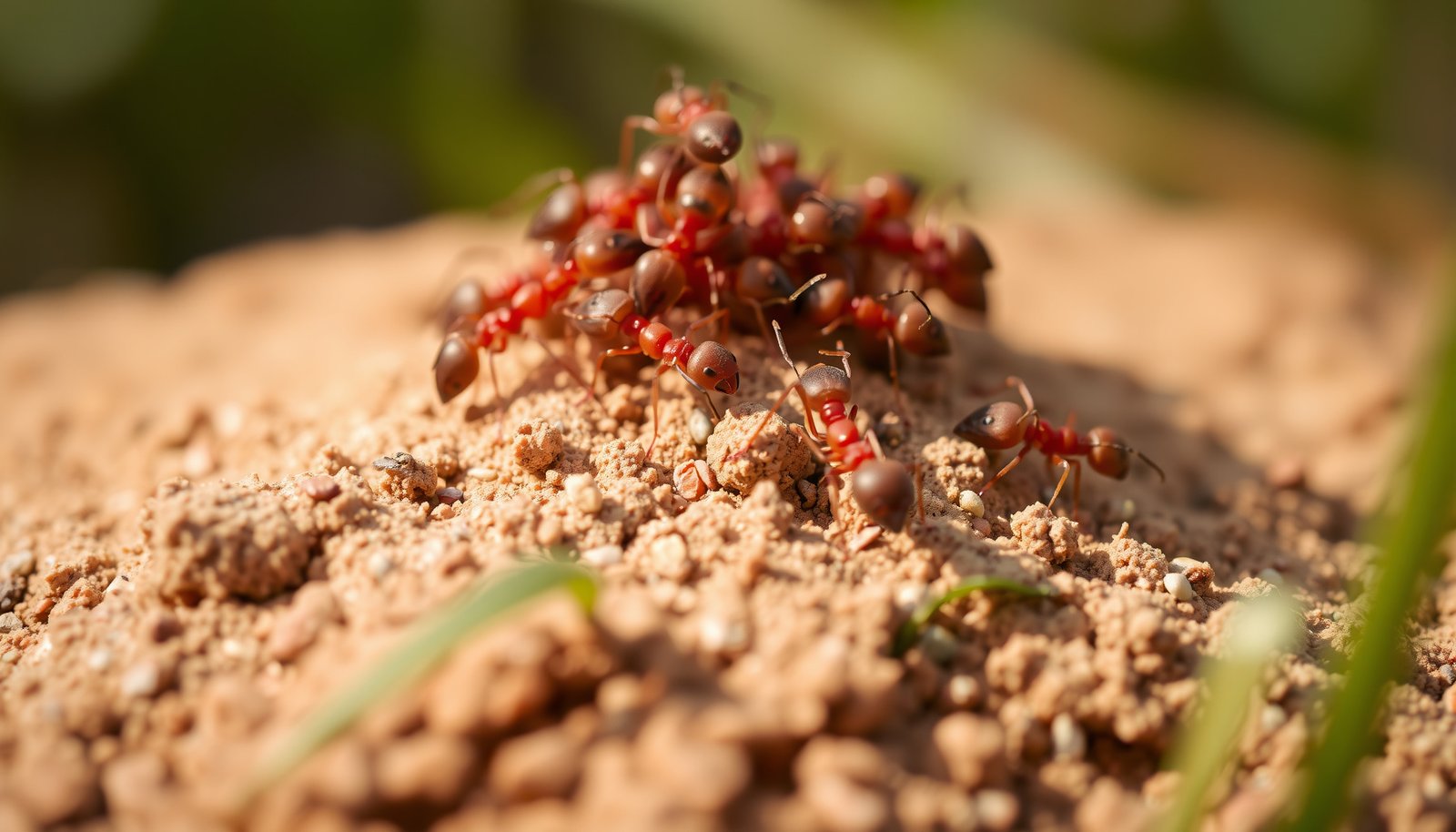
This close-up shows the tunnel structure just beneath a fire ant mound — notice how the visible dome is only a fraction of the colony’s actual footprint underground, which is why surface-only treatments so often miss the mark.
Which Chemical-Free Methods Actually Reach the Queen?
Two non-chemical approaches have the strongest track record for actually disrupting the queen and the colony’s ability to reproduce: food-grade diatomaceous earth applied as a drench with water (not dry-dusted on top), and natural bait-based systems that use slow-acting biological or food-grade carriers that worker ants carry back to the queen themselves. The second method is slower — sometimes taking 1 to 3 weeks to show full results — but it’s the one that most closely mimics how chemical baits work, using the ants’ own behavior against them.
Spinosad, a naturally derived fermentation byproduct classified by the EPA as a biopesticide, is one of the most effective organic options available. It’s not a synthetic chemical and is approved for organic gardening. When mixed into a granular bait that foraging workers pick up and bring back to the colony, spinosad can kill the queen within 1 to 2 weeks of consistent exposure. It’s worth noting that effectiveness depends on soil temperature — fire ants forage most actively between 70°F and 90°F, so bait applications work best during those temperature windows, not in peak summer heat when ants go deeper underground.
Pro-Tip: Apply any natural bait product in the early morning or late evening when soil surface temperatures are cooler and fire ant foraging activity is at its highest. Bait left out during midday heat gets ignored and degrades faster — you’ll waste product and miss the window when ants are actually moving it back to the colony.
How to Use the Two-Step Method Without Any Synthetic Chemicals
The two-step method was originally developed by Texas A&M AgriLife Extension as a yard-wide fire ant management strategy — and it works just as well with organic and chemical-free products as it does with conventional ones. The core idea is to address the whole yard first with a broadcast bait, then follow up with individual mound treatments for any colonies that survive. Doing it in reverse — hitting individual mounds first without broadcast bait — is one of the most common mistakes homeowners make, because it leaves the satellite mounds untouched and gives surviving colonies time to regroup.
Here’s how to run the chemical-free version of this method from start to finish:
- Broadcast a natural granular bait across the entire yard — use a hand-crank spreader for even coverage. Spinosad-based or food-grade borate baits work well here. Apply at the rate listed on the product label, typically around 1 to 1.5 pounds per acre.
- Wait 3 to 5 days before doing anything else. Worker ants need time to find the bait, pick it up, and transport it back into the colony. Disturbing mounds during this window interrupts that process.
- Treat individual visible mounds with a drench method — boiling water (2 to 3 gallons poured slowly and directly into the mound center) or a food-grade diatomaceous earth slurry mixed with water and poured in. Do this in the morning when ants are closer to the surface.
- Mark treated mounds with small flags or landscape stakes so you can track which ones show renewed activity in the following 2 weeks. Renewed activity at the same location means the queen survived and the colony relocated slightly — re-treat.
- Re-broadcast bait once every 4 to 6 weeks during active foraging season. Fire ant pressure doesn’t end after one treatment cycle. New queens from neighboring properties can establish new colonies in your yard in as little as 3 to 4 weeks.
Picture this: a homeowner treats three visible mounds in June, sees no activity for a week, and declares victory. By mid-July there are five new mounds in different parts of the yard. That’s not a treatment failure — that’s what happens when only the visible structure gets addressed and the broadcast step is skipped entirely. The two-step method closes that gap.
What Does Diatomaceous Earth Actually Do to Fire Ants?
Diatomaceous earth (DE) kills insects physically, not chemically — and that distinction matters if you’re trying to stay chemical-free. The microscopic fossilized shells puncture the waxy outer coating of an insect’s exoskeleton, causing it to lose moisture rapidly and die from dehydration. For fire ants, this works — but only under specific conditions that most people applying it in their yard don’t create. Dry DE dusted on top of a mound mostly sits there and gets avoided by ants or washed away by rain. DE needs to make direct, sustained contact with the ants’ bodies to work.
The more effective application method is a wet drench: mix food-grade DE at a ratio of about 4 tablespoons per gallon of water and pour 2 to 3 gallons slowly and steadily into the mound opening. The slurry coats the tunnel walls and the ants as the water moves downward. It’s not a perfect solution for deep colonies — if you’re dealing with food-grade versus pool-grade diatomaceous earth, always use food-grade for yard application around children and pets, since pool-grade DE is chemically treated and potentially hazardous to breathe. Results from DE drenching typically show up within 48 to 72 hours for surface colonies, though a deep-established colony may show only partial disruption.
“The fundamental error I see homeowners make with organic fire ant control is expecting speed. Chemical-free methods work, but they require patience and a whole-yard approach. A homeowner who treats one mound with boiling water and checks back in three days is almost always going to be disappointed — not because the method failed, but because they measured the wrong outcome at the wrong time.”
Dr. Sandra Tillman, Urban Entomologist and Extension Specialist, Texas A&M AgriLife
Which Natural Fire Ant Methods Are Worth Your Time — and Which Aren’t?
Not every “natural” remedy you’ll read about is worth applying. Some are harmless but ineffective. Others can actually make the problem worse by disturbing the colony in ways that trigger relocation or protective swarming behavior. Here’s an honest breakdown of the most commonly recommended chemical-free approaches and what the evidence actually says about each.
| Method | Effectiveness | Important Caveat |
|---|---|---|
| Boiling water drench | Moderate — kills ants on contact but rarely reaches queen in deep colonies | Best used as mound follow-up, not standalone treatment |
| Spinosad-based bait | High — worker ants carry it back to the queen | Must be applied during active foraging temps (70–90°F); degrades in UV light within hours |
| Food-grade DE slurry | Moderate — effective at surface and tunnel level | Food-grade only; loses effectiveness when completely dry or rained on |
| Orange oil / d-Limonene | Low to moderate — toxic to ants on contact but poor penetration | Can kill beneficial soil organisms; not recommended for broadcast use |
| Vinegar or dish soap drench | Low — disrupts surface activity temporarily but does not kill queens | Often just causes colony relocation; may harm surrounding grass |
The methods that work share a common mechanism: they either penetrate deep enough to reach the reproductive core of the colony, or they exploit the ants’ own foraging behavior to deliver something harmful inward. Methods that only affect what’s visible at the surface — vinegar, dish soap, dry dust applications — are essentially just inconveniencing the colony. Fire ant colonies are remarkably resilient. A colony can lose up to 10% of its worker population and recover fully within a couple of weeks if the queen is unaffected.
Here’s a quick-reference list of environmental adjustments that reduce fire ant pressure long-term alongside active treatment:
- Reduce excess soil moisture — fire ants prefer moist, well-irrigated soil. Overwatering your lawn is essentially setting up ideal nesting conditions for them.
- Avoid leaving pet food outdoors — even a few hours of accessible food draws scout ants, which leads to foraging trails, which leads to new satellite mound establishment nearby.
- Keep grass at 3 to 4 inches — fire ants prefer shorter, sparser ground cover because it warms faster and gives them sun exposure for mound thermoregulation. A slightly taller lawn discourages them.
- Treat along fence lines and property edges first — new fire ant colonies entering your yard almost always come in from the perimeter, not from the center. Starting your broadcast bait application from the edges inward is more effective than treating from mound centers outward.
- Avoid tilling or disturbing soil unnecessarily — disrupted soil creates the loose, aerated conditions fire ants actively seek for new mound construction.
One honest nuance worth calling out: how well any of these methods work depends heavily on your region and the time of year. In the Gulf Coast states — Texas, Louisiana, Florida — fire ant pressure is year-round and re-infestation from neighboring properties happens constantly. In more northern areas where fire ants have only recently expanded their range, a single thorough two-step treatment cycle in spring may hold for a full season. There’s no one-size-fits-all timeline, and anyone who tells you otherwise is oversimplifying.
It’s also worth knowing that managing shared-space pest problems without chemicals — whether in a yard or in a building — often involves coordination with neighbors, not just solo treatment. The same principle that applies when a roommate brings a pest problem into a shared living space applies here: if your neighbor’s yard is heavily infested and untreated, you’re fighting a losing battle treating only your side of the fence. A coordinated neighborhood broadcast treatment is exponentially more effective than individual yard-by-yard efforts.
Fire ants are one of the few pests where the biology genuinely rewards patience and strategy over speed and volume. The homeowners who see lasting results without chemicals aren’t necessarily using fancier products — they’re applying the right ones at the right time, in the right sequence, with a realistic understanding of how long it actually takes to collapse a colony from the inside. Start with the broadcast bait, follow up on individual mounds, and plan for at least one repeat cycle. That’s not a complicated plan — it’s just the one that actually works.
Frequently Asked Questions
does boiling water really kill fire ant mounds?
Yes, but you need to use about 3 gallons of boiling water per mound and pour it slowly and directly into the center. It kills the queen and workers on contact, but it only works about 60% of the time — you may need to treat the same mound 2 or 3 times. Be careful, because the ants will swarm fast when disturbed.
what can I put on fire ant mounds to kill them naturally?
Diatomaceous earth, orange oil mixed with compost tea, and dry grits are all popular natural options. Diatomaceous earth works by damaging the ants’ exoskeletons, so spread it around the mound and across any visible trails. Reapply after rain since moisture reduces its effectiveness.
how do I get rid of fire ants in my yard without killing my grass?
Boiling water and diatomaceous earth are both grass-safe when used correctly, though boiling water will kill grass in the immediate area around the mound. Beneficial nematodes are one of the best options if you’re worried about your lawn — you apply them with a hose sprayer and they target fire ant larvae underground without harming grass, pets, or plants.
how long does it take to get rid of fire ants naturally?
Natural methods take longer than chemicals — typically 2 to 6 weeks of consistent treatment before you see a significant reduction in mound activity. Beneficial nematodes can start working within 2 weeks, while methods like diatomaceous earth may need repeated applications over a month or more. Don’t expect overnight results with a chemical-free approach.
will fire ants go away on their own if I leave them alone?
They won’t — fire ant colonies grow aggressively and a single mound can contain 100,000 to 500,000 ants within a year or two. If left untreated, colonies spread by budding, where the queen splits the colony and starts new mounds nearby. Ignoring them almost always makes the problem worse, especially in warm Southern states where they thrive year-round.
Disclaimer: This article is for informational purposes only and isn’t a substitute for professional pest control advice. Always read and follow the product label instructions exactly — label directions are legally binding and vary by brand and active ingredient. Keep all pesticides, baits and traps away from children and pets, ventilate treated areas as directed, and consider calling a licensed pest control professional if an infestation is large, recurring, or involves a structural pest like termites or carpenter ants.