
Killing adult fleas and roaches is the easy part — and that’s exactly why most people keep losing the battle. An IGR doesn’t kill anything on contact. It works by disrupting the insect’s ability to mature, reproduce, and replace itself. That distinction matters more than most pest control articles will tell you, because if you’re only spraying adulticides, you’re managing a symptom while the next generation is already hatching in your baseboards.
Why IGRs Work When Sprays Alone Keep Failing You
Here’s the part most homeowners miss entirely: a single female German cockroach produces 30–40 eggs per capsule, and she can carry up to 8 capsules in her lifetime. Traditional contact sprays kill the adults you see, but the eggs — already tucked into wall voids, appliance gaps, and cardboard — are completely untouched. Two weeks later you’re back to square one, confused about why the spray “stopped working.”
IGRs break this cycle by mimicking or blocking juvenile hormones — the chemical signals that tell an insect when to molt and mature into a reproductive adult. Exposed nymphs get stuck in an immature state and never breed. Exposed eggs often fail to hatch at all. It’s not a dramatic knockdown; it’s a slow, methodical collapse of the population over 4–8 weeks, which is actually what long-term control looks like.
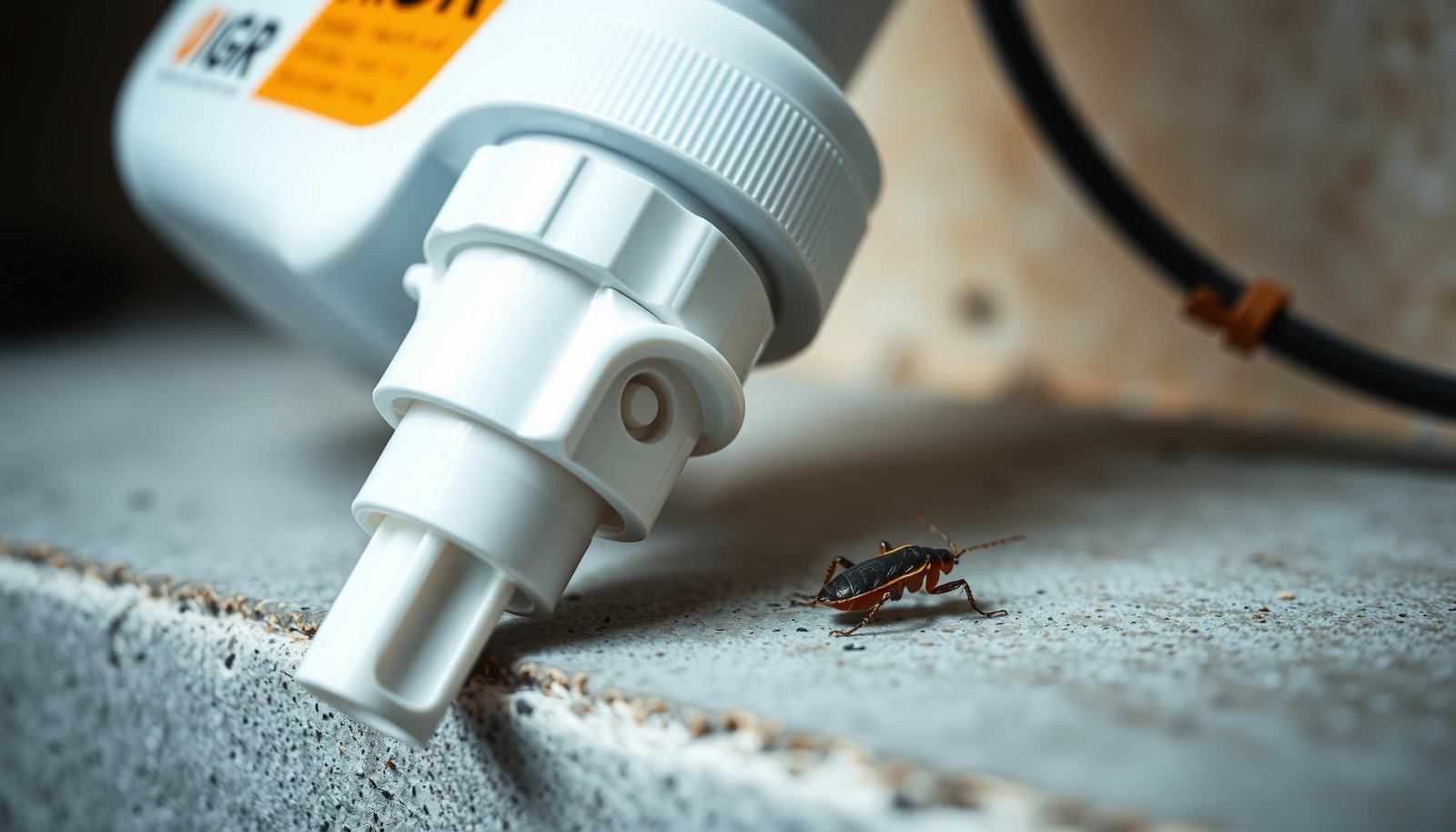
This close-up shows the life cycle stages that IGRs specifically target — eggs, larvae, and nymphs — the phases that adulticides completely skip over and the reason infestations keep rebounding after a single spray treatment.
What’s the Difference Between Methoprene, Pyriproxyfen, and Hydroprene?
Not all IGRs are built the same, and picking the wrong one for your pest is a real mistake people make. There are two main classes you’ll encounter as a homeowner: juvenile hormone analogs (JHAs) and chitin synthesis inhibitors (CSIs). The three active ingredients you’ll most commonly see on product labels — methoprene, pyriproxyfen, and hydroprene — are all JHAs, but they behave differently enough that the distinction matters.
| Active Ingredient | Best Target | Key Strength | Residual Activity |
|---|---|---|---|
| Methoprene | Fleas, mosquitoes | Disrupts flea egg development; widely available in flea products | 4–7 months in protected areas |
| Pyriproxyfen | Fleas, roaches, whiteflies | More photostable than methoprene; effective on wider range of insects | Up to 7 months indoors |
| Hydroprene | Cockroaches, stored product pests | Specifically formulated for roach species; low mammalian toxicity | 3–5 months in cracks and voids |
Hydroprene is the one roach-focused product that rarely gets mentioned in general IGR roundups, and that’s a missed opportunity. It’s engineered specifically for cockroach species — German, American, Oriental — and works at extremely low concentrations. Pyriproxyfen pulls double duty on both fleas and roaches, which makes it the workhorse choice if you’re dealing with both pests at once in a pet household.
Which IGR Products Actually Belong in a Home Treatment Plan?
Picture this: you’ve been renting an apartment for three months, you’ve sprayed twice, and every morning there are still juvenile roaches — the small translucent ones — running across the counter. That’s your sign that you have a breeding population inside the walls and the adults you’re killing are just the visible tip. An IGR is what changes that equation, and the product you choose will depend on your delivery method preference and your target pest.
Here are the most consistently effective IGR products available to homeowners, each with a reason it earns its spot:
- Gentrol Point Source (Hydroprene): Small plastic discs you place inside cabinets, under appliances, and in corners. No spraying required — the vapor diffuses slowly into cracks and voids where roaches hide. One disc treats up to 75 square feet for roughly 90 days.
- Gentrol IGR Concentrate (Hydroprene): The liquid version of the above. Mix and spray as part of a crack-and-crevice application alongside your bait or adulticide. Better for larger infestations where you need broader coverage.
- Martin’s IGR Concentrate (Pyriproxyfen): One of the most cost-effective options for flea and roach control. A single 4-oz bottle diluted correctly can treat up to 1,500 square feet. Commonly used by pest control professionals in its commercial form.
- Precor 2000 Plus Premise Spray (Methoprene + Permethrin): A combo product that kills adult fleas on contact while the methoprene halts development of eggs and larvae. Good for flea-heavy situations where you want immediate knockdown plus long-term prevention.
- Archer IGR (Pyriproxyfen): Professional-grade but available to homeowners. One of the most photostable options, meaning it holds up better in areas that get some light exposure. Works on both fleas and roaches and mixes well with most labeled insecticides.
- Nyguard IGR Concentrate (Pyriproxyfen): Another professional-tier option with solid residual activity up to 7 months indoors. Odorless, non-staining, and safe for use around pets once dry — a practical choice for households where chemical sensitivity is a concern.
Pro-Tip: Never apply an IGR as a standalone treatment. Pair it with a bait (like a gel bait for roaches) or an adulticide (like a pyrethroid for fleas). The IGR handles the next generation; the adulticide handles the adults in front of you. Together, they close both ends of the population cycle.
How and Where Do You Apply IGRs for Maximum Effect?
Application method matters as much as product choice, and this is where a lot of DIY treatments fall short. Fleas and roaches spend most of their time in protected microhabitats — not out in the open where you’re spraying. Flea larvae, for example, migrate away from light and burrow into carpet fibers, pet bedding crevices, and under furniture. Roach eggs and nymphs concentrate in harborage zones: the underside of refrigerator compressor pans, inside wall outlets, inside cardboard boxes.
For flea control indoors, focus your IGR spray on carpet edges, beneath furniture, and under cushion seams — not the middle of the carpet where you might instinctively spray. For roach control, use crack-and-crevice application along the inside edges of cabinets, behind the refrigerator, along the seam where plumbing enters walls, and inside false ceilings if accessible. Gentrol Point Source discs are particularly valuable for apartment dwellers because they work passively inside cabinets without requiring you to spray near food storage areas.
“Most homeowners rotate insecticides when treatments stop working, but they’re solving the wrong problem. The adults they’re killing are a fraction of the population. The eggs, larvae, and nymphs in harborage zones are the true reservoir — and only an IGR addresses that stage of development. Without one, you’re refilling a bucket that has a hole in the bottom.”
Dr. Patricia Callahan, Board-Certified Entomologist and Urban Pest Management Specialist, Cooperative Extension Program
Are IGRs Safe to Use Around Pets and Kids at Home?
IGRs have one of the better safety profiles in the pest control toolkit, largely because juvenile hormones are highly specific to arthropods — insects, fleas, and related species. Mammals don’t have juvenile hormone systems, which means the mode of action that disrupts a flea’s development doesn’t have an equivalent pathway in a dog, cat, or child. The EPA classifies most residential IGRs in the lowest toxicity categories, and products like pyriproxyfen and methoprene have extensive safety records in residential use.
That said, there’s an honest nuance here: “low toxicity” doesn’t mean “apply carelessly.” Some IGRs — particularly those formulated as concentrates — are harmful to aquatic invertebrates and should never be rinsed into drains, ponds, or waterways. If you have a fish tank, keep it covered and the filtration running during any indoor spray application, and allow the treated surfaces to dry fully before letting pets or kids back into the area. Pyriproxyfen, specifically, is highly toxic to aquatic insects at very low concentrations, so disposal of diluted leftover solution matters. Can You Get Out of a Lease Early Due to a Roach Infestation? — if your situation has escalated to the point where an infestation is affecting habitability, it’s worth understanding your legal options alongside any treatment plan.
How Long Does It Take for an IGR to Actually Work?
This is the expectation gap that causes people to give up on IGRs too early. You will not see a dramatic reduction in pest activity within the first few days — that’s not what IGRs do. What you’re doing is interrupting a reproductive cycle, and that cycle has lag time built into it. A flea egg takes 2–10 days to hatch depending on temperature and humidity. A German cockroach egg capsule takes about 28 days to hatch. The IGR disrupts development within those stages, which means visible population decline typically begins around the 4–6 week mark.
Here’s what makes IGRs uniquely effective in a way that most people don’t realize until they’ve used one correctly: some exposed adult female fleas can still lay eggs, but those eggs fail to develop. Exposed nymphs molt into sterile adults or deformed adults incapable of reproduction. The population doesn’t collapse overnight — it ages out. After 8–12 weeks of consistent IGR presence, you should see a significant, sustained drop in live insect activity, provided you’ve also been addressing the adults with a paired treatment. That’s the counterintuitive part — patience isn’t a weakness in this strategy; it’s the whole mechanism. For persistent infestations in shared living spaces, How to Get Rid of Wasps in the Wall Without Getting Stung offers a parallel example of why targeted, harborage-focused treatment always outperforms surface-level spraying alone.
Here’s a quick breakdown of what to expect during a realistic IGR treatment timeline:
- Week 1–2: No visible change in adult activity — this is normal. The IGR is working on eggs and juveniles you can’t see.
- Week 3–4: You may notice smaller nymphs behaving abnormally — slower movement, failed molts, deformed bodies. This is the IGR working as intended.
- Week 5–6: Adult numbers should begin declining noticeably, especially if you’ve paired the IGR with a bait or contact insecticide for adults.
- Week 8–12: Sustained population collapse if treatment has been applied correctly in harborage zones. Reapply IGR per label instructions to maintain residual pressure.
- After 3 months: Most IGRs require reapplication at 3–7 month intervals depending on the product and infestation severity. Don’t stop after the first application — one generation missed is a population reset.
One more thing worth saying plainly: IGRs don’t eliminate the need for sanitation. A kitchen with consistent food debris, moisture under the sink, and stacked cardboard will keep recruiting new roaches from neighboring units or the outdoors faster than any chemical can work. The IGR handles reproduction; you still need to deny harborage and food access to take back control of the space for good.
Frequently Asked Questions
How long does it take for an IGR to kill fleas?
IGRs don’t kill adult fleas — that’s not what they’re designed to do. They work by preventing flea eggs and larvae from developing into breeding adults, which breaks the life cycle over 4 to 8 weeks. For faster knockdown of adult fleas, you’ll need to pair an IGR with an adulticide like permethrin or bifenthrin.
What’s the difference between methoprene and pyriproxyfen for flea control?
Both are juvenile hormone analogs, but pyriproxyfen is generally considered more stable and longer-lasting — it can remain effective for up to 7 months indoors compared to methoprene’s 3 to 4 months. Methoprene is common in flea spot-on products like Precor, while pyriproxyfen shows up in products like Nylar and is often preferred for roach control as well.
Are insect growth regulators safe to use around pets and kids?
IGRs have very low mammalian toxicity because they target insect-specific hormones that don’t exist in humans or pets. Products containing methoprene and pyriproxyfen are EPA-registered and widely considered safe for indoor use once dry, which typically takes 30 to 60 minutes. Always keep kids and pets out of treated areas until the product has fully dried.
Do IGRs work on roach eggs already laid?
This is where IGRs have a real limitation — they can’t penetrate the roach egg case, called an ootheca, so eggs already laid are largely protected. Where they shine is preventing newly hatched nymphs from ever reaching reproductive maturity. For best results, combine an IGR like hydroprene with a roach bait or residual spray to tackle both adults and hatchlings.
How often do you need to reapply IGR for fleas in your house?
Most indoor IGR sprays need reapplication every 3 to 7 months depending on the active ingredient and how much foot traffic or sunlight the treated areas get. Pyriproxyfen-based products tend to last closer to 7 months indoors, while methoprene formulations usually need a refresh every 90 to 120 days. Vacuuming frequently can speed up degradation, so reapply after deep cleaning sessions.