
Bleach poured down the drain doesn’t kill drain flies — it just temporarily flushes away the adults while leaving the larvae and their food source completely intact. That’s the core mistake that keeps people buying product after product and still seeing those tiny moth-like wings flickering around the sink every morning. The biofilm — that thick, greasy, decomposing sludge lining your drainpipe — is the actual problem, and if you don’t destroy it, you haven’t solved anything. The drain cleaners that genuinely eliminate drain flies don’t just chemically burn; they digest the organic matter that drain fly larvae depend on for survival.
Why Standard Drain Cleaners Fail Against Drain Fly Larvae
Conventional caustic drain cleaners — the lye-based or sulfuric acid formulas marketed for clogs — work by dissolving hair and soap scum with a violent chemical reaction. That reaction is fast and localized, which means it may clear a blockage but leaves the gelatinous biofilm clinging to the upper pipe walls almost entirely undisturbed. Drain fly larvae (genus Psychoda) live inside that biofilm layer, not in the water itself, so a product that doesn’t break down organic matter at the pipe wall level simply doesn’t touch them.
A single female drain fly can lay between 30 and 100 eggs directly into that biofilm, and those eggs hatch in as little as 32–48 hours under warm indoor conditions. By the time you notice the adults hovering near your bathroom drain, there are almost certainly multiple generations of larvae embedded below. Chemical drain cleaners that lack enzymatic or bacterial action may kill some larvae on contact, but they don’t remove the environment — and within a week or two, new eggs are laid and the cycle restarts.
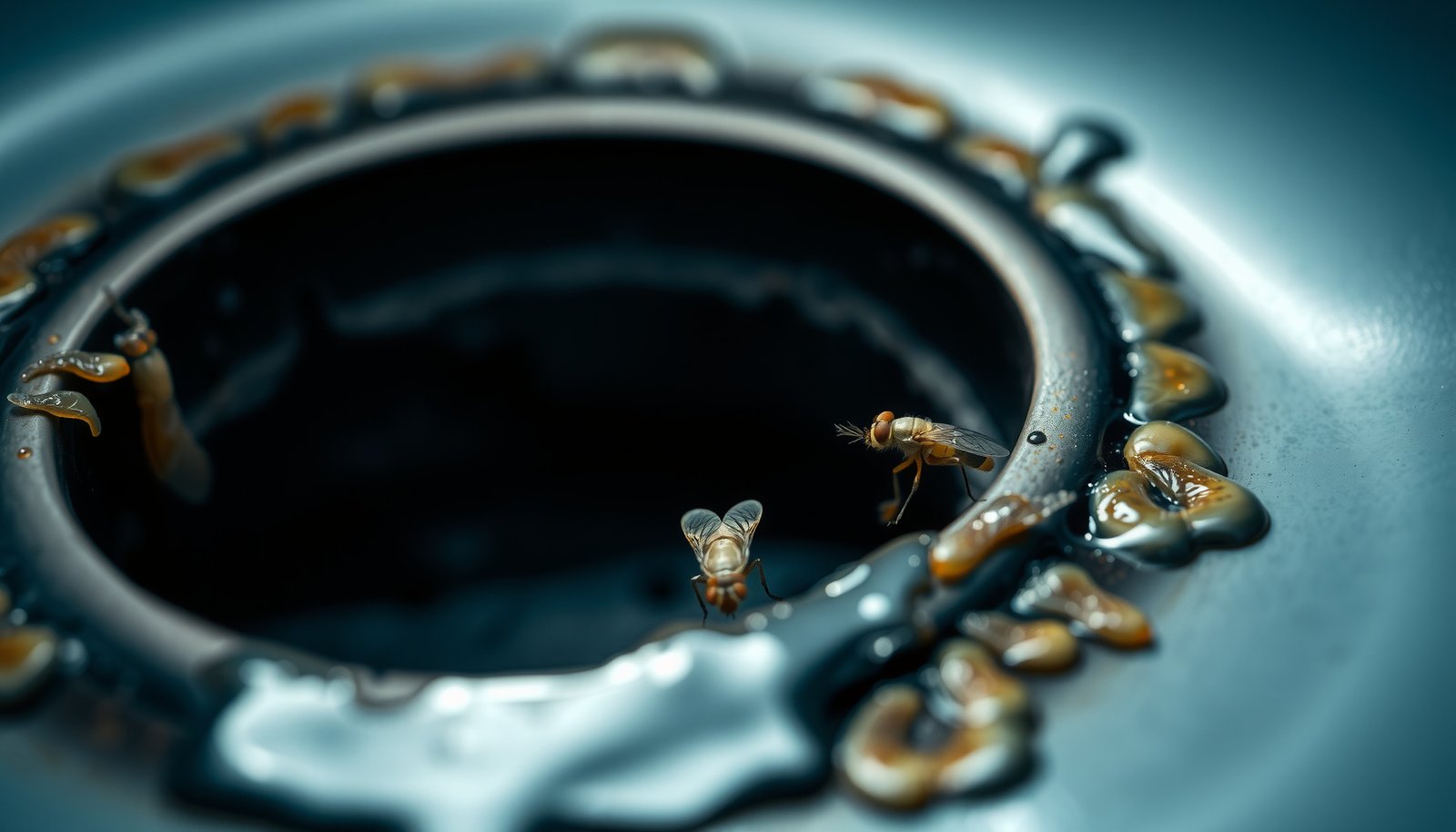
This close-up shows the type of thick organic biofilm coating the inside of a residential drainpipe — the exact material drain fly larvae use as both habitat and food source, and the reason enzyme-based cleaners outperform caustic formulas for this specific pest.
What Ingredients Actually Kill Drain Flies at the Source?
The products that genuinely work against drain flies rely on one of two active mechanisms — or ideally, both. Enzyme-based formulas use protease, lipase, and amylase enzymes to break down the proteins, fats, and starches that make up biofilm. Bacterial drain treatments go a step further, introducing live bacteria (typically Bacillus strains) that colonize the pipe surface and continue digesting organic matter for days after application. Neither of these is as dramatic as watching a caustic cleaner bubble and foam, but they’re measurably more effective against the actual pest.
Gel-based drain treatments with surfactants matter too. A thin liquid formula runs straight down the center of the pipe and drains away before it can penetrate the side-wall biofilm. Gel consistency means the product clings to pipe surfaces for an extended dwell time — typically 6 to 8 hours — long enough for enzymatic action to actually chew through the organic layer. That distinction between gel and liquid is something most product labels don’t explain clearly, but it has a real impact on results.
“Drain flies are a biofilm pest, not a water pest. Every treatment approach that ignores the pipe wall surface is going to disappoint the homeowner. Enzyme-based gel treatments applied at low-use hours — when the drain is sitting still overnight — outperform anything caustic by a wide margin because they have time to digest the habitat, not just rinse through it.”
Dr. Ellen Maris, Board-Certified Entomologist and Structural Pest Management Specialist, University Extension Services
The Best Drain Cleaners That Actually Kill Drain Flies — Ranked and Explained
Not every enzyme drain product is formulated with drain flies in mind — some are purely clog-prevention products that happen to use enzymes. The ones below are selected specifically because they have the biofilm-digesting capacity needed to eliminate the larval habitat, not just deodorize or unclog. These are the products that hold up after repeated testing and real-world use in residential plumbing.
- American Bio-Sciences Drain Gel — This is the closest thing to a professional-grade product in consumer packaging. It uses a concentrated blend of bacterial cultures and surfactants in a thick gel formula that clings to vertical pipe surfaces. Applied overnight for 5 consecutive nights, it eliminates existing biofilm and keeps working after application because the bacterial colonies persist. Best for: bathroom sink drains and shower drains where biofilm is heavy.
- Green Gobbler Drain Clog Dissolver (Enzymatic Formula) — Available widely and reasonably priced, Green Gobbler’s enzyme formula isn’t just a clog product. The enzyme concentration is high enough to degrade the grease and organic matter drain fly larvae depend on. It’s thinner than some gel options, so pour slowly and leave overnight — don’t flush with water for at least 6 hours. Best for: kitchen sink drains where grease is the dominant biofilm component.
- InVade Bio Drain Gel (Rockwell Labs) — Originally formulated for commercial food service pest control, InVade has made its way into the consumer market and it deserves its reputation. The combination of natural citrus microbes and surfactants is specifically engineered to break down the scum layers in drains, mop buckets, and garbage disposal areas. It’s the one professional pest control technicians actually use when treating drain fly infestations. Best for: kitchen drains, garbage disposal drains, and bar sink drains.
- BioWonder Drain Fly Eliminator Gel — Marketed directly at the drain fly problem rather than clogs in general, BioWorder’s formula includes enzyme strains specifically selected for organic sludge breakdown. It’s applied via a brush applicator that lets you coat the upper inches of the pipe walls directly — that’s a significant advantage over pour-only products. Best for: P-traps and sink drains where you want manual application control.
- Zep Drain Defense Enzymatic Drain Cleaner — Zep’s enzymatic formula is a solid mid-range option available at most hardware stores. It won’t outperform InVade or American Bio-Sciences in head-to-head biofilm tests, but it’s accessible, affordable, and genuinely contains active enzyme cultures rather than just surfactants with enzyme branding. Best for: maintenance use after initial infestation is cleared.
One honest nuance: how well any of these products performs depends significantly on your pipe material and drain configuration. Cast iron pipes develop rougher interior surfaces over time, which means biofilm adhesion is stronger and you’ll likely need more applications — sometimes 7 to 10 consecutive overnight treatments rather than the standard 5. PVC pipes in newer construction hold biofilm less aggressively, and 3 to 5 nights is often enough to see a dramatic drop in adult emergence.
How to Use Drain Cleaners Correctly So Drain Flies Don’t Come Back
Picture this: you apply a drain gel Sunday night, see fewer flies by Tuesday, feel like it’s handled, and stop treatment. Ten days later the flies are back in the same numbers. This is the most common reason drain fly treatments “fail” — the biofilm regenerates within 1 to 2 weeks if treatment is cut short. A full elimination protocol requires consistency across at least 5 consecutive nights, because the adult fly’s lifecycle from egg to emergence spans roughly 9 to 15 days, and you need to break that cycle completely, not just dent it.
Application timing matters more than most people realize. The drain needs to sit undisturbed while the enzymatic formula works. That means applying after the last sink use of the night — typically just before bed — and not running water in that drain until morning. Pouring boiling water first to loosen surface sludge before applying the enzyme gel is also a real improvement, not a myth: it softens the outer biofilm layer and lets the enzymatic formula penetrate deeper. Just let the pipe cool for 10 minutes before applying the gel so you don’t deactivate the enzyme cultures with excess heat.
Pro-Tip: After your initial 5-night treatment, don’t skip maintenance. A weekly enzyme treatment — even just a half-dose — prevents biofilm from re-establishing. Drain fly populations can rebound from even a small patch of surviving biofilm in as few as 3 weeks, so staying ahead of it is significantly easier than starting over.
Which Drains Do You Actually Need to Treat — and Which Ones People Miss?
Most people treat the drain where they see the adults flying. That’s a reasonable starting point, but drain flies don’t always emerge from the drain they’re breeding in — adults can travel 20 to 30 feet from the breeding site. Bathroom sink flies might actually be coming from the shower drain, the utility sink in the laundry room, or even a floor drain in the basement that sees almost no water use. Stagnant drains — ones that aren’t used regularly — are actually more likely to develop the undisturbed biofilm layer that drain fly larvae need.
The best way to confirm which drain is the source is the tape test: cover the drain opening with clear tape (sticky side down) before bed, leave it overnight, and check it in the morning. Adults emerging from the drain will get caught on the tape. Do this on every drain in the affected area over 2 to 3 nights before committing your treatment protocol. Treating every drain in the house isn’t a bad instinct, but knowing the primary source lets you concentrate your most intensive treatment where it will have the biggest impact.
| Drain Type | Drain Fly Risk Level | Key Factor |
|---|---|---|
| Bathroom sink drain | High | Hair, soap scum, and toothpaste buildup create dense biofilm quickly |
| Shower / bathtub drain | Very High | Warm humidity and heavy organic load; often overlooked during treatment |
| Kitchen sink drain | High | Grease and food particles accumulate fast; garbage disposal adds organic debris |
| Floor drain (basement, laundry) | Very High | Rarely flushed, often forgotten — ideal undisturbed breeding environment |
Floor drains deserve special attention. A basement floor drain that hasn’t seen significant water flow in months can develop a biofilm colony substantial enough to support hundreds of larvae with no one noticing. If your home has a finished basement or an older laundry setup, pour a quart of water down that floor drain monthly just to keep the trap wet — a dry trap doesn’t just smell, it turns the drain into a completely unobstructed entry and breeding point for drain flies and other pests.
Drain fly problems in multi-unit buildings follow a different logic. Shared plumbing stacks mean your neighbor’s drain activity (or inactivity) can feed a shared biofilm environment. This is actually similar to how ants in wall voids spread between units — the pest is using structural shared spaces that no single tenant controls, which limits how completely one person can solve the problem alone. If you’re in an apartment and treating consistently without improvement, the source may be in a shared drain stack that requires building management to address.
For renters in subsidized housing, this matters even more. If your drain fly infestation is tied to shared plumbing infrastructure that management refuses to address, you have documented habitability rights. Resources like Section 8 and public housing pest rights lay out exactly what tenants can demand in writing — including pest-related maintenance in common infrastructure — which is worth knowing before you spend money treating a problem the building is responsible for fixing.
What to Do When Drain Cleaners Alone Aren’t Enough
Enzyme drain gels handle the vast majority of residential drain fly problems if used correctly and consistently. But there are situations where the infestation is severe enough — or the biofilm buildup is extensive enough — that drain treatment alone can’t keep up with the reproductive rate. A single female drain fly lays up to 100 eggs per batch, and if biofilm extends several feet into your plumbing system, no consumer-grade gel is going to penetrate that far without supplemental mechanical cleaning.
In these cases, the most effective approach combines enzyme treatment with a physical scrubbing step first. A long-handled drain brush run down the pipe before the initial gel application physically dislodges the outer biofilm layer, dramatically improving how far the enzymatic formula can penetrate. For severe infestations in kitchen drains, a plumber’s auger or even professional hydro-jetting clears years of buildup in minutes — and that’s sometimes the only realistic starting point before enzyme maintenance can take over.
- Drain brush scrubbing: Use a flexible drain brush to physically break up biofilm before applying any enzyme product — this increases enzyme penetration significantly and is free if you already have the brush
- Boiling water flush: Pour near-boiling water down the drain first to loosen and partially dissolve the outer biofilm, then wait 10 minutes before applying enzyme gel so you don’t deactivate the cultures
- Adult fly control (temporary): While treating the drain, use a pyrethrin-based aerosol or a sticky trap near the drain opening to reduce the adult population and prevent re-laying eggs during the treatment window
- Garbage disposal cleaning: The underside of a garbage disposal splash guard is one of the most biofilm-rich surfaces in any kitchen and is almost never cleaned — scrub it with a brush and dish soap before treating the drain below
- Increase drain use frequency: For rarely used floor drains, simply running water through them once a week disrupts biofilm accumulation — the larvae need undisturbed, stagnant conditions to thrive
Here’s the counterintuitive part that most drain fly articles skip entirely: killing the adult flies is almost pointless as a standalone strategy. Adults live only about two weeks, they don’t feed or bite, and they’re not the infestation — they’re the symptom. Every adult you kill with a spray was already finished breeding. The infestation is the larvae in the pipe, which means your entire effort should be aimed below the drain cover, not above it. Adult control measures are only worth using to prevent re-infestation during the treatment window, not as the primary solution.
Once you’ve cleared the infestation and moved into a maintenance routine, the real goal is keeping biofilm from re-establishing in the first place. Monthly enzyme treatments, consistent drain use, and occasional physical scrubbing are genuinely enough to prevent drain flies from returning in most homes. The drains that stay clean aren’t necessarily the ones in the tidiest kitchens — they’re the ones whose owners treat drain maintenance as part of the routine, not a crisis response.
Frequently Asked Questions
What drain cleaners actually kill drain flies and their larvae?
Enzyme-based drain cleaners like Green Gobbler or Bio-Clean are your best bet because they break down the organic slime layer where drain flies lay their eggs. Gel formulas work better than liquids here — they cling to pipe walls long enough to destroy the biofilm instead of just washing through. For a severe infestation, you’ll want to apply the cleaner 2-3 nights in a row to wipe out multiple life cycle stages.
Will bleach kill drain flies in pipes?
Bleach will kill adult drain flies on contact, but it moves through pipes too fast to wipe out the gelatinous biofilm where larvae actually live. It’s also corrosive to older pipes and septic-unfriendly in large amounts. You’re better off using a dedicated enzyme drain cleaner that sits in the pipe and eats the organic matter — that’s what eliminates the breeding source, not just the adults you can see.
How long does it take for drain cleaner to get rid of drain flies?
Most people see a significant drop in adult flies within 3 to 7 days of consistent treatment, but full elimination usually takes 2 to 3 weeks. That’s because the drain fly life cycle runs about 8 to 24 days depending on temperature, so you need repeated treatments to catch eggs and larvae that survive the first round. Don’t stop after one application just because the adults disappear — there are almost certainly eggs still hatching in the pipe.
Can I use Drano or Liquid-Plumr to kill drain fly larvae?
Drano and Liquid-Plumr are designed to dissolve clogs, not biofilm, so they’re not reliable for killing drain fly larvae. They work fast and flush through quickly, which means they don’t have enough contact time with the pipe walls to destroy the slime layer drain flies breed in. If you’ve got a clog AND drain flies together, clear the clog first with a chemical drain cleaner, then follow up with an enzyme-based product to handle the infestation.
Are enzyme drain cleaners safe to use in bathroom sink drains for drain flies?
Yes, enzyme drain cleaners are safe for bathroom sinks and are actually the preferred option because they won’t damage PVC, metal pipes, or the rubber seals around your drain. They’re also septic-safe, which matters if you’re dealing with flies in multiple drains throughout the house. Pour about 8 ounces down each affected drain at night when the water won’t be running for several hours — that contact time is what makes the treatment work.