
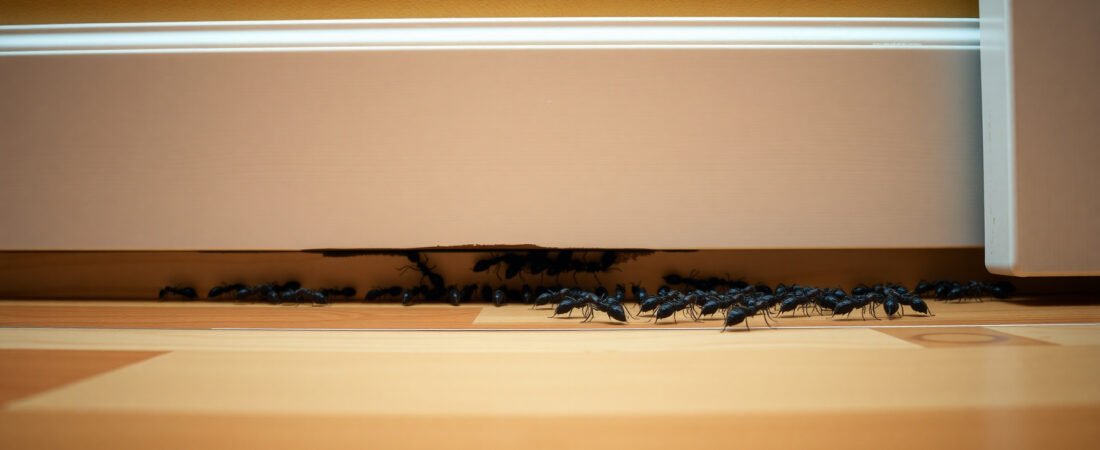
Spraying the baseboards won’t fix ants in the wall — and that’s exactly why most people are still dealing with them six months later. The wall itself isn’t the problem. The wall is just where the colony set up shop after finding something it needed inside your home. Treat the symptom and you’ll kill a few dozen workers. Find the reason they chose your wall and you can wipe out a colony of 100,000 or more. That’s the difference between a temporary fix and an actual solution.
Why Are There Ants Living Inside Your Wall in the First Place?
Ants don’t randomly colonize walls. They’re drawn there by three things: moisture, warmth, and a protected void they can hollow out or move into. Carpenter ants, for example, don’t eat wood the way termites do — they excavate it, chewing out galleries in wood that’s already been softened by moisture damage. A slow leak behind a bathroom tile or a weeping pipe under a kitchen sink can quietly turn a wall void into prime real estate for a colony that took up residency months before you noticed the first ant on your counter.
Odorous house ants and pavement ants behave differently — they’ll nest in wall voids without needing damaged wood, using the insulated space as a thermal refuge, especially in colder months. The critical point most homeowners miss is that the ants you’re seeing on the surface represent maybe 5–10% of the total colony. The workers forage. The queen and brood stay hidden, often 12–18 inches deep inside the wall structure, completely unreachable by a surface spray.
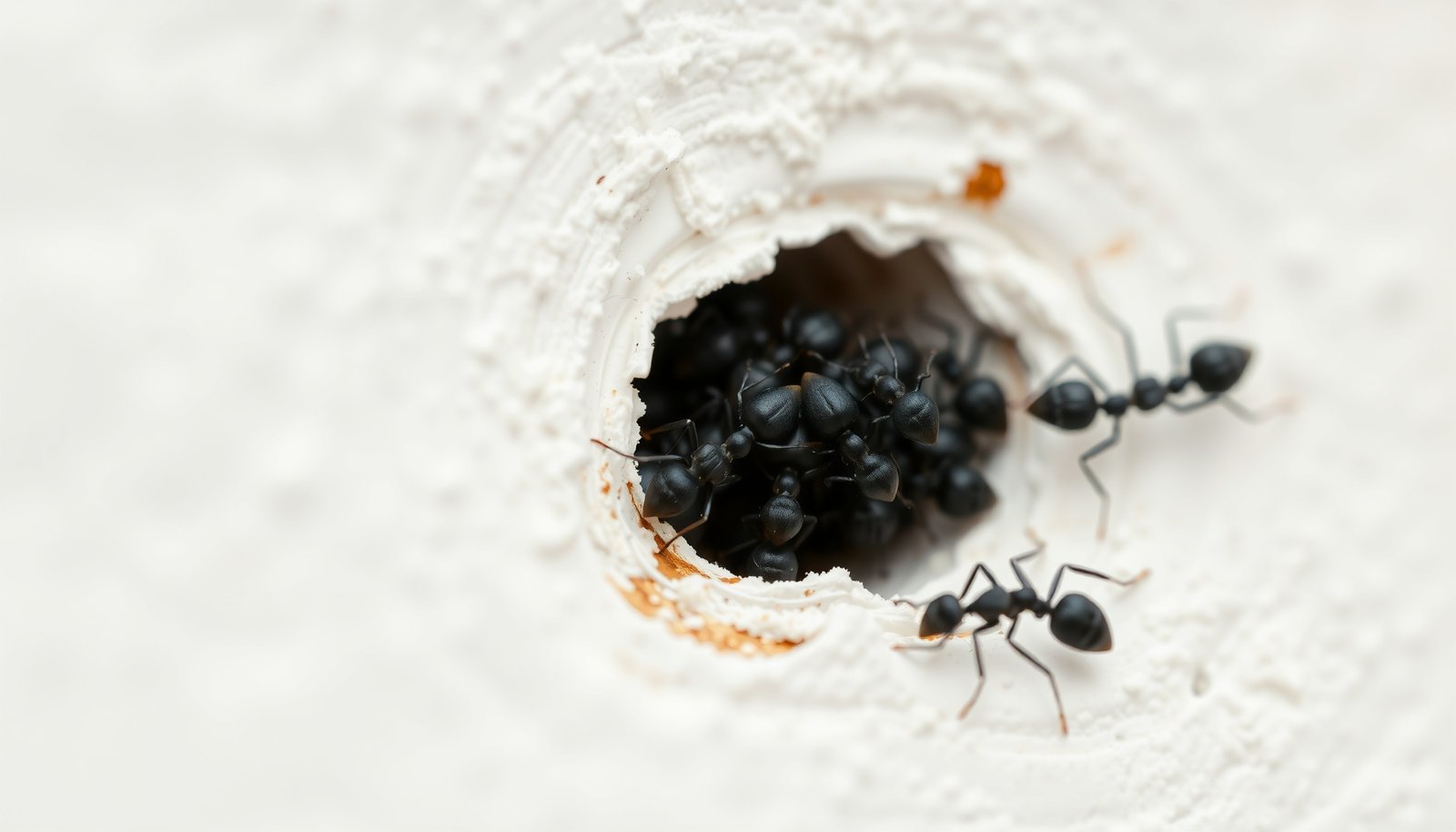
This close-up shows ant workers moving through a wall void along a visible trail — the kind of established highway that tells you a colony is already well-organized inside the structure, not just passing through.
How Do You Know the Ants Are Actually Inside the Wall (Not Just Entering Through It)?
There’s a real difference between ants nesting in your wall and ants using a gap in your wall as a doorway to forage from an outdoor nest. Getting this wrong is one of the most common reasons DIY treatments fail — people treat the interior heavily while the actual colony sits 3 feet outside in a tree root or a mulch bed. If you’re seeing ants emerge from an outlet plate, a baseboard crack, or a gap around a pipe penetration consistently throughout the day (not just in the morning when outdoor foragers first come in), that’s a strong sign of an interior colony.
Listen for the colony, too — this sounds odd but it works. Carpenter ant colonies inside walls sometimes produce a faint rustling or crinkling sound, particularly in quiet conditions at night. Tap along the wall with a screwdriver handle; a hollow, papery thud in a spot that should be solid often indicates excavated wood. Frass is another giveaway: carpenter ants push debris out of their galleries, and you may find small piles of what looks like coarse sawdust mixed with insect parts near wall-floor junctions, even if you’ve never seen a live ant there.
“Homeowners consistently underestimate how long an ant colony has been established before they see any surface activity. By the time you notice workers trailing along a baseboard, that colony may have been inside that wall void for several months. The foraging workers you see are just the tip of the iceberg — the reproductive core of the colony is insulated deep inside and won’t be affected by anything you put on the surface.”
Dr. Ellen Marsden, Board-Certified Entomologist and Urban Pest Management Specialist, Clemson University Extension
What Actually Kills Ants in the Wall Without Tearing It Open?
The only DIY methods that reliably eliminate a wall-nesting ant colony without an exterminator work through the ants themselves. Slow-acting bait is the mechanism that makes this possible. Worker ants pick up bait, carry it back to the nest, and share it through trophallaxis — a mouth-to-mouth food-sharing behavior — spreading the active ingredient through the colony before anyone dies. If bait kills ants too fast, workers stop carrying it. That’s why products with low concentrations of borax or fipronil (typically 0.001%–0.5%) outperform contact sprays every time for interior colony elimination.
Bait placement matters as much as bait selection. Put it directly on the active trail, not near it. Ants follow pheromone pathways and if the bait isn’t within a few millimeters of that path, many species simply won’t investigate it. Don’t clean the trail before baiting — that pheromone highway is exactly what you want to keep intact so workers keep moving through the area. And don’t use any spray insecticide in the same zone as your bait; the repellent chemicals in most contact sprays will cause ants to abandon the trail entirely, breaking the transfer chain back to the queen. For a deeper look at which bait products actually perform in field conditions, the Best Ant Bait Stations: Terro vs Amdro vs Raid Compared breakdown covers the real-world differences between the leading options.
Pro-Tip: If ants are ignoring your bait after 48 hours, the issue is usually one of two things — either a competing food source nearby (crumbs, pet food, a sticky spill behind the stove) or the wrong bait matrix for that ant species. Carpenter ants prefer protein-based bait, especially in spring. Odorous house ants lean toward sugar. Switch matrices and eliminate competing food sources before assuming the bait doesn’t work.
Step-by-Step: How to Treat Ants in the Wall Without Calling Anyone
This process won’t take a single afternoon — a realistic timeline for collapsing a wall colony with DIY bait is 1–3 weeks, sometimes longer for large carpenter ant colonies. That’s not a failure of the method; it’s how the biology works. Rushing it by adding sprays or switching products too early is the most common reason people end up calling a professional anyway.
- Identify the species first. Carpenter ants (large, usually black, 1/4 to 1/2 inch) need different bait and treatment than odorous house ants (tiny, dark brown, smell like rotten coconut when crushed) or pavement ants (small, dark, seen near foundations). Getting this wrong means using the wrong bait matrix.
- Locate the active trail and the entry point. Follow workers from your bait stations back toward where they’re emerging. Mark the entry points with painter’s tape — you’ll caulk these after treatment is complete, not before (sealing them now just redirects the colony).
- Place slow-acting bait directly on the trail. Use pre-filled bait stations or gel bait applied in pea-sized dots. For wall-nesting ants, stations near the entry point and along baseboards within 6 inches of where ants are emerging tend to get the highest uptake. Refresh bait every 3–4 days or whenever it’s depleted.
- Inject a non-repellent dust into the wall void if activity is heavy. Diatomaceous earth or boric acid powder can be injected through outlet plates or small drilled holes (1/4 inch diameter) using a hand duster. These work mechanically — DE damages the exoskeleton, boric acid disrupts the digestive system — and won’t repel ants away from bait. This step is optional for small colonies but worth adding for established carpenter ant nests.
- Address the moisture source if one exists. This step is non-negotiable for carpenter ant infestations. No bait program will deliver permanent results if there’s still a slow leak or persistently damp wood making the wall void attractive. Fix the moisture issue before you declare victory.
- Seal entry points once foraging activity has dropped to near zero. Use paintable caulk for gaps at baseboards and wall-floor junctions; expanding foam for larger gaps around pipes. Don’t seal while active ants are still moving through — you’ll trap survivors who may find another exit elsewhere in the house.
Picture this: a homeowner in a 1960s ranch house spends three weekends spraying Raid along the baseboard in her kitchen, wiping out hundreds of ants each time — only to find them back within four days. The colony in the wall behind her dishwasher was never touched. When she finally switched to a protein-based gel bait placed directly on the trail, activity dropped by roughly 80% within 10 days and was gone by week three. The spray felt like it was working. The bait actually worked.
What’s the Difference Between Ant Species in Walls — and Does It Change the Treatment?
Yes, it changes everything. Carpenter ants nesting in walls represent a structural concern that odorous house ants simply don’t — they can hollow out load-bearing lumber over time, and a mature colony can contain 10,000–20,000 workers at its peak. Odorous house ants are more of a nuisance issue; they nest in wall voids but don’t damage the structure. Pavement ants typically nest in wall insulation or between floors near concrete foundations. Each species responds to different bait matrices and has different foraging patterns that affect where and how you place product.
| Ant Species | Preferred Bait Type | Wall Damage? | Typical Colony Size |
|---|---|---|---|
| Carpenter Ant | Protein-based (spring/summer), sugar (fall) | Yes — excavates soft/damp wood | 3,000–20,000 workers |
| Odorous House Ant | Sugar/sweet liquid bait | No — nests in void only | 10,000–100,000 workers |
| Pavement Ant | Sugar or protein (varies) | No — nests in insulation/gaps | 3,000–5,000 workers |
One honest nuance worth flagging: the DIY approach described here works well for single-species infestations in single-family homes. Multi-unit buildings complicate things significantly — colonies can span multiple units and migrate through shared wall voids, meaning treatment in one unit is undermined by untreated sections next door. If you’re renting and your neighbor’s infestation keeps reseeding yours, that’s a landlord responsibility issue rather than a product failure. Tenants in subsidized housing can find specific guidance on what they can formally request in Section 8 and Public Housing Pest Rights: What Tenants Can Demand.
Species identification also matters for knowing when to escalate. Carpenter ants in walls with visible frass and hollow-sounding wood, especially in a home with known moisture issues or older lumber, are worth having a professional assess — not because the baiting method won’t work, but because you want to know whether the wood damage has already progressed to a structural level. Baiting will eliminate the colony. It won’t rebuild a compromised wall stud.
How Do You Stop Ants From Coming Back to the Wall?
Permanent prevention is mostly about eliminating the conditions that made your wall attractive in the first place. For carpenter ants, that means controlling moisture — gutters that drain away from the foundation, no wood-to-soil contact on siding or framing, and fixing any slow leaks before they soften structural wood. For odorous house ants and pavement ants, it’s about eliminating entry points and disrupting the foraging trail chemistry so the wall void doesn’t get “remembered” as a resource-rich site.
- Caulk every gap around pipe penetrations, electrical conduit, and HVAC lines where they pass through exterior walls — these are the most common entry highways into wall voids.
- Keep mulch at least 12 inches from your foundation. Mulch retains moisture and harbors ant colonies that will eventually bridge into the structure. Gravel is a better border material directly against the foundation.
- Trim tree limbs and shrubs so they don’t touch the exterior walls. Carpenter ants routinely use overhanging branches as a bridge from outdoor nest sites into structures.
- Store firewood at least 20 feet from the house and off the ground. Firewood is one of the most common sources of carpenter ant satellite colonies that end up migrating inside.
- Replace weather stripping on doors and windows annually if you’re in a climate with heavy ant pressure in spring and summer. The gap under a poorly sealed exterior door is often 1/4 inch or more — more than enough for any ant species to use as a regular entry.
Here’s the counterintuitive part of long-term prevention that almost no article mentions: a successfully treated wall void doesn’t protect you from reinfestation. Once a colony is gone, the void is empty again — and it still has the same qualities (insulation, protection, proximity to moisture) that made it attractive the first time. A new colony can move in within a single foraging season. Sealing the physical entry points after treatment isn’t optional if you want the result to last. The bait kills the colony. The caulk prevents the sequel.
Get the structural sealing done right and your odds of a repeat infestation drop dramatically. Ants are extraordinarily good at finding new entry points, but they’re also efficient — they’ll exploit the easiest available route first. Take away the easy routes and most foraging scouts will move on to a different structure entirely.
Frequently Asked Questions
How do I know if I have ants in the wall?
The clearest sign is a faint rustling or crinkling sound coming from inside your walls, especially at night when it’s quiet. You might also notice small piles of sawdust-like frass near baseboards, which points to carpenter ants hollowing out wood. If you’re seeing ants consistently emerging from the same crack or outlet, there’s almost certainly a nest behind it.
What kills ants in the wall without tearing it open?
Bait stations are your best bet — ants carry the poison back to the colony and kill it from the inside out. Gel baits like Terro (borax-based) work well placed along ant trails near where they’re entering the wall. Give it 1 to 2 weeks to fully work; killing them too fast with a spray actually makes things worse because it scatters the colony.
Can I use Raid or bug spray to kill ants inside walls?
It’s not a great idea. Spraying an insecticide into a wall void will kill the ants it reaches but forces the rest of the colony deeper or causes them to split into multiple nests, making the problem harder to fix. Bait is a much more effective approach because it works with the ants’ natural behavior rather than against it.
How long does it take to get rid of ants in the wall with bait?
Most homeowners see a significant reduction in ant activity within 3 to 7 days, but completely eliminating a colony can take 2 to 4 weeks depending on how large it is. Don’t remove or replace the bait too early — worker ants need time to keep feeding it back to the queen. If there’s no improvement after 4 weeks, you may be dealing with a large carpenter ant colony that needs a different treatment approach.
What’s the best way to seal walls so ants don’t come back?
Once the colony is gone, caulk every gap you can find around pipes, outlets, baseboards, and window frames — ants can squeeze through a crack as small as 1/16 of an inch. Use silicone or latex caulk for small gaps and expanding foam for larger openings around pipes. Also fix any moisture problems like leaky pipes or water-damaged wood, since wet wood is one of the main things that attracts carpenter ants to walls in the first place.
Disclaimer: This article is for informational purposes only and isn’t a substitute for professional pest control advice. Always read and follow the product label instructions exactly — label directions are legally binding and vary by brand and active ingredient. Keep all pesticides, baits and traps away from children and pets, ventilate treated areas as directed, and consider calling a licensed pest control professional if an infestation is large, recurring, or involves a structural pest like termites or carpenter ants.