

Ants coming through electrical outlets aren’t looking for electricity — they’re looking for shelter, warmth, and a highway that bypasses every barrier you’ve set at ground level. That distinction matters more than most people realize, because if you treat this like a standard ant entry-point problem, you’ll seal the wrong things, apply product in the wrong places, and watch the ants keep coming.
Here’s the core issue most articles skip entirely: the outlet isn’t where the infestation starts. It’s where it becomes visible. The colony — or the satellite colony — is almost certainly already living inside your wall void, and the outlet faceplate is just the door they cracked open. Plug the outlet without addressing what’s behind the wall, and you’ve done almost nothing.
This guide focuses specifically on that wall-void reality: what’s driving ants toward electrical infrastructure, how to confirm what species you’re dealing with, and how to eliminate the source rather than just block the exit. You’ll also find out which control methods can backfire badly near live electrical components — and what to use instead.
Why Are Ants Using Your Electrical Outlets as a Door?
Electrical outlet boxes create a near-perfect ant habitat by accident. The wiring that runs through your walls generates a small but consistent amount of heat, and wall voids are dry, protected from rain and predators, and almost completely undisturbed. For species like carpenter ants, odorous house ants, and Argentine ants, a wall void with electrical runs is genuinely attractive real estate — not just a passageway.
The outlet opening itself is a structural gap that exists in almost every home. Standard electrical boxes rarely form an airtight seal against drywall, and the space around the wire entry points into the box can be wide enough to let ants pass through single file. Ants communicate trail locations through pheromone signals, so once even a handful of scouts discover this route, dozens — or hundreds — follow within 24 to 48 hours. By the time you see ants appearing at the outlet faceplate, there’s already a well-established chemical highway running behind your wall.
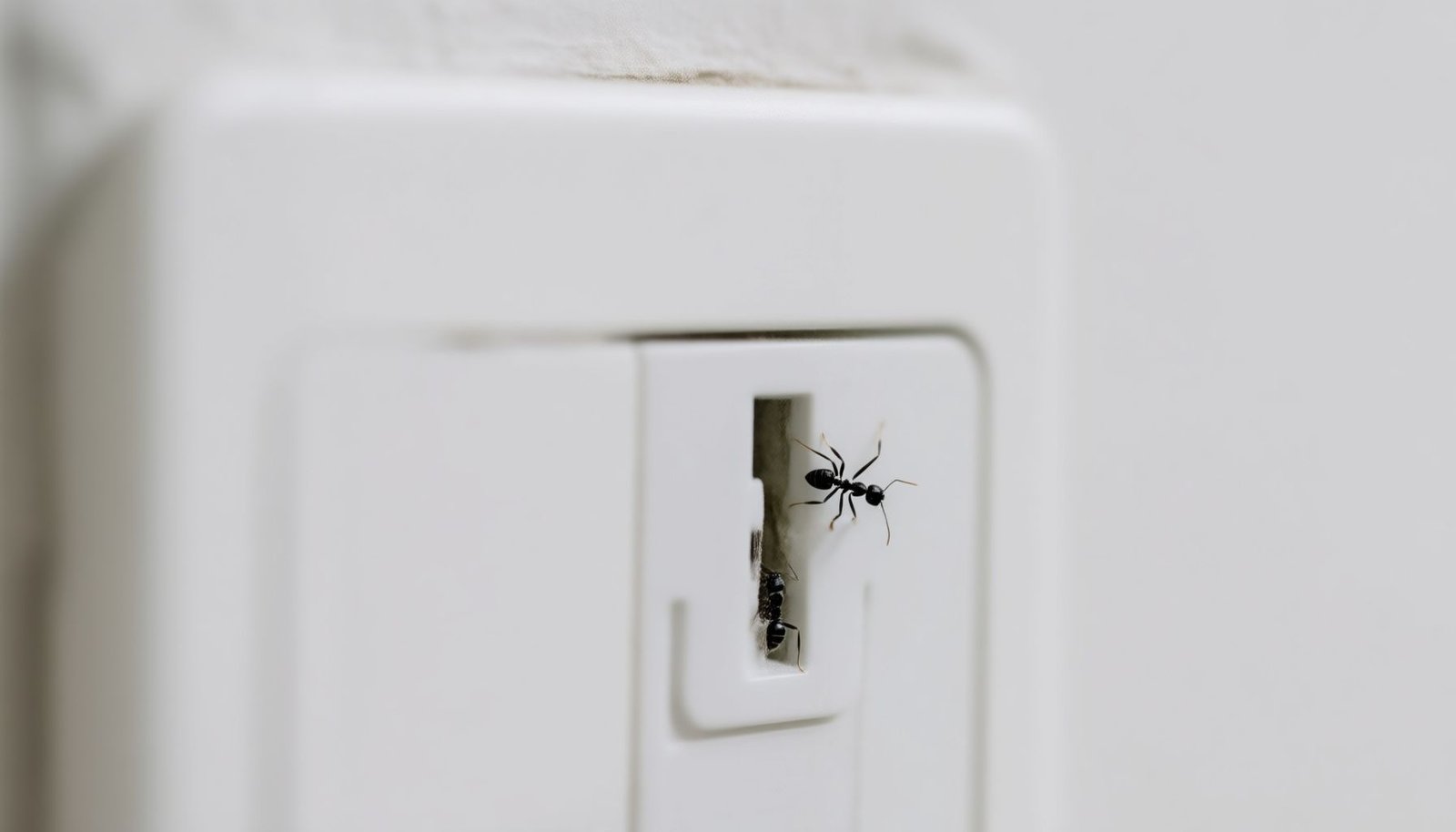
This close-up shows the gap between a standard outlet box and the surrounding drywall — a gap that looks insignificant to us but is a four-lane highway for foraging ants carrying pheromone trails back to a colony inside the wall.
Which Ant Species Are Most Likely Behind Your Outlet?
Species identification changes everything about how you treat this problem. Not all ants nest in walls — some are just passing through from an outdoor nest — and using the wrong bait for the wrong species can actually make the infestation worse by causing colony budding, where stressed ant colonies split and scatter into multiple new nesting sites deeper in your home.
Picture this: you spray a pyrethroid aerosol into the outlet and feel good about it. Two weeks later, you have ants coming out of a different outlet on the same wall, plus a new trail appearing in the bathroom above. That’s budding in action — and it’s one of the most common ways a manageable ant problem turns into a multi-room situation. Here are the species most commonly found nesting in or traveling through wall voids near electrical infrastructure:
| Species | Nest Location | Key Identifier | Risk of Budding |
|---|---|---|---|
| Odorous House Ant | Wall voids, insulation | Rotten coconut smell when crushed | High |
| Carpenter Ant | Moist or damaged wood inside walls | Large, black or bicolored, winged swarmers | Low |
| Argentine Ant | Shallow outdoor nests, forages inside | Trails of uniform tiny brown ants | High |
| Pavement Ant | Soil under slabs, occasionally walls | Parallel lines on head/thorax under magnification | Low |
What NOT to Spray Into an Electrical Outlet (And Why It Backfires)
The instinct to grab a can of aerosol spray and blast it into the outlet gap is understandable, but it’s genuinely one of the worst things you can do in this specific situation. Most aerosol insecticides — including pyrethroids and permethrin-based products — are repellent, not attractive. Spraying them directly at the colony’s entry point panics the foragers, breaks the trail, and signals danger back to the nest. The colony doesn’t die. It relocates, often deeper into the wall or into an adjacent void.
There’s also an electrical safety angle that almost nobody talks about. Many aerosol sprays and liquid insecticides are water-based or alcohol-based, and spraying them into a live outlet box creates a real — if typically small — risk of short-circuit or arcing. Even products not labeled as flammable can cause conductivity issues if they contact live terminals inside the box. Unless the circuit is turned off at the breaker, you should not be spraying liquid products directly into an outlet. Full stop.
Pro-Tip: Before doing anything near the outlet, flip the circuit breaker for that room. It takes 30 seconds and eliminates any risk while you’re working. Once the power is off, you can remove the faceplate safely and inspect the inside of the box for nesting material, ant frass (fine sawdust-like debris from carpenter ants), or live ants — all of which tell you something useful about what you’re dealing with.
How to Actually Eliminate Ants That Are Nesting Inside Your Walls
The correct strategy for wall-void ant infestations relies on slow-acting bait — not repellent sprays. Ant bait works because forager ants pick up the active ingredient (usually a borate compound like disodium octaborate tetrahydrate, or a protein-based or sweet-based matrix depending on species), carry it back to the nest, and share it with the queen and larvae through a process called trophallaxis. The colony dies from the inside out. This process typically takes 3 to 7 days, and it requires that you do not disturb the ant trail while bait is active.
Here’s the step-by-step approach that addresses the wall void specifically, not just the visible outlet gap:
- Identify the species first. Sweet-feeding ants (odorous house ants, Argentine ants) take gel baits with sugar-based attractants. Protein-feeding ants (carpenter ants, some pavement ants) need a protein or grease matrix bait. Using the wrong bait type results in zero uptake — ants will walk right past it.
- Place bait along the active trail, not inside the outlet box. Set small bait stations or gel bait dots within an inch or two of where ants are exiting the outlet. The foragers need to find it on their established route. Don’t move it, don’t wipe up the trail, don’t spray anything nearby for at least 5 days.
- Apply a non-repellent residual to the wall void entry point. Products containing fipronil or imidacloprid (non-repellent active ingredients) can be applied as a crack-and-crevice treatment around the outlet box perimeter after the power is off. These don’t panic the colony — ants pick up the active ingredient without detecting it and carry it back to nestmates.
- Dust behind the outlet box with a silica gel or diatomaceous earth product. With the faceplate off and power off, a light application of insecticidal dust inside the void around the wiring acts as a long-lasting mechanical and desiccant barrier. It won’t cause electrical issues when applied as a fine, thin layer and allowed to settle — but don’t use a wet application in any form.
- Seal the gap after the colony is confirmed dead. Wait at least two full weeks after seeing zero ant activity before sealing around the outlet box with fire-rated foam or paintable latex caulk. Sealing too early traps surviving ants that may find new exit points elsewhere in the wall.
“The number-one mistake I see with outlet ant problems is treating the symptom — the visible trail — rather than the nest. Wall voids are essentially invisible to most homeowners, and the ants know it. Slow-acting bait is the only tool that can follow them back to where the colony is actually living. Anything repellent just moves the problem laterally inside the wall.”
Dr. Marcus Leland, BCE (Board Certified Entomologist), Urban Pest Management Specialist
How Do You Know If the Nest Is in the Wall vs. Outside?
This is a genuinely underappreciated diagnostic question, and the answer determines whether you need to treat primarily inside or primarily outside. If ants are nesting in the wall void, you’ll typically see them emerging from the outlet at multiple times of day, including overnight, and the trail inside your home will be more or less constant. If the colony is outdoors and ants are simply foraging through the outlet gap, you’ll usually see heavier activity during daytime hours, and the trail tends to lead from the outlet toward a specific food source — your kitchen, a pet bowl, a sticky spill — rather than circulating through multiple rooms without a clear destination.
Carpenter ants deserve special mention here because they’re the one species that can actually cause structural damage while living inside your wall. A colony of carpenter ants — which can reach 10,000 to 20,000 workers at full size — excavates galleries in wood to nest, and they strongly prefer wood that’s already been softened by moisture. Seeing large black ants (typically 1/4 to 1/2 inch long) emerging from an outlet near a bathroom, kitchen, or exterior wall should prompt you to check for a moisture issue behind the drywall. The ants aren’t the root problem in that case — a leak or condensation issue is. Interestingly, the same kind of hidden structural access that makes wall voids attractive to ants is what makes them attractive to wood-boring beetles — if you’ve already dealt with something like a powderpost beetle treatment for furniture and floors, you already understand how pests exploit concealed wood that rarely gets inspected.
Here’s a quick diagnostic checklist to figure out where the nest actually is:
- Ants are active at night just as much as during the day → likely nesting in the wall
- Trail leads directly from outlet to a food source and back, nothing more → likely an outdoor colony foraging in
- Fine, sawdust-like debris (frass) below the outlet → carpenter ants nesting nearby in wood
- Winged ants (swarmers) emerging from the outlet, especially in spring → established mature colony inside the structure
- Multiple outlets on the same wall showing ant activity → colony is mobile inside a shared wall void
- Activity stops when outdoor temperatures drop below 50°F → outdoor colony, ants were foraging inside for warmth
One honest nuance worth naming: in older homes — particularly those built before the 1980s with open-cavity balloon framing — wall voids can run continuously from the basement to the attic with almost no horizontal breaks. In those structures, a colony can spread across an entire wall plane and emerge from outlets on two different floors at once. Standard bait placement addresses this eventually, but treatment timelines in those homes are longer, and professional inspection becomes genuinely worth the cost. In newer homes with platform framing, wall voids are compartmentalized floor by floor, which naturally limits how far a nest can spread.
Long-Term Prevention: Closing the Entry System, Not Just the Outlet
Sealing individual outlet gaps is only one piece of the exclusion puzzle. Electrical wiring enters your home from the exterior through conduit penetrations, weep holes, and utility pass-throughs, and those exterior entry points are where ants actually get into the wall in the first place. An outlet gap on your interior wall is the last stop on a much longer journey that started outside. Treating only the interior without addressing the exterior entry points means you’re winning a battle while losing the war.
Outside the home, focus on the areas where exterior walls meet soil, mulch, or dense ground cover, since those are the staging zones where ant colonies set up satellite nests closest to your foundation. Keep mulch at least 6 inches away from siding. Trim any vegetation that bridges from the ground to the wall. Apply a non-repellent perimeter spray (fipronil or bifenthrin at label rate) along the foundation every 90 days during warmer months — bifenthrin specifically has a residual window of 60 to 90 days depending on rain and sun exposure. The same principle of creating a treated perimeter zone applies to wasp and hornet control, and if you’ve looked into tools like a long-range wasp nest foam spray for exterior gaps and void spaces, you already know that wall voids and eaves are shared infrastructure for multiple pest types — treating them proactively pays dividends across more than one problem.
Inside, the goal is to make your wall voids less hospitable and less accessible. Fix any active moisture issues — even a slow drip under a sink that shares a wall with an outlet showing ant activity is worth investigating. Use electrical outlet gaskets (they’re cheap foam inserts that slip behind the faceplate) to reduce the air gap between the box and the wall without restricting outlet function. They won’t stop a determined ant colony, but they reduce the appeal of the gap as an entry point for scouts initially exploring the territory. Think of them as friction, not a solution — one component in a layered approach rather than a fix on their own.
Once you’ve confirmed the colony is gone and you’re ready to seal permanently, fire-rated acoustical caulk or a non-expanding foam sealant applied around the perimeter of the outlet box (with power off) is more durable than standard paintable caulk and holds up better to temperature changes inside wall cavities. That’s a small detail most guides skip, but wall voids cycle through wider temperature ranges than finished interior spaces, and a sealant that cracks after one winter just creates the problem again the following spring.
Ant colonies are patient, and the ones that have already found a warm wall void in your home have essentially no reason to leave unless conditions inside that void become actively hostile or the food source disappears. The best outcome here isn’t “I killed the ants I saw” — it’s “I made my walls boring enough that no future colony bothers to move in.” That’s the standard worth working toward.
Frequently Asked Questions
why are ants coming through my electrical outlets?
Ants are attracted to the warmth and electromagnetic fields that electrical wiring produces, which can mimic the conditions they seek when building nests. They’re also using the wall void behind the outlet as a highway — if there’s a colony established inside your walls, the outlet is just the exit point, not the source. Small species like odorous house ants and ghost ants are the most common culprits.
is it dangerous to have ants in electrical outlets?
Yes, it can be. Ants, especially fire ants, are known to chew through wire insulation, which creates a real risk of short circuits or electrical fires. Even non-destructive species can cause problems in large numbers by triggering shorts or getting into breaker boxes. If you’re seeing more than a few ants consistently coming from an outlet, treat it as an urgent problem, not just a nuisance.
how do I get ants out of my electrical outlets?
Don’t spray liquid pesticides directly into an outlet — that’s a shock and fire hazard. Instead, use a dry bait like a gel ant bait placed on a piece of tape near the outlet so ants carry it back to the colony. You can also use food-grade diatomaceous earth carefully applied around the outlet’s edge to kill ants passing through. For heavy infestations inside the walls, a licensed exterminator is the safer call.
how do I stop ants from coming through outlets in the future?
After treating the infestation, seal the gap between the outlet box and the wall plate using foam backer rod or fire-rated caulk — this cuts off their entry point for good. Install foam outlet gaskets behind the outlet cover plates, which cost less than $1 each and reduce drafts that attract ants. Also check for moisture issues or food sources near affected walls since those are the main things drawing ants inside in the first place.
what kind of ants nest in walls and come out of electrical outlets?
The most common species that nest inside walls and show up at outlets are odorous house ants, Argentine ants, ghost ants, and pavement ants. Fire ants are less common inside walls but have been documented nesting in electrical systems, especially in the southern US. Carpenter ants are also a concern since they excavate wood to build nests and are often found in wall voids near moisture-damaged areas.
Disclaimer: This article is for informational purposes only and isn’t a substitute for professional pest control advice. Always read and follow the product label instructions exactly — label directions are legally binding and vary by brand and active ingredient. Keep all pesticides, baits and traps away from children and pets, ventilate treated areas as directed, and consider calling a licensed pest control professional if an infestation is large, recurring, or involves a structural pest like termites or carpenter ants.