
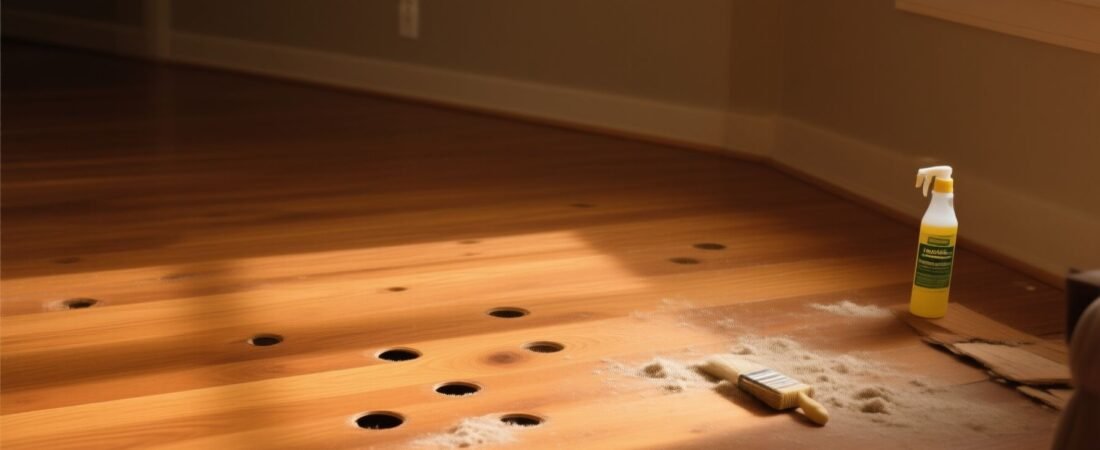
Sanding down the exit holes and refinishing your furniture won’t stop powderpost beetles — it just makes the wood look better while the larvae keep eating. That’s the mistake most people make, and it’s why they end up retreating the same bookcase or hardwood floor two seasons in a row. The real problem isn’t the holes you can see; it’s the eggs and larvae hidden up to an inch deep inside the wood that you can’t.
Why Most Powderpost Beetle Treatments Fail Before They Even Start
Here’s the part nobody talks about: powderpost beetles can spend anywhere from 1 to 5 years inside wood before the first adult ever chews its way out. By the time you notice that fine, flour-like frass spilling from tiny round holes — typically 1/32 to 1/16 inch in diameter for the most common Lyctus species — the infestation has often been ongoing for multiple generations. You’re not catching it early. You’re catching it late, after the larvae have already tunneled extensively through the wood’s interior.
This timeline changes how you should think about treatment. A surface spray alone won’t reach larvae sitting 3/4 of an inch inside a piece of antique oak. The treatment has to either penetrate deeply, fumigate the entire air space, or be applied as a preventive measure before the eggs are laid. Anything less is cosmetic. That single misunderstanding explains why so many homeowners spend money on products that genuinely work — just not in the way they’re applying them.
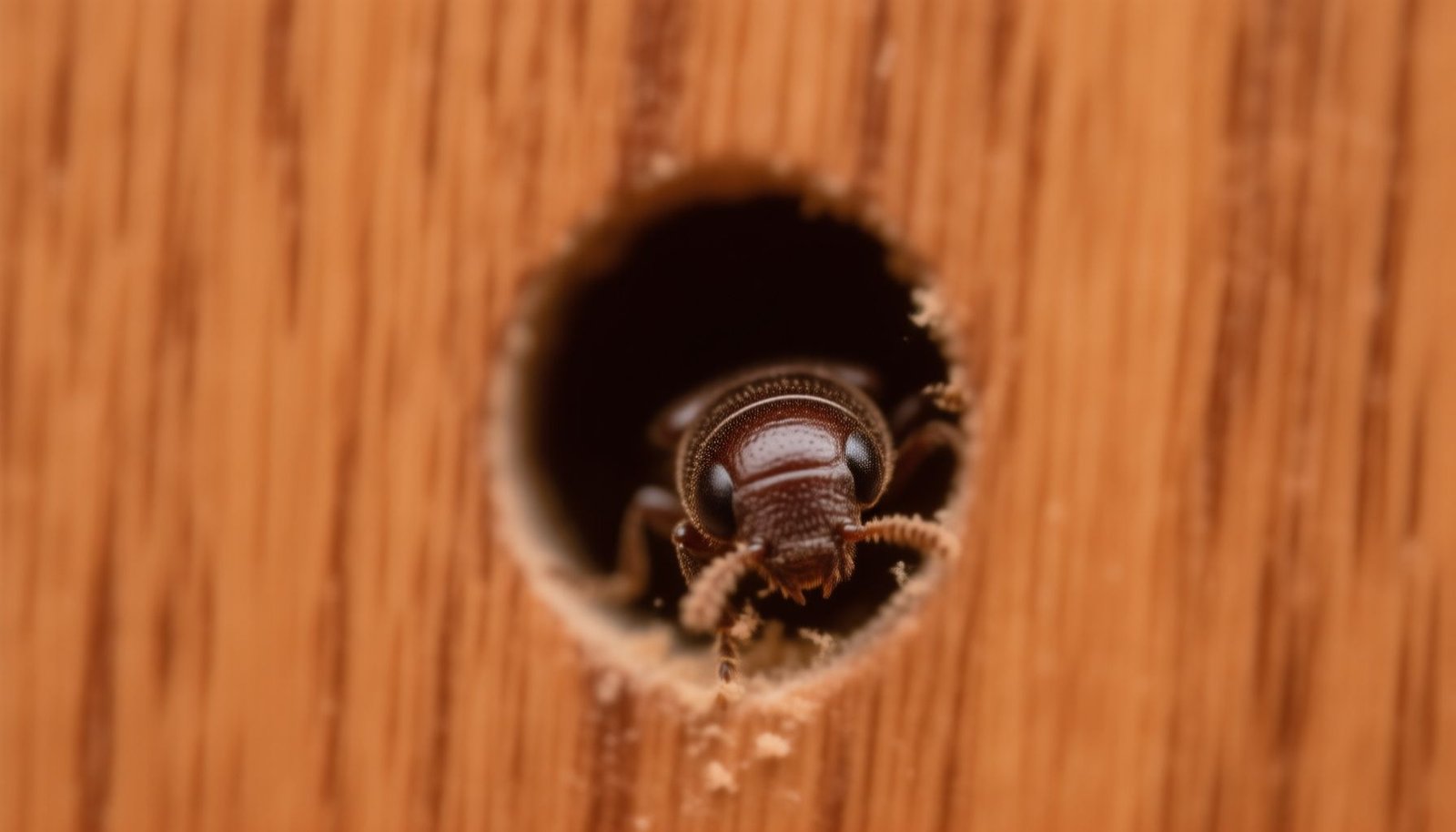
This close-up shows the telltale exit holes and powdery frass that signal an active infestation — understanding exactly what you’re looking at here determines which treatment approach will actually work for your situation.
Which Products Actually Penetrate Deep Enough to Kill Larvae?
Borate-based treatments are the gold standard for active powderpost beetle infestations in structural wood and furniture, and there’s a solid scientific reason for that. Borates — sodium borate, disodium octaborate tetrahydrate (DOT), or boric acid in solution — are water-carried, which means they penetrate into the wood fibers rather than just coating the surface. When a larva ingests treated wood, the boron disrupts its digestive system at a cellular level, killing it without leaving a harsh residue that’s dangerous to people or pets after it dries. Products like Bora-Care and Tim-bor Professional have been tested specifically for wood-boring beetle control and are the most recommended by pest professionals for this application.
The catch with borates is moisture. They need the wood’s moisture content to be above about 25% to carry the chemical deep enough, or they need to be diluted and applied in a way that allows absorption. On finished, sealed, or painted wood — like a lacquered dining table — borates can’t penetrate the surface coating and won’t reach the larvae underneath. That’s when you have to either strip the finish first, switch to a fumigation approach, or use a residual surface spray as a contact killer for emerging adults only. Knowing which situation you’re in before you buy anything saves a lot of wasted product.
Borate vs. Residual Spray vs. Fumigation: What’s Right for Your Situation?
The treatment that fits depends almost entirely on whether the wood is finished or unfinished, structural or freestanding, and how severe the infestation appears. A single antique dresser with a few exit holes is a completely different problem than an old-growth pine subfloor with frass coming up through cracks across 600 square feet. Treating them the same way is where DIY efforts fall apart.
| Treatment Type | Best For | Penetrates Finish? | Kills Larvae Inside Wood? |
|---|---|---|---|
| Borate solution (Bora-Care, Tim-bor) | Unfinished structural wood, subfloors, joists | No — finish must be removed | Yes, when absorbed properly |
| Residual surface spray (permethrin, bifenthrin) | Killing emerging adults, preventing re-infestation | N/A — surface contact only | No — larvae are protected |
| Fumigation (sulfuryl fluoride) | Finished furniture, antiques, severe whole-room infestations | Yes — gas penetrates entirely | Yes — 100% of life stages |
Pro-Tip: If you have a single piece of infested finished furniture — like an antique chair or a small cabinet — one practical option is sealing it completely in a heavy contractor bag with a few No-Pest strips or a Nuvan ProStrip for 2–3 weeks. This creates a localized fumigation environment at a fraction of the cost of professional tenting, and it’s a method many experienced collectors use quietly without advertising it.
How to Treat Hardwood Floors for Powderpost Beetles Without Destroying the Finish
Picture this: you pull back an area rug that’s been sitting on your hundred-year-old oak floor all winter, and underneath it there’s a fine ring of cream-colored powder around a cluster of tiny holes you’ve never noticed before. That frass is fresh — which means the infestation is currently active, not leftover from decades ago. Now you’re staring at a finished, sealed hardwood floor and wondering how anything is going to reach what’s living inside it.
For finished hardwood floors, here’s the honest answer: surface-applied liquids won’t fix the underlying problem. Your most effective options are either professional fumigation of the entire space, or — in cases where the infestation is localized — carefully sanding affected boards down to bare wood, applying a borate solution, letting it dry fully, and refinishing. For widespread infestations in older homes, pest professionals often recommend injecting borate solutions directly into exit holes using a fine-tipped applicator bottle, which gets the chemical closer to the larval galleries even through finished surfaces. It’s not a complete solution alone, but it slows active damage while you evaluate longer-term options.
“The single biggest mistake homeowners make with powderpost beetles is treating the holes as the problem. The holes are just evidence. The actual infestation — the larvae, the eggs, the gallery networks — is entirely inside the wood, and whatever you apply has to get there to matter. I tell people: if you can’t get the chemistry inside the wood, you’re just killing the ones that come out, and that’s not control, that’s monitoring.”
Dr. Michael Cassidy, Board-Certified Entomologist and Wood Pest Specialist, University Extension Service
Step-by-Step: How to Apply Powderpost Beetle Treatment Correctly
Getting the application right matters as much as picking the right product. Borates applied incorrectly — too diluted, on finished wood, or during a dry stretch when the wood is below 18% moisture content — won’t work, and you won’t know it didn’t work for another year until new exit holes appear. Taking an extra 20 minutes to prep correctly is the difference between one treatment and three.
- Confirm the infestation is active. Tap or scrape a small section of suspected wood onto dark paper. Fresh frass is powdery and cream to tan colored. Old frass clumps and turns grayish. If you’re seeing new frass appear after cleaning the area, the infestation is live and treatment is warranted.
- Remove or strip finishes where possible. On structural wood — floor joists, subfloor planks, unfinished attic lumber — this isn’t an issue. On furniture or finished floors you plan to treat with borates, sand or strip the surface to bare wood before applying. Otherwise skip borates and go to step 5.
- Mix and apply the borate solution at the correct ratio. Tim-bor is typically mixed at 1 lb per gallon of water for painted or weathered wood, 1.5 lbs per gallon for raw wood. Bora-Care is mixed 1:1 with warm water and applied in two coats, allowing the first to dry before the second. Use a pump sprayer or brush, saturating completely.
- Inject solution into active exit holes. Use a narrow-tip applicator bottle or a veterinary syringe without a needle. Fill each visible hole to encourage the chemical to travel along the larval gallery tunnels, which can extend 6–12 inches from the entry point.
- Apply a residual surface spray as a secondary layer. Products containing 0.5% permethrin or bifenthrin applied to wood surfaces kill emerging adults before they can mate and re-infest. This doesn’t fix the current generation underground, but it breaks the reproductive cycle going forward. Tengard SFR and Bifen I/T are commonly used for this purpose.
- Monitor for 12 months before declaring success. Because the pupal stage can last several months, adults may continue to emerge for up to a full year after a successful treatment. Mark treated areas and check monthly. New frass appearing 12+ months after treatment suggests re-infestation or an area you missed.
One thing worth noting: just as hidden pest problems in walls require a different strategy than what’s visible on the surface — similar to how getting rid of mice in walls demands you think about access points you can’t see rather than just what’s in front of you — powderpost beetle treatment is fundamentally about reaching something you can’t observe directly. The visible damage is always a lagging indicator.
What About Heat, Cold, and Other Non-Chemical Options?
Non-chemical treatments get less attention than they deserve, partly because they’re harder to DIY at scale. But for individual pieces of furniture — particularly antiques where chemical exposure is a real concern — thermal treatment is legitimately effective. Powderpost beetle larvae die when internal wood temperature reaches 130°F (54°C) for a sustained period of at least 30 minutes, or when temperature drops below 0°F (-18°C) for 72 hours or longer. A small sealed chamber with space heaters and a thermometer probe placed at the center of the thickest piece of wood is how some furniture restorers handle this without chemicals at all.
Here’s what most articles skip: cold treatment is often more practical for homeowners in northern climates than heat, because winter gives you a free resource. A clean, sealed garage during a sustained cold snap — 10 or more days consistently at or below 0°F — can serve as a natural kill chamber for isolated pieces. This only works reliably at those extreme low temperatures, not at 20°F for a weekend. The following non-chemical options are worth knowing about:
- Heat treatment chambers: Professional services use industrial heaters to bring room temperature to 130–140°F for 4–6 hours. DIY versions work for small items in enclosed spaces with portable heaters and careful monitoring.
- Sustained freezing: Effective at 0°F or below for a minimum of 72 hours. Best for small furniture pieces in northern climates during winter months. Wrap the piece in plastic to prevent moisture damage during the transition back to room temperature.
- Microwave dielectric heating: Used by some pest professionals for localized structural wood. Not practical as a DIY method but worth asking about if you’re getting professional quotes.
- Isolation and monitoring: For low-severity infestations, sealing a piece in an airtight bag for 6–12 months starves emerging adults of mating opportunities and breaks the cycle, though this is slow and requires patience.
- Replacing heavily damaged wood: Not glamorous, but if more than 30% of a structural member’s cross-section is compromised by gallery tunnels, replacement is often the safest structural choice regardless of what treatment you use.
One honest caveat worth saying plainly: the right approach depends heavily on your specific situation. A homeowner dealing with a 200-square-foot finished hardwood floor in a coastal climate where humidity stays above 70% year-round is in a fundamentally different position than someone in a dry inland climate treating exposed subfloor joists in an unfinished basement. Borates perform better in humid environments because the moisture aids penetration. Heat treatment becomes more complicated in spaces that can’t be sealed well. There’s no universal answer — just the right answer for your wood type, finish condition, infestation severity, and climate.
Dealing with hidden structural damage from insects shares something with other invisible pest problems. The way you’d approach getting rid of a hornets nest in the eaves of your house — where the actual colony is concealed and you’re treating access points rather than the nest directly — applies here too: effective pest control almost always involves treating the space you can’t see, not just the evidence you can.
How to Prevent Powderpost Beetles from Coming Back
Powderpost beetles almost always enter homes in infested wood — new lumber from a sawmill, firewood, antique furniture from an estate sale, reclaimed barnwood used in a renovation. A female can lay 20 to 50 eggs directly into the pores of unfinished hardwood, and if that wood enters your home before those eggs hatch, you’ve imported the problem yourself without knowing it. The biology matters here: Lyctus beetles specifically target the starchy sapwood of hardwoods like oak, hickory, walnut, and ash, which is why new, freshly milled hardwood is actually higher risk than older kiln-dried lumber.
Kiln drying is your best preventive tool when buying new lumber or wood furniture. Wood that’s been properly kiln-dried to below 8% moisture content is almost completely resistant to new infestation because the low moisture content prevents eggs from developing and the starch content that larvae feed on is significantly reduced. Ask suppliers specifically whether lumber has been kiln-dried to NHLA standards, not just air-dried. Applying a borate pre-treatment to any new unfinished wood before it’s installed — subfloors, framing lumber, raw furniture — costs almost nothing and provides multi-year protection. That 15-minute step on the front end is worth considerably more than three rounds of treatment after the fact.
Ultimately, powderpost beetle treatment isn’t a single product decision — it’s a systems decision. Get the chemistry inside the wood, eliminate conditions that support re-infestation, and give it a full year before you assume it worked. The beetles are patient. Your treatment plan should be too.
Frequently Asked Questions
what kills powderpost beetles in wood furniture?
Borate-based products like Tim-bor or Boracare are the most effective DIY powderpost beetle treatments for furniture — they penetrate the wood and kill larvae as they feed. For finished furniture where borates can’t absorb properly, a professional heat treatment or freezing (below 0°F for at least 72 hours) are solid alternatives. Surface sprays alone won’t cut it since the larvae live deep inside the wood.
how do I know if my powderpost beetle infestation is still active?
Look for fresh, fine sawdust-like powder called frass near or below the exit holes — if it’s cream or tan colored and powdery, the infestation is likely still active. Old frass turns grayish and packs together over time. You can also tape over exit holes and check back in a few weeks to see if new holes appear, which confirms beetles are still emerging.
can I treat powderpost beetles in hardwood floors myself?
Yes, if the floors are unfinished or bare wood, you can apply a borate solution like Boracare directly to the surface and it’ll soak in and kill larvae. Finished or polyurethane-coated floors are trickier because the finish blocks absorption, so you’d need to sand them first or call a pest control pro for a heat treatment. For severe floor infestations, professional fumigation is sometimes the only way to guarantee full elimination.
how long does it take to get rid of powderpost beetles?
Powderpost beetle treatment timelines depend on the method — borate treatments start killing larvae quickly but you may still see adult beetles emerging for up to a year since they complete their life cycle inside the wood. Heat treatments and fumigation work faster, typically eliminating the infestation in a single treatment session. Don’t assume treatment failed just because you see new exit holes in the months after applying borates.
do powderpost beetles spread from furniture to house framing?
They can, especially if infested furniture sits against or near structural wood for an extended period — lyctid powderpost beetles prefer hardwoods, while anobiid beetles will also attack softwood framing and subflooring. It’s worth inspecting nearby wood surfaces for small round exit holes (about 1/16 to 1/8 inch in diameter) if you’ve found beetles in furniture. Treating the furniture quickly and isolating it from structural wood reduces the risk of spread.