
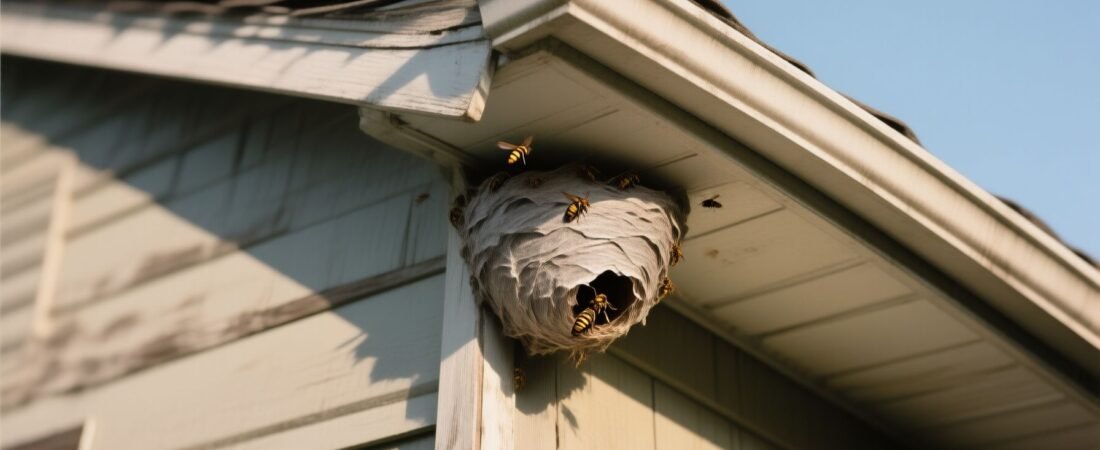
Spraying a hornet nest in your eaves at dusk and calling it done is the wrong move — and it’s exactly why so many homeowners end up getting stung multiple times over the same summer. The real problem isn’t the nest you can see. It’s that eave locations create a specific set of conditions that make hornets return to the exact same spot year after year, long after you’ve knocked down the original nest. Understanding that cycle — not just the spray-and-pray approach — is what actually breaks it.
Why Hornets Choose Eaves in the First Place (And Why They Keep Coming Back)
Eaves are essentially perfect hornet real estate: protected from rain, shaded from direct afternoon sun, and structurally solid enough to anchor a paper nest. A European hornet or bald-faced hornet queen doesn’t pick your eave randomly — she’s responding to very specific environmental signals, including pheromone traces left behind by previous colonies. Even after you remove a nest, those chemical markers can linger on wood and soffit material for an entire season, actively advertising the spot to next year’s queens.
This is the detail most pest control articles skip over entirely. They tell you how to spray the nest. They don’t tell you that the dried nest material and the surface underneath it are still broadcasting “great nesting site here” to every fertilized queen searching for a location in spring. A colony of bald-faced hornets can grow from a single queen to over 400 workers by midsummer — so the stakes of missing that cleanup step are real.
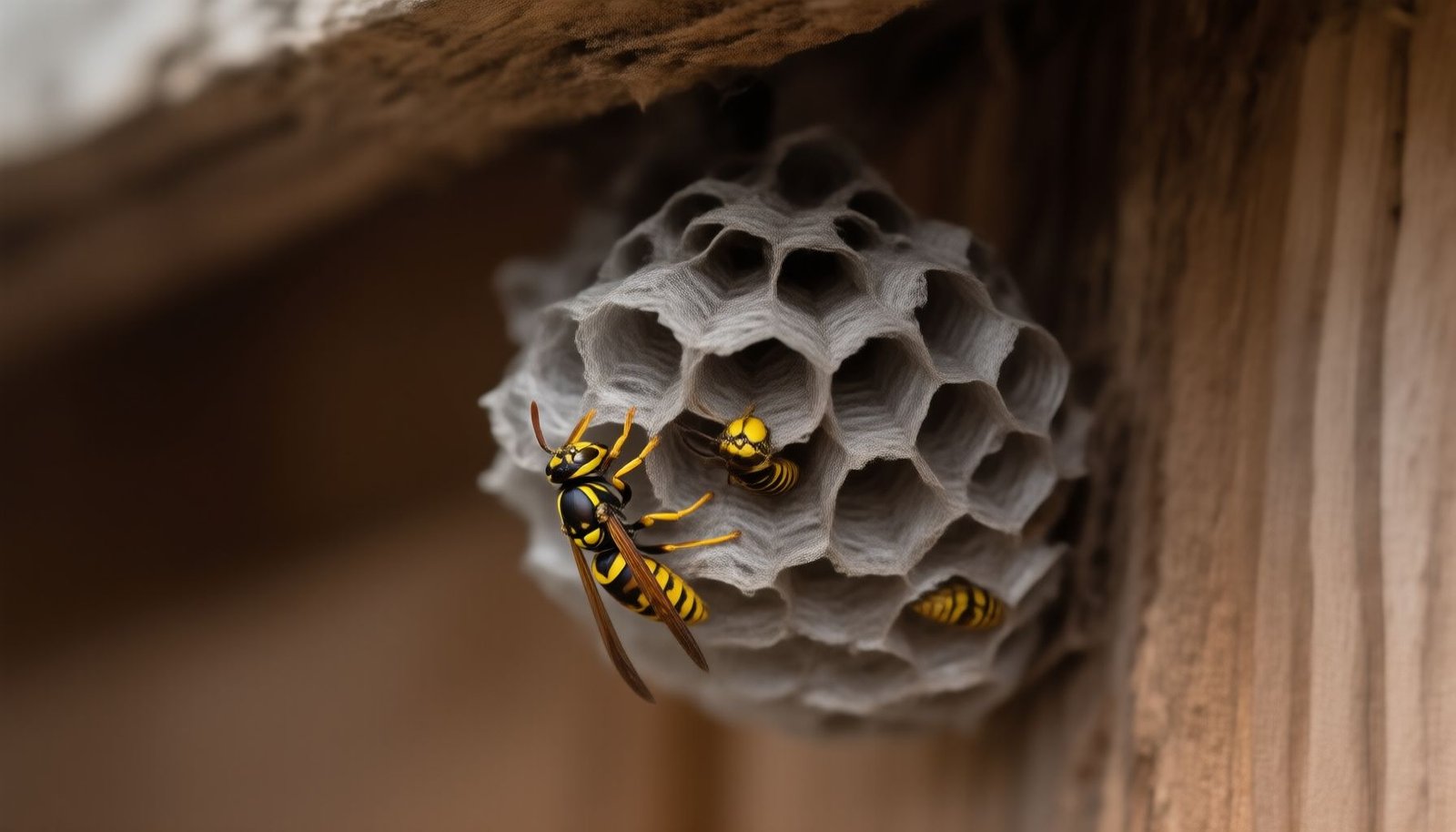
This close-up of a bald-faced hornet nest attached to a soffit board shows exactly how tightly the paper envelope bonds to painted and unpainted wood — which matters when you’re deciding whether to scrape or cut the nest free after treatment.
How to Tell What Kind of Hornet Is Actually in Your Eaves
Not every papery nest in your eaves belongs to true hornets. Bald-faced hornets (Dolichovespula maculata) are the most common eave nesters in the US — they build that classic gray, football-shaped enclosed nest you’re probably picturing. European hornets (Vespa crabro) are the only true hornet species established in North America, and they prefer sheltered cavities like wall voids, hollow trees, and attic overhangs rather than fully exposed eave edges. Paper wasps (Polistes species) build the open, umbrella-shaped combs with visible cells — no paper envelope around them — and they’re frequently mistaken for hornets.
Why does the ID matter? Because the treatment timing, the product type, and especially the aggression level of the colony differs significantly. Bald-faced hornets are notoriously defensive and will mobilize dozens of workers instantly if the nest is disturbed. European hornets are actually less aggressive when approached calmly but become extremely dangerous if the nest entrance is blocked. Treating the wrong species with the wrong approach — say, using a short-range aerosol on a bald-faced hornet nest 14 feet up in your eave — is a fast way to end up in the ER.
| Species | Nest Appearance | Aggression Level | Preferred Eave Location |
|---|---|---|---|
| Bald-Faced Hornet | Enclosed gray paper envelope, football-shaped | Very High | Open soffit, exposed eave edge |
| European Hornet | Enclosed nest, often inside a cavity | Moderate | Eave cavity, wall void, attic overhang |
| Paper Wasp | Open comb, no envelope, umbrella-shaped | Low-Moderate | Eave corners, porch ceilings |
The Right Time to Treat a Hornet Nest in Eaves (Most People Get This Wrong)
Here’s the counterintuitive part: late summer, when the nest is at its absolute largest and most visible, is the worst time to attempt DIY removal — but it’s when most homeowners finally decide to deal with it. A mature bald-faced hornet colony in August can contain 400 to 700 workers, all of whom will defend the nest simultaneously if threatened. Contrast that with early June, when the same nest might have only 20 to 50 workers and the queen is still doing much of the foraging herself.
Timing within the day matters just as much as timing within the season. Hornets are cold-blooded, which means their reaction speed drops significantly when temperatures fall below 50°F. Treating at night — specifically between 10 PM and 2 AM — puts the entire colony inside the nest, reduces available light for them to orient toward you, and slows their flight response. Wearing a headlamp with a red light filter instead of a white beam further reduces the chance of attracting workers toward your face during the spray.
Pro-Tip: Check the forecast before you treat. Rain the night before your planned treatment makes hornets more docile — but rain during treatment washes pesticide off the nest before it penetrates. Pick a dry night after a rainy day for the best of both conditions.
Step-by-Step: How to Safely Remove a Hornet Nest From Eaves
Picture this: you’ve confirmed the species, you’ve picked your treatment window, you’ve got the right gear. The actual removal sequence still trips people up because they rush the gap between “spray” and “done.” Here’s the process that actually works, laid out in the order that matters.
- Suit up fully before you go outside. Long sleeves, gloves, a hat, and eye protection at minimum. A full beekeeper veil is worth it for any nest larger than a baseball. Don’t compromise on this step — bald-faced hornets sting multiple times and can target your face.
- Use a jet-spray aerosol rated for hornets, not a general wasp spray. You want a product that shoots 15 to 20 feet accurately — a best wasp nest foam spray for long-range spraying is ideal for eave nests you can’t safely reach by ladder, because the expanding foam seals the nest entrance as it saturates the interior.
- Aim at the nest entrance hole first, then drench the exterior. The entrance is usually at the bottom of the nest. Saturating it first traps workers inside before they can mobilize. Then coat the full outer surface. Apply for at least 6 full seconds — most people stop too early.
- Back away immediately and wait 24 to 48 hours before approaching again. Don’t poke the nest that night. Stragglers returning to the colony after treatment are the ones that sting people who come back too soon.
- Remove the physical nest structure and bag it. Use a garbage bag, slip it over the nest from below, and detach the nest at its attachment point with a putty knife or pruning shears. Seal the bag immediately. Don’t just knock it down — a nest that falls to the ground still contains pesticide-laden material that pets and wildlife can contact.
- Clean and treat the attachment surface. Scrub the area where the nest was anchored with soapy water, then apply a residual insecticide spray or permethrin-based product to the wood surface. This degrades the pheromone markers that attract future queens.
One honest nuance worth acknowledging: if your nest is inside an enclosed eave cavity — meaning you can hear hornets but can’t see the nest — this process changes entirely. Cavity nests require drilling an access point and injecting dust insecticide rather than spraying the exterior of a nest you can’t reach. That situation is worth a call to a professional, especially if the void connects to interior wall space.
“The single biggest mistake homeowners make is removing the nest without treating the substrate. The nest is just the structure — the pheromone residue on the wood is the real invitation. I’ve inspected homes where the same eave corner had been colonized four summers in a row because nobody ever cleaned and sealed that surface after removal.”
Dr. Marcus Fielding, Structural Entomologist and NPMA-Certified Pest Control Consultant
How to Stop Hornets From Rebuilding in the Same Eave Next Season
Removal is half the job. The prevention side is where most homeowners drop the ball — and then act surprised when a new queen sets up in the exact same spot come April. The good news is that the prevention toolkit is simple and doesn’t require repeated chemical applications. The bad news is that it does require getting up on a ladder in the off-season, which most people put off indefinitely.
Here’s what actually deters re-colonization at eave locations specifically:
- Seal any gaps in the soffit board wider than 1/4 inch using paintable exterior caulk or hardware cloth. Queens are searching for enclosed spaces in early spring and even a small gap is an open invitation to explore.
- Apply a residual pyrethroid spray to eave surfaces in late March or early April, before queens emerge and start scouting. Products containing bifenthrin or cypermethrin stay active on wood and painted surfaces for 4 to 6 weeks — which covers the entire queen-scouting window.
- Hang a decoy nest near — but not at — your eave. Hornets are highly territorial and typically won’t build within 200 feet of an established colony. A decoy nest placed in a visible spot before the season starts can redirect scouts. This doesn’t work mid-season once a queen has committed to your eave, but it’s surprisingly effective as an early deterrent.
- Repaint or varnish bare or weathered wood on soffit boards. Unpainted, rough-textured wood is significantly easier for hornets to chew and incorporate into nest paper. A fresh coat of exterior paint makes the surface less workable and less appealing as a nesting material source.
- Remove food attractants from the area below your eaves. Open compost bins, uncovered pet food, and fallen fruit within 30 feet of a potential nesting site increase forager activity near your house — which in turn increases the chance a scout will investigate your eave for a nesting spot.
Worth noting: if your yard also has ongoing ground pest pressure — the kind of lawn damage that indicates burrowing activity — that can indirectly affect hornet forager patterns, since hornets hunt soft-bodied insects and grubs as larval food. Addressing broader yard pest issues, like the problems covered in resources on best vole and gopher traps for lawn damage, can reduce the insect prey density that keeps hornet colonies well-fed and expanding into new territory around your home.
The bigger picture here is this: a hornet nest in your eaves is a symptom of a location that has already proven itself to multiple generations of queens. Treating it once without modifying the site is roughly equivalent to fixing a roof leak without replacing the damaged sheathing underneath — you’ve addressed the visible problem while leaving the underlying vulnerability exactly as it was. The homeowners who stop seeing annual hornet problems are the ones who treat the nest, clean the surface, seal the gaps, and apply a preventive residual before the next spring season kicks off. That sequence, done once properly, typically breaks the cycle for good.
Frequently Asked Questions
how do I get rid of a hornets nest in the eaves of my house?
For small nests under a softball size, you can spray them yourself with a jet-spray wasp and hornet killer at night when the hornets are inactive — stand at least 15 feet back and soak the nest completely. Larger nests or nests you can’t safely reach should be handled by a licensed pest control professional, since a single disturbed colony can contain 700 or more hornets.
is it safe to remove a hornets nest in eaves yourself?
It can be safe if the nest is small, easy to reach, and you’re not allergic to stings. If the nest is bigger than a grapefruit, located in a tight eave where you’d need a ladder, or you’ve been stung before and had a strong reaction, call a professional — it’s not worth the risk of getting swarmed 20 feet off the ground.
what time of year should I remove a hornets nest from my eaves?
Late fall or winter is the easiest time to remove a hornets nest in eaves because the colony dies off naturally once temperatures consistently drop below 45°F, leaving the nest empty. If you need to remove an active nest in spring or summer, do it at night between 10 PM and 4 AM when hornets are sluggish and inside the nest.
what kills hornets instantly in eaves?
Pyrethroid-based jet sprays like Raid Wasp & Hornet Killer or Spectracide work fast, killing on contact from up to 27 feet away. For nests deep inside an eave void, a foam wasp spray is more effective because it expands into the space and reaches hornets that a liquid stream can’t hit directly.
how do I keep hornets from building a nest in my eaves again?
After removing the nest, seal any gaps or cracks in the eave with caulk or expanding foam, since hornets are attracted to the same spots year after year. You can also hang a fake hornet nest near the area — hornets are territorial and will usually avoid building within about 20 feet of what they think is a rival colony.
Disclaimer: This article is for informational purposes only and isn’t a substitute for professional pest control advice. Always read and follow the product label instructions exactly — label directions are legally binding and vary by brand and active ingredient. Keep all pesticides, baits and traps away from children and pets, ventilate treated areas as directed, and consider calling a licensed pest control professional if an infestation is large, recurring, or involves a structural pest like termites or carpenter ants.