
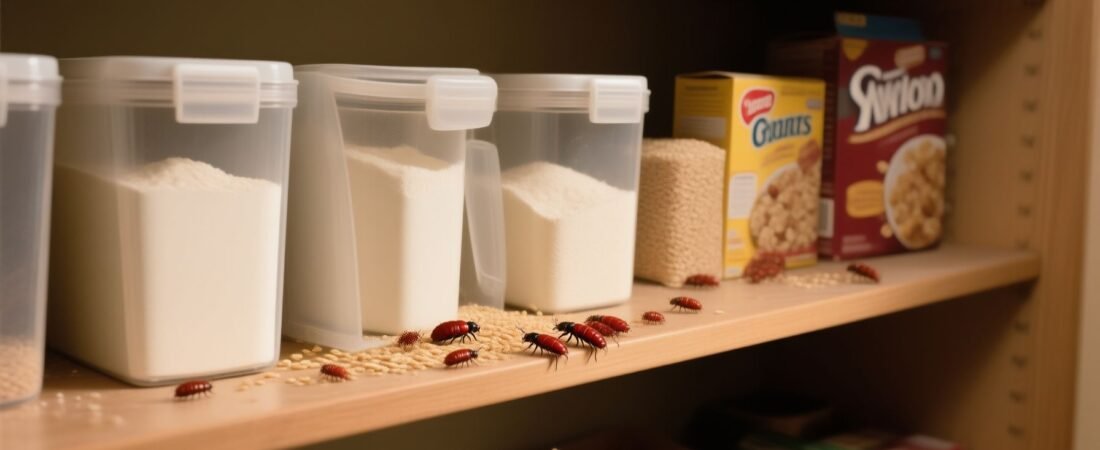
Throwing out the infested bag doesn’t fix the problem — the infestation is already living in your pantry, not the package. That’s the single most common reason grain beetles in pantry situations come back two weeks after a cleanout. Homeowners toss the obvious culprit, wipe down a shelf, and restock. Then a month later the beetles are back, because the eggs that were already deposited in shelf cracks, spilled flour dust, and cardboard seams never got touched. This article is about closing that loop permanently, not just reacting to what you can see.
Why Do Grain Beetles Keep Coming Back After You Clean?
The real culprit isn’t the bag of rice you threw out — it’s the residue you didn’t touch. Female grain beetles, both the sawtoothed grain beetle (Oryzaephilus surinamensis) and the merchant grain beetle (Oryzaephilus mercator), can lay between 45 and 285 eggs over their adult lifetime. Those eggs are deposited individually, tucked into tiny cracks in shelving, stuck to cardboard box flaps, and hidden inside spilled grains so small you can’t see them without getting on your knees. A single missed pocket of grain dust in a shelf corner can restart the whole cycle within 3 to 5 weeks under warm indoor conditions.
Here’s what most cleaning guides skip: adult grain beetles can survive for weeks on almost nothing — thin films of flour, crumbs ground into shelf liner grooves, even the residue inside an “empty” cereal box. They don’t need a visible food source. A pantry that looks clean to you after a quick wipe-down can still be fully operational as a breeding habitat. The temperature sweet spot for rapid reproduction is 70–90°F, which is exactly what most American kitchens run year-round, making the problem self-sustaining without any help from you.
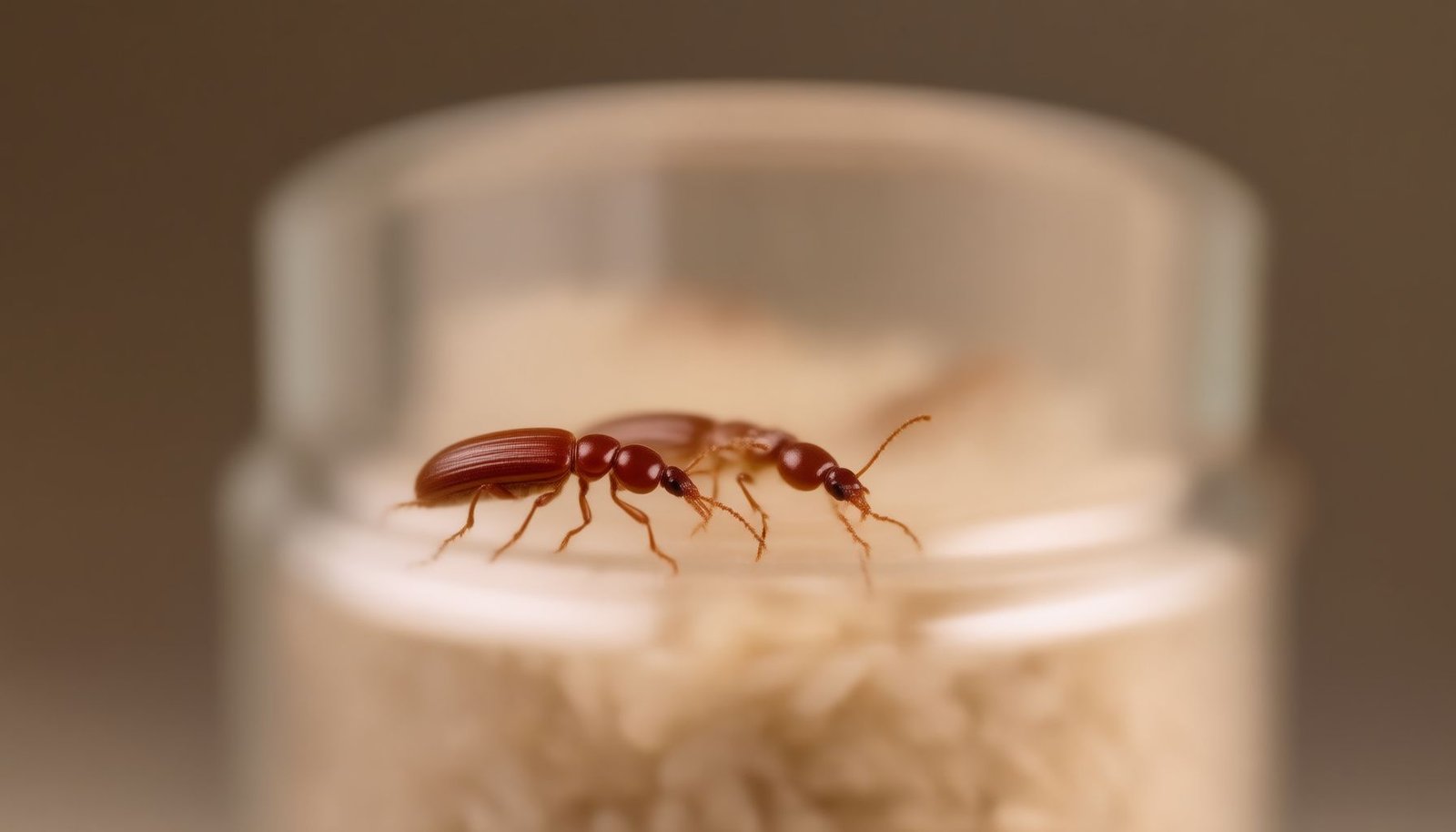
This close-up shows how small grain beetles actually are relative to common pantry products — understanding their size and hiding spots is exactly what makes a surface-level cleanout fall short every time.
How to Tell If You Have Grain Beetles (Not Weevils or Psocids)
Grain beetles get misidentified constantly, and that matters because the wrong ID leads to the wrong treatment. Sawtoothed and merchant grain beetles are tiny — roughly 1/10 inch long — flat, brown, and fast-moving. The easiest field ID is those six serrated “teeth” projecting from the thorax on each side, visible with a hand lens. Weevils, by contrast, have a distinctive elongated snout and are rounder in body shape. Psocids (booklice) are even smaller, almost translucent, and prefer damp environments more than dry grains. If what you’re seeing is flat, brown, and found inside dry cereal or pasta, you’re almost certainly dealing with grain beetles.
Their flat body shape isn’t accidental — it’s an evolutionary adaptation that lets them squeeze through sealed packaging that you’d assume was airtight. They can enter through glued cardboard seams, push through the folded inner bag of a cereal box, and access pasta through microscopic cracks in cellophane. Picture this: you buy a fresh box of oats from a perfectly reputable grocery store, and it already contains a few eggs laid before the product even reached the shelf. That’s called a “store infestation” and it’s more common than most people realize, particularly in large-volume retailers with warehouse storage. According to USDA data, grain beetle contamination is one of the leading causes of stored product pest complaints in U.S. households — not because of poor hygiene, but because of supply chain exposure.
What to Do the Day You Find Grain Beetles in Your Pantry
Speed matters here, not because the beetles are dangerous — they don’t bite, don’t carry disease, and don’t damage your home structure — but because every day you wait is another round of eggs being deposited. The goal on day one is to interrupt the reproductive cycle before it resets. Don’t just remove the obviously infested items and stop there. You need to systematically go through everything, not just grains and cereals, but spices, dried herbs, dry pet food, powdered drink mixes, and even decorative dried flowers, all of which can harbor active infestations.
Here’s the step-by-step process that actually works, in the order that matters:
- Empty the entire pantry completely. Every shelf, every item. Don’t do this in sections — partial cleanouts leave eggs behind and waste your effort.
- Inspect every package individually. Hold each one up to light, shake it, and look for live beetles, larvae (tiny white grubs), or brown-tinged webbing inside clear packaging. When in doubt, throw it out — a $4 box of pasta isn’t worth a re-infestation.
- Vacuum every shelf surface, crack, and corner. Use a crevice tool. Pay special attention to the back wall of shelves, shelf bracket holes, and underneath any removable shelf liner. Immediately seal and discard the vacuum bag or empty the canister outside.
- Wash shelves with hot soapy water, then wipe with white vinegar. The vinegar doesn’t kill eggs chemically, but it removes the food film residue that sustains newly hatched larvae. Let shelves dry completely before restocking — moisture invites a different problem.
- Freeze any borderline items you want to salvage. Placing suspect dry goods in a sealed bag and into the freezer at 0°F for at least 4 full days kills all life stages — eggs, larvae, pupae, and adults. This is the same method commercial grain storage facilities use, just scaled down.
- Transfer all dry goods to hard-sided airtight containers before restocking. Glass jars with rubber-sealed lids or thick polypropylene containers with locking lids. Thin plastic bags, twist-tied bags, and cardboard boxes are not barriers — they’re beetle invitations.
Pro-Tip: Before you restock, place a few dry bay leaves on each shelf. Bay leaves contain eucalyptol, a compound that grain beetles actively avoid. It’s not a treatment, but it adds a deterrent layer that won’t harm your food and smells far better than any spray.
Which Treatments Actually Work on Grain Beetles (And What Wastes Your Time)
This is where a lot of homeowners make expensive mistakes. Grain beetles live inside food-storage areas, which immediately rules out most conventional insecticide sprays — you should never spray pesticides in a food contact zone unless the product is explicitly labeled for pantry use. Fortunately, some of the most effective tools for grain beetles are also the safest ones for a kitchen environment. The honest nuance here is that what works best depends somewhat on the size and duration of your infestation: a fresh, contained outbreak responds beautifully to physical and non-chemical methods, while a long-standing infestation that’s spread to multiple cabinet zones may need a more layered approach.
Here’s a breakdown of what works, what doesn’t, and why:
| Method | Effectiveness | Notes |
|---|---|---|
| Airtight container storage (glass/polypropylene) | Very High — prevents reinfestation | Best long-term investment; eliminates harborage and food access simultaneously |
| Freezing at 0°F for 4+ days | High — kills all life stages | Ideal for salvaging valuable or bulk dry goods; no chemical residue |
| Food-grade diatomaceous earth (perimeter only) | Moderate — works on adults | Apply in thin lines around shelf edges and cabinet interiors, not directly on food; does not kill eggs |
| Pheromone sticky traps (grain beetle specific) | Moderate — monitoring and population reduction | Helps confirm infestation is resolved; won’t eliminate a heavy infestation alone |
One thing that genuinely surprises people: those broad-spectrum kitchen sprays and ultrasonic devices marketed for pantry pests do almost nothing for grain beetles. The beetles spend the vast majority of their life cycle inside food packages or in tight crevices — neither surface sprays nor sound waves reach them there. It’s the same principle behind why ultrasonic plug-in devices don’t hold up to real-world testing for rodents either — penetration into enclosed harborage areas is the core limitation. Your effort is far better spent on physical exclusion than on any passive electronic or aerosol solution for pantry beetles.
How to Prevent Grain Beetles From Returning Permanently
Long-term prevention is almost entirely a storage and inspection habit, not a chemical program. The single highest-leverage change you can make is to stop storing dry goods in their original packaging after opening. Cardboard and thin plastic bags are functionally transparent to grain beetles — a determined adult can enter a resealed pasta bag through the fold in under a minute. Hard-sided containers eliminate the entry point entirely and also make it visually obvious when something is wrong because you can see through the container without opening it.
A few less-discussed prevention habits that actually make a difference:
- Inspect new groceries before they enter the pantry. This takes 30 seconds and catches store-origin infestations before they establish in your home. Look for live insects, frass (tiny brown powder), or clumped grain particles inside the packaging.
- Rotate stock using FIFO (first in, first out). Older items sitting at the back of a shelf for 6+ months are far more likely to harbor undetected populations. Grain beetles can complete their egg-to-adult cycle in as little as 3 to 4 weeks at 86°F.
- Don’t overlook dry pet food. Commercial dry kibble is one of the most common and most overlooked grain beetle sources in a home. Store it in a sealed container, not the original paper bag, and never pour new food on top of old food without cleaning the container first.
- Check behind and underneath shelving units annually. Grain dust accumulates in places you never see, and a thin layer of old flour in a crack is all a grain beetle population needs to persist quietly for months.
- Keep pantry temperature below 65°F where possible. Reproductive rates drop significantly at cooler temperatures, and grain beetle populations can’t sustain themselves at all below 50°F. Even modest temperature reductions slow the cycle considerably.
“The majority of household grain beetle infestations I’ve investigated trace back to a product that arrived already infested — not to a sanitation failure. The packaging is simply not designed to be a pest barrier. Consumers who transfer dry goods to sealed rigid containers immediately on purchase eliminate roughly 80% of their reinfestation risk right there, without any chemical intervention at all.”
Dr. Marcus Hale, Board-Certified Entomologist and University Extension Specialist in Stored Product Pests
One counterintuitive fact worth knowing: grain beetles are actually weak fliers, and most spread within a home happens through passive transport — you carry them from the pantry to the kitchen counter in a bag, they drop off, and if there’s a food residue nearby, that becomes a secondary site. This is why treating only the pantry and ignoring adjacent drawers, the area under the toaster, and the gap behind the refrigerator can leave you scratching your head when the infestation seems to reappear out of nowhere. Secondary spread zones are almost always the explanation.
For homeowners dealing with multi-room infestations or situations where grain beetles have spread into wall voids or adjacent cabinets, the approach mirrors what you’d do with any persistent small-insect problem in structural gaps — thorough physical cleanup first, desiccant dusts like food-grade diatomaceous earth in voids, and consistent monitoring with species-specific pheromone traps to confirm that populations have genuinely collapsed rather than just gone quiet. Managing pests in structural gaps is genuinely different from managing them in open spaces, similar to dealing with pill bugs that have worked their way into interior spaces through foundation gaps — the entry point matters as much as the treatment.
Grain beetles are one of the few household pests where a disciplined, non-chemical approach genuinely outperforms a chemical one — not because chemicals don’t exist for them, but because the places beetles actually live make chemical treatment impractical and physical exclusion remarkably effective. Do the full cleanout once, switch to airtight containers permanently, and inspect new groceries before they hit the shelf. That’s the real permanent fix — and it works because it removes the conditions that sustain the infestation, not just the insects you can currently see.
Frequently Asked Questions
How do grain beetles get into a sealed pantry?
Grain beetles almost always enter your home inside infested food packages — not through cracks in your walls. They can chew through thin plastic bags and cardboard boxes, so even a “sealed” pantry isn’t safe if you brought in infested flour, cereal, or rice from the grocery store. Inspect every new dry good before putting it away, especially bulk items.
What do grain beetles look like so I can identify them?
Grain beetles are tiny, flat, reddish-brown beetles that are usually 1/10 to 1/8 inch long — about the size of a sesame seed. The sawtoothed grain beetle has 6 distinctive tooth-like projections on each side of its thorax, which is the easiest way to tell it apart from similar pantry pests. If you’re not sure what you’re looking at, place a few beetles in a clear bag and compare them to reference photos before treating.
How long does it take to get rid of grain beetles in pantry?
If you do a thorough cleanout and remove all infested food at once, you can break the active infestation within 2 to 4 weeks. The key is eliminating every food source, because grain beetles can complete their life cycle from egg to adult in as little as 3 to 4 weeks, so leaving even one infested package behind resets the clock. Persistent infestations that drag on for months are almost always caused by a missed food source hiding in the back of a shelf.
Do grain beetles in pantry infest the whole house?
Grain beetles typically stay close to their food source, so they’re usually contained to the pantry, kitchen cabinets, or wherever dry goods are stored. That said, you might spot a few wandering beetles in other rooms, especially if the infestation is large or if food is stored in multiple locations. They don’t infest furniture, bite people, or spread into walls the way some other pests do.
Do I need an exterminator for grain beetles or can I treat them myself?
In most cases, you don’t need a professional exterminator — a thorough DIY cleanout handles the vast majority of grain beetle infestations. Toss all infested food, vacuum every shelf crack and corner, wipe surfaces with white vinegar, and store surviving dry goods in airtight glass or hard plastic containers. If you’ve done a full cleanout twice and still see live beetles after 4 to 6 weeks, it’s worth calling a pest control professional to check for a hidden infestation source.
Disclaimer: This article is for informational purposes only and isn’t a substitute for professional pest control advice. Always read and follow the product label instructions exactly — label directions are legally binding and vary by brand and active ingredient. Keep all pesticides, baits and traps away from children and pets, ventilate treated areas as directed, and consider calling a licensed pest control professional if an infestation is large, recurring, or involves a structural pest like termites or carpenter ants.