

Citronella candles do almost nothing to get rid of no-see-ums on a porch — and that’s the reason most people stay frustrated all summer. No-see-ums (biting midges, Culicoides spp.) are so small — as little as 1–3 mm — that the smoke and scent barriers most people rely on disperse long before the insects reach them. The real fix is a combination of physical exclusion, targeted repellents, and addressing the one breeding source most homeowners completely overlook: the damp organic material accumulating within 50 feet of their patio. Get those three things right and the biting stops. Miss any one of them and nothing else you try will hold.
Why Your Porch Specifically Is a No-See-Um Magnet
No-see-ums don’t swarm your porch randomly. Female Culicoides need a blood meal to produce eggs, and they’re drawn to carbon dioxide, body heat, and lactic acid — all of which pool in calm, sheltered outdoor spaces like covered patios. A porch with a roof and partial walls is essentially a funnel that concentrates those attractants while blocking the wind that would otherwise disperse the midges before they reach you.
The other factor almost no one talks about: no-see-ums rarely travel more than 300 feet from their breeding site. That means whatever is breeding them is almost certainly in your immediate yard, not drifting in from across the neighborhood. Poorly draining planters, a soggy patch of lawn beside the deck, a birdbath that hasn’t been emptied in a week, or even the wet organic debris in a clogged gutter overhead — any of these can sustain a breeding population within flight range of your patio chair.
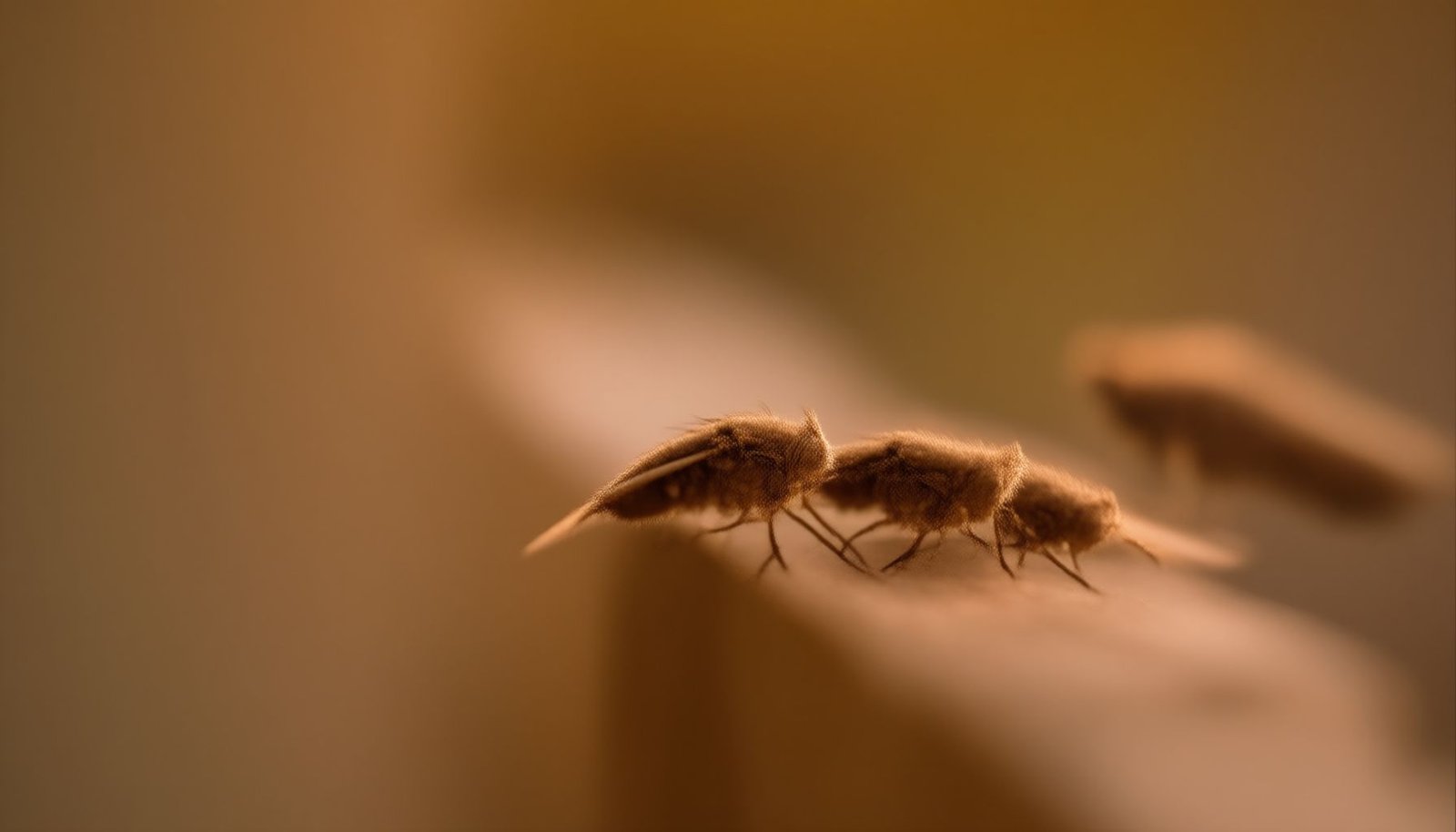
This close-up shows just how small biting midges are relative to a screen mesh opening — a reminder of why standard porch screens (typically 16×16 mesh) let them pass through freely, and why mesh size matters more than most product labels admit.
What’s Actually Breeding Them (And It’s Probably Not What You Think)
Picture this: you’ve emptied every standing water container in the yard, you’re running a fan on the porch, and you’ve sprayed the perimeter twice — and the no-see-ums are still as bad as ever. That’s because Culicoides larvae don’t need open standing water the way mosquitoes do. They breed in saturated soil, algae-covered mud margins, decomposing leaf litter, and the sludge layer at the bottom of a neglected potted plant saucer. Even a patch of lawn that stays wet for 48 hours after rain can produce a new generation.
A female no-see-um lays 25–100 eggs per batch, and under warm conditions larvae can complete development in as little as two to three weeks. That rapid cycle means a small, overlooked moisture source can restock the population faster than any spray you apply to the porch itself. The breeding investigation needs to happen before — not after — you buy a single product.
How to Physically Stop No-See-Ums From Reaching the Porch
Repellents and sprays buy you time. Physical barriers are the only thing that stops no-see-ums entirely without you having to reapply anything. The catch is that standard porch screening — the 16×16 mesh that keeps out mosquitoes — has openings large enough for biting midges to pass straight through. You need 20×20 mesh or finer, sold specifically as “no-see-um screen” or “midge screen,” to actually block them.
Here’s the sequence that works for a screened porch or a patio you want to enclose:
- Replace or add no-see-um mesh screen — 20×20 or 25×25 count mesh blocks midges at the source. Yes, it reduces airflow slightly, which is why step two matters.
- Install a ceiling fan or box fan aimed outward — No-see-ums are weak fliers. A sustained breeze of just 1–2 mph is enough to ground them. A fan running on medium keeps them from landing even if a few get through.
- Seal gaps around the screen frame — Loose corners, warped door frames, and gaps at the sill are common entry points. Use foam weatherstripping or caulk rated for outdoor use.
- Add a screen door with a spring closer — A screen door that stays open for even 10 seconds is enough time for a cloud of midges to enter during peak activity at dusk.
- Apply permethrin spray to the screen mesh itself — Permethrin bonds to fabric and mesh and kills insects on contact for up to six weeks. This adds a kill layer to your physical barrier so midges that land on the screen die rather than find a gap.
An open patio without walls is harder to fully enclose, but a combination of fans, a permethrin perimeter spray, and a CO2-style midge trap positioned upwind of your seating area can dramatically cut the biting pressure.
Which Repellents and Treatments Actually Work Against No-See-Ums
Here’s the counterintuitive part that most articles skip over: DEET works, but it works better against no-see-ums at higher concentrations than you’d use for mosquitoes. Products with 20–30% DEET offer solid short-term protection, but studies on Culicoides specifically show that picaridin at 20% concentration performs comparably to DEET and is better tolerated on skin during extended outdoor sessions. Oil of lemon eucalyptus (OLE) is a third option with CDC backing, but it needs reapplication every 2–4 hours, which most people don’t bother with.
For the porch environment itself — not your skin — the options that actually move the needle are different:
- Residual perimeter sprays (bifenthrin or permethrin-based) — applied to the ground and vegetation within 10–15 feet of the porch; reapply every 3–4 weeks during peak season
- CO2 midge traps — devices like the Mosquito Magnet that emit CO2 and a warmth plume work on no-see-ums as well as mosquitoes; position them 30–40 feet upwind of your seating area to intercept midges before they reach you
- Methoprene or BTI (Bacillus thuringiensis israelensis) larvicides — applied to breeding areas like soggy lawn patches or planter saucers; BTI specifically kills larvae without harming beneficial insects or pets
- Permethrin-treated clothing — especially for open patios, treating pants and socks with permethrin spray (separate from skin-applied products) blocks the ankle and lower leg biting that no-see-ums favor
- Oscillating fans with an essential oil diffuser — cedarwood and geraniol-based diffusers provide modest repellent action when the fan distributes the scent; this won’t eliminate the problem but reduces landing rates during low-activity periods
Pro-Tip: Time your porch treatments to match no-see-um peak activity — typically the 90 minutes around dusk and, to a lesser extent, dawn. Applying a residual spray at noon and then sitting outside at 7 p.m. without a fan running is why many people think the spray “didn’t work.” The spray is fine; the timing and airflow support are missing.
“Homeowners consistently underestimate how close the breeding source is. In almost every call I get about biting midges on a porch, there’s saturated soil or decaying organic matter within 100 feet — often in a planter, a low spot in the lawn, or a neglected birdbath. Eliminate the breeding habitat first, and the adults you spray won’t be replaced within two weeks.”
Dr. Renata Holloway, Board Certified Entomologist and Vector Control Specialist, University Extension Consulting
How to Reduce the Breeding Population in Your Yard Long-Term
Killing the adults on the porch is a short-term fix. The population resets itself within two to three weeks if you haven’t touched the breeding habitat. This is exactly the frustration cycle that sends people back to the hardware store for yet another citronella product — and it’s the part of no-see-um control that separates people who actually solve the problem from those who manage it indefinitely.
The yard-level comparison below shows how different moisture sources stack up as no-see-um breeding risks, which helps you prioritize where to focus your habitat remediation effort:
| Breeding Source | Risk Level | Best Fix |
|---|---|---|
| Saturated lawn patch (stays wet 48+ hrs after rain) | High | Improve drainage; aerate and top-dress with sand |
| Potted plant saucers with standing water or wet soil | High | Empty saucers weekly; drill drainage holes |
| Birdbath or decorative water feature | Medium-High | Change water every 4–5 days; add BTI dunks |
| Decomposing leaf litter or mulch near porch | Medium | Remove or replace with dry gravel buffer zone |
Grading and drainage improvements feel like overkill until you realize that a no-see-um colony can sustain thousands of adults from a breeding patch the size of a garbage can lid. A dry gravel border — 12 to 18 inches wide — between moist lawn or garden beds and your porch foundation creates a zone that midges won’t breed in and gives residual sprays a harder surface to bind to longer. It’s one of the few yard modifications that pays dividends for multiple biting pest problems, and it’s not a bad parallel to what works against chiggers in the yard — reducing the moist, shaded organic layer is the common thread.
One honest nuance worth naming: if your property backs up to a tidal marsh, a creek, a pond, or any wetland — the breeding source is not something you can eliminate. In that situation, the goal shifts entirely toward barrier management (fine mesh screening, fans, perimeter sprays, and CO2 traps) because habitat modification isn’t an option. Coastal homeowners and those near water features need to accept that they’re managing a persistent exposure, not solving it at the source. That’s a different approach than what works for a suburban yard with a soggy lawn.
No-see-um problems can also appear suddenly after other structural changes — a neighbor’s landscaping that redirected runoff toward your yard, a new garden bed that compacts moisture, or even a poorly graded patio extension that creates a new low spot. Thinking through any recent changes to the immediate environment is worth doing before you assume the problem is new insects arriving from farther away. And if you’re troubleshooting a cabin, garage, or outbuilding with a porch area that suddenly has biting pressure from multiple directions, it’s worth ruling out other small pests that bite at floor level — the investigation process isn’t entirely unlike dealing with a situation like deer mice in a cabin or garage, where recent environmental changes often explain a sudden infestation.
Get the screen mesh right, run a fan, apply a perimeter spray on schedule, and dry out whatever is breeding them within 300 feet. Do all four and you’ll be back outside at dusk without reaching for the DEET. Skip the habitat work and you’ll be replacing citronella candles every two weeks for the rest of the season.
Frequently Asked Questions
What is the fastest way to get rid of no-see-ums on a porch?
The fastest fix is setting up a fan — no-see-ums are weak fliers and can’t handle wind speeds above 1 to 2 mph, so even a basic box fan pointed outward will clear them off your porch quickly. For immediate relief, you can also spray your porch screens and furniture with a permethrin-based insecticide, which kills on contact.
What smell do no-see-ums hate?
No-see-ums are strongly repelled by scents like eucalyptus, lavender, and citronella. You can place citronella candles around your patio or apply eucalyptus-based repellents to your skin before heading outside — but keep in mind these work best as a deterrent, not a full elimination method.
Why are no-see-ums so bad on my porch at dusk?
No-see-ums are most active during dawn and dusk because they prefer low light, calm wind, and high humidity — conditions that are common on porches in the evening. If you’re near standing water, moist soil, or dense vegetation within 50 to 100 feet of your porch, that’s almost certainly where they’re breeding.
Do no-see-um screens actually work for a porch?
Yes, but you need screens with a mesh size of at least 20×20 per square inch — standard window screens are typically 16×16 and aren’t fine enough to block no-see-ums. Look for screens specifically labeled ‘biting midge screens’ or ‘no-see-um screens,’ which are widely available at home improvement stores.
How do I get rid of no-see-um breeding grounds near my porch?
Eliminate any standing water within 50 feet of your porch, including clogged gutters, plant saucers, birdbaths, and low spots in the yard — no-see-ums only need a thin film of moisture to breed. You should also clear out wet mulch, leaf litter, and overgrown vegetation close to the foundation, since these areas stay damp and give larvae a place to develop.
Disclaimer: This article is for informational purposes only and isn’t a substitute for professional pest control advice. Always read and follow the product label instructions exactly — label directions are legally binding and vary by brand and active ingredient. Keep all pesticides, baits and traps away from children and pets, ventilate treated areas as directed, and consider calling a licensed pest control professional if an infestation is large, recurring, or involves a structural pest like termites or carpenter ants.